Youngsoo Shin (2025). Personalizing Digital Self-Control Tools: Exploring the Role of Decision-Making Styles, Motivation, and Self-Esteem. In: Human Factors in Design, Engineering, and Computing. AHFE Open Access, vol. 199, pp. 766–776. https://doi.org/10.54941/ahfe1006889
Personalization is viewed as an important aspect of effective behavioral interventions in designing Digital Self-Control Tools (DSCTs). However, a shared understanding of how to consider users’ individual differences for tailoring self-management interventions is still lacking in the HCI community. To address this, this paper extends previous discussions on three experiential aspects of users’ self-management behaviors with DSCTs: self-esteem, different decision-making styles, and motivation goal types. An exploratory user study was conducted to investigate the effects of users’ decision-making styles and motivation goal types on their levels of self-esteem and self-management behaviors when experiencing self-management contexts. The results of the user study are presented in this paper, which will be used as a theoretical and empirical ground for further design initiatives. Furthermore, the findings highlight the importance of considering users’ individual differences for further design research and practice to create effective DSCTs.
Digital Self-Control Tools (DSCTs) are becoming a critical part of our daily lives. In daily Human-Computer Interaction (HCI) contexts, people are adopting more effective behavioral interventions with personal informatic systems and well-being enhancing techniques to improve their overall level of daily engagement in the name of Productivity Hacks (Meta, 2018). Especially, Generation Y (born between 1981 and 1996) and Generation Z (born between 1997 and 2012), who have grown up with various technologies throughout their entire lives, are actively integrating DSCTs into everything they do, making their daily lives better.
Specifically, they endeavor to manage their mental function and optimize their workflow through incorporating various DSCTs, including time- management applications, reminders, device usage monitoring tools, or mindfulness techniques. However, in the past two decades, studies on self- management and behavior changes have tended to focus more on the specific contexts of education and healthcare settings (Lorig & Holman, 2003; Ng et al., 2012; Shin & Yoon, 2021), not the context of individuals’ daily
lives. Furthermore, a shared understanding of how to consider various users’ individual differences for developing tailored self-management interventions is still lacking within the HCI and Interaction Design (IxD) community.
In terms of creating more immersive DSCTs, this paper focuses on the concept of personalization that has been viewed as an important aspect of effective daily behavioral interventions (Kaptein et al., 2015; Rabbi et al., 2015; Shin & Yoon, 2021). According to a set of recent empirical findings from behavioral science, personalized behavioral interventions with a consideration of individual differences have a strong association with performance on behavioral decision-making and behavioral changes (Mejova & Kalimeri, 2019; Sherman et al., 2006; Shin, 2022). In addition, personal informatics and behavioral intervention systems are establishing their status as an active companion that can assist users in daily contexts (Fogg, 2002; Li et al., 2010). For this reason, this paper aims to extend recent discussion on individual differences in behavioral decision-making from the field of behavioral science which can be implemented into the design process for creating more personalized DSCTs.
The current study began by carrying out a literature review to understand relevant factors underpinning users’ self-management behaviors and their impacts on behavioral decision-making experiences. This process led the study to outline three core areas of research focus: users’ self-esteem, different decision-making styles, and motivation goal types. Subsequently, an exploratory user study was conducted to investigate the causal relationship among these three aspects within users’ daily self-management contexts. Based on the results from the user study, two main contributions are expected to advance future HCI/IxD research and practice concerning the creation of more personalized DSCTs:
To reveal the importance of considering each user’s specific individual difference for further design initiatives.
To ground a theoretical and empirical basis for the development of personalized and human-centered DSCTs.
THEORETICAL PERSPECTIVES Based on extant literature, this section describes how this study was operationalized by outlining the three aspects of focus regarding users’ self-management behaviors and DSCTs: users’ self-esteem, different decision- making styles, and motivation goal types.
Self-Management Systems That Foster Increased Self-Esteem This paper intended to investigate users’ technology-mediated experience with a focus on effects of using a DSCT on their self-esteem. Self-esteem is defined as the attitude and sense of self that people have regarding themselves and how worthwhile they feel (Campbell, 1990). Existing literature has shown that self-esteem is an outcome of self-management behaviors rather than a cause of it (Baumeister et al., 2003; Ferris et al., 2010). Similarly, in our daily lives, we often realize that accumulating small achievements boosts our
768 Shin
self-esteem and encourages us to consecutively complete various other tasks. In this regard, it can be an effective form of reinforcement for initiating long- lasting behavioral changes. Thus, in this study, as a core dependent variable of the study, self-esteem was selected as a potential experiential impact of using a DSCT due to its implication for user’s self-management behaviors and experiences.
Decision-Making Style and Self-Management Behaviors This paper intended to address the issue of personalization in self- management by considering individuals’ two different decision-making styles. Decision-making is a critical aspect of the overall model of behavior changes (Prochaska, 2008; Shin & Yoon, 2023; Shin et al., 2021). According to studies in psychology, people can be classified into two categories based on their daily decision-making processes: maximizers and satisficers (Cheek & Schwartz, 2016; Parker et al., 2007). Maximizers tend to strive for the greatest benefit from every opportunity, while satisficers are satisfied with good enough choices. Previous research has characterized maximizers as those who prefer avoiding losses to acquiring equivalent gains and have shown that they typically achieve better outcomes than satisficers (Polman, 2010). In this paper, the value of incorporating this clear distinction of two different decision-makers to nudge them to change their daily behaviors in more positive ways was recognized. Thus, an investigation was conducted into how these two decision-making styles affect users’ self-esteem and behavioral reflection and change in the context of self-management.
Influence of Users’ Motivation Goals in Self-Management Behaviors This paper aimed to explore the influence of different motivation goals on user’s self-management behaviors and experiential aspects. According to the existing works on motivation theories, people’s behavior is controlled by two different behavioral goal systems: an approach goal system that manages behavior toward prospective rewards and an avoidance goal system that manages behavior away from prospective threats (Carver & White, 1994). The avoidance goal system is based on extrinsic motivation to reduce negative feelings and anxiety, whereas the approach goal system is associated with intrinsic motivation, thereby more effective for long-term behavior change (Rokes et al., 2014). In this regard, this study focused on how these two behavioral motivation goal types affect users’ behavior change and self-management experiences in their daily lives.
METHODS
In this paper, a 2 × 2 between-subjects experiment design was used [Decision- Making Style (Maximizer, Satisficer) × Motivation Goal Type (Approach- motivated behavioral goal, Avoidance-motivated behavioral goal)]. The decision-making style was measured through a self-reported survey and then utilized for the group assignment, and the motivation goal was manipulated by providing two contexts of self-management. The changes in self-esteem and self-reported habit modification scores were measured
Personalizing Digital Self-Control Tools 769
as dependent variables. All procedures in the study including explanations for the experiment and response, exposure of types of behavioral goal, and writing consent form were remotely performed in a web-based experimental setup.
Participants Sixty-four participants were recruited through notices posted on the university bulletin boards. They ranged in age from 21 to 35 (M = 26.09, SD = 3.26).
Constructs and Measures The first attribute independent variable, decision-making style, was measured through a questionnaire of the maximization scale by employing a seven- point Likert scale (Schwartz et al., 2002). Based on previous similar research works in the field, participants were assigned into either maximizer or satisficer groups by incorporating the median score (MAD = 3.88) of all participants’ scores (Parker et al., 2007; Polman, 2010).
The second active independent variable, motivation goal types, was manipulated by providing guidelines for priming motivation goal types. Participants were instructed to write down two daily habits and the reasons why they want to have (approach-motivated behavioral goal) or fix (avoidance-motivated behavioral goal) them according to their assigned motivation goal conditions. Additionally, they were encouraged to set a daily reminder for one bed making habit and two personal habits on their smartphone. In this part of the study, participants in each motivation goal condition were asked to use a pre-designed reminder format for five days (e.g., approach: “Let’s do something” vs avoidance: “Let’s not do something”).
Regarding the two dependent variables, the mean difference score between before and after levels of self-esteem and the total score for the extent of actual behavior change were measured as final outcome measurements. For participants’ level of self-esteem, a widely used self-reported measurement was used (Rosenberg, 2015), with the final analysis utilizing the change score (post-test minus pre-test) to quantify the effect. For the extent of actual behavior change, participants were asked to report their self-evaluation level of daily behavior changes for three habits through a questionnaire employing a seven-point Likert scale, resulting in a maximum possible score of 21 (7 × 3 habits).
Procedures Before participating in the study, all participants were informed of the details of the study and asked to sign a written consent form. Next, participants were encouraged to answer questionnaires about their level of self-esteem and types of decision-making styles. After that, participants were asked to write down their personal list of two habits they wanted to change according to the assigned condition instructions. Then, all participants were encouraged to participate in a daily “making your bed” challenge
770 Shin
for five days. For each daily habit which they wrote down including the bed making habit, participants were randomly assigned to one of the two motivation goal conditions. Some participants were asked to register the approach reminders on their own smartphone calendar applications and the remaining participants assigned to another condition were asked to register the avoidance reminders in their daily context. At the end of their participation, to compare the level of self-esteem, participants were asked to (1) fill out the questionnaire on self-esteem and (2) report the total successful scores of the challenge with their three daily habits. At the end of all sessions, participants were thanked and debriefed.
RESULTS
A total of 64 participants (Male = 30; Female = 34) provided valid data for the analysis, with no data elimination required. The descriptive statistics for the dependent variables, self-esteem and behavioral change, across the four experimental conditions are presented in Table 1.
To investigate the effects of the decision-making style and the motivation goal type on self-esteem and behavioral change, a two-way ANOVA was performed. Both the overall main effects and the interaction effect were found to be significant for both dependent variables.
Table 1: Descriptive statistics for self-esteem and behavioral change scores across experimental conditions.
Main Effects The main effect of the decision-making style was found to be statistically significant for both self-esteem (F (1, 60) = 11.39, p = .001, η2 = 0.16) and behavioral change (F (1, 60) = 4.61, p = .036, η2 = 0.07). Post-hoc analysis showed that maximizers reported significantly higher overall mean scores than satisficers for both self-esteem (Mdiff = 0.32, p = .001) and behavioral change (Mdiff = 0.81, p = .036).
Personalizing Digital Self-Control Tools 771
The main effect of the motivation goal type was also statistically significant for both self-esteem F (1, 60) = 37.05, p = .001, η2 = 0.38) and behavioral change (F (1, 60) = 13.21, p <.001, η2 = 0.18). Post-hoc analysis revealed that the avoidance-motivated goal led to significantly higher overall mean scores than the approach-motivated goal for self-esteem (Mdiff = 0.58, p = .001) and behavioral change (Mdiff = 1.38, p = .001).
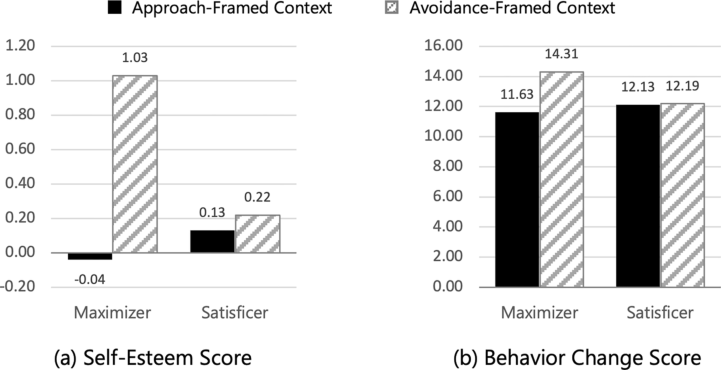
Interaction Effects A statistically significant interaction effect between the decision-making style and the motivation goal type was identified for both self-esteem (F (1, 60) = 26.63, p <.001, η2 = 0.31) and behavioral change (F (1, 60) = 12.04, p <.001, η2 = 0.17). This significant interaction indicates that the effect of the motivation goal type on the dependent variables varied depending on the users’ decision-making style. The significant interaction patterns for both self-esteem and behavioral change are visually represented in Figure 1 (a) and (b), respectively.
Figure 1: Mean plots of self-esteem score (a) and behavioral change score (b).
Post-Hoc Simple Effects Analysis Results Simple effects analysis was also conducted to further understand the nature of the observed interaction.
Regarding the self-esteem, the effect of the motivation goal type was significantly different for maximizers compared to satisficers. For maximizers, the avoidance-motivated goal (M = 1.03) resulted in a significantly higher self-esteem score compared to the approach-motivated goal (M = −0.04), Mdiff = 1.06, p <.001. For satisficers, no significant difference was observed between the two motivation goal types (MAvoidance = 0.22 vs. MApproach = 0.13, p = .52).When examining the avoidance-motivated condition, maximizers reported significantly higher self-esteem than satisficers (Mdiff = 0.81, p <.001).
772 Shin
A similar pattern was observed for behavioral change. For maximizers, the avoidance-motivated goal (M = 14.31) led to a significantly higher behavioral change score compared to the approach-motivated goal (M = 11.63), Mdiff = 2.69, p <.001. For satisficers, no significant difference was found between the avoidance (M = 12.19) and approach (M = 12.13) goals (Mdiff = 0.06, p = .91). In the avoidance-motivated condition, maximizers showed a significantly higher behavioral change score than satisficers (Mdiff = 2.13, p <.001).
These results clearly indicate that the Maximizer-Avoidance condition was the most effective combination, leading to the greatest improvements in both self-esteem and behavioral change. Conversely, the motivation goal type did not significantly affect the outcomes for satisficers.
DISCUSSION
The present work investigated the personalization issue in DSCTs by examining the interaction effects of users’ decision-making styles (maximizer vs. satisficer) and motivation goal types (approach vs. avoidance) on self- esteem and behavioral change in an HCI context. Based on the findings from the user study (N = 64), significant main and interaction effects were identified across all dependent variables, confirming and expanding previous psychological literature by demonstrating that individual differences in decision-making style significantly influence self-management outcomes in digital contexts.
The Potent Synergistic Effect for Maximizers People tend to make decisions after exploring various alternatives and considering potential costs or benefits they might experience (Tversky & Kahneman, 1992). The current study supports this by confirming that individuals’ moment-to-moment self-management experiences are significantly affected by their inherent decision-making style, expanding these differences from purchase-related contexts into a daily HCI context (Parker et al., 2007; Polman, 2010). The most critical discovery from the current analysis lies in the potent synergistic effect observed within the Maximizer-Avoidance condition.
Contrary to the main effect, which indicated that avoidance goals were generally more effective for the entire sample, the interaction pattern revealed a nuanced fit. Specifically, Maximizers who pursued avoidance goals showed the greatest improvements in both self-esteem (M = 1.03) and behavioral change (M = 14.31), significantly outperforming all other groups (p <.001). This result suggests that for Maximizers, who are driven to achieve the “best” outcome and often engage in thorough comparison, framing self- management as a clear strategy to avert losses or eliminate negative habits (avoidance) provides the ideal motivational fit. This framework may resonate with maximizers by aligning with a preference for avoiding losses to acquiring equivalent gains, a characteristic sometimes associated with their tendency (Polman, 2010), thereby facilitating better outcomes.
Personalizing Digital Self-Control Tools 773
The Contrast With Approach Motivation and Satisficers The opposite effect was observed when Maximizers pursued approach goals (MSelf-esteem = −0.04). This highlights the psychological friction that can occur when a Maximizer’s striving nature is misaligned with the goal framing. In contrast, for Satisficers, the motivation goal type (approach vs. avoidance) had no significant differential effect on either self-esteem or behavioral change (p > .50). This stability suggests that Satisficers’ preference for “good enough” choices makes them less susceptible to the framing effects of goal orientation compared to Maximizers.
In accordance with the approach-avoidance distinction, previous literature suggests approach-motivated behavioral contexts naturally align with positive emotional valence and motivational factors (Roskes et al., 2014). However, the finding that avoidance-motivated contexts are superior for Maximizers suggests that for effective DSCT design, the elimination of undesirable outcomes (avoidance) can be a powerful driver, especially when targeting individuals with a strong disposition for optimization. This perspective suggests the possibility that the effect of avoidance-motivated behavioral contexts could be varied depending on the psychological disposition of the individuals.
Implications for Personalization in DSCT Design The observed interaction highlights a fundamental principle for designing personalized DSCTs: intervention effectiveness depends heavily on the fit between the user’s stable psychological disposition and the goal-framing mechanism. These findings empirically support the need for DSCTs to move beyond one-size-fits-all motivational strategies toward dynamically tailoring content based on measured individual traits. For Maximizers, DSCTs should employ loss-framed messages and focus on negative consequence prevention (e.g., “Avoid X bad habit,” “Eliminate Y risk”) to harness their drive for success. Conversely, for Satisficers, design priority should focus on ensuring minimal effort and high task completion feasibility, aligning with their preference for “good enough” choices.
Limitation and Future Directions Based on the current exploratory findings and reflections, three core implementation aspects can be discussed for future studies.
To build upon the current findings, further investigations are necessary to enhance external and statistical validity. This paper focused on the initial set- up of the entire design process by conducting a user study; the current study shows that there is a significant causal relationship between users’ decision- making styles and their levels of self-esteem or self-management behaviors when experiencing self-management HCI contexts. However, to identify the causal relationship more rigorously, future studies should focus on several improvements of external and statistical validity.
First, to address threats to external validity, future studies should expand the experimental environments into real-life, longitudinal contexts by utilizing fully developed, functional interfaces. This situational background,
774 Shin
enabled by the advent of interactive interfaces (Harlow & Oswald, 2016), allows for easier collection and analysis of diverse behavioral data over time. Secondly, the use of objective behavioral measurements is crucial. Although a self-reported questionnaire for decision-making styles and self- esteem level were utilized on the basis of previous studies (Rosenberg, 2015; Schwartz et al., 2002), these measurements were not originally developed to investigate daily behavioral change in everyday environments. Thus, utilizing various objective behavioral measurements that can replace or supplement the self-reported questionnaire is necessary for higher generalizability.
The current results offer a strong empirical foundation for the design of human-centered DSCTs. The findings can inform the integration of personalized strategies using emerging technologies. Regarding measuring and collecting users’ various attitude/behavior data and providing personalized interventions, researchers can utilize various emerging technologies and approaches such as conversational user interfaces, personal informatic systems, behavioral intervention technologies, or AI-powered recommendation systems. This exploratory initiative can thus produce technical opportunities for relevant HCI researchers and practitioners who are interested in developing and designing personalized DSCTs. Furthermore, future research should be elaborated upon from a more academic point of view of self-management and behavior change in the HCI and design field. Exploring the mediating role of specific psychological constructs in the highly effective Maximizer-Avoidance condition could provide a deeper academic understanding of the mechanism driving the superior outcome.
Based on the significant interaction found, this study concludes that a personalized DSCT should match a user’s decision-making style with the appropriate goal-framing mechanism, specifically by leveraging avoidance- motivated contexts to maximize behavioral outcomes and self-esteem improvements for maximizers.
ACKNOWLEDGMENT
This project was supported by the NYC Scholarly Research Award from Pace University (F51338).
REFERENCES
Baumeister, R. F., Campbell, J. D., Krueger, J. I., & Vohs, K. D. (2003). Does High Selfesteem Cause Better Performance, Interpersonal Success, Happiness, or Healthier Lifestyles? Psychological Science in the Public Interest, 4(1), 1–44. https://doi.org/ 10.1111/1529–1006.01431. Campbell, J. D. (1990). Self-esteem and Clarity of the Self-concept. Journal of
Personality and Social Psychology, 59(3), 538–549. https://doi.org/10.1037/ 0022–3514.59.3.538. Carver, C. S., & White, T. L. (1994). Behavioral Inhibition, Behavioral activation, and Affective Responses to Impending Reward and Punishment: The BIS/BAS Scales. Journal of Personality and Social Psychology, 67(2), 319–333. https://doi.org/ 10.1037/0022–3514.67.2.319.
Personalizing Digital Self-Control Tools 775
Cheek, N. N., & Schwartz, B. (2016). On the Meaning and Measurement of Maximization. Judgment and Decision Making, 11(2), 126–146. https://doi.org/ 10.1017/S1930297500007257. Ferris, D. L., Lian, H., Brown, D. J., Pang, F. X., & Keeping, L. M. (2010). Self-esteem and Job Performance: The Moderating Role of Self-esteem Contingencies. Personnel Psychology, 63(3), 561–593. https://doi.org/10.1111/ j.1744–6570.2010.01181.x. Fogg, B. J. (2002). Persuasive Technology: Using Computers to Change What We
Think and Do. Ubiquity, 2002 (December), Article 5, 32. https://doi.org/10.1145/ 764008.763957. Harlow, L. L., & Oswald, F. L. (2016). Big Data in Psychology: Introduction to the Special Issue. Psychological Methods, 21(4), 447–457. http://dx.doi.org/10.1037/ met0000120. Kaptein, M., Markopoulos, P., De Ruyter, B., & Aarts, E. (2015). Personalizing
Persuasive Technologies: Explicit and Implicit Personalization Using Persuasion Profiles. International Journal of Human-Computer Studies, 77, 38–51. https:// doi.org/10.1016/j.ijhcs.2015.01.004. Li, I., Dey, A., & Forlizzi, J. (2010). A Stage-based Model of Personal Informatics Systems. In Proceedings of the SIGCHI Conference on Human Factors in Computing Systems (pp. 557–566). https://doi.org/10.1145/1753326.1753409. Lorig, K. R., & Holman, H. R. (2003). Self-management Education: History,
Definition, Outcomes, and Mechanisms. Annals of Behavioral Medicine, 26(1), 1–7. https://doi.org/10.1207/S15324796ABM2601_01. Mejova, Y., & Kalimeri, K. (2019). Effect of Values and Technology Use on Exercise: Implications for Personalized Behavior Change Interventions. In Proceedings of the 27th ACM Conference on User Modeling, Adaptation and Personalization (pp. 36–45). https://doi.org/10.1145/3320435.3320451. Meta. (2018). The 2019 Topics and Trends Report from Facebook IQ. Facebook. https://www.facebook.com/business/ news/insights/2019-topics-and- trends-report/. Ng, J. Y., Ntoumanis, N., Thøgersen-Ntoumani, C., Deci, E. L., Ryan, R. M., Duda,
J. L., & Williams, G. C. (2012). Self-determination Theory Applied to Health Contexts: A Meta-analysis. Perspectives on Psychological Science, 7(4), 325–340. https://doi.org/10.1177/1745691612447309. Parker, A. M., De Bruin, W. B., & Fischhoff, B. (2007). Maximizers versus Satisficers: Decision-making Styles, Competence, and Outcomes. Judgment and Decision making, 2(6), 342–350. https://doi.org/10.1017/S1930297500000486. Polman, E. (2010). Why are Maximizers Less Happy than Satisficers? Because
They Maximize Positive and Negative Outcomes. Journal of Behavioral Decision Making, 23(2), 179–190. https://doi.org/10.1002/bdm.647. Prochaska, J. O., Wright, J. A., & Velicer, W. F. (2008). Evaluating Theories of Health Behavior Change: A Hierarchy of Criteria Applied to the Transtheoretical Model. Applied Psychology, 57(4), 561–588. https://doi.org/ 10.1111/j.1464–0597.2008.00345.x. Rabbi, M., Aung, M. H., Zhang, M., & Choudhury, T. (2015). MyBehavior: Automatic Personalized Health Feedback from User Behaviors and Preferences Using Smartphones. In Proceedings of the 2015 ACM International Joint Conference on Pervasive and Ubiquitous Computing (pp. 707–718). https:// doi.org/10.1145/2750858.2805840. Rosenberg, M. (1965). Society and the Adolescent Self-image. Princeton, NJ:
Princeton. University Press.
776 Shin
Roskes, M., Elliot, A. J., & De Dreu, C. K. (2014). Why is Avoidance Motivation Problematic, and What Can be Done About It? Current Directions in Psychological Science, 23(2), 133–138. https://10.1177/0963721414524224. Schwartz, B., Ward, A., Monterosso, J., Lyubomirsky, S., White, K., & Lehman, D. R.
(2002). Maximizing versus Satisficing: Happiness is a Matter of Choice. Journal of Personality and Social Psychology, 83(5), 1178–1179. https://doi.org/10.1037/ 0022–3514.83.5.1178. Sherman, D. K., Mann, T., & Updegraff, J. A. (2006). Approach/avoidance Motivation, Message Framing, and Health Behavior: Understanding the Congruency Effect. Motivation and Emotion, 30(2), 164–168. https://doi.org/ 10.1007/s11031–006-9001–5. Shin, Y. (2022). Supporting Users’ Decision-Making Experiences through Hyper-
Personalized Human-Technology Interactions. In Companion Publication of the 2022 ACM Designing Interactive Systems Conference (pp. 8–11). Association for Computing Machinery, New York, NY, USA. https://doi.org/10.1145/ 3532107.3532873. Shin, Y., Kim, C., & Yoon, J. (2021). Development of a Scale to Measure Decision-making Tendency in Human-product Interactions. In Congress of the International Association of Societies of Design Research (pp. 144–159). Singapore: Springer Nature Singapore. https://doi.org/10.1007/ 978–981-19–4472-7_11. Shin, Y. & Yoon, J. (2021). Towards Designing Human-Centered Time Management Interfaces: The Development of 14 UX Design Guidelines for Time-related Experiences in Mobile HCI. In Adjunct Publication of the 23rd International Conference on Mobile Human-Computer Interaction (MobileHCI ’21). Association for Computing Machinery, New York, NY, USA, Article 15, 1–7. https://doi.org/10.1145/3447527.3474861. Shin, Y. & Yoon, J. (2023). Too Many or Too Little: Investigating Different Decision-
making Experiences of Maximizers and Satisficers in HCIs. In Proceedings of the 35th Australian Computer-Human Interaction Conference (pp. 432–445). Association for Computing Machinery, New York, NY, USA. https://doi.org/ 10.1145/3638380.3638450. Tversky, A., & Kahneman, D. (1992). Advances in Prospect Theory: Cumulative Representation of Uncertainty. Journal of Risk and Uncertainty, 5(4), 297–323. https://doi.org/10.1007/BF00122574.
LISTED IN THE AHFE DIGITAL BOOKSTORE CATALOGUE
Explore the complete digital volume
Human Factors in Design, Engineering, and Computing
Read this individual research paper free through the original publisher, or explore the full digital proceedings book.
ISBN 978-1-964867-75-5
Explore this ISBN in the AHFE Bookstore ↗Listed in the July 2026 bookstore catalogue; search by ISBN to confirm current availability · Digital book purchase optional