Kwangtae Jung, Yejin Lee (2024). The Elderly's Response for Choice Reaction and Movement Time. In: Human Factors in Design, Engineering, and Computing. AHFE Open Access, vol. 159, pp. 668–673. https://doi.org/10.54941/ahfe1005633
User interface plays important role in product safety and usability as an interactive part between user and product. In particular, in case of the elderly, bad user interface design causes some problems in aspect of usability and safety. In this aspect, this study was conducted to investigate the elderly’s characteristics of the elderly's choice reaction and movement time for elderly-centered universal design. In the elderly’s choice reaction time, the number of alternatives was three or more, the female's response times were greater than the male. And as the number of alternatives increased, the choice reaction time of the elderly was found to increase for both men and women, and was found to be appropriately expressed by a formula applying Hick's law. The choice reaction time tended to decrease as the experiment was repeated, but in repetitions of two or more times, the decrease appeared insignificant even if the number of repetitions increased. However, it was found that there was a significant decrease in reaction time for both men and women between the first and second experiments. In the elderly’s movement time, the movement time was affected by the index of difficulty (ID) that was calculated by moving distance and button size. In particular, the movement time was more steeply increased with the increment of ID in case of the elderly than the young. This study provides meaningful results in terms of identifying the general characteristics of elderly people regarding choice reaction and movement time, and these results can be used as basic data for future universal design.
The rapid increase in the elderly population is increasing the importance of universal design for various products, facilities, services, and environments used in daily life. In Korea, the proportion of the population aged 65 or older among the total population was 17.5% in 2022, and is expected to reach 20.6% in 2025, entering a super-aged society. Because older adults have reduced physical, sensory, and cognitive functions compared to younger adults (Rogers, 1997), using systems designed for younger adults can be difficult and dangerous. Therefore, in order to provide the usability of the system to the elderly, it is necessary to consider the needs and characteristics of the elderly in the system design.
In this way, universal design is the concept that should be designed so that even underprivileged people, such as the elderly or the disabled, can easily use it without additional devices or special design changes (Mace, 1999; Jung, 2004).
The Elderly’s Responses for Choice Reaction and Movement Time 669
As an important factor in determining the quality of life, the provision of an environment in which people can live independently and without inconvenience led to the need for universal design, and eventually efforts to approach it with an expanded concept of usability spread.
For universal design, it is necessary to first understand the characteristics of various users. In particular, it is necessary to study various characteristics related to system use because the elderly and the disabled are likely to be extreme users of the system.
Recently, the importance of user interface design is increasing due to the proliferation of digital devices and services. Users must process various stimulus information provided by the system to make appropriate decisions and operate the interface. In that respect, choice reaction to the interface and movement time can be important considerations in designing a digital system. In particular, from the perspective of universal design, it is important to investigate the response and operating characteristics of elderly people belonging to extreme classes.
THE ELDERLY’S CHARACTERISTICS FOR CHOICE REACTION Experiment
The experiment was conducted on a computer to investigate the characteristics of the elderly’s choice reaction time when there were buttons corresponding to various stimuli presented to the subjects. The experimental condition was the number of stimulus alternatives presented as an independent variable, and the dependent variable was the reaction time in each experimental condition. Ten repetitions were performed for each experimental condition. The subject was 8 men and 8 women, and the average age was 72.6 years old for men and 71.3 years old for women.
Before starting the experiment, the elderly was asked to familiarize themselves with the experimental method through a preliminary experiment, and were asked to wait with their hands 17cm away from the keyboard before starting the experiment in each condition.
The experimental stimuli were presented in the center of the computer monitor, and the types of stimuli were numbers from 1 to 9. Then, subjects performed an experiment in which they pressed the button corresponding to the stimulus presented on the screen. The buttons used were the numeric keypad on the keyboard. The experiment was conducted with keys other than those corresponding to the stimulus covered.
Results
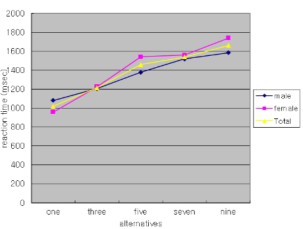
Looking at Figure 1, which shows the average reaction time by gender, the reaction time of male subjects was large for simple responses (when the number of alternatives was 1), but when the number of alternatives was 3 or more, the average reaction time of female subjects was higher. The time was slightly greater than that of the male elderly, and the deviation in reaction time was also greater in the female elderly. However, the difference was not statistically significant at the significance level of 0.05 (F = 2.175, p = 0.141).
670 Lee and Jung
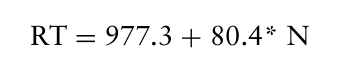
Looking at the average reaction time according to the number of alternatives available in Figure 1, you can see that the average reaction time increases for both male and female seniors as the number of alternatives increases. And the difference was statistically significant at the significance level of 0.05 (F = 45.367, p = 0.000). These results are consistent with Hick’s Law, which states that human reaction time is proportional to the number of alternatives available to choose from. Therefore, according to Hick’s law, the reaction time of elderly people is estimated through regression analysis as follows.
Equation reproduced from the original PDF.Figure 1: Reaction time according to the number of alternatives.
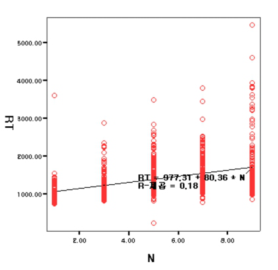
Figure 2 shows the scatter plot and regression equation between the number of alternatives and reaction time. It can be seen that the reaction time tends to increase as the number of alternatives increases.
Figure 2: Scatter plot and regression equation with the number of alternatives.
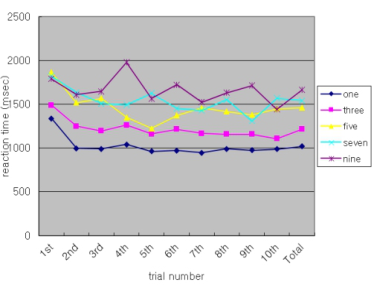
Looking at Figure 3, which shows the average reaction time according to the repetitions of the experiment, the average reaction time was the largest in the first trial, and the average reaction time tended to decrease as the experiment was repeated.
And the difference was statistically significant at the significance level of 0.05 (F = 3.939, p = 0.000). However, the average reaction time from 2nd
The Elderly’s Responses for Choice Reaction and Movement Time 671
to 9th trial was analyzed as the same group from the post hoc test (Duncan test). This trend can be seen in Figure 3, where you can see that the average reaction time does not change significantly from the second time regardless of the number of alternatives. In other words, in the choice reaction experiment targeting elderly people, the average reaction time shows that the learning effect according to the number of trials appears to be insignificant regardless of the number of alternatives. These results were confirmed through the significance analysis results of the interaction effect between the number of alternatives and repetition. In other words, the interaction effect between the number of alternatives and repetition was not statistically significant at the significance level of 0.05 (F = 0.638, p = 0.952).
Figure 3: Reaction time according to trial number.
THE ELDERLY’S CHARACTERISTICS FOR MOVEMENT TIME Experiment
In this experiment, we investigated the characteristics of elderly people’s movement time when operating buttons. The time required to complete a movement depends on the nature of the movement and the degree of accuracy required (Sanders & McCormick, 1992).
In general, movement time would be affected by the moving distance and the precision demanded by the size of the target to which one is moving. The longer the distance and/or the smaller the target, the longer the movement will take. In this experiment, effects of the moving distance and the target size on movement time were studied for old people in comparison with young people.
The moving distance is 20cm or 30cm from the position of subject’s hand to button. Button size was varied in four levels; 6mm, 10mm, 14mm, and 18mm in the radius of button. Ten old people (average = 69.5; maximum = 75, minimum = 65) and ten young people (average = 24.3; maximum = 28, minimum = 20) participated in this experiment. All experimental conditions were randomly selected to obtain unbiased data. Experimental models were made to effectively carry out this experiment.
672 Lee and Jung
Results
The movement time that subject takes to press a button was significantly influenced by the index of difficulty (ID) which is calculated from moving distance and button size (F = 4.227, p = 0.000) and showed a significant difference between old people and young people (F = 59.708, p = 0.000). Also, the interaction effect between ID and age was significant for the movement time (F = 2.926, p = 0.007).
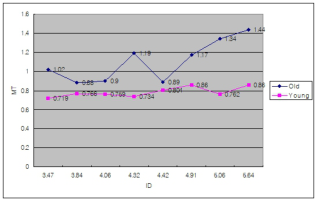
Average movement times according to each experiment conditions were represented in Figure 4. As you can see in Figure 4, the higher ID, the longer the movement time takes. In particular, the movement time was steeply increased with the increment of ID in case of old people.
Figure 4: Average movement time with ID.Figure 5: Movement time according to ID (Left: the elderly, right: the young).
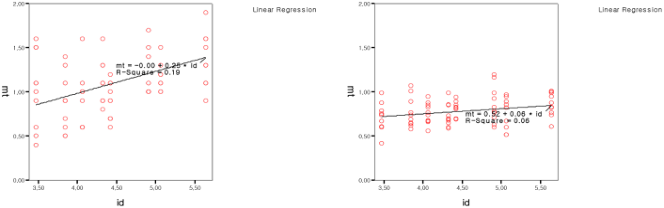
Figure 5 show graphs plotting movement time with ID in both cases of old and young people and Fitts’ equations. As you can see Figure 5, movement times were effectively fitted in Fitt’s equation. So, it was validated that movement time could be estimated by Fitts’ equation in case of old people as well as young people.
CONCLUSION
This study was conducted to investigate the elderly’s characteristics of the elderly’s choice reaction and movement time for elderly-centered universal design. First, a study was conducted to identify the choice reaction characteristics of elderly people to stimuli. As a result of the experiment, in the case of simple reactions, the male elderly’s reaction times were greater
The Elderly’s Responses for Choice Reaction and Movement Time 673
than the female’s, but in cases where the number of alternatives was three or more, the female’s response times were greater. This means that as the number of alternatives increases, the decision-making time of the female elderly increases more than that of the male elderly. And as the number of alternatives increased, the choice reaction time of the elderly was found to increase for both men and women, and was found to be appropriately expressed by a formula applying Hick’s law.
From the results of analyzing the effect of repetition on the choice reaction, it was found that the choice reaction time tended to decrease as the experiment was repeated, but in repetitions of two or more times, the decrease appeared insignificant even if the number of repetitions increased. However, it was found that there was a significant decrease in reaction time for both men and women between the first and second experiments.
Second, the elderly’s movement time for pressing a button with button size and moving distance was studied. As the result, the elderly’s movement time was not remarkably different in comparison with the existing principles. Movement time was affected by the index of difficulty (ID) that was calculated by moving distance and button size. In particular, the movement time was more steeply increased with the increment of ID in case of the elderly than the young. This means that the index of difficulty in case of an electric appliance for the elderly has to be lower than the young.
Because this study was conducted under limited experimental conditions, there may be limitations in generalizing the elderly’s characteristics regarding choice reaction and movement time. However, it provides meaningful results in terms of identifying the general characteristics of elderly people regarding choice reaction and movement time, and these results can be used as basic data for future universal design.
ACKNOWLEDGMENT
This results was supported by “Regional Innovation Strategy (RIS)” through the National Research Foundation of Korea (NRF) funded by the Ministry of Education (MOE) (2021RIS-004).
REFERENCES
Cox, K. and Walker, D. (1993) User Interface Design, Prentice Hall. Fisk, A. D. (1999) Human Factors and the older adult, Ergonomics in design, pp. 8–13. Jung, K. T. (2004) Universal Design for Electric Home Appliances, Fall Conference
of ESK. Mace, R. L. (1999) Universal Design: Housing for the Lifespan for All People, https: //www.design.ncsu.edu/cud/index.html. Rogers, W. A. (1997), Handbook of Human Factors and the Older Adult, Academic
Press, 1997. Rogers, W. A., Fisk, A. D., Mead, S. E., Walker, N., and Cabrera, E. F. (1996) Training older adults to use automatic teller machines, Human Factors, vol. 38, pp. 425–433. Statistics Korea (2022) The elderly’s Statistics.
LISTED IN THE AHFE DIGITAL BOOKSTORE CATALOGUE
Explore the complete digital volume
Human Factors in Design, Engineering, and Computing
Read this individual research paper free through the original publisher, or explore the full digital proceedings book.
ISBN 978-1-964867-35-9
Explore this ISBN in the AHFE Bookstore ↗Listed in the July 2026 bookstore catalogue; search by ISBN to confirm current availability · Digital book purchase optional