Tejaswini Indukuri, Heejin Jeong (2025). Toward Empathetic mHealth Design for Pediatric Scoliosis: A User-Centered Inquiry. In: Human Factors in Design, Engineering, and Computing. AHFE Open Access, vol. 199, pp. 1688–1698. https://doi.org/10.54941/ahfe1006980
This paper presents the early stages of a design inquiry exploring what young individuals managing scoliosis actually struggle with, and how we might design digital tools to better support them. Idiopathic scoliosis affects approximately 1.7% of the global pediatric population, yet current tools available to children for understanding and managing their condition are often limited in scope, accessibility, and age-appropriateness. Rather than starting with a predefined technical solution, this research was guided by an open question: What do these young patients need? To address this, we adopted a multi-method qualitative approach including surveys (N=5), semi-structured interviews (N=10), heuristic evaluations of six existing scoliosis apps conducted by two UX practitioners, and card-sorting exercises (N=4) with participants representing diverse age ranges and condition severities. Several key themes emerged: late diagnosis, lack of clear educational resources, social stigma, insufficient emotional support, and confusion about treatment pathways. Notably, many participants had never used scoliosis-related apps, and existing apps failed to incorporate usability principles tailored for younger users, often presenting content in overly technical language lacking emotional resonance. Based on these findings, we proposed an early-stage mHealth prototype with five core areas directly addressing the uncovered themes—including features like facial blurring for privacy and simplified language for younger users. Preliminary usability testing (N=3) provided initial feedback for refinement. This paper does not claim a finalized solution, but rather contributes to design-led research by documenting how a user-centered approach can guide the development of more empathetic and accessible digital health tools for pediatric scoliosis populations.
This paper presents an exploratory design inquiry into how an mHealth tool might support children with scoliosis, focusing on user-centered design and age-appropriate content. Learning directly from patients allowed us to better empathize better with their needs. While the condition requires
Toward Empathetic mHealth Design for Pediatric Scoliosis: A User-Centered Inquiry 1689
ongoing monitoring and interventions, patients emphasized that support and community were equally important, especially given the lack of a definitive cure. Rather than proposing a finalized application, this study highlights key insights into the gaps in current digital resources and the potential of user- centered approaches to foster more empathetic, supportive, and accessible mHealth tools for pediatric scoliosis populations.
Scoliosis, particularly idiopathic scoliosis, is a significant health concern among children and adolescents, affecting approximately 1.7% of the global pediatric population, with notable regional variations (Li et al., 2024). Early detection and treatment are critical, as early rehabilitation can significantly reduce disease progression, especially in younger children (Kluszczy´nski et al., 2024). Our inquiry explores how mHealth tools might empower patients and families by equipping them with knowledge, skills, and confidence to manage their condition. Evidence suggests that empowered patients adhere more consistently to treatment and experience better overall health (Gabrielli, 2017), with parental involvement playing a particularly crucial role in pediatric care (Bottino, 2023). Although existing digital solutions, often leveraging artificial intelligence (AI), offer opportunities for personalized and accessible care (Bhatt et al., 2022), many fall short in addressing age-appropriate design, emotional support, and usability. To advance this space responsibly, it is also essential to account for ethical considerations and ensure strong data privacy protections (Adeniyi et al., 2024; Vassallo, 2024).
This paper therefore presents our work in two stages: first, a pre- application development phase, in which we investigated patient needs and gaps in existing tools; and second, an application development phase, in which we explored how initial insights informed a conceptual prototype and preliminary feedback.
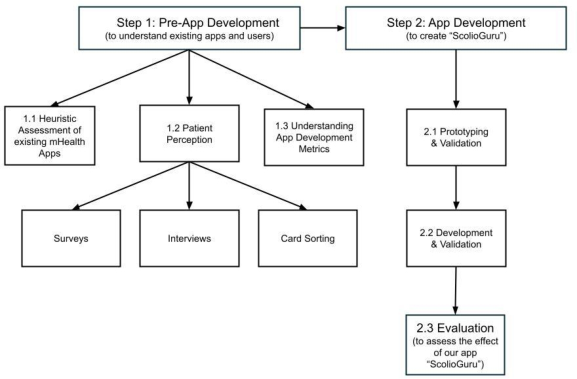
Pre-App Development Phase: Understanding Users Through Multi-Method Research To gain a comprehensive understanding of scoliosis and the potential usability of mHealth apps in managing the condition, we employed a multi- faceted research approach. This strategy enabled us to gather diverse types of information which, when combined, provided a deeper understanding of user needs. Figure 1 illustrates the process we used to design and evaluate our study, focusing on an mHealth app for scoliosis. The selected steps were chosen for their effectiveness in gathering qualitative insights through patient perceptions and interviews, as well as for their ability to capture more structured data through card-sorting, heuristic evaluations, and adherence to industry standards.
1690 Indukuri and Jeong
Figure 1: Process flow for the app development.
Heuristic Assessment of Existing mHealth Apps Before designing new solutions, we examined existing scoliosis-related mHealth apps and gathered first-hand perspectives from patients and caregivers. A multi-method approach was applied to capture complementary insights: heuristic evaluations of six scoliosis apps conducted by two UX students (one with scoliosis, one without, see Table 1), surveys (N = 5, see Table 2) and interviews (N = 10, see Table 3) to capture lived experiences, and a moderated card-sorting exercise (N = 4, see Table 4) to explore how participants organized scoliosis-related concepts. Guided in part by the NSF’s Innovation Corps program, these methods enabled us to integrate structured usability analysis with personal narratives and user-driven categorization, resulting in a richer understanding of user needs, challenges, and mental models (Nielsen Norman Group, 2024; Righi et al., 2013).
The card-sorting exercise provided a focused view of how young users conceptualize scoliosis-related information. Participants consistently grouped content into themes such as diagnosis and measurement, treatment options (exercises, physiotherapy, surgery), support resources, and privacy or record-keeping. These categorizations revealed a preference for logical hierarchies that align with users’ mental models, offering clear guidance for designing more intuitive information architectures (Righi et al., 2013; Nielsen, 2010). Taken together, the findings highlight recurring challenges such as delayed diagnosis, social stigma, inconsistent treatment adherence, and limited access to educational resources. They also underscore shortcomings in existing apps, which often fail to meet usability and age- appropriate design standards (Nielsen, 2010; Verywell Mind, 2023; Google, n.d.). The combined evidence emphasizes the importance of clear information hierarchies, empowering patients and families with knowledge and support (Gabrielli, 2017; Bottino, 2023), and ensuring privacy in digital health contexts (FTC, 2022; W3C, 2024). These insights directly informed the
Toward Empathetic mHealth Design for Pediatric Scoliosis: A User-Centered Inquiry 1691
next phase of our work, where we explored how a conceptual prototype might embody these user needs while aligning with established guidelines for children’s mHealth design.
Ease of Use - + - + + + Navigation - + - + + + Accuracy of testing
- + - + + +
Quality of information Key findings measuring and diagnosis Back SCNR, Scoliosis Tracker, Scoliometer: These apps were found to be lacking in accuracy and user-friendliness. The usability was not optimal, making it difficult for users to rely on them for accurate measurements. Education Scoliosis Tracker: This app excels in breaking down information into manageable chunks, making it easier for users to understand the relevant topics. Brace tracking
Brace Rite, Brace Tracker: These apps allow users to keep track of their bracing schedules between doctor visits, enhancing compliance and monitoring. Exercise/ physiotherapy
Back Exercises: This app provides a comprehensive breakdown of exercises, allowing users to create custom routines with simple and effective exercises.
Note. The table indicates whether the feedback provided by the testers was positive or negative. When feedback conflicted, we asked participants to elaborate on their comments and assigned a sign based on their explanations.
Table 2: Survey findings summary.
Table available in the original PDF paper.
Category Key Findings Detection Majority diagnosed before age 15; awareness often came from non-medical observers (e.g., teachers, family members). Engagement with healthcare
100% maintained contact with healthcare providers; 40% did not engage with treatment plans weekly; 60% did not know their curvature angle. Economic factors Many treatments were not covered by insurance, leading to high out-of-pocket costs and inconsistent treatment adherence. App usage 0% used apps to track their progress.
Note. The table summarizes key findings based on the survey questions shared with users. The surveys addressed patients’ concerns about their condition, its effects, treatment plans, age at diagnosis, specific struggles, and the apps they used.
1692 Indukuri and Jeong
Table 3: Interview findings summary.
Table available in the original PDF paper.
Theme Key Insights Delayed diagnosis and treatment “Self-identified around the age of 12 but parents didn’t take complaints seriously until diagnosed at 16/17.” Social stigma and misunderstanding
“Family and friends sometimes ask why I stand the way I do.” Seeking support and information
“Engages with others on Discord to learn more about surgery and share experiences.” Impact on daily life “Bus rides are challenging due to discomfort sitting.” Gender disparities “Read a study suggesting women are more prone to scoliosis.” Importance of skilled healthcare providers
“Importance of finding a good surgeon for successful treatment.” Lack of awareness and professional experience
“Nurse hasn’t worked with scoliosis patients and lacks professional experience.” “Doctor acknowledges surgery complexity but hasn’t treated scoliosis patients recently.”
Note. These themes were derived from patterns identified in the interviews. Representative participant statements relevant to each them are included.
Table 4: Guidelines for kids apps.
Table available in the original PDF paper.
Guideline Description Simplicity in design Interfaces should be intuitive and easy to navigate, accommodating the cognitive development stage of young users (Cognitive Development in Children, 2023). Vibrant, contrasting colors & Legible Fonts
Use bright colors and clear fonts to maintain attention and facilitate readability, making the app visually appealing and accessible (Nielsen Norman Group, 2010). Forgiving interactions Interactions should be forgiving of mistakes, offering gentle guidance and positive feedback to encourage learning and exploration (Verywell Mind, 2023). Balanced animations and sound effects
Balance animations and sound effects to enhance the experience without overwhelming users, keeping the app engaging but not distracting (Google, n.d.). Privacy and data protection
Ensure data protection and adherence to COPPA, building trust with parents and guardians by making the app safe for children to use (Federal Trade Commission, 2022).
Note. This table outlines key design guidelines for developing a child-centered scoliosis app. The goal is to create a prototype that informs, supports, and empowers young users while ensuring privacy and data protection. Future enhancements should emphasize education, self-monitoring, feedback, and gamification to boost engagement and effectiveness. Despite challenges in evaluating digital interventions, robust methodologies remain essential to validate their impact (Vassallo, 2024).
Toward Empathetic mHealth Design for Pediatric Scoliosis: A User-Centered Inquiry 1693
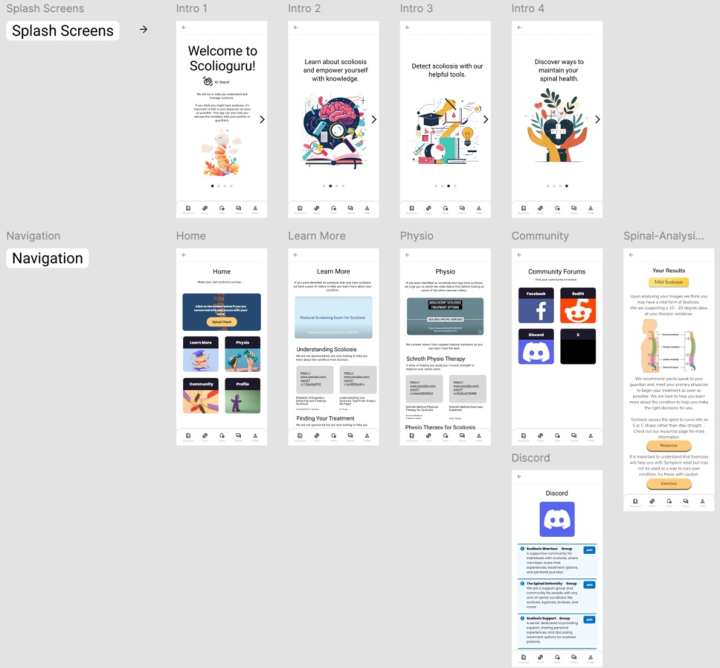
App Development Phase Building on pre-app insights, we developed a conceptual prototype guided by developmental and usability principles (Cognitive Development in Children, 2023; Nielsen Norman Group, 2010). The design balanced education, support, and monitoring, prioritizing the Spinal Check feature for easy access (Interaction Design Foundation, 2023). Privacy safeguards, such as facial blurring, audio guidance, and lighting checks, were integrated to ensure safety and comfort. Educational content was simplified and age-appropriate, while the Physio section used familiar language and structured routines, as shown in Figure 2.
Figure 2: User interface and workflow for an application to act as a support system for young scoliosis patients: combining educational resources and community engagement.
Social needs were addressed through a Community section linking to existing scoliosis forums, promoting peer support without managing youth- specific platforms. The minimal Profile feature supported personal logs without storing sensitive data, aligning with COPPA and privacy standards (FTC, 2022; W3C, 2024). Bright colors, large icons, and forgiving
1694 Indukuri and Jeong
interactions ensured accessibility and engagement (Verywell Mind, 2023; Google, n.d.).
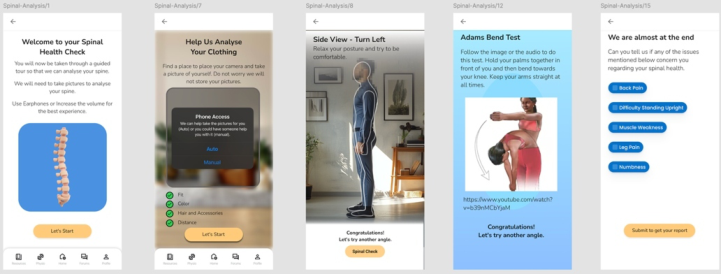
To improve measurement accuracy, the workflow (Figure 3) added a pre-capture screen to verify background, lighting, and clothing, reducing environmental variability. The updated assessment screen included additional scoliosis symptoms (Cleveland Clinic, 2024) to encourage holistic evaluation. Overall, the prototype synthesized user insights into a cohesive, child- centered digital health concept (Vassallo, 2024).
Figure 3: Proposed application flow and interface for enhanced body posture analysis, aiming to minimize image-based tracking errors.
Evaluation To gather preliminary feedback, we conducted small-scale usability sessions with three participants of varying ages (Table 5). Their input revealed both encouraging signals and areas for improvement. Younger users appreciated the app’s simplicity but struggled with terminology and navigation to community forums, underscoring the need for age-appropriate language and multiple navigation pathways (Cognitive Development in Children, 2023). An adult participant with scoliosis valued the Spinal Check feature but requested more detailed physiotherapy information, highlighting the importance of balancing educational depth with accessibility. Overall, the feedback suggested that while the prototype design was engaging, further refinement would be necessary to address the diverse needs of pediatric users.
In parallel, two experts (one specializing in AI and other in cybersecurity) reviewed the Spinal Check feature for technical soundness (Table 6). Their assessment identified challenges related to model accuracy, stemming from limited datasets and the absence of a robust reference framework for data interpretation. While the functionality was deemed operational, recommendations included expanding training data, strengthening interpretive models, and ensuring rigorous privacy safeguards (FTC, 2022). These findings align with broader discussions on the importance of AI- enabled accuracy (Bhatt et al., 2022; Yagi et al., 2023a) and the need for iterative, exploratory testing in pediatric digital health. The prototype thus functioned not as a validated tool but as an early-stage design artifact, clarifying both opportunities and limitations before advancing toward implementation.
Toward Empathetic mHealth Design for Pediatric Scoliosis: A User-Centered Inquiry 1695
Table 5: User testing findings.
Table available in the original PDF paper.
Participant Age Condition Key Feedback Participant 1: adult female 36 has scoliosis The first participant, who leads an active lifestyle, was immediately drawn to the yellow “spinal check” button on the home page and appreciated the clothing and background assessment feature for improving diagnostic accuracy. She suggested adding more detailed physiotherapy information, clearer treatment distinctions, and prompts encouraging users to talk to adults about scoliosis.
Participant 2: young male user
8 no scoliosis, no awareness of condition
The second participant, unfamiliar with scoliosis, found some words difficult to read and the video content too technical. He was hesitant about using the camera feature without adult supervision and had trouble locating the community forum, though he found the bottom menu easy to use. His feedback emphasized the need for simpler language and easier access to community features.
13 basic awareness, no scoliosis
Participant 3: adolescent female
The third participant, who had basic awareness of scoliosis, liked the app’s simplicity and would recommend it to friends but didn’t realize the community page linked to forums, suggesting clearer labelling. She preferred navigating through individual pages rather than the bottom menu, indicating value in multiple navigation options.
Note. These insights offered valuable feedback for improvement and underscored the need to consider users unfamiliar with scoliosis. Further testing with children without prior experience could enhance clarity and accessibility.
Table 6: App validation findings.
Table available in the original PDF paper.
Evaluation Criteria Key Challenges Recommendations Model accuracy Limited positive and control datasets reduced model accuracy.
Increase dataset size with more scoliosis images and balanced control samples.
Data interpretation The Spinal Check feature lacked a reference file for data interpretation.
Develop a robust reference model to translate raw data into clear results indicating scoliosis presence and severity.
Continued
1696 Indukuri and Jeong
Table 6: Continued Evaluation Criteria Key Challenges Recommendations
Table available in the original PDF paper.
Overall functionality Experts found the app functional but noted the need for greater robustness.
Implement enhancements to improve app functionality, focusing on data interpretation and model accuracy.
Note. This table summarizes key technical validation findings, highlighting the need for improved data accuracy and interpretation. Details on the Spinal Check feature are available on GitHub: https://github.com/yijingru/Vertebra-Landmark-Detection?tab=readme-ov-file) (Yagi et al., 2023b).
CONCLUSION
This exploratory design demonstrates how user-centered methods can shape mHealth tools for scoliosis. By synthesizing insights from heuristic evaluations, surveys, interviews, and card sorting, we identified critical needs such as accessible education, privacy, emotional support, and community connection. The prototype was not intended as a clinically validated application but as a visualization of how these needs could be addressed through design. Usability feedback showed that younger participants valued simplicity and engaging visuals but struggled with technical terminology, emphasizing the importance of child-appropriate design (Cognitive Development in Children, 2023; Nielsen Norman Group, 2010). Adult participants highlighted the need for physiotherapy information and guidance to consult caregivers, underscoring that digital tools should complement—not replace—medical care and family involvement (Gabrielli, 2017; Bottino, 2023). The technical review revealed challenges in model accuracy and interpretation, reflecting broader debates on AI in healthcare (Bhatt et al., 2022; Yagi et al., 2023a; Zhang, 2023). While AI offers potential for data curation and personalized recommendations, its integration must include safeguards to ensure privacy and compliance with COPPA and WCAG standards (FTC, 2022; W3C, 2024). These findings support calls for evidence-based digital health design (Vassallo, 2024) and suggest that successful mHealth interventions require iterative refinement, co-design with pediatric users, and collaboration with clinicians to create empathetic, supportive, and accessible tools for pediatric scoliosis.
ACKNOWLEDGMENT
This work was supported in part by funding from the National Science Foundation (NSF) I-Corps Hub: Desert and Pacific Region, whose faculty and staff provided invaluable support and guidance. We also extend our sincere gratitude to all the participants who generously dedicated their time and shared their personal experiences with scoliosis, making this study possible. The authors additionally acknowledge Mr. Hari Iyer and Mr. Priyank Ahuja for their valuable contributions to the technical development of this work.
Toward Empathetic mHealth Design for Pediatric Scoliosis: A User-Centered Inquiry 1697
REFERENCES
Adeniyi, A. O., Arowoogun, J. O., Okolo, C. A., Chidi, R. and Babawarun, O.
(2024). Ethical considerations in healthcare IT: A review of data privacy and patient consent issues. World Journal of Advanced Research and Reviews, 21(2), pp. 1660–1668. https://doi.org/10.30574/wjarr.2024.21.2.0593. Bhatt, K., Joshi, R. and Patel, N. (2022). Advances in AI for mHealth Applications.
Journal of Healthcare Engineering, 2022, pp. 123–145. Bhatt, P., Liu, J., Gong, Y., Wang, J. and Guo, Y. (2022). Emerging Artificial Intelligence–Empowered mHealth: Scoping Review. JMIR Mhealth and Uhealth, 10(6), e35053. https://doi.org/10.2196/35053. Bottino, L., Settino, M., Promenzio, L. and Cannataro, M. (2023). Scoliosis
Management through Apps and Software Tools. International Journal of Environmental Research and Public Health, 20(8), 5520. https://doi.org/10.3390/ ijerph20085520. Cleveland Clinic. (2024, January 26). Scoliosis: What it is, types, causes, symptoms & treatment. Retrieved from https://my.clevelandclinic.org/health/diseases/15837- scoliosis. Cognitive Development in Children (2023). Cognitive Development in Children
| Advice for Parents. Cincinnati Children’s Hospital. Available at: https:// www.cincinnatichildrens.org/health/c/cognitive-development. Federal Trade Commission (2022). Complying with COPPA: Frequently Asked Questions. Available at: https://www.ftc.gov/tips-advice/business-center/ guidance/complying-coppa-frequently-asked-questions-0. Gabrielli, S., Dianti, M., Maimone, R., Betta, M., Filippi, L., Ghezzi, M. and Forti,
S. (2017). Design of a Mobile App for Nutrition Education (TreC-LifeStyle) and Formative Evaluation With Families of Overweight Children. JMIR Mhealth and Uhealth, 5(4), e48. https://doi.org/10.2196/mhealth.7080. Google (n.d.). Designing engaging apps | Building for kids. Google for Developers.
Available at: https://developers.google.com/building-for-kids/designing-engaging- apps. Interaction Design Foundation (2024). What is Fitts’ Law? Available at: https:// www.interaction-design.org/literature/topics/fitts-law. Kluszczy´nski, M., Zaborowska-Sapeta, K., Kowalski, I. and Karpiel, I. (2024). The
Effectiveness of Early Rehabilitation in Limiting the Progression of Idiopathic Scoliosis. Journal of Clinical Medicine, 13(5), 1422. https://doi.org/10.3390/ jcm13051422. Li, M., Nie, Q., Liu, J. and Jiang, Z. (2024). Prevalence of scoliosis in children and adolescents: a systematic review and meta-analysis. Frontiers in Pediatrics, 12. https://doi.org/10.3389/fped.2024.1399049. Nielsen, J. (2010). Children’s cognitive development and website design. Nielsen
Norman Group. Available at: https://www.nngroup.com/articles/kids-cognition/. Nielsen, J. (2024). Why you only need to test with 5 users. Nielsen Norman Group.
Available at: https://www.nngroup.com/articles/why-you-only-need-to-test-with- 5-users/. NSF’s Innovation Corps (I-Corps™) (2024). NSF. Available at: https://new.nsf.gov/ funding/initiatives/i-corps. Righi, V., James, J., Beasley, M., Day, D., Fox, J., Gieber, J., Howe, C. and Ruby, L. (2013). User-Centered Design Stories: Real-World UCD Case Files. Available at: https://www.researchgate.net/publication/344752507_ Methods_of_User_Centered_Design_and_Evaluation_for_Learning_Designers.
1698 Indukuri and Jeong
Vassallo, M. (2024). The need for evidence-based mobile health technology. Age and Ageing, 53(3), afae034. https://doi.org/10.1093/ageing/afae034. Verywell Mind (2023). Cognitive Developmental Milestones. Available at: https://
w3.org/TR/wcag-3.0/. Yagi, M., Honda, S. and Ito, Y. (2023a). Machine Learning and AI in mHealth: Current Trends and Future Directions. Computers in Biology and Medicine, 147, pp. 105–117. Yagi, M., Yamanouchi, K., Fujita, N., Funao, H. and Ebata, S. (2023b).
Revolutionizing Spinal Care: Current Applications and Future Directions of Artificial Intelligence and Machine Learning. Journal of Clinical Medicine, 12(13), 4188. https://doi.org/10.3390/jcm12134188. Zhang, T., Zhu, C., Zhao, Y. et al. (2023). Deep Learning Model to Classify and Monitor Idiopathic Scoliosis in Adolescents Using a Single Smartphone Photograph. JAMA Network Open, 6(8), e2330617. https://doi.org/10.1001/ jamanetworkopen.2023.30617.
LISTED IN THE AHFE DIGITAL BOOKSTORE CATALOGUE
Explore the complete digital volume
Human Factors in Design, Engineering, and Computing
Read this individual research paper free through the original publisher, or explore the full digital proceedings book.
ISBN 978-1-964867-75-5
Explore this ISBN in the AHFE Bookstore ↗Listed in the July 2026 bookstore catalogue; search by ISBN to confirm current availability · Digital book purchase optional