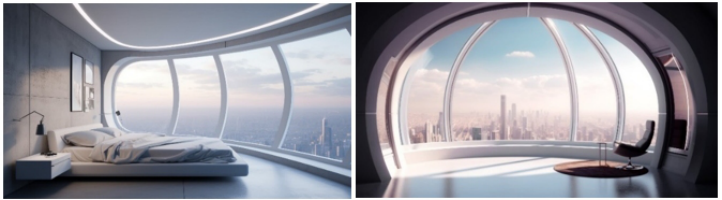
George Chow (2025). Visualizing the Future with the Help of AI. In: Interdisciplinary Practice in Industrial Design. AHFE Open Access, vol. 183, pp. 155–162. https://doi.org/10.54941/ahfe1006436
When students are asked to visualize service design concepts, they usually try to tell an engaging story with video clips of users utilizing their service design. Since their version of a service design concept does not exist yet, they will try to create touchpoints such as a kiosk or product, app prototypes on mobile devices, and have a supporting cast of actors to portray service design representatives in their story. If their service design is set 15-25 years in future, the storytelling can be even more challenging because everything needs to look more futuristic to match the time period the service design concept is being proposed for. Everything including the buildings, infrastructure, stores, vehicles, people, clothing, etc. need to look like they are from the future. Trying to create futuristic looking environments, and elements for the live actors to interact with can be extremely time consuming and require a large amount of money to virtually and/or physically create, however, with new AI tools, entire rendered futuristic environments can be generated with much less time and money. The following case study describes methods and tools that 3rd year industrial design students utilized to create futuristic backdrops and environments in conjunction with actors in front of green screens to tell their service design concept stories. With new AI tools, the future of service design storytelling can be done with much less time and money, and looks to be inspiring and exciting!
In the realm of service design, designers would often create videos with live actors interacting with physical prototype touchpoints like kiosks or wearable devices and apps for UI/UX touch screens to communicate their service design concept. This is already a challenging process, however, it can become exponentially more challenging if the service design concept is set in the future because everything in the video needs to also look like it is set in the future including the environments, buildings, infrastructure, vehicles, people, clothing, food, products, etc. Before the onset of Artificial Intelligence (AI) generative tools, designers would need to meticulously CAD model and render entire futuristic environments, people, products, etc. which could take hundreds of hours, depending on the amount of detail. If there are multiple scenarios in the service design, each scenario may have a different environment and therefore, exponentially increase the development time. With AI image generative tools such as Midjourney and Adobe Firefly,
background environment image creation time is drastically reduced and can make generating futuristic service concepts possible in a shorter time frame. This paper describes a case study of a 3rd year product design studio class using AI generative tools in conjunction with green/blue screens, and live actors to quickly create futuristic service design concept videos.
LITERATURE REVIEW
Visualizing future sci-fi scenarios have been done for many years especially with popular movies like Star Wars, Star Trek, 2001: Space Odyssey, Interstellar, Terminator, Matrix, Minority Report, Robocop, and I, Robot. These movies took millions of dollars and hundreds of thousands of hours to produce (Mueller, 2023). AI generative tools have revolutionized the creative industry by enabling users to quickly produce content through machine learning algorithms. Among these tools, Midjourney and Adobe Firefly have emerged as prominent platforms, each offering unique features and capabilities.
Green Screens and Computer Graphics Green screens, also known as chroma key, were first introduced in the late 1930s and gained widespread use in film and television, particularly with the rise of affordable computer graphics in the 1970s and 80s. The earliest implementations were often blue screens. Green screens became more prevalent later on because green is a color less commonly present in human skin tones, making it easier to isolate the subject from the background (Care, 2023). The futuristic environments that filled in the green screen background areas were often computer rendered images and animations that were painstakingly created by humans digitally modeling and rendering for hundreds, sometimes thousands of hours. Before the advent of AI generative tools, designers had to follow a similar process if they wanted to create a futuristic service design concept video.
Midjourney Midjourney is a generative AI program and service created and hosted by the San Francisco-based independent research lab, Midjourney, Inc. Midjourney quickly generates images from natural language descriptions, called prompts, and was first open to the public on July 12, 2022. Midjourney is not the first prompt-based AI image generating tool, however, it became more popular especially with students due to its lower basic subscription cost and students’ familiarity with using Discord, a free voice, video, and text communication platform that Midjourney utilizes to receive prompts and send generated images (Midjourney, 2024).
METHODS AND PROCESSES In the Spring semester of 2023, 16 junior industrial design students were challenged with a six-week project to create a service design concept for 2040 or 2050, roughly 15–25 years in the future, while keeping sustainability in
Visualizing the Future With the Help of AI 157
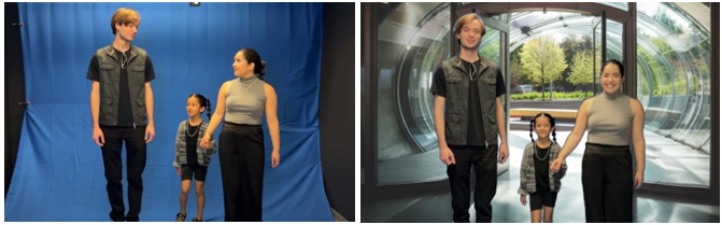
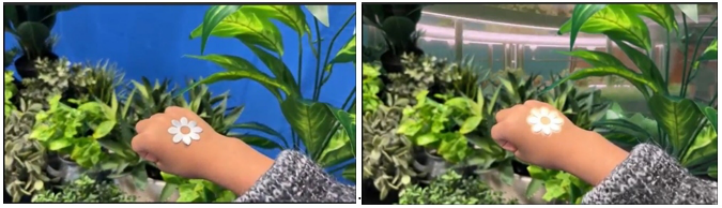
mind. They were formed into teams of four and each team was required to conduct futuring research exercises such as historical studies, and market and trend analyses to predict potential problems 15–25 years in the future, given our current trajectory as a society. Each team identified and defined a specific problem and target users before starting an ideation and development phase. Then each team generated 40 concept sketches, which were later narrowed down to their top four concepts, and after further refinement, narrowed down to their strongest concept to execute for their final concept. Each team developed a storyboard and a service design blueprint to guide them in their video production, and used several different AI tools including Midjourney, Adobe Firefly, and AI image enlarging software to help them create a final video demonstrating how their service design worked. As shown in Figure 1, many of the teams utilized a combination of live actors with physical props, acting in front of green or blue screens, and overlaying Midjourney AI-generated background images over the green/blue screens in video post-production using Adobe Premiere.
Figure 1: Before and after adding Midjourney AI-generated background image (Alsagheer, Anzures, Saqib, Schuman, 2023).
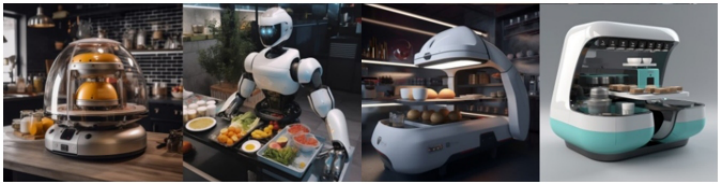
Some teams utilized Midjourney to generate many different concepts for a certain aspect of their service design. For example, one team utilized Midjourney to generate several different robot designs for a food-serving robot as shown in Figure 2.
Figure 2: Food-serving robots generated by Midjourney (Anzures, Schuman, 2023).
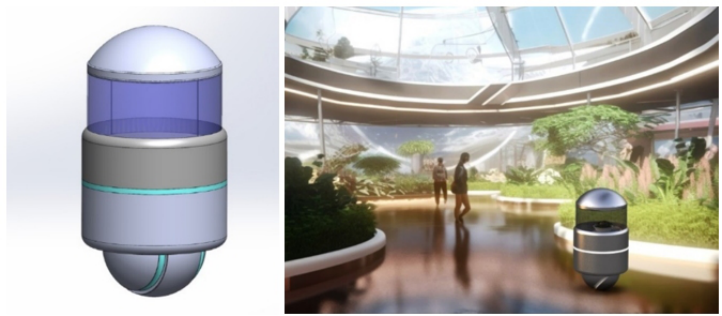
Using the images generated by Midjourney as inspiration, one team modeled their own food-serving robot with Solidworks (CAD) and later
158 Chow
animated it moving in Keyshot (rendering software) and then further enhanced it with a Midjourney background image to make it look like the robot was rolling through an area in their service design concept as shown in Figure 3.
Figure 3: Robot Solidworks CAD model (L), and video still with a Midjourney background (R) (Anzures, 2023).
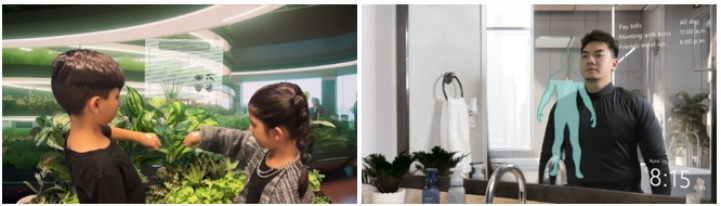
Other teams utilized Adobe Firefly to quickly create AI-generated, prompt- based logos and graphics and Adobe After Effects to overlay motion graphics over the videos to illustrate key features of their concept as shown in Figure 4.
Figure 4: Examples of motion graphics added with Adobe After Effects (Anzures, Saqib, Vu, Wolfarth, 2023).
RESULTS
At the end of six weeks, all of the teams presented their service designs with a project poster, service design blueprint, and a four-minute video. Here are two out of the four projects.
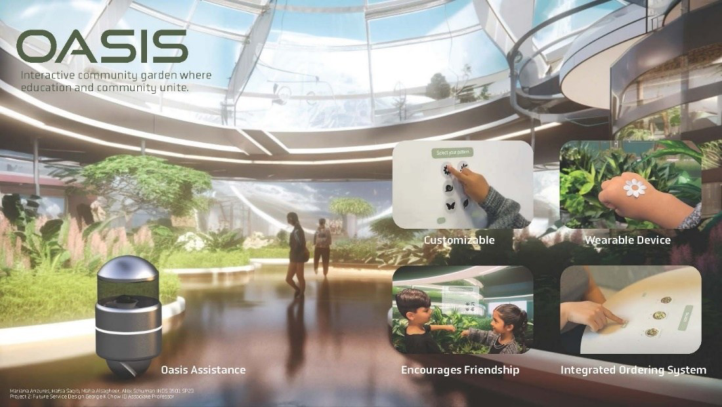
Oasis Oasis is an interactive community garden for families which promotes sustainability through education, efficient hydroponic organic gardens, and restaurants which utilize the produce grown in the gardens. There are
Visualizing the Future With the Help of AI 159
interactive educational games such as a collaborative scavenger hunt for children which teaches about different plants and gardening techniques, and encourages teamwork.
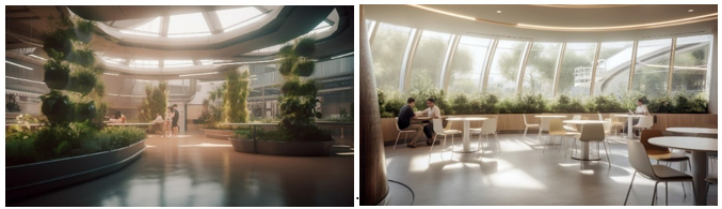
Figure 5: OASIS project poster with backgrounds generated by Midjourney (Alsagheer, Anzures, Saqib, Schuman, 2023).Figure 6: Some of the Midjourney background images utilized in Oasis (Schuman, 2023).
As shown in Figure 7, the combination of live actors, physical props such as plants, and Midjourney backgrounds were utilized to create some of the scenes in the video. In this case, a blue screen was utilized instead of a green screen to prevent the physical plant props from blending into the background.
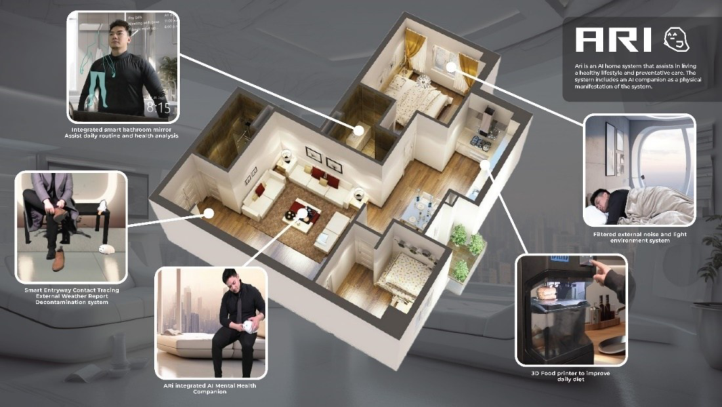
ARI ARI is an AI home health system that encourages sustainability and healthy living by providing preventative health care. The system includes ARI, an AI companion which communicates throughout the home using built-in speakers and also through a small physical robot that moves around the user’s home. The system has cameras and sensors such as retinal and full body scanners throughout the home to detect potential illnesses and works
160 Chow
in conjunction with robots and machines to provide preventative health care. For example, if ARI detects hypertension or high cholesterol in a user, it will prepare meals designed to lower the blood pressure or cholesterol of that user. The system also has a decontamination chamber which decontaminates users with light therapy before they enter the home.
Figure 7: Combination of a live actor, physical plants, and a Midjourney background image (Alsagheer, Anzures, Saqib, Schuman, 2023).Figure 8: ARI project poster with backgrounds and images generated by Midjourney (Blacker, Rousseau, Vu, Wolfarth, 2023).Figure 9: Some of the Midjourney background images utilized in ARI (Wolfarth, 2023).
Visualizing the Future With the Help of AI 161
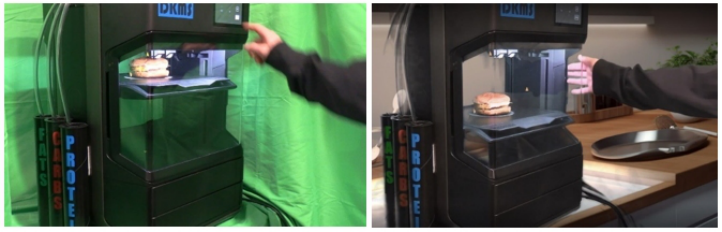
As shown in Figure 10, a combination of live acting, physical props, such as the meal preparation machine, and a Midjourney background added over a green screen was utilized to create the healthy meal preparation scene in the video. The meal preparation machine was an existing 3D printer that was modified and painted to look like a futuristic meal preparation machine.
Figure 10: Combination of a live actor, physical prototype, and a Midjourney background image (Blacker, Rousseau, Vu, Wolfarth, 2023).
ANALYSIS Overall, all the projects were completed with a relatively high level of quality, given the six-week time frame. The students reported learning about futuring, and developing many new visualization skills and storytelling processes with the combination of AI tools, green/blue screen videos, and post processing tools such as Adobe After Effects. The use of Midjourney, in particular, greatly increased the speed in which students could generate ideas for inspiration and background environments to use in their service design videos. The combination of Midjourney background images added over green screened video clips with live acting was shown to be an efficient and effective process to visualize their service design stories. One student summarized in her process book reflection: “I learned a lot of skills during this project. As AI is becoming more normalized, this project taught us to leverage AI as a tool for design. Not only for generating ideas, but also for creating visualization tools. We also learned how to use a green screen, and video editing with AI to strengthen our storytelling.” However, another student stated “…the amount of AI used in this project made me feel like I contributed less to the project than the rest of my teammates and it is difficult to take full claim of the work I did.” Since the Midjourney image creation process was fast and seemed almost too easy, the student didn’t feel like he contributed as much to the project as his fellow teammates and he was concerned whether or not the images generated by Midjourney were really his work. Another constraint of the Midjourney images is that they were static, so the students needed to be creative with actor movements, in combination with image panning and zooming to make it seem like the actors were not in a static environment. At the time of the project, the software to create AI-generated moving video backgrounds was not available to students, which could have greatly increased the realism of the futuristic environments.
162 Chow
CONCLUSION
Before the widespread availability of AI image generation tools like Midjourney and Adobe Firefly, designers had to spend many hours modeling and rendering futuristic environments as backgrounds for futuristic service design concepts. AI generative tools have greatly increased the speed in which designers can create futuristic background image environments. In this case study, students were able to create service design video concepts utilizing a combination of actors interacting in front of blue or green screens, and replacing the screens with AI generated futuristic environment background images, saving a lot of time and money in the process. Through this project, students reported learning about service design, futuring, and advanced storytelling and visualization skills with the help of AI. With AI tools continuing to improve, the future looks bright for students and professional designers who want to tell stories and inspire others with what our future could look like.
REFERENCES
Adobe Firefly Overview (2025) Adobe Help Center. Available at: https:// helpx.adobe.com/firefly/get-set-up/learn-the-basics/adobe-firefly-overview. html (Accessed: 23 April 2025). Care, C. (2023) History of the chroma key green screen, Projector Screen World. Available at: http://www.projectorscreenworld.com/blogs/news/history- of-the-chroma-key-green-screen (Accessed: 23 April 2025). Midjourney (2024). Available at: https://www.midjourney.com/home (Accessed: 23 April 2025). Mueller, A. (2023) Why movies cost so much to make, Investopedia. Available
at: http://www.investopedia.com/financial-edge/0611/why-movies-cost-so-much- to-make.aspx (Accessed: 23 April 2025).
LISTED IN THE AHFE DIGITAL BOOKSTORE CATALOGUE
Explore the complete digital volume
Interdisciplinary Practice in Industrial Design
Read this individual research paper free through the original publisher, or explore the full digital proceedings book.
ISBN 978-1-964867-59-5
Explore this ISBN in the AHFE Bookstore ↗Listed in the July 2026 bookstore catalogue; search by ISBN to confirm current availability · Digital book purchase optional