Jennifer Martinez, Justin Macdonald (2025). Improving Airspace Awareness: Possible Conspicuity Solutions For Safe sUAS Operations. In: Human Factors in Robots, Drones and Unmanned Systems. AHFE Open Access, vol. 179, pp. 64–72. https://doi.org/10.54941/ahfe1006375
Currently, there is no standardized lighting system to enhance the visibility of small Unmanned Aircraft Systems (sUAS), despite reports of their limited conspicuity. This study has identified the characteristics of a lighting system (placement of the light, flash type, movement of the sUAS) that can enhance the detection and visibility of a sUAS. This work was done using a virtual reality (VR) headset, a platform that can offset or mitigate persistent issues with UAS field research. This experiment used a within-subject factorial design to explore the effects of lighting design and sUAS movement on detection and reaction time. The study included three factors: light flashing type (flashing, non-flashing, half-flashing, and half-non-flashing); light placement (top and bottom or around the perimeter of the sUAS); and relative movement of the sUAS (approaching or orbital). Participants viewed 360-degree videos of a sUAS flying. They were tasked to locate the sUAS within six seconds, relying on the drone's lighting and sound. The participants completed a total of 96 trials. Fifty participants (31 female, 19 male; mean age 24.4 years) were recruited from the student (31 participants) and general population (19 participants). Half-flashing and half-solid lights around the perimeter of the sUAS maximized the chance of quick detection. Perimeter lighting increased detection counts [F(1, 590) = 38.295, p < 0.001]. There was also a significant flash type by placement interaction [F(2,98) = 8.87, p < 0.001] for reaction time, with decreased reaction times for half-flashing/half-solid lighting placed around the perimeter. The type of relative movement depends on the vantage point of the observer and did not lead to lighting recommendations. This virtual reality-based study identified lighting configurations that increase sUAS visibility. It also highlighted the potential of VR-based experiments to increase participant turnout, decrease financial stressors, and avoid hazardous accidents. This experiment identified two factors that increase detection and decrease reaction time: a combination of solid and flashing lights around the perimeter of the sUAS. As sUAS use expands to include flying beyond line of sight and more advanced mobility aircraft fly in swarms, these lighting systems may be further examined to minimize human error.
Improving Airspace Awareness: Possible Conspicuity Solutions for Safe sUAS Operations 65
INTRODUCTION
Over recent years, air travel has gradually changed how we travel and transport goods. Despite these changes, one of its fundamental purposes remains the same: to export goods to other countries and transport emergency supplies, both of which are indispensable to our society. Small Unmanned Aircraft Systems (sUAS), a relatively new addition to the aviation fleet, are paving the way for short-distance cargo transportation within cities (Lydon, 2022). However, the use of the sUAS for the transportation of goods is currently facing a hurdle due to the current regulations set by the FAA for both commercial and private use. This outcome is mainly because of the safety concerns surrounding sUAS operation, particularly the potential for elevated frequency of collisions caused by human error and other environmental factors (Beechener, 2023; FAA, 2023a; Jacob et al., 2018; Jaussi & Hoffmann, 2018). In addition to its regular tasks, the National Airspace System has also taken on the responsibility of transitioning all UAS into civilian airspace (Neville & Williams, 2016). As part of these efforts, Unmanned aircraft system Traffic Management (UTM) the management of low-altitude uncontrolled drone operations are currently in development (UTM; FAA, 2023b). Majority of these aircraft will be flying in class G airspace. With these programs, the FAA has created opportunities to increase research and formulate preventative measures, such as Aircraft Safety/ Safety Risk (FAA, 2022). However, additional protocols and procedures should be considered to identify what preventatives can increase safety, such as visual cures.
The FAA mandates that all aircraft have navigation and anti-collision lights throughout their body (FAA, 1981; Maaz, 2022). For sUAS, anti-collision lights only need to be on at dusk or dawn (Giles, 2022). It is mandatory to have blinking and solid-state anti-collision lights that are visible up to three miles for a night flight (FAA, 2020; Gross, 2023). While sUAS are required to have navigation lights like larger aircraft, there are no set locations for anti-collision lights. Lastly, the FAA does not specify colors for anti-collision lights (FAA, 2020; Gross, 2023; Rupprecht, 2022).
The FAA conducted a lab-based study in 2022 to determine what type of detection enhancement can be used for UAS operation protocols (Williams et al., 2022). The study focused on finding a lighting scheme that could enhance visual conspicuity for sUAS and, thus, the operators’ performance. The study involved 35 participants, all of whom were FAA employees, but the majority were not sUAS operators. The study aimed to identify a scheme that could improve the safety and visibility of sUAS systems (Williams et al., 2022). Results indicated that pure white light is the most effective color for detecting sUAS, and that flashing lights are more effective in detecting UAS that are moving toward the participants. In contrast, steady lights work better for UAS that are moving across the screen, regardless of whether it is day or night.
Wallace and associates conducted a related study to determine whether airplane pilots can detect sUAS using strobe lights while operating a regular aircraft (Wallace et al., 2018). The researchers discovered that participants were only able to visually detect the sUAS in three out of the 39 possible
66 Martinez and MacDonald
intercepts, indicating a detection rate of 7.7%. This percentage is significantly lower than the 36.8% found in a similar previous study (Loffi et al., 2016). Additionally, 90% felt that the sUAS was either difficult or very difficult to identify during the flight.
The current study implemented a sUAS detection task in a virtual reality platform to determine optimal configurations for light placement and flashing behavior according to sUAS movement.
METHODS
Participants Fifty participants (31 female, 19 male) were recruited from the student participant pool (31 participants) and the general population (19 participants). The mean age of the sample was 24.4 years. Student participants were predominantly enrolled in an Introduction to Psychology course, and the general population included anyone from both campus and outside campus. Nine subjects had non-normal hearing, and 20 had non- normal vision (defined as worse than 20/20)1. After completing the study, student participants received course credit and a $10 gift card. Individuals from the general population only received a $10 gift card. Any participant who was unable to complete the study earned half credit and/or a $5 gift card.
Design A 3X2X2 within-subject factorial design was conducted to explore the effects of lighting design and sUAS movement on the participants’ detection and reaction time. The first independent variable was a light flashing type configuration (flashing, non-flashing, half-flashing, and half- non-flashing). The second independent variable was light placement (top and bottom or around the perimeter of the sUAS). The third independent variable was the type of sUAS movement relative to the observer (approaching or orbital).
Recordings The flight recording took place at an abandoned housing construction site. This location was chosen because it allowed for minimal noise interference from people and passing cars during the sUAS recording. A Holy Stone 700E UAS was flown for the recordings. It was equipped with navigation lights, a 4K camera, and some unmanned capabilities, such as “Follow me mode,” “Point of interest,” and “Flight trajectory.” For this experiment, the “Point of interest” unmanned option was used, allowing the sUAS to fly in an orbit around the camera. The Orbital was at 30 feet, and the approach was at 50 feet, with an altitude of 10 feet. Flight recordings were made using an Insta Pro2 360 camera, which enables a high-quality 3D VR video experience within a VR headset. The full recording was sliced into 6-second increments for use as stimuli in the experiment.
1T-Test analyses revealed significant differences in results/outcomes between normal and non-normal vision/hearing individuals. However, the difference between these groups did not negatively impact the general outcome of this study.
Improving Airspace Awareness: Possible Conspicuity Solutions for Safe sUAS Operations 67
Procedure The study was carried out in a laboratory at New Mexico State University. The study started with processing the participants, which involved having them read and accept the consent form. Once the participants agreed to the terms, they underwent screening for hearing and vision. Regardless of the screening results, participants completed the experiment. After the screening, the experiment processing phase began, during which the facilitator explained the instructions to the participants.
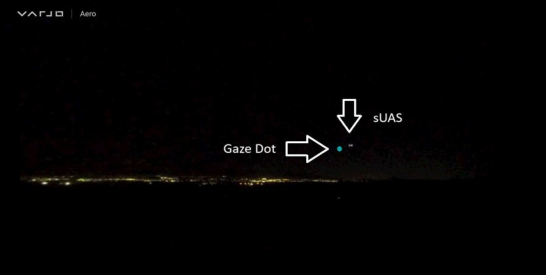
After the instructions were presented, the facilitator helped the participant adjust the VR headset (Varjo Aero VR) and perform the necessary calibrations. Once this was completed, the facilitator checked whether all the functions were working correctly before the participant started the experiment. Throughout the study, participants were shown 360-degree videos of a sUAS flying in different locations. Their task was to locate the sUAS within their field of view (FOV) within six seconds, relying on the drone’s lighting and sound, and to confirm their detection by pressing the square button on their controller. The participant was seated on a swivel chair and could twist left or right to search for the sUAS. The facilitator, at random, verbally instructed the participant to turn left or right before starting into the next trial. There were a total of 12 combinations of conditions that were shown twice, and the participants had to complete a total of 96 trials. Therefore, participants had 8 opportunities to detect the conditions per block. During each session, each participant’s eye gaze was video recorded, and eye- tracking technology by Varjo was used to capture their eye gaze behavior for each trial. This information data was used to accurately determine whether the participant detected the sUAS with their eye gaze. An example frame from one of the video clips is shown in Figure 1 below. After the study concluded, The study concluded with a demographics questionnaire and a 5-minute debriefing. The entire session, including onboarding, the experiment, and the debriefing, took approximately 30 minutes.
Figure 1: An example of what a participant sees within their headset. The green dot represents their gaze, and the white dot is the sUAS.
68 Martinez and MacDonald
RESULTS
Individuals with non-normal vision and/or hearing were included in the results. Although these individuals tended to respond more slowly and less accurately than subjects with normal perceptual capabilities, the qualitative pattern of results was the same. Given that the goal of the experiment was to determine the optimal lighting configuration for observers in general (rather than only those with normal hearing and vision), we chose to include these individuals in the analysis.
A trial was scored as a correct detection if it met the following requirements: the subject responded during the 6 second video, and their eye gaze was near the sUAS (determined after the experiment by three human reviewers) when the response was made. Fleiss’ Kappa was used to assess the level of concordance among the raters while evaluating detection responses. The agreement between the raters was found to be very high at 0.94 (1 being the highest and 0 the lowest in agreement) and SE 0.01, p < 0.001.
Number of Detections Out of 4800 trials in the full dataset, 3142 (65.5%) were correct detections. A standard repeated-measures ANOVA is not suitable for detection counts. Instead, a generalized linear mixed model (GLMM) with a Poisson distribution was employed to model the three within-subject factors. The main effects and two-way interactions were considered fixed effects, while the subject factor was treated as a random effect. The three-way interaction was not included in the model, in accordance with the findings of the Williams et al. (2022) study. There were two significant interactions: Movement Type by Flashing Behavior [F(2, 590) = 5.71, p = 0.003], and Movement Type by Spatial Configuration [F(1, 590) = 10.765, p = 0.001]. There was also a significant main effect of Spatial Configuration [F(1, 590) = 38.925, p < 0.001]. All other interactions and main effects were not statistically significant.
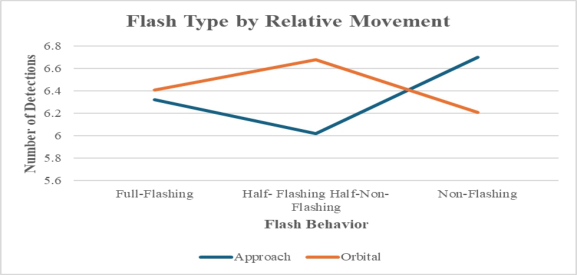
The Movement Type by Flashing Behavior interaction is illustrated in Figure 2 below. Half-flashing led to the most detections for orbital movements and non-flashing led to the most detections for approach movements.
Figure 2: Number of detections by flashing behavior and movement type.
Improving Airspace Awareness: Possible Conspicuity Solutions for Safe sUAS Operations 69
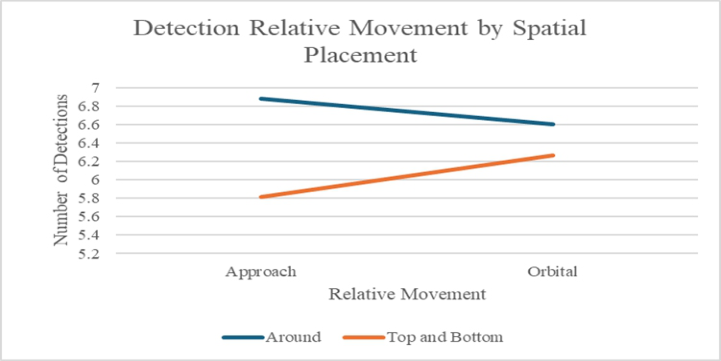
The Movement Type by Spatial Configuration interaction is illustrated in Figure 3 below. Reaction times were slightly higher for orbital movements relative to approach movements when the lights were placed on the top and bottom of the sUAS. In contrast, RTs were slightly lower for orbital movements relative to approach movements when the lights were placed around the perimeter of the sUAS. The top/bottom configuration led to lower RTs for both types of movements, however, consistent with the main effect of Spatial Configuration.
Figure 3: Number of detections by spatial configuration and movement type.
Reaction Time Only correct detection trials were considered for the RT analysis. A three- way repeated measures ANOVA was used to analyze reaction times. Reaction times were calculated as the elapsed time between the moment when the sUAS first entered the subject’s field of view and the time when the participant pressed the button to confirm detection. The reaction times were transformed using a log function to address the non-normality of RT data. Only main effects and two-way interactions were included in the ANOVA model. There were two significant interactions: Movement Type by Flashing Behavior [F(2, 98) = 11.33, p < 0.0001], and Flashing Behavior by Spatial Configuration [F(2, 98) = 8.87, p = 0.0003]. There was also a significant main effect of Movement Type [F(1, 49) = 70.48, p < 0.0001]. All other interactions and main effects were not statistically significant.
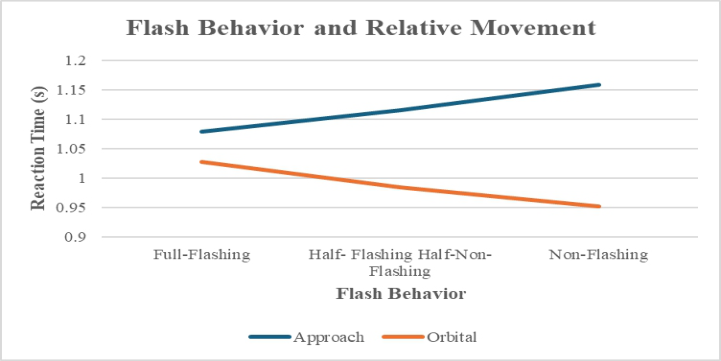
The Movement Type by Flashing Behavior interaction is illustrated in Figure 4 below. For approach movements, RTs increased as the proportion of flashing lights was reduced. In contrast, for orbital movements, RTs decreased as the proportion of flashing lights was reduced. Orbital movements led to lower reaction times regardless of flashing behavior, consistent with the significant main effect of Flashing Behavior.
70 Martinez and MacDonald
Figure 4: Reaction time by flashing behavior and movement type.
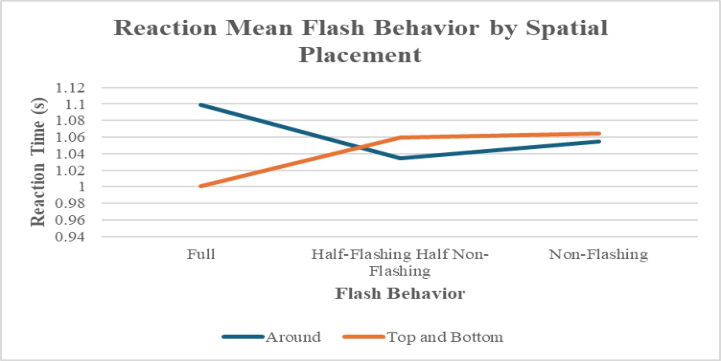
The Flashing Behavior by Spatial Configuration interaction is illustrated in Figure 5 below. There was a larger simple effect of Spatial Configuration within the Full Flashing Condition relative to the other two flashing conditions.
Figure 5: Reaction time by flashing behavior and spatial configuration.
CONCLUSION
Overall, placing lights around the perimeter of the drone led to greater detections for both types of movement compared to placing the lights on the Top and Bottom of the sUAS. Reaction times were also lower for the perimeter configuration when the lights were half-flashing or non-flashing. Therefore, the combination of these results indicates that lights should be placed around the perimeter of the sUAS and that the flashing behavior
Improving Airspace Awareness: Possible Conspicuity Solutions for Safe sUAS Operations 71
should be either half-flashing or no flashing. This combination should lead to the best detection counts and fastest reaction times.
Considering both detections and RTs, results indicated interactions of Movement Type with Flashing Behavior and Spatial Configuration. Full flashing led to the smallest RTs for approach movements, and non-flashing led to the smallest RTs for orbital movements. Therefore, one might change flashing behavior depending on the type of movement in order to minimize detection times. However, sUAS movement is relative to the observer. If the location of the observer relative to the sUAS is known, then the movement type can be determined, and flashing behavior could be altered. However, if the location of the observer is unknown or if there are multiple potential observers at different locations, flashing behavior cannot be altered in this way. We expect this to be the case for the large majority of real- world scenarios. Therefore, our recommendation to place half-flashing or non-flashing lights around the perimeter of the sUAS stands.
Previous research in sUAS and general aviation largely relied on field studies and small sample sizes. This experiment has showcased the potential of VR in mitigating the lack of statistical power in small-sample field studies. VR experiments can accommodate a larger number of participants and allow for realistic testing in a controlled environment.
Future studies should explore using these systems (to include advanced headsets, such as night vision goggles) in various environments and weather conditions, such as foggy and cold, to assess their effectiveness more comprehensively. While this experiment was conducted under sunset conditions, resulting in reduced light levels in the background for both systems, testing in varied conditions can further identify whether these light systems can truly enhance the operators’ performance during other lighting conditions.
Effectiveness of Virtual Reality in Nursing Education: Meta-Analysis. Journal of Medical Internet Research, 22(9), e18290. https://doi.org/10.2196/18290 FAA. (2020). Small Unmanned Aircraft Systems (UAS) Regulations (Part 107). https://www.faa.gov/newsroom/small-unmanned-aircraft-systems-uas-reg ulations-part- 107 FAA. (2022). UAS Information Papers. https://www.faa.gov/uas/research_developme nt/information_papers FAA. (2023a). Certificated Remote Pilots including Commercial Operators. https:
//www.faa.gov/uas/commercial_operators FAA. Human Factors Division | Role of Human Factors in the FAA. (2023b). https: //www.hf.faa.gov/role.aspx Giles. (2022). Complete Guide To Drone Lights. https://www.foxfury.com/complete
-guide-to- drone-lights/ FAA (Ed.). (1981). Aircaaft Position Lighting and Anticollision Light Installations.
Federal Aviation Association, AC20-308. Gross. (2023). Best Guide To Drone Anti-Collision Lights. https://www.propelrc.c om/drone-anti- collision-lights/
72 Martinez and MacDonald
Jacob, J., Mitchell, T., Loffi, J., Vance, M., & Wallace, R. (2018). Airborne visual detection of small unmanned aircraft systems with and without ADS-B. 2018 IEEE/ION Position, Location and Navigation Symposium (PLANS), 749–756. https://doi.org/10.1109/PLANS.2018.8373450 Jaussi, J., & Hoffmann, H. (2018). Manned Versus Unmanned Aircraft Accidents,
Including Causation and Rates. International Journal of Aviation, Aeronautics, and Aerospace. https://doi.org/10.15394/ijaaa.2018.1262 Lydon. (2022). Advanced Air Mobility Makes Travel More Accessible. Loffi, J. M., Wallace, R. J., Jacob, J. D., & Dunlap, J. C. (2016). Seeing the threat: Pilot visual detection of small unmanned aircraft systems in visual meteorological conditions. International Journal of Aviation, Aeronautics, and Aerospace, 3(3). https://doi.org/10.58940/2374-6793.1142 Maaz. (2022). Aircraft Lighting: The Rules And Roles. https://simpleflying.com/air
craft-lights-rules-and- roles/#: ∼: text=A%20summary%20of%20the%20rules, the%20aircraft%20(during%20nig ht%20operations) Neville, K., & Williams, K. (2016). Integrating remotely piloted aircraft systems into the national Airspace System. In Remotely Piloted Aircraft Systems: A Human Systems Integration Perspective. https://doi.org/doi/10.1002/9781118965900.ch9 Rupprecht. (2022). Ultimate Guide to Drone Anti-Collision Lights. https://jrupprechtlaw.com/drone-anti-collision-lights/ Wallace, R. J., Loffi, J. M., Vance, S. M., Jacob, J., Dunlap, J. C., & Mitchell, T.
A. (2018). Pilot Visual Detection of Small Unmanned Aircraft Systems (sUAS) Equipped with Strobe Lighting. Journal of Aviation Technology and Engineering, 7(2). https://doi.org/10.7771/2159-6670.1177 Williams, Theodore, Choi, & Klevgard. (2022). An Investigation of Lighting Schemes to Improve sUAS Conspicuity. https://doi.org/DOT/FAA/AM
LISTED IN THE AHFE DIGITAL BOOKSTORE CATALOGUE
Explore the complete digital volume
Human Factors in Robots, Drones and Unmanned Systems
Read this individual research paper free through the original publisher, or explore the full digital proceedings book.
ISBN 978-1-964867-55-7
Explore this ISBN in the AHFE Bookstore ↗Listed in the July 2026 bookstore catalogue; search by ISBN to confirm current availability · Digital book purchase optional