Manuel Gertrudix Barrio, Alejandro Carbonell-alcocer, Juan Romero-luis, Alberto Sanchez-acedo, Begoña Rivas-rebaque (2024). Applying UX principles to innovate citizen Science platform development: an integrative approach. In: Human Factors in Design, Engineering, and Computing. AHFE Open Access, vol. 159, pp. 859–868. https://doi.org/10.54941/ahfe1005652
The development of digital platforms is critical for the success of Citizen Science initiatives, as it facilitates the effective engagement of diverse participant profiles. To ensure these platforms are effective, efficient, and satisfactory for users, a strategic development approach is necessary. This research proposes a design and development model for a Citizen Science platform at the European level, grounded in User Experience (UX) principles. The methodology involved benchmarking existing platforms, developing user stories to identify necessary functionalities, and assessing user engagement and satisfaction through focus groups, UX research using Hotjar, and web analytics via Matomo. The findings reveal a set of principles—such as the STP model, user-centered design, content marketing, and digital analytics—that are instrumental in optimizing the development of Citizen Science platforms.
In a complex society where technology and scientific knowledge are becoming increasingly sophisticated, it is important to build a bridge between scientific research, technological innovation and everyday life and public concerns. This bridge is the basis for responsible research and innovation (European Commission, 2014). Over the last decade, the European Union has launched several initiatives to involve society in the scientific process. Programs such as Science with and for Society (SwafS) or the new H2020 framework program aim to involve all members of society in science, make science more attractive to young people and create innovative spaces for development in line with the principles of equity, ethics and engagement (European Commission, 2018).
The connection between society and science is based on dialog (National Coordination Center for Public Engagement, 2016) and requires
communication strategies on several levels (Gertrudix et al., 2021). One of these is based on the formation of communities of interest, which play a central role in connecting interested citizens with the scientific community (Aristeidou et al., 2017). The development of digital platforms is a crucial factor for the success of citizen science initiatives, as they enable engagement from diverse participant profiles: the “diligent”, “sporadic”, “persistent”, “persevering” and “moderate” identified by Ponciano and Brasileiro (2014). These platforms not only facilitate interaction, but also enable citizens to contribute meaningfully to scientific research and ensure that innovation and development go hand in hand with the needs and values of society. To achieve this, the development of these platforms must be closely aligned with user needs in terms of effectiveness, efficiency and satisfaction (Yakunin & Bodrunova, 2022; Kübler et al., 2014). This requires a design approach that focuses on the user experience and ensures that the dimensions of the platform are carefully considered to maximize the usability of the application.
This research presents the results of the design and development process of the Citizen Science community platform CS Track, which was developed according to UX principles (Yablonski, 2020). This platform, which is the result of a research project funded by the European Union, aims to create a better understanding of the functioning and impact of Citizen Science activities. To this end, the CS Track platform aims to disseminate best practices and present knowledge-based policy recommendations to increase the benefits of citizen science for individual citizens, organizations and society as a whole (CS Track, 2023). The role of the platform is therefore crucial in disseminating the recommendations to various stakeholders so that they can be implemented in new projects funded under Horizon Europe to support the European Union’s objectives of “increasing the excellence and impact of research and deepening the links between science and society” (European Commission, 2022).
METHODS
The text describes the UX-driven design and development of a community platform to facilitate two-way communication for community members to exchange queries on Citizen Science topics. This web space serves as a central hub through which users can access all public information and scientific results related to the project. It will also disseminate findings on participation patterns, incentives, barriers, facilitators and the scientific, social, economic and democratic benefits of Citizen Science.
The initial technical requirements and implementation plan for the community platform were developed in the following steps: 1) Requirements analysis: This phase included strategic and functional benchmarking with other Citizen Science platforms, consultations with consortium partners to prioritize goals, and a user analysis based on user stories (Lucassen et al., 2015). 2) Breakdown of functional and non-functional requirements: Detail the functional requirements of the eMagazine, dashboard and newsletter, as well as the non-functional requirements describing the structural and
Applying UX Principles to Innovate Citizen Science Platform Development 861
technical features required. 3) Development of security and data protection guidelines: Created in accordance with EU standards and guidelines.
The development process was iterative and allowed for refinement of the various requirements through UX analysis techniques:
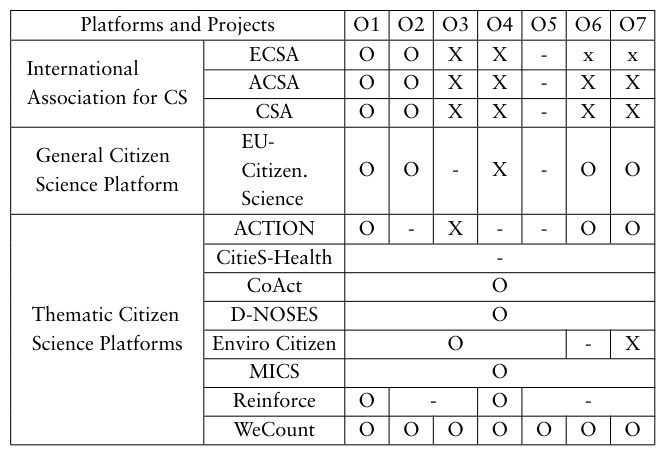
1) Benchmarking of Citizen Science platforms: A functional benchmarking analysis identified both opportunities and shortcomings that the platform needed to address. A detailed comparative study was conducted with other European Commission-funded projects offering Citizen Science platforms to identify potential overlaps. This ensured that the CS Track Community Platform would fill existing information gaps not covered by other resources. Data was collected from project descriptions on the CORDIS website and by direct examination of the features offered on the respective websites. A comprehensive table compared the objectives of the CS Track platform with those of the platforms analyzed, finding minimal overlap and confirming the platform’s unique position.
Table 1. Functional benchmarking. Legend: O: Complete; X: Partial; -: Does not meet.
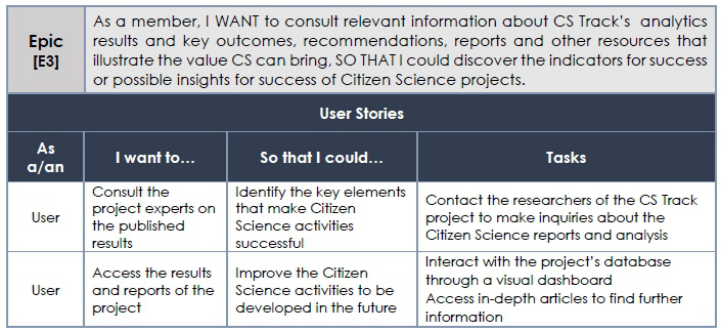
2) User analysis: To find out what types of users are interested in the community platform; the functionalities were evaluated through the development of user stories — an agile approach to software development (Gupta et al., 2022). User stories provide a general and informal explanation of the software features from the end user’s perspective. Based on the outlined goals and target groups, typical users and the essential functions to fulfill their needs were defined. User paths were also analyzed to understand how each user would interact with the platform, which enriched the requirements analysis (Raharjana et al., 2021). For each user “persona”, the following scheme was applied: a) User description and motivation: description of the user persona and their primary needs (e.g. information retrieval); b) Epic
definition: Description of the main tasks that the user performs to fulfill their needs, which can be broken down into smaller tasks or user stories; c) Detailed user stories: These describe the functional requirements that the CS Track platform must fulfill. One example is “Pedro, a 43-year-old policy maker from Spain, whose needs relate to finding relevant information about analysis results, recommendations, reports and support mechanisms in Citizen Science”. His user stories help to define the functional requirements of the platform to fulfill these needs.
Figure 1: Example of user story (Policymaker).
RESULTS
Requirements and Objectives The Citizen Science Community Platform (CC) was developed over a 24-month period with the aim of creating an accessible communication channel for a wide range of stakeholders in the field. These stakeholders included policy makers, academics, citizen scientists, representatives of civil society organizations, businesses and educators. The main aim of the platform was to provide these users, who have varying levels of experience with Citizen Science, with access to a variety of resources such as reports, summaries, interviews and a newsletter that keeps them up to date with the latest developments in the field.
The functional objectives of the platform included providing direct knowledge of ongoing project results, responding to demand for relevant and timely information, and offering critical insights into analyzes, key findings and recommendations. Furthermore, the platform should stimulate awareness, exchange and interaction between different Citizen Science initiatives, as well as promote synergies and the generation of new ideas. It also aimed to sensitize public institutions and businesses to the potential of Citizen Science, with a focus on innovation, employability and support for science within the community.
Applying UX Principles to Innovate Citizen Science Platform Development 863
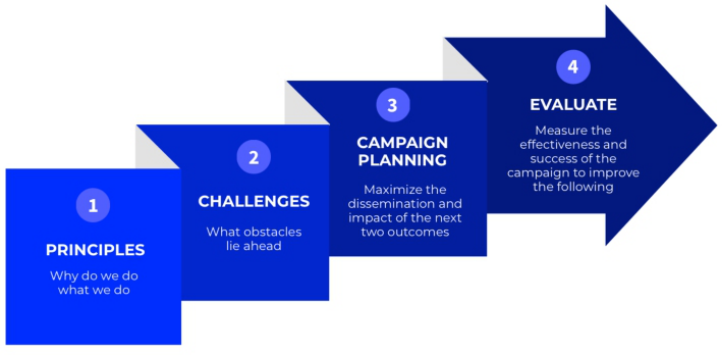
Figure 2: Iterative process of analysis and evaluation of the results of the community platform.
Potential Users Several key stakeholders were identified as potential users of the platform who could benefit from the information available. These include policy makers at regional, national and international levels, academics specializing in Citizen Science research, citizen scientists involved in the management or planning of projects, representatives of civil society and non-governmental organizations, representatives of companies that fund or support Citizen Science activities, and educators interested in integrating Citizen Science into the classroom.
Information Hub One of the most important components of the platform was the Information Hub in the form of an eMagazine, which became the main communication and distribution channel for the project. This hub contained articles written by project experts with advanced visualizations that conveyed key findings from analyzes and empirical studies conducted as part of the CS Track project. Since its launch, adjustments have been made on an ongoing basis to improve the presentation of content and better tailor it to the needs of the audience.
The Hub’s content was categorized by format: graphic articles, reports, briefing reports and interviews. The graphical articles presented the information in a concise and visual way, showing the data stored in the project database so that users could quickly grasp the key aspects. Reports provided detailed analysis and allowed users to interact through comments. Briefing reports summarized selected public results of the project and adapted them to the article format. Interviews with Citizen Science experts enriched the hub’s content by presenting various perspectives on relevant topics.
In addition to the format-based categories, articles were also categorized by topic so that authors could assign one or more topics to the content, making
it easier for readers to find the most relevant information. Internal articles created by the CS Track team were distinguished from external contributions provided by external experts, thus enriching the content of the Information Hub.
Technological Requirements The platform was built on a WordPress content management system (CMS), using tools like Metabase for data visualization and GTranslate to facilitate accessibility in multiple languages. A metadata management system was implemented to ensure content was easily searchable, and improvements were made in search engine optimization (SEO). Additionally, the WordPress REST API was enabled, facilitating content reuse on other platforms and external services.
Impact Measurement To ensure the platform’s impact, various evaluation activities were carried out using qualitative techniques. A Focus Group study with over 30 participants provided feedback on their experience with the website. The purpose of these focus groups was to assess the extent to which both the content and the format of the communication efforts in CS Track meet the needs and expecta- tions of our target stakeholders’ groups (Reynolds, 2022) As a result of these discussions, opportunities to improve website usability were identified and acted upon.
User Experience Research For 12 months, the Hotjar tool was used to analyze user behavior on the platform, revealing several key insights. Navigation patterns showed a concentration of users on certain pages while other areas were overlooked, suggesting a need to improve the information architecture. Click and scroll maps indicated that some buttons and links did not receive the expected attention, implying visibility or design issues. Session recordings showed frustration among some users, leading to the simplification of processes like newsletter signup to improve conversion rates. Heatmaps revealed a disconnect between user interest areas and key information areas targeted to each profile. As a result, it was recommended to redesign the navigation and optimize key interface elements.
External Advisory Board Additionally, the CS Track External Advisory Board (EAB), composed of experts from various institutions and disciplines, played a crucial role in the platform’s development. Their primary task was to advise on key aspects of the project, including research activities, tools, and resources developed to provide insights into Citizen Science. The Board met annually and provided valuable recommendations that helped improve the usability and impact of the Community Platform.
Applying UX Principles to Innovate Citizen Science Platform Development 865
CONCLUSION
The results obtained show how important it is to continuously analyze the user experience to ensure that the Citizen Science platform actually achieves its goals. This ongoing evaluation process has allowed us to identify areas for improvement and adapt our communication strategies to better align with users’ needs and expectations. We have learned that scientific communication is not only a fundamental component for fostering collaboration and coordination between the different stakeholders, but also requires a constant focus on optimizing both external and internal communication. The principles that will guide our future work are based on these insights. These include the insights we have gained about the community, the topic, the existing channels and the segmentation by specific profiles, enriched by the contributions of the External Advisory Board (EAB) and our observations through participation in various exchange spaces on the platform. The results offer us the following conclusions:
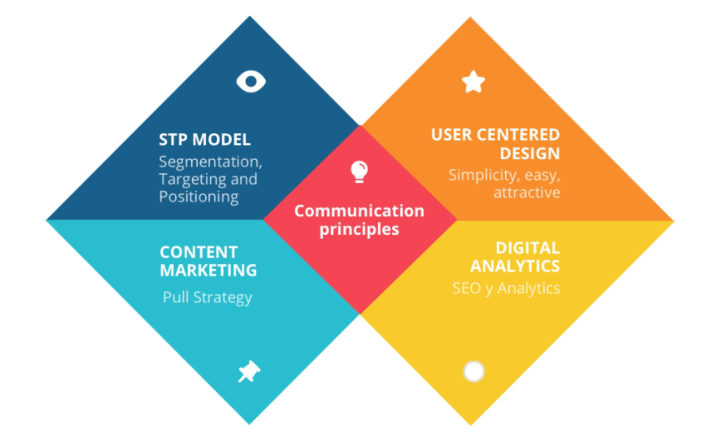
1) The target marketing strategy of the Segmentation, Targeting & Positioning (STP) model is proving useful for audience analysis, as it allows us to provide better information and content for each target. Using this information has helped to grow the CS Track community and segment the available information by different targets according to the STP model, for example by segmenting and classifying our content in the Information Hub.
Figure 3: STP model. Prepared by the authors based on Camilleri (2018).
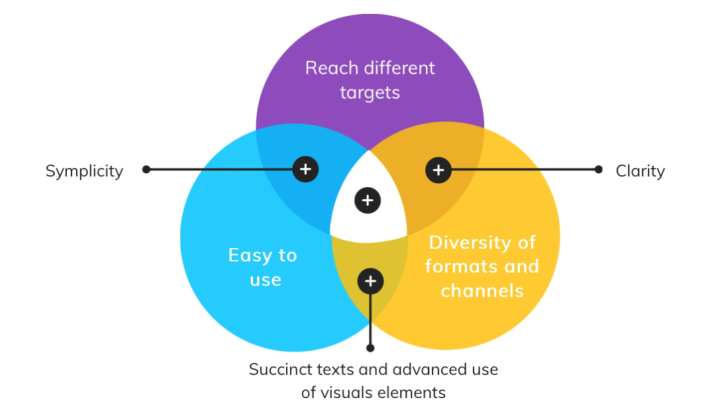
2) User-centric design is fundamental to creating formats and content that meet the needs and expectations of users and make it easier for a non-specialized audience to engage with the project.
Figure 4: User-centered design criteria.
Simplicity and clarity in copy and the advanced use of visual elements are crucial to ensure audiences are reached across multiple channels (Golumbic et al., 2019). The use of short texts and attractive visual elements such as infographics, videos and diagrams has proven to be effective in this regard (Bongers & Macartney, 2020).
3) The content development and content marketing strategy based on branded content was key to delivering relevant content that added value to the project’s objectives. This approach helped to maintain relevance and audience interest in the platform.
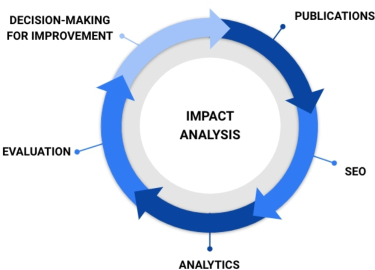
4) Digital analytics are indispensable tools for making informed decisions about improving the performance of communication activities. The creation of analytical dashboards enabled continuous evaluation of the performance and impact of these measures and helped us to adapt and optimize our strategies.
Figure 5: Iterative analysis procedure.
Applying UX Principles to Innovate Citizen Science Platform Development 867
5) We face significant challenges due to the multidisciplinary nature of the field, which includes multiple research communities such as social sciences, computer science, political science, pedagogy, among others. Additionally, the diversity of profiles, ranging from policymakers to academics, citizen scientists, organizational representatives, business representatives, and educators in various countries and languages, adds complexity to our segmentation and communication tasks.
6) The immaturity of the Citizen Science field presents another challenge. The concept is relatively new and not universally understood in the same way. The pathways for communicating and sharing knowledge are dispersed, making it difficult to measure impact in the short and medium term. This aspect requires a careful and ongoing approach to establish an effective evidence base for Citizen Science.
7) The challenges arising from daily reality, such as the difficulty in capturing attention due to the information overload experienced by many users. Furthermore, different profiles have varying expectations, practices, needs, and requirements, which demands a highly personalized approach to our communications.
To address these challenges in future Citizen Science projects (EU-Citizen. Science, 2024), it is essential to continue analyzing and evaluating the effectiveness of campaigns both quantitatively and qualitatively, which will allow us to improve future initiatives. Implementing more robust performance monitoring analytics systems, with a greater number of indicators, will facilitate direct and immediate tracking of digital analytics indicators and KPIs on the web. Qualitative analysis, in turn, will help us understand the results to assess the short and medium-term impact and estimate it in the long term, thus ensuring the effectiveness of communication actions and the achievement of project objectives.
ACKNOWLEDGMENT
The authors would like to acknowledge the financial support from the Community of Madrid [040scgh75] (Action 3. Excellence Program for Manuel Gertrudix Barrio, F969), the European Union’s Horizon 2020 [019w4f821] (CS-Track, No 872522); the Ministerio de Ciencia e Innovación [05r0vyz12] (eCOMCIENCIA project. PID2021-127019OB- I00); the Predoctoral Research Grant of the URJC own program [01v5cv687] (PREDOC 20-008); and the Call for the recruitment of Research Assistants of the Community of Madrid 2021 (PEJ-2021-AI/SOC-22035)
REFERENCES
Aristeidou, M., Scanlon, E. and Sharples, M. (2017) “Profiles of engagement in online communities of citizen science participation”, in: Computers in Human Behavior, 74, pp. 246–256. doi: https://10.1016/j.chb.2017.04.044. Bongers, K. and Macartney, H. (2020) “Infographics”, in Scientific Communication:
A Practical Guide to the Science of Writing and Communicating. eCampusOntario: https://ecampusontario.pressbooks.pub/scientificcommun ication/chapter/infographics/
Camilleri, M.A.(2018) “Market Segmentation, Targeting and Positioning”, in Travel Marketing, Tourism Economics and the Airline Product. Tourism, Hospitality & Event Management. Springer, Cham. doi: https://doi.org/10.1007/978-3-319- 49849-2_4. CS Track Project (2023) CS Track: Investigating Citizen Science: https://cstrack.eu EU-CITIZEN. SCIENCE (2024) EU-Citizen. Science: https://eu-citizen.science/ European Commission (2014) Public engagement in responsible research and
innovation. Portal H2020: https://ec.europa.eu/programmes/horizon2020/en/h 2020-section/public-engagement-responsible-research-and-innovation European Commission (2018) Science with and for Society. Horizon H2020: https: //ec.europa.eu/programmes/horizon2020/en/h2020-section/science-and-society European Commission (2022) “Citizen science: Inspiring examples of societal engagement for Horizon Europe”, CORDIS. EU Research Results: https://cordis.europa.eu/article/id/435872-citizen-science-inspiring-examples-of- societal-engagement-for-horizon-europe Gertrudix, M., Rajas, M., Romero-Luis, J. and Carbonell-Alcocer, A. (2021)
“Comunicación científica en el espacio digital: Acciones de difusión de proyectos de investigación del programa H2020”, Profesional de la Información, 30(1). doi: https://10.3145/epi.2021.ene.04. Golumbic, Y. N., Fishbain, B. and Baram-Tsabari, A. (2019) “User centered design of a citizen science air-quality monitoring project”, International Journal of Science Education, Part B, 9(3), pp. 195–213. doi: 10.1080/21548455.2019.1597314. Gupta, A., Poels, G. and Bera, P. (2022) “Using conceptual models in agile software
development: a possible solution to requirements engineering challenges in agile projects”, IEEE Access, 10, pp. 119745-119766. Kübler, A., Holz, E. M., Riccio, A., Zickler, C., Kaufmann, T., Kleih, S. C., et al., (2014) “The User-Centered Design as Novel Perspective for Evaluating the Usability of BCI-Controlled Applications”, PLoS ONE, 9(12): e112392. doi: https://doi.org/10.1371/journal.pone.0112392. Lucassen, G., Dalpiaz, F., Van Der Werf, J. M. and Brinkkemper, S. (2015) “Forging
high-quality user stories: towards a discipline for agile requirements”, in 2015 IEEE 23rd international requirements engineering conference (RE), pp. 126–135. IEEE. National Coordinating Centre for Public Engagement (2016) “What is public engagement?”. University of Bristol: https://www.publicengagement.ac.uk/about- engagement/what-public-engagement Ponciano, L. and Brasileiro, F. (2014) “Finding Volunteers’ Engagement Profiles in
Human Computation for Citizen Science Projects”, Human Computation, 1(2). doi: https://10.15346/hc.v1i2.12. Raharjana, I. K., Siahaan, D. and Fatichah, C. (2021) “User stories and natural language processing: A systematic literature review”, IEEE Access, 9, pp. 53811–53826. Reynolds, S., Vanbuel, M., Andries, P. and Dudenaite, D. (2022) “Community of Interest support plan D6.5”. Zenodo. doi: https://doi.org/10.5281/zenodo .5874193. Yablonski, J. (2020) Laws of UX. O’Reilly Media, Inc. Yakunin, A. V. and Bodrunova, S. S. (2022) “Cumulative Impact of Testing Factors
in Usability Tests for Human-Centered Web Design”, Future Internet, 14, p. 359. doi: https://doi.org/10.3390/fi14120359.
LISTED IN THE AHFE DIGITAL BOOKSTORE CATALOGUE
Explore the complete digital volume
Human Factors in Design, Engineering, and Computing
Read this individual research paper free through the original publisher, or explore the full digital proceedings book.
ISBN 978-1-964867-35-9
Explore this ISBN in the AHFE Bookstore ↗Listed in the July 2026 bookstore catalogue; search by ISBN to confirm current availability · Digital book purchase optional