Natalie Jankowski, Vivian Waldheim, Katharina Lorenz, Christina Mittag (2024). A user-centered design approach in the development of a modular AI-system for detection of cerebral palsy in infants. In: Human Factors in Design, Engineering, and Computing. AHFE Open Access, vol. 159, pp. 1390–1399. https://doi.org/10.54941/ahfe1005706
One in 500 newborns is born with cerebral palsy (CP), a malformation of the brain that results in restricted movement and muscle spasticity. The earlier CP is diagnosed and targeted therapy is initiated, the more potential there is to reduce the physical impairments of the affected children and the resulting consequential damage and costs. However, the diagnosis depends largely on the qualifications of the clinicians. In the CP-Diadem project, a modular sensor AI-system is being developed to objectively support paediatricians in the diagnosis. The aim is to develop a support system that automatically detects conspicuous movement patterns, which can then be examined more closely by experts. In this paper, we address the following research questions (1) How should an AI-diagnostic tool for clinicians to detect CP be developed that is accepted by all those involved (clinicians, parents and infants) in the treatment? (2) How can the diagnostic system be integrated into the clinical routine (treatment pathway)? Based on the human-centered approach according to DIN EN ISO 62366 the following formative studies were conducted iteratively. Initially, the prototype of the modular sensor system was tested in a field study with 50 infants, their parents and clinicians during regular treatment. It consists of a sensor mat with eight piezo sensors, on which the infant is placed, and seven inertial measurement units (IMUs), which are attached to the child's limbs. Two cameras record the infant's movements. Parents and clinicians evaluated the system in terms of their user experience and assessed the challenges of integrating it into standard pediatric care for the early detection of neurological movement impairments. Based on the results, a click prototype was developed. The AI-system was evaluated with clinicians as part of a workshop. The aim was to achieve a high level of usability and user experience and to identify challenges in the use of AI in the diagnosis of CP in infants. All UCD methods used in the project involve clinicians, parents and children with their requirements, needs and ideas for active co-decision and participation.
In the first year of life, the fundamentals are laid for a person’s future development. A key aspect is the infant’s motoric behaviour, playing a decisive role in determining participation in later life. Therefore, one of the central concerns of developmental research is to initiate targeted therapy with an early diagnosis of neurological, neurodegenerative and muscular diseases to avoid or reduce consequential impairments and high rehabilitation costs later on. Currently a diagnosis for CP is often only done at an age between 12 and 24 months although there exist assessment methods for a detection before 6 months (Novak et al., 2017). A very promising approach is the Prechtl’s General Movement Assessment (sensitivity ≥92%; specificity ≥82%) (Burger & Louw, 2009). It is based on a visual exploration of the spontaneous movements of the infant, while it lays in supine position without any stimuli. A significant predictor of CP is the absence of so called Fidgety Movements (FMs), defined as “small movements of moderate speed with variable acceleration of the neck, trunk, and limbs in all directions”
A User-Centered Design Approach in the Development of a Modular AI-System 1391
(Einspieler & Prechtl, 2008). They usually occur between 9 and 20 weeks corrected age. Einspieler et al. (2019) developed and revised the Motor Optimality Score (MOS-R), which combines the observations. It is a validated tool, but a right application is only ensured with a large amount of training and should be done by certified experts. Because of this burden, a detection of impairments is often delayed, resulting in a late treatment start, although an early begin of therapy is associated with a better outcome (Novak et al., 2017). To support clinicians in early diagnosis, current research regard methods for an automated, machine learning based detection of CP.
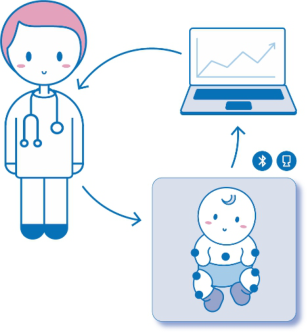
In this project a multi-sensor system (Waldheim et al., 2024) as decision support for clinicians is developed. It consists of a sensor mat with 8 piezo sensors, on which the infant is placed, and 7 inertial measurement units (IMUs), which are attached to the child’s limbs. Two cameras record the infant’s movements (see Figure 1). The aim of the support system is to automatically detect conspicuous movement patterns, which can then be examined more closely by experts. This system should be integrated into standard pediatric treatment for the early detection of neurological movement impairments.
In this paper, we address the following research questions (1) How should an AI-support system to detect CP be developed that is accepted by all those involved (clinicians, parents and infants) in the treatment? (2) How can the support system be integrated into the clinical routine (treatment pathway)?
Figure 1: Multi-sensor system consisting of a sensor mat with 8 piezo sensors, 7 inertial measurement units (IMUs) and 2 cameras to support clinicians in making a diagnosis.
USER RESEARCH At the beginning, the main goal was to identify potential barriers and positive influences during the measurement with the system. Based on a deep understanding of user’s needs, main operating procedures and appropriate requirements of the system were then specified, applied and evaluated. The various iteration loops of the development are presented below.
Workshop With Experts and Parents In the first step we collected requirements from the perspective of experts and parents for the development of a suitable measurement setup and procedure using IMUs for infants. Therefore, we conducted 3 expert workshops with in total 11 participants including clinical experts (e.g. Physiotherapists, Pediatricians, Physiologists, Developmental Psychologist, Computational Scientist) as well es two workshops with 3 parents (2 mothers, 1 father).
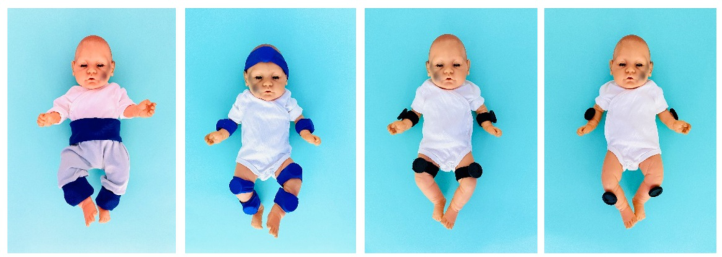
Together with the experts and parents, appropriate concepts for attaching a body-worn measurement system in form of simple mock-ups (Figure 2) were tried out and discussed (e.g., regarding suitable materials, ease of attachment, stability, acceptance by infants and parents, recognition of typical movement patterns) as well as experiences regarding optimal conditions during measurement (e.g., favourable prerequisites, environmental parameters, measurement duration, etc.).
In addition, characteristic indicators of CP that could be detected by the sensors were discussed with the clinical experts.
Figure 2: Different sensor attachment systems in form of simple mock-ups (e.g., sensor trousers, stretch bands, stretch Velcro straps, adhesive pads etc.).
Regarding the sensor attachment system, the following aspects can be summarised: The adhesive method is the preferred option by all experts and 2 parents, as it is quick to apply and there are no additional components that could disturb the infant (application effort, weight, pressure on the skin). Just one parent rejected this option due to their experience with plasters. If parents refuse to use adhesive, or if the sensors do not adhere sufficiently to the skin in individual cases (due to insufficient adhesive surface or skin type) or if skin irritation is expected, flexible bands could be used as an alternative. In case of the bands, the blood supply must not be affected. It may be advisable to make the straps wider to increase the contact surface or to use a different material that is as light and thin as possible. The choice of colour should be as inconspicuous as possible to avoid attracting the child’s attention. The bands should also be made of skin-friendly material. A self-adhesive bandage was suggested.
Attachment options for dressing were generally excluded by the experts, as they cause stress for both parents and infants. In contrast to that, all
A User-Centered Design Approach in the Development of a Modular AI-System 1393
parents favoured applying the sensors using clothing, as this is a procedure that both parents and infants are used to. Based on the experts’ concerns and considering hygiene aspects as well as avoiding time-consuming changing, we ruled this option out as a solution.
Regarding sensor placement several aspects play an important role. The sensors must not influence the infant’s movements (through weight, sensitivity, blocking, etc.). They must not become detached because of the movements, and they should be positioned in places where the extent of movement is particularly characteristic. Some experts were concerned that the sensors could influence movement due to their weight, their appearance in the infant’s field of vision and the feeling on the skin. According to Dibiasi et al. (2004), weights of 14g at the distal joints have no influence on fidgety movements. Nevertheless, we will analyse this aspect as part of our further data collection.
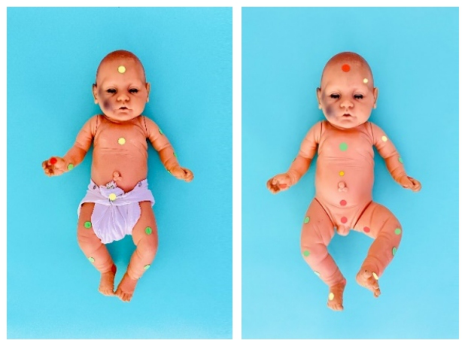
Apart from that all experts and all parents emphasise that sensors must never be allowed to come within reach of the mouth or eyes and that it must be ruled out that a limb will hit a sensor during movement (e.g. head against shoulder sensor). Parents wished also that sensitive areas on the head and stomach should be avoided. According to the experts, the relative movement between proximal and distal segments is generally important, as is the relationship between left and right. However, it was also noted that the aim should be to use as few sensors as possible to achieve better acceptance: as much as necessary, as little as possible. An overview of the various conceivable positions for sensor placement is shown in Figure 3.
Figure 3: Sensor positions marked by experts (left) and parents (right) for attaching the IMUs (green – recommendation, yellow – acceptable, red – avoid).
In the second part of the workshop, the optimum measurement procedure was discussed using a timeline consisting of three phases: Preparation, measurement and follow-up. The general conditions and environmental parameters were discussed, and the optimum preconditions defined.
The whole procedure should not exceed 20–30 minutes and the measurement itself should not exceed 5 minutes. The infant’s well-being should be the top priority. The parents should be well informed in advance, ideally in a separate appointment. The room for the measurement should be pleasant, quiet and warm (use a heat lamp if necessary), and the infant should be relaxed, full and well-rested (arousal state 4 or 5).
The measurement system should be prepared before the family arrives so that only the infant needs to be prepared (undressing, placing in the measurement setting, attaching the sensors). During the measurement the infant should not be distracted by noises or people in the field of vision. Parents can interrupt the measurement at any time if they deem it necessary.
The knowledge and experience of the experts as well as the perspective of the parents served as a starting point to develop a measurement setup and procedure that is as non-intrusive as possible for this highly sensitive target group, ensuring that infants and their parents are not burdened by the data collection process with the system being developed.
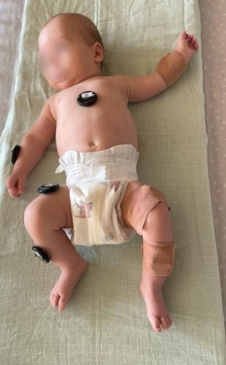
Preliminary Investigation With Users The aim of the preliminary investigation was to obtain information on the feasibility of measurements with IMUs on healthy infants and with piezo sensors integrated in a measuring mat to develop a user-friendly setup for the motion capture study (described in the next section) that is accepted by infants and their parents. As part of the preliminary study, various sensor positioning options were evaluated and the data collection process was analysed regarding possible problems and potential. The following aspects were addressed: (1) Identification of a suitable attachment method and position for the IMUs that does not restrict the natural movement of the infant, does not slip significantly and is accepted by parents. (2) Identification of problems and potentials in the data collection process. (3) Analysing the collected data regarding signal quality (measurement noise and error influences) and positions of the IMUs to provide meaningful and reliable data, as well as number and arrangement of piezo sensors in the measuring mat. To carry out the measurement the infants shold move freely on for a maximum of 3 minutes wthis IMUs and sensor mat. Two types of attachment were compared for the IMUs: self-adhesive bandages (Cohesive Compression and Support Bandages) and hydrogel adhesive strips (Argyle Hydrogel Adhesive Baby Tape Strips). These were applied to the limbs and sternum as shown in Figure 4. Participant observation was conducted during data collection. The measurement was also documented by video recording so that it could also be analysed retrospectively. Following the measurement, the parents were asked in a short interview about their impressions of the measurement procedure and sensor attachment options. Five healthy infants and their parents (4 mothers, 2 fathers) took part in the preliminary investigation. In addition, the measurement procedure and sensor attachment were also evaluated by 9 experts (average practical experience 15 years) through an online survey based on the anonymised video data.
A User-Centered Design Approach in the Development of a Modular AI-System 1395
Figure 4: Measurement setup - infant with IMUs attachment with hydrogel adhesive strips (right) and self-adhesive bandages (left) on the sensor mat).
The preliminary investigation showed that both sensor attachment options do not restrict the infant’s movement, and the sensors do not slip or come loose during the measurement. It takes less than 5 minutes to attach the sensors with both options. However, attaching the sensors with self-adhesive bandages requires a little more effort, as movements or body positions of the infant can make attachment more difficult. The adhesive method is quick and easy and offers good adhesion to the skin. Both methods were generally accepted by the parents. Two pairs of parents had concerns regarding the removal of the tape and preferred the self-adhesive dressing. According to the results we suggested that it would be best to offer both options.
The tested sensor positions provide meaningful and reliable data. Although the sensor on the sternum shows very small deflections, it is useful for recognising whether the infant is restless and turning on the mat. The relative positions between the arms and legs in relation to the upper body can be determined. It is problematic if the infant grabs or accidentally touches a glued sensor. This can influence the measured values. These sequences must be filtered out or excluded from the evaluation.
Based on the results of the preliminary study and the feedback from the experts and parents, we decided to use the skin-friendly adhesive strips for sensor attachment for further studies. In addition, the self-adhesive bandage will be offered as an alternative if parents refuse to attach the sensors by adhesive.
Motion Capture Study for the Development of an AI System The aim of this study is to record the movement of infants for the development of a modular AI sensor system to support pediatricians in the early detection of neurological movement impairments. Parents and clinicians evaluated the system in terms of their user experience and assessed the challenges of integrating it into standard pediatric care for the early detection
of neurological movement impairments. The data collected is used to develop algorithms for the detection of healthy and pathological movement patterns in infants. In this paper we focus on the evaluation of user acceptance and aims to answer the following questions: Is the procedure accepted from the perspective of parents and clinicians? Where is there potential for improvement in the procedure for implementing the system in standard treatment?
The study involved 49 infants and their parents as well as 11 clinicians. The infants were M = 15 weeks (D = 3 weeks) old and 22 of them were female. The following diagnoses were made CP (N = 2), suspected CP (N = 1), plexus palsy (N = 2), “favorite side”/ torticollis (N = 7), hydrocephalus (N = 2), SMA (N = 1), stroke (N = 2). Most infants were dependent on medical devices after birth (N = 17).
The data collection includes observation of the infant during the 5-minute measurement with the system. In addition, interviews are conducted with the parents and clinicians and a UX questionnaire (adapted AttrakDiff) is completed by both users. AttrakDiff is used to evaluate the user-friendliness and appearance of the system.
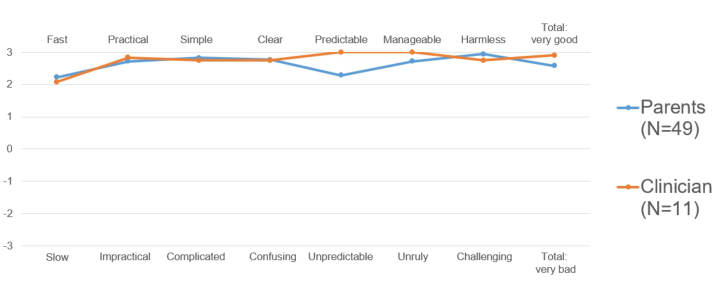
The results show a high level of acceptance among both user groups. Figure 5 shows the positive evaluation of the various items in the AttrakDiff.
Figure 5: AttrakDiff-Ratings of clinicans and parents.
The clinicians were asked what feedback they would like on the movement in the system. Above all, they mentioned support and confirmation of their own observations which child has conspicuous movements and is therefore a risk. With regard to movement patterns, the clinicians would like precise information on the quality and quantity of movement, lateral differences, symmetry of movements and regulation problems. Another focus of the data collection was on the requirements for integration into standard treatment (U4 screening). Both user groups were asked whether the measurement could be integrated into the standard treatment and what could make integration more difficult.
Most users rate the measurement as easy to integrate into standard treatment. The following aspects were mentioned as barriers: the preparation
A User-Centered Design Approach in the Development of a Modular AI-System 1397
time is seen as a possible limitation. From the clinicians’ point of view, more staff is required. From the parents’ point of view, the infant’s endurance during the examination is noted. In addition, both user groups believe that the technical setup in the examination room should be firmly integrated and easy to use in order to increase acceptance on the part of clinicians. This is particularly important because space in surgeries is limited. Finally, an affordable price was also mentioned as a requirement.
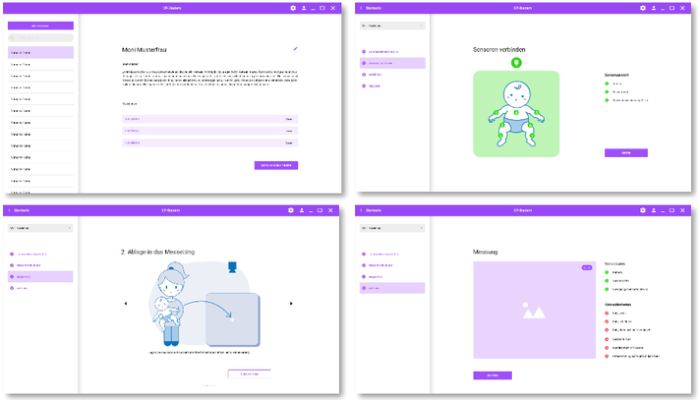
Defining the Interaction Concept Based on the findings of the workshops and considering the technical requirements, the operating sequence was first developed in the form of a flowchart, which contains all relevant functions and information required to operate the system competently. On this basis, initial ideas for the interaction concept were first visualized in the form of simple sketches, which were then further defined as a wireframe-based interactive click prototype (created with Adobe XD), that will be iteratively defined and improved. With regard to the home screen, we followed a simple and minimalistic design strategy to provide direct access to the main functions: Conducting a measurement and showing measurement results (Figure 6).
Figure 6: Screenshots of the click prototype: (1) Patient list with access to the measurement results and the measuring function, (2) Connecting the sensors, (3) Guided instructions for carrying out the measurement, (4) Starting the measurement.
Evaluation of the AI-System The AI-System will be evaluated by formative usability tests planned for September 2024. In this paper we present the planned study design. The results will be presented as part of the presentation at the AHFE conference.
The aim of the study is to assess the ease of use and user experience of the measurement process and to derive optimizations for the system. Ten
clinicians with a specialization in CP (> 2 years) are to participate in the study. The clinicians should carry out the diagnostic process independently in the measurement setting (Figure 1) in order to define comprehensible system feedback as well as meaningful and understandable evaluation parameters.
The methodological approach comprises two parts: In the first part, task- guided usability tests are carried out in combination with the Wizard of Oz method to simulate the AI. The Wizard of Oz method is a moderated research method in which a user interacts with an interface that appears to be autonomous but is (fully or partially) controlled by a human.
The data collection is supplemented by observations, interviews and a UX questionnaire (adapted AttrakDiff). In the second part, users will create paper prototypes to present feedback and evaluation parameters. Based on the data collected, the interaction concept will be further developed, and the measurement process optimized so that it can be integrated effortlessly into standard care.
DISCUSSION
The motor characteristics of infants aged three to five months provide insight about the risk for neurological disorders, but an extensive investigation currently requires a huge amount of expertise and training and is therefore not yet applied as standard investigation. This can result in a delayed diagnosis of diseases like CP, and subsequently leads to a late initiation of important rehabilitation steps. An automated detection of specific movement patterns can support the clinicians in the decision, if and which therapy should be prescribed. For this, the findings of the system need to be comprehensible for the clinicians, as well as for the parents.
This paper shows an extensive exploration of the user groups and relevant contexts of use. It was important to let them actively participate in all phases of the design process. As we have shown, active participation of users allowed us to refine the ideas, to develop the interaction concept and will help us even to find innovative design solutions for system feedbacks. We always combined different approaches and methods (e.g., qualitative and quantitative data, objective and subjective measures and field observations). Furthermore, an extension of the field study would be interesting for the multicentre and long-term evaluation of usefulness, effectiveness and user experience of the AI-system with a large number of pediatricians in practices.
ACKNOWLEDGMENT
This research was supported by the German Federal Ministry of Education and Research (BMBF), FKZ: 13GW0555C and by the Stiftung Industrieforschung. It has been approved by a local ethics committee (Department of Psychology and Ergonomics at TU Berlin). We thank our colleagues and all approached experts within the CP-Diadem project who provided insight and expertise that greatly assisted the research. In particular we are greatful to Dagmar Siebold and Katharina Rischer for their support during the study, as well as to the families for participating.
A User-Centered Design Approach in the Development of a Modular AI-System 1399
REFERENCES
Burger, M. & Louw, Q. A. (2009) The predictive validity of general movements–a systematic review. European Journal of Paediatric Neurology : EJPN : Official Journal of the European Paediatric Neurology Society, 13(5), 408–420. Available from: https://doi.org/10.1016/j.ejpn.2008.09.004. Dibiasi, J. & Einspieler, C. (2004): Load perturbation does not influence spontaneous
movements in 3-month-old infants. In: Early Human Development 77 (1-2), S. 37–46. DOI: 10.1016/j.earlhumdev.2004.01.004. Einspieler, C. & Prechtl, H. F. R. (2008) Prechtl’s method on the qualitative assessment of general movements in preterm, term and young infants. Mac Keith Press: London. Einspieler, C., Bos, A. F., Krieber-Tomantschger, M., Alvarado, E., Barbosa, V. M. &
Bertoncelli, N. et al. (2019) Cerebral Palsy: Early Markers of Clinical Phenotype and Functional Outcome. Journal of Clinical Medicine, 8(10). Available from: https://doi.org/10.3390/jcm8101616. Novak, I., Morgan, C., Adde, L., Blackman, J., Boyd, R. N. & Brunstrom- Hernandez, J. et al. (2017) Early, Accurate Diagnosis and Early Intervention in Cerebral Palsy: Advances in Diagnosis and Treatment. JAMA Pediatrics, 171(9), 897–907. Available from: https://doi.org/10.1001/jamapediatrics.2017.1689. Waldheim, V., Lorenz, K., Mittag, C. & Jankowski, N. (2024). Feasibility of IMU-
based leg movement detection in infants. In Proceedings of the AUTOMED, Germany (in Print).
LISTED IN THE AHFE DIGITAL BOOKSTORE CATALOGUE
Explore the complete digital volume
Human Factors in Design, Engineering, and Computing
Read this individual research paper free through the original publisher, or explore the full digital proceedings book.
ISBN 978-1-964867-35-9
Explore this ISBN in the AHFE Bookstore ↗Listed in the July 2026 bookstore catalogue; search by ISBN to confirm current availability · Digital book purchase optional