Dubois Caroline, Foucault Béatrice (2024). Reflexivity, a Tool for Experiential Learning and Digital Practices Transformation: Two Examples of Didactic Devices. In: Human Systems Engineering and Design (IHSED2024): Future Trends and Applications. AHFE Open Access, vol. 158, pp. 93–99. https://doi.org/10.54941/ahfe1005532
In the context of digital usages, acting on practices, avoiding risky behaviors or moving towards more responsible mobile consumption are questions that have become central to our hyperconnected lives. Corporate Sustainability and Responsibility (CSR) strategies are underway, but companies are struggling to translate into action in some technocentric areas, such as in the Telco world. This paper proposes to examine the interest of the reflexive approach, as described by Vacher (2011), for the user-centered design of innovative and participatory services. Two educational devices were tested with French customers. Within Orange Innovation Research, these two devices have been designed to support customers in their digital uses. The first one focuses on cybersecurity risk management and the second one deals with the appropriation of responsible behavior regarding the purchase and usage of smartphone. We fall within the scope of persuasive technologies, as defined by Foulonneau (2017), within an influence that can be described as responsible and respectful of the recipient “without the use of coercion or deception”.The reflexive process, at the heart of our approach, encourages individuals to analyze and to question their actions and their consequences, thus facilitating the development and transformation of ethical and sustainable behaviors. Reflexivity can be described as experiential learning (Dewey, J. 1938 ), and mobilizes a metacognitive ability on how to learn. The first device deals with a priority topic for Orange: the digital protection of its customers. Through a chatbot, customers are encouraged to verbalize the risks they encounter, analyze their experience and take a step back to consider changing their behavior. The results of experiments with a group of young people show that reflective practice allows participants to become aware of their protective behaviors and to put in place effective and informed strategies aimed at countering daily risks. The second device is a service model designed to assist users in selecting a new smartphone via a questionnaire. The model provides information on the ecological and social impacts of smartphone manufacturing and suggests ways to reduce it. The qualitative test carried out in the laboratory shows that the use of the device allows the generation of "socio-eco-reflections" as well as a meta-reflection, both steps validating the start of a reflexive process. This questioning is accompanied by projections on practices built from the reflexive experience. We postulate that this reflexive approach, in an industrial environment, allows individuals to build and transform their own behaviors through a guided experiential journey. It also promotes the emergence of changes that are significant, adapted, and sustainable. This hypothesis highlights the importance of ethics and behaviors persistence within the framework of CSR, offering promising perspectives for the provision of enabling tools for our clients. Vacher, Y. (2011). La pratique réflexive. Un concept et des mises en œuvre à définir. In Recherche et formation, Vol 66, p. 65-78. Foulonneau A. (2017). Les technologies persuasives adaptatives. Intelligence artificielle [cs.AI]. Thèse, Université Grenoble Alpes. Dewey, J. 1938 Experience and Education (Internet Archive). Experience and Education. Macmillan Publishers. P. 9-10.
The environmental crisis and digital insecurity are now part of the daily concerns of citizens and the responsibility of all economic actors. However, despite growing awareness, few citizens are actually changing their practices (Martin, 2022). This is demonstrated by a citizen consultation commissioned by Orange in France (Make.org, 2023) and the increase in digital scams and bank fraud (Opinionway for Orange, 2024). The prospect of controlled digital use in terms of carbon footprint and cyber risks appears to be a necessity. For digital operators, supporting their customers in a reasoned and secure use is a central issue. On the customer side, the challenge is to engage them sustainably in these perspectives.
CONTEXTES AND ISSUES Understanding Digital Risk Perception to Build Effective Protection Strategies
In the face of digital risks, awareness and education appear to be the first lines of defense. Users must be informed of the risks and trained to recognize the signs of suspicious activity to protect themselves as best as possible. In this context, we sought to understand whether and how young people are exposed
to digital risks and how they perceive these risks. From there, the question arose of how to obtain traces of the activity to understand it and propose a didactic tool consistent with the actual uses and habits of young adults (Scherer, 2022). The final objective is to propose a system, based on real activity, to help young adults anticipate and apprehend new critical situations during their online activities.
Raise Awareness of the Stakes of Smartphone Consumption to Address Socio-Environmental Issues In the race to reduce the human ecological footprint, digital technology is now designated as one of the most energy-intensive sectors and therefore one of the most polluting (Pôle numérique ARCEP - ARCOM, 2023). To better control the consumption of related products and services, the understanding of the issues by the populations and the education of individuals to more responsible uses of the digital, are key. The smartphone, an iconic personal object, therefore, carries a strong stake in terms of user accountability. The question is then to make users aware of their own choices with regard to ecological and societal consequences, without making them feel guilty and over-responsible. We imagined and designed a device to help the selection of a new smartphone, accompanied by socio-ecological educational content.
Research Hypotheses We argue that the adoption of a reflective practice accompanied by educational support could be an effective strategy to encourage more respectful and secure digital consumption. This practice would enable consumers to understand and act in an informed manner, aligning their purchasing behaviors with environmental, social and safety values. In this context, two educational support devices, via digital tools, were set up and evaluated during our research.
REFLEXIVE PRACTICE, THEORIC FRAMEWORK Reflexivity is a widely used approach in the fields of education and professional training. It was developed by Donald Schön (1994), for whom reflective practice is a powerful tool to take a step back, challenge our beliefs and actions, and explore new perspectives. It allows us to improve our practice and develop as individuals.
The process of reflexive analysis includes several key steps. First of all, it is about carefully observing our own experiences, paying special attention to details and interactions. Then we must describe these experiences using a precise and objective language to account for what happened. After the description comes the analysis, which consists of examining the different dimensions of the experience, such as the emotions felt, the thoughts that emerged and the contextual factors that influenced the situation. This step allows us to become aware of the thought patterns and underlying beliefs that can influence our actions. Once the analysis is done, comes the evaluation, which consists of evaluating the relevance and effectiveness of our actions and decisions. This involves asking critical questions about our choices,
Reflexivity, a Tool for Experiential Learning and Digital Practices Transformation 95
motivations, and consequences of our actions. Finally, action is the last step of reflexive analysis. It is about using lessons learned from thinking to make improvements to our practices. This can result in adjustments in our future actions, changes in behavior or different decisions.
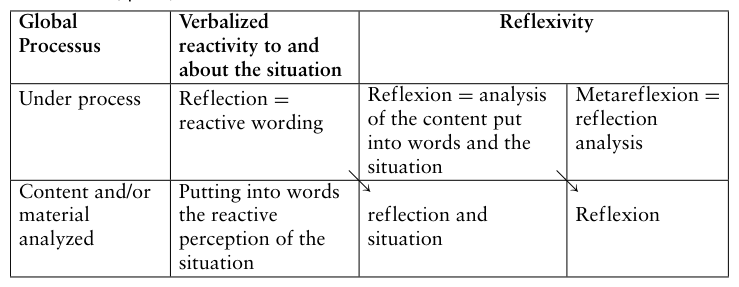
According to Vacher (2022), three elements are necessary and indispensable for the implementation of reflective practice: reflection, reflection and meta reflexion associated with action and experience.
Table 1. Articulation of rational processes of reflection in reflective practice (Vacher, 2022, p. 33).
Reflective practice, as described above, is a source of effective learning in that it encourages individuals to step back and analyze their experiences, actions, and emotions.
TWO DEVICES FOR DEVELOPING REFLEXIVE PRACTICE Through the experimentation of the devices described below, we seek to analyze the conditions in which reflective practice could serve as a lever not only for a change of attitude but especially for a lasting change of behavior, responsible and secure in the digital sphere. We particularly seek to induce a process of reconstruction of knowledge and behavior, in consciousness and in a long-term perspective. This process is described as reflexive, as described by Vacher (2011).
Device 1: A Logbook to Understand the Digital Risks An 8-week longitudinal study was conducted between May and July 2023 with 13 young adults aged 19 to 32, including 6 women and 7 men. The first objective of the study was to collect data on digital practices, online threat perception and protective behaviors of young people facing these risks. The second objective was to test the hypothesis that the daily use of the device, allowing the explanation of their usages in writing, leads to a reflexive effect, source of learning. An online logbook in the form of a chatbot was developed to allow young people to report suspicious/malicious messages they received and verbalize their experiences, opinions, and emotions. A qualitative analysis method was used by crossing the writings of the logbook, the interviews of self-confrontation and the questionnaires of perception and
96 Dubois and Foucault
knowledge of digital risks. The logbook played an essential role in supporting the verbalization. It acted here as a fundamental artifact in the process of constructing reflexivity (Laszczuk and Garreau, 2015).
During the experiment, we observed several positive effects in the participants’ speech. They declare they have realized that fraud is everywhere, in all areas. They have become aware of the demands to which they are exposed. They say they are more vigilant now, with full knowledge of the facts. They were able to put in place protection routines when faced with a questionable message. They try to analyze it by identifying the email address or the sender’s number… One explains, “My perception of digital risks has changed. I step back. I don’t fall into fear right away. I’m trying to find resources on the Internet. I’m trying to find out where this message is coming from and if other people are facing it.” Also, beyond his personal protection strategies, they have developed a role of ambassador/ expert with their personal circle to reassure their loved ones.
Participants express that it is through writing and interacting with the logbook that they have taken a step back, learned to analyze the situation and to think without haste about the response they would bring to the risk. In a word, they brought their activity to consciousness, as we see in this interview excerpt: “The fact of having this bot, the feedback, the information, … I realize that because I have knowledge, I take fewer risks. I am more vigilant.”
The regular use of the logbook seems to lead to a reflective practice on the digital activity of the participants. They push personal reflection on their actions to induce behavioral changes adjusted to the possibilities. At the same time, they can anticipate digital risks to better avoid them, using their experiences and knowledge.
We can say that this research paradigm has led participants, through interactions with the bot, to verbalization and reflection on their experiences and feelings during the confrontations with digital risks. This metacognitive consciousness allows to structure the reflection towards the awareness and conceptualization of protection activities. This stage involves the construction of new mental patterns and strategies as well as the consolidation of skills to protect oneself from risks. Participants learned to adapt their behaviors, feeling better control of the situation and thus better emergency management. Beyond the simple acquisition of pragmatic knowledge, we can note that the participants were led to transmit their knowledge and to troubleshoot their entourage. This leads us to believe that we are witnessing a truly engaging and sustainable learning.
Device 2: A Model to Raise Awareness Regarding Smartphone Usage A mock-up was designed to help users choose a new smartphone by following an eight-step questionnaire. Each question is associated with a virtual card that offers educational content on the ecological or social footprint of the object, allowing a verbalization of the participants’ experience. The cards were designed by integrating the results of studies on persuasive interfaces (Foulonneau, 2017) to limit the risks of rejection. The device was tested in laboratory with 16 participants, 9 women and 7 men, aged 22 to 66
Reflexivity, a Tool for Experiential Learning and Digital Practices Transformation 97
years and presenting various levels of expertise, in terms of smartphones. During the mock-up discovery, individual interviews were conducted to gather participants’ verbatims, emotions and questions. The objectives of the model are to make customers aware of the eco-social impacts of frequent smartphone renewal and to provide them with levers for action to reduce this impact. We therefore place ourselves in a reflexive perspective, which must lead participants to question their choices and mechanisms, to become aware of the criteria that guide them and build a knowledge and awareness of their own functioning.
The analysis of the recorded interviews allowed us to identify 42 positive verbatims on the part of the participants, relating to the usefulness of the device, against 4 questioning the usefulness of the tool in light of a perceived lack of commitment from digital companies and other consumers. For 15 of the 16 participants, we showed a commitment to a reflective process. On the one hand, we identified 101 socio-environmental verbatims, arising from a process of reflection on their practices or reflections on their reactions to informative content. On the other hand, the individual and collective levers of action were identified and examined by the participants, to be weighed against their self-analysis of their personal uses. Finally, many emotional markers were observed. In addition, we found that the commitment to reflexivity is more or less marked. Thus, the two participants least engaged in a socio-eco-responsible approach, present the clearest level of reflexive commitment, as illustrated by these two verbatim extracts: [card 2] “Don’t even talk to me about reconditioned. As a pro I will never go on a reconditioned.” (Verbatim before the discovery of the mock-up). [card 8] “I don’t know why I have a psychological need that goes beyond anything else. It’s compulsive. While my [washing] machine of course I’ll fix it. An electronic machine, of course I’ll change it. It’s education in fact. We were taught to fix that, not this [his phone].” (Meta-analysis of his behavior).
Finally, the participants expressed intentions to share with their entourage, either concerning the model itself, or concerning specific behaviors, as illustrated by the following two verbatim extracts.
Participant 10: “Well indirectly when you know something … you have to transmit it. Yes you took pictures but you take 15 times the same thing. Is it necessary? But it has an impact. And the, … maybe go to the source [the device] at the same time.”
Participant 5: “In fact we don’t dwell on that. So we’ll be talking more about the airwaves that it generates. […] But now I’m going to tell my children about the SAR [Specific Absorption Rate].”
Laboratory experimentation has shown that the device allows to raise a socio-environmental awareness of the participants regarding the purchase and use of smartphones. In accordance with our assumptions, participants mobilized a metacognitive capacity on how to assess their knowledge about their equipment needs and desires, and smartphone usage, in terms of socio-environmental impacts.
98 Dubois and Foucault
JOINT DISCUSSION OF EXPERIENCES Through these two experiments, we have set up two very different modalities of reflexive approaches. First, from a methodological point of view, one was a longitudinal study with integrated remote support in the daily life of the participants, while the other was a laboratory test with semi-structured interviews. Both experiments collected indicators of engagement in the reflexive process. The ways to engage users in a reflexive approach were different in each experiment, with writing in the chatbot for one and verbalization for the other.
Regarding the results obtained, we note in both cases that some participants took on the role of ambassador, but only those of the chatbot showed proactive behaviors in seeking information and solutions. Moreover, we have highlighted in both experiments a wide range of emotional expressions, sometimes strong. This point is even more remarkable as the topic of cybersecurity as well as that of digital overconsumption remain subjects ordinarily rarely evoked. This emotional emergence constitutes for us a new proof of the success of the reflexive practice in these two devices.
The two experiments are different modalities of embodying a persuasive tool to engage users in a reflective process. Thus, our approach can be closer to persuasive technologies, insofar as the influence we wish to exercise is limited to educating in a constructivist perspective, responsible and respectful of the recipient (Foulonneau, 2017). The devices are designed to allow each user to develop their own behaviors with support. Our work is part of an educational and responsible perspective, ≪without coercion or deception≫ in a personal approach, which does not mean a solitary approach. The engaging effect of the devices allows effective learning, supported by human support.
CONCLUSION
The main objective of this article was to analyze the conditions under which two devices could operationalize pedagogical reflexivity for the purpose of digital behavior change. Through the devices studied, we have provided resources to users, so that they are fully able to self-regulate their actions. We have shown that the reflexive approach is relevant in the context of a service for the general population, in a pedagogical approach respecting individuality, while giving the keys to better understand digital uses. In this sense, this work seems to us to produce a positive social impact for a safer and more responsible digital world.
The results of the experiments carried out are encouraging, but it remains to address on the one hand the possible generalization of the results, and on the other hand the persistence of the behaviors in the duration. In perspective, these points will be the subject of further studies.
We postulate that this reflexive approach, in an industrial environment, allows individuals to build and transform their own behaviors through a guided experiential journey. It also promotes the emergence of changes that are not only significant and adapted, but also sustainable. This hypothesis highlights the importance of ethics and the persistence of behaviors in the
Reflexivity, a Tool for Experiential Learning and Digital Practices Transformation 99
context of Corporate Social Responsibility, offering a perspective for the provision of enabling tools (Falzon, 2010). In conclusion, reflective practice, rarely used in the field of evolutive digital services, seems promising for digital actors, who are required today to raise awareness and educate their customers.
ACKNOWLEDGMENT
The authors would like to acknowledge their research workteam at Orange Innovation.
REFERENCES
Falzon, P. (2010). À propos des environnements capacitants : Pour une ergonomie constructive. In C. Roux (Ed.). Prévention de l’usure professionnelle ou construction de la santé ? Actes du séminaire organisé par le réseau ANACT. Paris: ANACT. Foulonneau, A. (2017). Les technologies persuasives adaptatives. Intelligence
artificielle [cs. AI]. Thèse, 39–51. Université Grenoble Alpes. Laszczuk, A. et Garreau, L. (2015). Le journal de bord sibyllique : de l’importance des anticipations dans le processus de construction de sens du chercheur en immersion. 24e conférence annuelle de l’Association Internationale de Management Stratégique de Paris. Make.org. (2023). Comment pouvons-nous réduire ensemble les impacts environnementaux du numérique (équipements, usages internet, mobile, vidéo...) ? Martin, S. (2022). Les extrêmes climatiques : Perceptions et enjeux sociaux et
politiques. Responsabilité & environnement (106), pp. 89–95. Récupéré sur https://doi.org/10.3917/re1.106.0089 Opinionway (2024). Etude pour Orange “Les Français face aux risques numériques”.
Récupéré sur https://make.org/FR/consultation/numerique-durable/results] Pôle numérique ARCEP - ARCOM. (2023). Référentiel des usages du numérique. Schön, D. A. (1994). Le praticien réflexif : À la recherche du savoir caché dans l’agir professionnel. (Trad. Heynemand, J. et D. Gagnon). Éditions Logiques (1re éd. 1983). Scherer, A. (2022). Education financière : Concevoir un dispositif de formation à
la gestion budgétaire pour les jeunes adultes. Comprendre leurs activités pour identifier les besoins de formation. Rapport interne. Vacher, Y. (2011). La pratique réflexive. Un concept et des mises en œuvre à définir. Recherche et formation, 66, pp. 65–78. Récupéré sur https://doi.org/10.4000/rechercheformation.1133 Vacher, Y. (2022). Construire une pratique réflexive. Comprendre et agir. De Boeck Supérieur.
LISTED IN THE AHFE DIGITAL BOOKSTORE CATALOGUE
Explore the complete digital volume
Human Systems Engineering and Design (IHSED2024): Future Trends and Applications
Read this individual research paper free through the original publisher, or explore the full digital proceedings book.
ISBN 978-1-964867-34-2
Explore this ISBN in the AHFE Bookstore ↗Listed in the July 2026 bookstore catalogue; search by ISBN to confirm current availability · Digital book purchase optional