Fabian Reimer, Ivana Moerland-Masic, Albert End, Jana Schadow, Thomas-Mathias Bock, Frank Meller, Bjoern Nagel (2022). Safety & Privacy in Urban Air Mobility (UAM) - A User Centric Design Approach Providing Insights into People´s Preferences for UAM Cabin Designs. In: Human Factors in Transportation. AHFE Open Access, vol. 60, pp. 593–599. https://doi.org/10.54941/ahfe1002494
For years, manufacturers and research institutions around the world have been working on various concepts to start a new era of urban and suburban transportation for people with so-called Air Taxis. However, the social acceptance of this new type of mobility is widely assumed to play an essential role in the future development of this field. Since passengers of future Air Taxis will spend most of the trip inside the cabin area, the desire for safety and privacy within the cabin might have a substantial impact on people´s opinions about such vehicles. Therefore, users are being involved in the design process of future Air Taxi cabins from the very beginning as part of the Horizon UAM project at the DLR German Aerospace Center. For this purpose, an online survey was initiated in July 27, 2021 and completed in October 19, 2021, resulting in 202 valid datasets of participants from various demographic groups in Germany. One survey part focused on factors of safety and privacy and was divided into two stages. In the first stage, respondents were asked to share their personal experiences and opinions about safety and privacy in public transport. In the second stage, six different scenarios for UAM cabins were presented. All scenarios used cabins with four seats in two rows of seats facing each other, including different types of partition walls. For evaluating each concept, participants were asked to imagine themselves being on a 10-15 -minute flight with an Air Taxi. Both in a scenario as a solo traveler and as a traveler with an accompanying person, the overall evaluation of each concept had to be given with respect to privacy, safety and comfort.The response pattern of the first part indicates, that the hygiene of a seat in public transportation was perceived to be particularly important. Furthermore, respondents showed a strong preference to have a free seat next to them, while group seating areas with four seats seemed to be rather avoided. Moreover, it tended to be relatively unimportant for the participants to be able to see the driver of the public vehicle. The response pattern of the second part suggested, for instance, that respondents seemed to decline partition walls in case they disturb the visual contact with an accompanying person. Accordingly, the absence of any partitions was also rated relatively positive, for the scenario of traveling with companion. In trips without an accompanying person, sharing a separated area with a foreigner tended to be evaluated rather negatively, especially when facing each other. However, complete separation from all fellow passengers also received a substantial amount of negative evaluations.Consequently, future Air Taxi cabin design concepts should avoid fully closed compartments with two foreign travelers facing each other. Therefore, flexible separation concepts might be considered in order to create an individual level of safety and privacy inside UAM cabins. The findings of the survey provide important information for future cabin design of air taxis. By involving the population into the process, the acceptance towards new modes of transport might be increased.
Urban Air Mobility (UAM) is currently one of the fastest growing fields in future mobility research. The first flight of a manned multicopter pro- totype by Volocopter in 2011 formed the basis for a global hype around the topic (Reinholt, 2021). Despite the huge potential, however, processes such as designing future UAM cabins are complex and create various chal- lenges for researchers and designers all over the world. Besides technology and safety-related factors, the social acceptance for this future technology is commonly expected to play an essential role. Therefore, within the project Horizon UAM at the German Aerospace Center (DLR), the user-centered design of future UAM cabins constitutes an important aspect to consider the potential acceptance of newly developed UAM vehicles from the very begin- ning. In order to create a user-centered design, the so-called Design Thinking Method has proven to be an effective way to involve the user in the early
design process (Hasso Plattner Institute of Design, 2010). To get a deeper understanding of possible user groups, a focus group study was conducted in December 2020. On the one hand, the groups were instructed to collabo- ratively design a concept of a UAM Cabin from different perspectives and according to their own wishes. On the other hand, experiences, concerns and wishes based on experiences of the public transport sector were collected with the help of a questionnaire and a joint discussion (Stolz et al., 2021). Based on the collected information, the main target group requirements could be determined and subsequently used to create first cabin design drafts. In a fur- ther iteration process, an online survey was conducted from July to October 2021, in which the mentioned first cabin design drafts were evaluated and in-depth experiences from public transport were collected.
BACKGROUND
Several surveys provided evidence that a majority of people may not generally intent to use UAM themselves (Dannenberger et al., 2020; Eißfeldt et al., 2020), even though corresponding percentages were shown to vary across different regions around the globe (Riedel et al., 2021). Correspondingly, in their literature review, Straubinger and colleagues discussed studies on public acceptance among other important pillars of UAM research such as infrastru- ctural requirements, official regulations and economic factors (Straubinger et al., 2020). Moreover, from an industrial perspective, emphasized social considerations can be considered to be one of the major challenges for the future market introduction of UAM vehicles (Yedavalli and Moorberry, 2018). In the wake of the described ideas, Stolz and colleagues identified the perception of safety as a relevant factor for passenger acceptance.
On the one hand and parallel to this finding, metros with few passengers were found to be perceived as particularly insecure (Ouali et al., 2019). On the other hand, Stolz and colleagues also identified the need for an individual level of privacy for future air taxi cabin designs in the desire for distance to other travelers. Additionally, according to Edward T. Hall, it is also impor- tant for people to avoid direct eye contact as well as physical contact with strangers in public transport (Hall, 1982).
In the present study, we assumed that creating distance by means of parti- tion walls in shared vehicles may create an increased feeling of security and privacy. Accordingly, among other aspects, six UAM cabin concepts with dif- ferent partition approaches were presented to the participants of our online survey. Additionally, the participants were asked to give an overall evaluation for each of concept in terms of privacy, safety and comfort with respect to different usage scenarios.
METHOD
Participants 365 participants began to fill out the survey, 203 persons fully completed it, while one of them explicitly stated within the final comments section to have
Safety & Privacy in Urban Air Mobility (UAM) 595
given invalid answers. Thus, the final sample used for data analysis comprised n = 202 volunteers. Age ranged between 15 and 79 years with a mean of 37.28 years (SD = 12.48 years), two participants did not report their age. 56.9% reported to be male, 42.1% female, 0.5% diverse and one participant did not answer this question. Volunteers more frequently lived in bigger cities than in smaller towns or villages (place of residence below 5,000 people: 8.9%; 5,000 to less than 20,000 people: 14.4%; 20,000 to less than 100,000 people: 15.3%; 100,000 to less than 500,000 people: 25.2%; 500,000 people or more: 34.2%; not answered: 2.0%). The majority of participants (62.9%) reported to have private or professional reference to aviation (e.g., hobby, interest, work), while 29.7% had no such reference (7.4% answers missing).
It is important to always take the described sample characteristics into account when interpreting the results of the present study, because the survey did not aim at generating results representative for the German population and it cannot fulfill this criterion. Nevertheless, it can provide helpful insights into preferences of the surveyed sample group with respect to future UAM cabin designs.
Procedure The study was conducted as an online survey in Germany. It was implemen- ted in LimeSurvey (version 3.25.20) and open for participation from 20 July to 19 October 2021. The survey language was German. All answers were anonymized.
The survey included several sections regarding different topics relevant for either future UAM cabin designs or the use of common public transport. In one section of the survey, which forms the basis for the present article, six different UAM cabin concepts had to be evaluated regarding the perceived overall level of safety, comfort and privacy. As a basis for all six concepts, a cabin with four seats aligned in two rows was used. The front row was alw- ays positioned backwards and the rear row of seats was always positioned in the direction of flight. In addition to four personal exits, a pilot was always positioned in the front area and separated from the rest of the cabin by a par- tition wall. The six concepts differed only in the positions and the features of the room separation by means of partitions. A fictitious scenario of a ten to fifteen-minute flight in a fully occupied air taxi was described as the starting point for evaluating each concept. The respondents were asked to rate the concepts first from the perspective of a flight without an accompanying per- son and then from the perspective of travelling with accompanying person. Answers had to be given as a single choice out of six options (i.e., ‘very bad’, ‘bad’, ‘neutral’, ‘good’, ‘very good’ as well as ‘no answer’). Participants were instructed that the design of the seats as well as other aesthetic factors in the presented pictures were only of exemplary character and were irrelevant for the purpose of their evaluations.
RESULTS
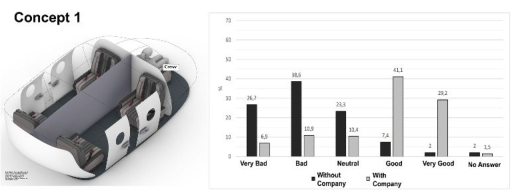
Concept 1 (see Figure 1) shows the cabin with a central partition option that fully separates the left and right part of the cabin.
Figure 1: Concept 1 (left) and corresponding overall evaluations with respect to privacy, safety and comfort (right). (German Aerospace Center, 2021).
In the scenario without an accompanying person, this concept was evalu- ated rather negatively regarding the overall impression of privacy, safety and comfort, while it received mainly positive evaluations in the scenario with an accompanying person.
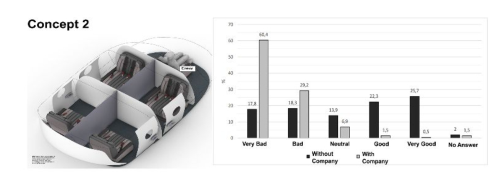
Figure 2: Concept 2 (left) and corresponding overall evaluations with respect to privacy, safety and comfort (right). (German Aerospace Center, 2021).
Figure 2 shows concept 2, which included both a horizontal and a vertical separation of the cabin, dividing it into four fully separate areas. Whereas most respondents rejected this concept for the case with an accompanying person, the percentage shares between the options were more balanced for the case without an accompanying person.
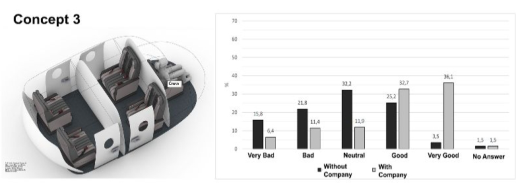
Figure 3: Concept 3 (left) and corresponding overall evaluations with respect to privacy, safety and comfort (right). (German Aerospace Center, 2021).
In concept 3 (see Figure 3), the front and rear areas of the cabin were completely separated from each other with the help of a partition wall. In
Safety & Privacy in Urban Air Mobility (UAM) 597
the case without an accompanying person, the option ‘neutral’ received the largest amount of overall ratings of privacy, safety and comfort, followed by the options ‘good’ and ‘bad’, which were chosen similarly often. For the scenario with an accompanying person, concept 3 was evaluated relatively positively.
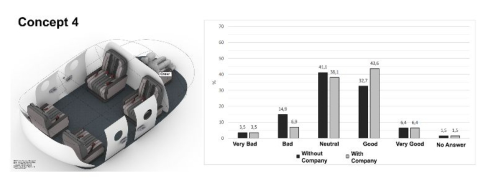
Concept 4 constituted an approach without any partition walls in the pas- senger area (see Figure 4). For both scenarios, the majority of respondents gave ‘neutral’ or ‘good’ evaluations. The proportions with which the other options were selected, were comparable between the case with and the case without accompanying person.
Figure 4: Concept 4 (left) and corresponding overall evaluations with respect to privacy, safety and comfort (right). (German Aerospace Center, 2021).
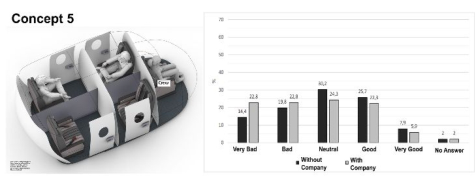
Concept 5 (see Figure 5) was similar to concept 2 in having the front and rear cabin areas completely separated by a partition wall. However, the fur- ther partition between the seats in concept 5 did not reach up to the cabin’s ceiling as in concept 2, but was only about half the height.
Figure 5: Concept 5 (left) and corresponding overall evaluations with respect to privacy, safety and comfort (right) (German Aerospace Center, 2021).
For the scenario with accompanying person, the evaluations of concept 5 were balanced across the rating options, with the exception that the option ‘very good’ was chosen rather rarely. The rating option ‘very good’ was also rarely selected for the scenario without accompanying person. However, in this case, there was a slight tendency towards rather positive evaluations.
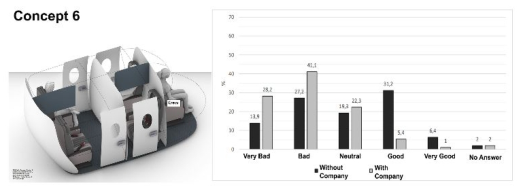
Concept 6 (see Figure 6) contained a partition wall separating the front from the rear cabin area just like concepts 2 and 5.
In concept 6, a small privacy screen was implemented between the passen- gers within these areas. In the case with an accompanying person, the concept
was evaluated rather negatively, while for the scenario without accompan- ying person, the rating options ‘good’ and ‘bad’ were chosen by similarly large proportions of respondents.
Figure 6: Concept 6 (left) and corresponding overall evaluations with respect to privacy, safety and comfort (right). (German Aerospace Center, 2021).
DISCUSSION & CONCLUSION Designing a user-centered cabin for a non-existent commercial vehicle is a major challenge. The investigation of user preferences as well as the involve- ment in an early design stage can be an important contribution to achieve the highest possible level of acceptance for future UAM cabin designs. Focusing on the parameters safety, comfort and privacy, different concepts were eva- luated in the present study, both for scenarios of travelling with and without an accompanying person.
In the case without an accompanying person, it was noticeable, that travel- ling in a separated area with a stranger facing each other was evaluated rather negatively. This result confirms the findings of Edward T. Hall (1982), where the ‘violation of space’ should be observed and direct physical or eye contact with strangers should be avoided. In addition, one might speculate that there might be link to the finding of Ouali et al. (2020), that especially public tran- sport trains with few fellow passengers were found to be perceived as rather unsafe. A concept that was partially rated as positive in case of travelling without company in the present study was the one with complete separation between all passengers. However, due to the particularly high level of privacy and protection from fellow passengers in that concept, a significantly higher approval rate was expected here. Another unexpected result was the high approval rate for the current study’s concept that included no partition walls at all, even for the scenario of travelling without companion. It could be spe- culated that this finding might be explained by a possible desire for a shared experience with other people using a new type of transportation. In addition, it could be assumed that a fully occupied cabin without partition walls may not lead to a decreased level of safety. Furthermore, additional space could possibly lead to a higher level of comfort due to increased leg space and a bigger field of view.
For the scenario of travelling with an accompanying person, particularly those concepts were evaluated positively which did not include any walls or screens between companions, but ideally implied sharing a separated
Safety & Privacy in Urban Air Mobility (UAM) 599
area with the accompanying person. It seems plausible that the respondents preferred concepts in which they would have had the possibility of commu- nicating with their companion and of sharing the experience. In addition, it is possible, that the level of privacy played the most essential role in this case. However, the concept without any partition walls also received quite high approval rates in the scenario of travelling with companion, even though the rating ‘very good’ was given rather rarely.
The results of the present study offer a valuable basis for further activities in the process of designing UAM cabins. In the next step, the focus could be placed on the creation of individualized space and separation concepts such that travelers with and without accompanying persons may get the oppor- tunity to tailor cabins to their individual needs. In addition, the influence of further safety parameters such as alternative seat arrangements, window concepts, displays or flight information should be examined on the basis of future concepts. Last but not least, it has to be noted that it cannot be precisely estimated to what extent the COVID-19 pandemic might have influenced the respondents in evaluating the cabin concepts in the current study, especially because the results reported in this article focused on different arrangements of partition walls. Due to the dynamic pandemic development and the pos- sibility of lasting effects on the perception of safety, this factor should be explicitly addressed and examined in further studies.
REFERENCES
Dannenberger, N., Schmid-Loertzer, V., Fischer, L., Schwarzbach, V., Kellermann, R., and Biehle (2020). Traffic solution or technical hype? Representative population survey on delivery drones and air taxis in Germany, Germany: Sky Limits. Eißfeldt, H., Vogelpohl, V., Stolz, M., Papenfuß, A., Biella, M., Belz, J., and
Kügler, D. (2020) The acceptance of civil drones in Germany, Braunschweig: CEAS Aeronautical Journal 11. Hall, E. T. (1982) “The Hidden Dimension.” In: I. Random House, Hrsg. s.l.:Anchor Books Edition, pp. 117–131. Hasso Plattner Institute of Design (2010) An Introduction in Design Thinking Process
Guide, Stanford. Ouali, L.A.B., Graham, D.J., Barron, A. and Trompet, M. (2019) Gender differences in the perception of safety in public transport, London: Journal of the Royal Statistical Society. R. Riedel, B. Kloss (June 1, 2021) Up in the air: How do consumers view adva-
nced air mobility?. https://www.mckinsey.com/industries/aerospace-and-defense/ our-insights/up-in-the-air-how-do-consumers-view-advanced-air-mobility Reinholt, L., (May 17, 2021). www.aerokurier.de: https://www.aerokurier.de/elektr oflug/volocopter-pioniere-der-zukunft/ Stolz, M., Reimer, F., Moerland-Masic, I. and Hardie, T. (2021) A User-Centered
Cabin Design Approach to Investigate Peoples Preferences on the Interior Design of Future Air Taxis. Braunschweig, German Aerospace Center. Straubinger, A., Rothfeld, R., Shamiyeh, M., Büchter, K.D., Kaiser, J., Plötner K.O., (2020) An overview of current reserach and developments in urban air mobility - Setting the scene for UAM introduction, Journal of Air Transport Management. Yedavalli P. and Moorberry, J. (2018) An Assessment of Public Perception of Uraban
Air Mobility (UAM), Airbus.
LISTED IN THE AHFE DIGITAL BOOKSTORE CATALOGUE
Explore the complete digital volume
Human Factors in Transportation
Read this individual research paper free through the original publisher, or explore the full digital proceedings book.
ISBN 978-1-958651-36-0
Explore this ISBN in the AHFE Bookstore ↗Listed in the July 2026 bookstore catalogue; search by ISBN to confirm current availability · Digital book purchase optional