Sebastian Cornelje, Fabian Reimer, Jessica Herzig, Line Winkler, Jörn Biedermann (2026). Physical vs Virtual Design: Advancing the XR+ Method for Facilitated Passenger Aircraft Cabin Co-Design. In: Advances in Human Factors of Transportation. AHFE Open Access, vol. 224, pp. 135–148. https://doi.org/10.54941/ahfe1007841
Developing aircraft cabin interiors requires balancing operational needs with evolving passenger expectations. Translating the lived passenger experience into early spatial concepts remains challenging. This paper describes a series of facilitated co-design workshops enabling non-designer stakeholders (passengers) to create aircraft cabin layouts from scratch. In 18 time-boxed group sessions lasting 120 minutes each, passengers were instructed to create concepts for a long-haul space beyond the seat, also known as a ‘third space’. These sessions utilised the XR+ methodology: a workflow that combines ideation on reduced-scale (1:20) with immersive full-scale (1:1) refinement in XR. While prior XR+ applications focused on professional stakeholder groups in cabin-related contexts, the present work extends XR+ to passenger-led co-design. Furthermore, two variants of the method are tested: an all-virtual approach (XR scale 1:20 → XR scale 1:1) against a hybrid approach (physical scale 1:20 → XR scale 1:1). Results show that novice passengers in both workflows produced concept artefacts within a single session, as evidenced by the completion of layout prototypes and facilitator observations. Facilitators observed that the 1:20 scale supports rapid layout creation and a shared negotiation space. This was followed by embodied spatial refinement at 1:1 scale. Key practical differences between the workflows were (i) where facilitation effort is needed most and (ii) continuity of artefacts across stages. In conclusion, practical workflow trade-offs to inform the adoption of XR+ variants in early aviation research and ideation are summarised.
Developing new passenger aircraft cabins presents persistent challenges for aviation research and industry. Solutions must satisfy the operational and safety requirements while also delivering a high-quality passenger experience. At the same time, passenger requirements are diverse and highly individual, making them difficult to capture and translate into early spatial concepts. Particularly because experiences are often tacit and multi-layered (Pettersson, 2018). Moreover, requirements expressed in interviews can be open to interpretation and remain ambiguous unless anchored in concrete representations (Ferrari et al., 2016).
This situation motivates more user-centred and participatory approaches in which users (in this study: aircraft passengers) contribute actively to the concept development process, complementing traditional evaluation methods (De Crescenzio et al., 2019). In design research, participatory design builds on this principle by recognising people without formal design training as experts of their own experiences and capable contributors to the design process (Sanders & Stappers, 2008). They can become capable contributors when given the appropriate tools and facilitation. The underlying idea is that those most affected by the design should be given the means to make it fulfil their true needs (Mattelmäki & Sleeswijk Visser, 2011). Since passengers are an important target group when designing new aircraft cabins, we argue that their lived flight experience is a core input to designing for their needs. Feasibility, therefore, must be demonstrated with passenger teams rather than design experts. To investigate the needs of future passengers this study utilises the context of a future long-haul hydrogen aircraft taken from the DLR project EXACT 2. The transition to hydrogen powered aviation is a potential leap for the industry, but inherently changes the cabin architecture and available space. Investigating this specific context allows us to shape the future of flight. Because the constraints and opportunities of hydrogen aircraft are still being defined, it is crucial to capture the passenger’s perspective on safety, space and comfort early in the conceptual phase.
Extended Reality (XR) technologies offer opportunities to involve stakeholders, such as passengers and cabin crew, in early spatial concept development. XR is an umbrella term for different technologies such as Virtual Reality (VR), Augmented Reality (AR) and Mixed Reality (MR) (Santhosh et al., 2022). In the aircraft cabin domain, while XR is frequently used to visualise existing designs, there remains a lack of structured workflows that leverage these immersive technologies to empower passengers to co-create preliminary spatial layouts from scratch.
To address this gap, the XR+ method (Cornelje, 2023) was developed to give non-designer users the tools and scaffolding to create cabin concepts from the ground up, utilising reduced-scale models and full-scale immersive refinement for ideation. In prior XR+ applications (Cornelje, 2023; Cornelje et al., 2024; Reimer et al., 2025) co-design was conducted with professional stakeholder groups. The present work extends the XR+ method to facilitated passenger cabin co-design at scale through 18 group sessions. It examines an additional deployment pathway by comparing a fully virtual reduced scale stage against the original hybrid workflow. The focus of these sessions is on designing a third-space (a space beyond the seat) entrance zone for a long-haul future aircraft, where we utilise two variants of the XR+ method.
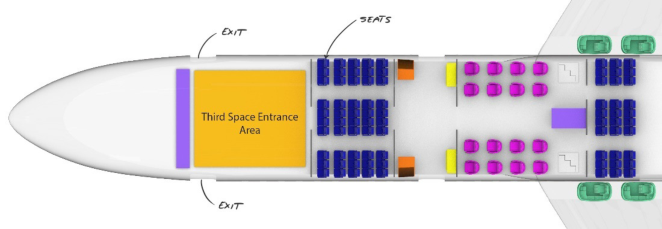
Figure 1: Layout of Passenger Accommodations (LOPA) of the conceptual long-haul hydrogen aircraft used in this study. The yellow area indicates the available workspace for the co-design session.
This paper describes the workflow of the user study and compares an all-virtual variant to the traditional hybrid (physical + XR) workflow. Furthermore, it investigates how passenger teams (2-4 participants) can be involved in a facilitated XR+ co-design workflows to create early ‘third- space’ (see page 3 for definition) cabin layouts and what practical trade-offs emerge between a hybrid and fully virtual variant.
METHOD
Study Overview We conducted a facilitated XR co-design study to demonstrate and examine the feasibility and workflow of the XR+ method for early ideation of cabin space with non-designers. The study compares two variants of the XR+ workflow: (1) a hybrid variant with reduced-scale physical ideation at 1:20 scale, followed by virtual 1:1-scale ideation and (2) the all-virtual variant that follows the same sequence, but where reduced-scale ideation is done virtually rather than physically. The present paper reports XR+ session outputs as documented concept artefacts and facilitator observations.
Participants All procedures were conducted in accordance with the research ethics guidelines of the German Aerospace Center (DLR) and approved by the DLR ethics office. All participants provided written informed consent to participate in an XR study and for the use of their data for scientific publication.
Data collection took place between 17 and 21 November 2025. N = 7 individuals participated in a pilot study. The main study comprised N = 65 participants, of whom 36 participated in the all-virtual setup and 29 in the hybrid setup.
Participants were recruited to represent a broad range of ages and professional backgrounds (26 female, 46 male). Mean age was 36.89 years (SD = 11.42), ranging from 20 to 59 years. To be eligible, participants must have previously flown as airline passengers. Participants were asked to form a co-design team with a target group of four. Group sizes ranged from 2 to 4 participants. This slight variance in group size did not negatively impact the study and its objective since all groups were able to effectively engage in the
co-design process. Most participants had no formal design training and no prior XR co-design experience.
All workshop sessions were video recorded to provide an archive for future analysis.
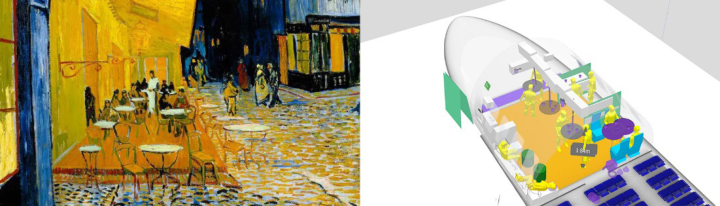
Design Task (Third Space) Participants were asked to design a ‘third space’ derived from Ray Oldenburg’s sociological concept of the ‘third place’ (Oldenburg, 1989). A social environment distinct from the primary environments of home and the workplace.
Figure 2: On the left: Van Gogh’s Café terrace at night. An example of a ‘third place’ according to Ray Oldenburg. On the right: A representation of a third place in a conceptual aircraft layout as proposed by a passenger group.
In the context of a future long-haul aircraft a ‘third place’ represents a shared space beyond the seat. It can be used during cruise to interact with other passengers and for movement, relaxation, or retreat. Because we are designing a space, we will continue to refer to this term as ‘third space’ throughout the paper. For this task, the entrance area of a conceptual hydrogen aircraft was chosen as the design space. The layout is based on an aircraft configuration from the DLR project EXACT 2. The space was left intentionally empty for participants to propose spatial layouts grounded in their own passenger experiences. Participants were instructed to:
- Design a new type of entrance area for a future conceptual hydrogen aircraft that allows enough room for passengers to board and deboard. - Design an area that can be used as a shared space during cruise, with all its special features. - Work as a team: ideate and prototype together at a reduced scale and agree on a concept.
XR+ Workflow Variants Each session was set for 120 minutes. At the start of each session, the researchers gave a short introduction about themselves and the task of the day. This was followed by the participants introducing themselves and reflecting on positive and negative experiences they had on their most recent flight as a way of ‘sensitizing’ (Sleeswijk-Visser et al., 2005) themselves for the
Physical vs Virtual Design: Advancing the XR+ Method for Facilitated Passenger 139 upcoming task. As part of this ‘sensitizing’, participants were shown videos and images of innovative cabin concepts and concepts beyond the realm of aircraft cabin design as a way to inspire them. These inspirational materials were a collection of videos found on the Internet, images of existing and conceptual cabin and room concepts and some AI generated images. After the presentation, participants were then instructed by the researchers to form a co-design group for co-designing their ‘third space’.
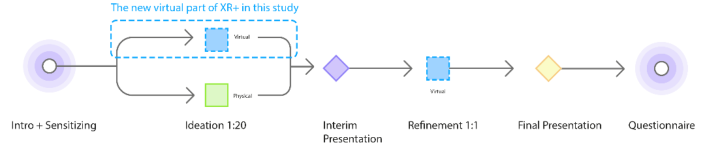
In the all-virtual variant, reduced-scale building blocks were utilized. Participants ideated their concepts at a 1:20 scale inside the XR environment. The reduced-scale concept served as a base for subsequent refinement at 1:1 scale.
In the hybrid variant, participants collaborated by ideating with physical 1:20 scale make tools (scaled models of cabin elements) on a printed floor plan of the hydrogen aircraft. The transition from physical 1:20 to virtual 1:1 is done by a facilitator through copying the design into XR and scaling it up. In the all-virtual XR+ variant, the facilitator only needed to scale the objects and align them to the room in 1:1 scale.
Both XR+ variants follow the same overall logic: Ideation is first done at a reduced 1:20 scale. Then a facilitator transfers and/or scales the ideas used on a 1:20 scale to a 1:1 scale for further ideation and refinement. The progression of scale is a defining element of XR+. Reduced scale supports rapid early layout exploration, whilst full-scale XR supports the spatial evaluation and refinement of ideas (Cornelje, 2023). In both hybrid and all- virtual variants, the 1:1 scale included a minimal airframe to clarify the room boundaries and to give the participants a better sense of scale.
Figure 3: The XR + Process. The two workflow variants of the XR+ co-design method. The blue dotted box highlights where the method branches out into the all-virtual variant. The bottom path depicts the hybrid approach.
Materials
For the all-virtual portion of the study, XR concept development was conducted using the immersive 3D design software Gravity Sketch (gravitysketch.com) running on a Meta Quest 3 headset in passthrough mixed reality mode. Passthrough mixed reality mode allows the participants to remain oriented in the physical room while simultaneously interacting with virtual objects. It was also chosen to minimise the risk of motion sickness and to stimulate communication between participants by allowing them to see each other while wearing the headsets. To reduce motion sickness and collisions, the
headsets were modified by removing the facial interface of the XR headset to allow peripheral awareness.
For the hybrid condition of the study, a set of physical 1:20-scale 3D-printed mock-up tools was provided to support the collaborative co-creation effort. These 3D-printed objects consisted of cabin elements that were scaled down, such as cabin walls, seats and trolleys, but also included a lot of unlabelled, more ambiguous objects. These invited the participants to project their own ideas onto them. A short introductory tutorial by the facilitators familiarised the participants with the relevant interactions to complete the tasks.
Procedure and Session Structure A total of 18 group sessions were completed in the main study, comprising 10 all-virtual sessions and 8 hybrid sessions. Each session lasted 120 minutes and followed a set schedule (see Table 1). Facilitators guided the participants through the stages and supported the transition to 1:1 XR. After each design stage, groups presented their work to the facilitators to explain their design choices and enable documentation.
Captured Outputs Each group session aimed to produce a concept artefact for the final third- space layout. A concept was considered complete when it (i) represented a spatial layout within the provided design space, (ii) was accompanied by a brief rationale of intended use during the final group presentation, and (iii) was documented in XR space as 3D model or through photo and/or XR screenshots. This resulted in 18 documented concepts across the main study session. Participants completed a post-session questionnaire about their experiences within the study. This data will be analysed in a follow-up publication focused on comparative evaluation between hybrid and all- virtual groups.
Table 1: Schedule of both XR co-design approaches.
Table available in the original PDF paper.
Time Virtual Hybrid 20 Minutes Introduction & Context
30 Minutes Virtual and collaborative Mixed Reality Cabin Design in 1:20 scale
Physical and collaborative cabin design in 1:20 scale
10 Minutes Presentation of results
30 Minutes Virtual and collaborative Mixed Reality Cabin Design in 1:1scale
Virtual and collaborative Mixed Reality Cabin Design in 1:1scale
10 Minutes Presentation of results
20 Minutes Questionnaire
RESULTS
Key Results Overview:
Feasibility: All 18 main-study sessions were able to successfully produce a documented third space concept in the 120 minutes timeboxed session.
Scale progression: Reduced scale ideation (1:20) supported rapid layout and negotiation of ideas. Full-scale XR (1:1) enabled embodied spatial refinement and facilitated additional design iterations.
Variant trade-offs: facilitation effort differed between the two workflow variants. More effort was needed during physical-to-virtual translation phase in the hybrid variant. In the all-virtual variant, more effort was needed during the XR onboarding phase.
Feasibility of Facilitated Passenger Cabin Co-Design Across the study, participants (passengers) were able to complete a documented ‘third space’ concept artefact per session for a long-haul aircraft. In total, 18 main study group sessions (10 all-virtual, 8 hybrid) produced 18 concept artefacts, captured via photos and/or XR screenshots and 3D models in XR. There was no minimum number of features imposed on the participants. The earlier mentioned completeness definition was used only to determine whether a session produced a fully documented concept.
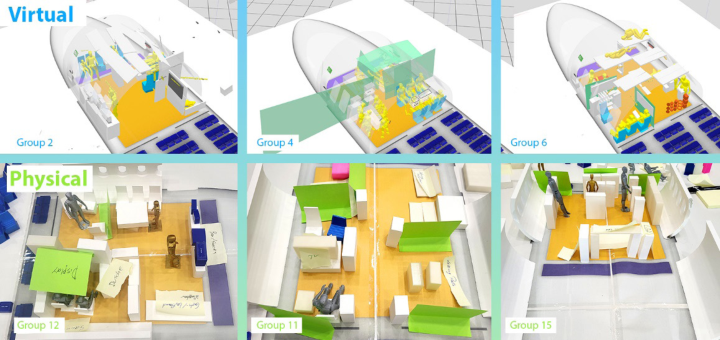
Each concept artefact showed variation between functional emphasis and spatial layout, rather than variants of a single layout pattern (see Figure 4). The documented artefacts, therefore, provide traceable evidence that the XR+ workflow supports the generation of multiple third-space concepts within the predefined design space.
Figure 4: Concept artefacts produced by various workshop groups. above: Concepts produced in the all-virtual ideation stage. beneath: concepts produced in different physical ideation stages.
Facilitators noted that whilst engaged in the workshop, groups drew on personal flight memories and adopted different perspectives (for instance, travelling with children) when designing and articulating their needs. Additionally, it was noted that participants generally had no experience with co-design or XR, but were able to contribute to layout decisions after the initial onboarding.
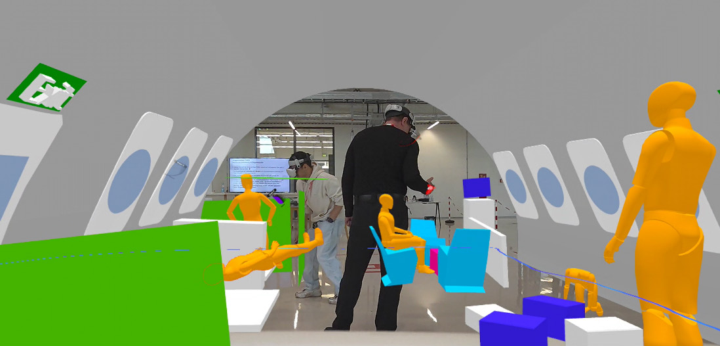
Observations Facilitators observed a shift in design focus between these two stages. The 1:20 scale ideation was mainly used as a rapid means of exploring and negotiating layout. Here, the groups proposed arrangements, reconfigured elements, and found consensus on a baseline concept within the spatial boundaries. After transitioning to a 1:1 scale, the discussion shifted to the embodied human experience. This included topics such as spaciousness, circulation, exposure, and privacy.
The 1:1 scale stage was mostly used for additional refinements, such as adding and repositioning features relative to the 1:20 scale baseline concept, and new ideas arose in this life-size scale. Sessions were videorecorded for future behavioural analysis. Systematic video coding is outside the scope of the present paper.
Figure 5: Participants engaging in the spatial refinement at 1:1 scale.
Participants were able to produce complete concept outputs within the 120-minute session time. Facilitators observed differences in how support, early ideation, and transitions manifested across conditions.
Hybrid XR+ In the hybrid variant, the first ideation stage was conducted using physical make tools. It was observed that groups could immediately manipulate shared objects and discuss the layout whilst negotiating placement during the 1:20 physical stage. Facilitators noticed that during the 1:20 scale ideation phase, groups could work mostly independently. Facilitation was needed only when questions of permission or uncertainties about the design space and
Physical vs Virtual Design: Advancing the XR+ Method for Facilitated Passenger 143 assignment arose. Following the 1:20 scale stage, a facilitator was required to transfer the physical results into the virtual XR 1:1 stage. This transition step introduced additional coordination tasks, including decisions about how to accurately represent the physical layout at 1:1 scale. After transferring the physical design to the virtual world, the virtual 1:1 scale required manual calibration with the physical room. Participants then required onboarding upon entering the XR stage.
All-Virtual XR+ In the all-virtual workflow, the first ideation stage took place within the XR environment. Early support from facilitators focused on onboarding and basic interaction. This included object manipulation, navigation and collaboration. Most participants could, within minutes, manipulate objects in the XR environment, even without prior knowledge or experience in XR. Because both ideation stages were handled in the same digital environment, no additional transfer steps were needed from 1:20 to 1:1. The 1:1 scale only required alignment to fit the physical world.
Observed Workflow Trade-Offs Facilitator debriefs and session observations indicated systematic differences between variants in (i) onboarding demands, (ii) continuity across stages, and (iii) facilitation effort distribution. Table 2 summarises these observed trade-offs as deployment-oriented criteria.
Table 2: Observed criteria for deploying XR+ variants.
Entry barrier for non-designers Often lower at the start due to intuitive physical manipulation
Requires XR onboarding and early facilitator support
Continuity/Handover Requires a physical-to-digital transfer step
Continuous in one digital environment
Facilitation Load Higher during the transfer/ reconstruction of the 1:20 baseline and 1:1 scale phase
Higher early in the process during XR onboarding XR capture only
Documentation Mixed (photos and XR screenshots) Scalability Medium (Physical concept prep + transfer overhead)
High (repeatable, digital only) Efficiency and scaling
Best fit use-case Low cognitive effort. Mixed XR confidence groups. Emphasis on face to face interaction
DISCUSSION
What the Feasibility Demonstration Adds to Cabin Development This study demonstrated that passengers are able to design early cabin-space concepts within a time-boxed co-design session. Across 18 main study group sessions, passenger teams produced a third-space concept within a spatially constrained envelope. These group sessions resulted in concept artefacts (see Figure 4) that can be further communicated and reviewed outside the workshop context. From a methodological perspective, this matters because passengers’ needs and wishes are now translated into concrete concepts instead of mere ideas. These ideas and concepts are strengthened by being developed in a constraint-aware environment. This makes them easier for designers and engineers to take forward in the cabin design process. It is important to note that these concepts are not ready-to-build engineering models. They can instead be regarded as spatially-aware ‘brainstorming’ prototypes. Their value lies in the fact that they translate passenger wishes into spatial volumes. Engineers can extract information on preferred layouts and use these for future engineering work. Looking specifically at the conceptual hydrogen aircraft, these passenger-led designs can help shape the future of flight by providing insights into the needs and wishes of passengers. The diverse range of preferences in each concept shows what passengers care about when they are confronted with new architectural constraints of hydrogen-powered flight. Analysis of each concept artefact is out of the scope of the present paper. It must be noted that feasibility should not be interpreted as the quality of the concept output or preference for a hybrid or all-virtual workflow. It lies in the fact that passenger groups can generate coherent and diverse concept directions in a controlled and repeatable workshop format that remain traceable beyond the workshop itself.
Scale Progression (1:20 – 1:1) The central theme in all-virtual and hybrid XR+ is the shift from 1:20 to 1:1 full scale. Findings within the workshop indicate that the different scales facilitate different modes of reasoning. The 1:20 scale enables rapid layout of ideas and encourages exploration whilst engaging in shared negotiation. This is in line with the findings of Cornelje (2023). Full-scale 1:1 supports an embodied spatial experience. This aligns with earlier descriptions of XR+ (Cornelje, 2023) and (Sanders 2009). The 1:1 scale not only serves as an evaluation of the concept designed in a 1:20 scale but also as a continuation of ideation once human-scale effects are taken into account. In other words, the 1:1 scale is not merely showing the design at full scale, but enabling participants to respond to their embodied spatial impressions so they are able to make the necessary adjustments.
Deployment Guidance Both hybrid and all-virtual XR+ variants in this study were feasible methods for creating completed concept artefacts. They differed only in practical
Physical vs Virtual Design: Advancing the XR+ Method for Facilitated Passenger 145 requirements for facilitation and preparation. Table 3 summarises guidelines for practitioners and facilitators, which were derived from (i) the workflow characteristics of each variant and (ii) recurring themes captured by facilitators in debriefing. Transitions between realities can disrupt the user experience (Pavavimol, 2025), which is relevant when comparing hybrid XR+ to all-virtual XR+. The table is intended for facilitator guidance.
The hybrid version of XR+ can be a low-tech, quick-to-deploy entry point into the co-design process. Mixed-familiarity groups can benefit from a tangible, tactile approach of working, as it requires no initial XR knowledge. The all-virtual XR+ variant reduces the transfer step between the scaling phases, making the overall process more streamlined. It does require more onboarding in the early phases. It is likely that the transition to XR in the hybrid version of XR+ could be less drastic due to familiarity with the existing design from the physical part. However, this assumption is beyond the scope and research of this paper. Based on the observations comparing the all-virtual and hybrid workflows, the following guidelines are proposed for future passenger co-design studies using the XR+ method. See Table 3.
Table 3: Deployment guidelines for XR+.
Table available in the original PDF paper.
1: Match the Workflow to Passenger Tech-Readiness.
For participants group with low prior experience in XR, prioritise the hybrid XR+ approach. Starting with tangible physical 1:20 scale objects was seen as a low entry starting point for users to get acquainted with the design task. It aids face-to-face communication and prevents cognitive overload during early ideation.
2: Anticipate Facilitation Bottlenecks.
When deploying any of the XR+ variants, resource allocation must shift depending on the chosen variant. The all-virtual approach requires intensive facilitation at the beginning of the workshop (technical onboarding and controller set up). The hybrid approach requires a dedicated facilitator during the transfer phase (reconstructing the 1:20 layout into the 1:1 XR environment) to prevent workflow stagnation.
3: Leverage ‘Material Ambiguity’ in Physical and Virtual Tools.
When using the make tools, either in hybrid or in virtual, provide unlabelled or abstract shapes rather than highly detailed models. Abstraction was shown to encourage creative thinking were participants projected their own ideas and imagination onto the models.
4: Maximise the 1:1 Scale for Embodied Evaluation.
The transition to the 1:1 XR scale should not be treated as a final ‘viewing’ stage but as the next stage in the design process. Facilitators must encourage participants to walk through their layouts, however encouragement was hardly needed in the case of this study. The embodied spatial refinement is crucial for exposing human-scale issues. These can remain invisible at 1:20 scale and for example be concern accessibility, lack of privacy and other spatial constraints.
Artefact-Based Evidence and Documentation Since this paper describes a method-oriented contribution, feasibility claims benefit from transparent artefact reporting. Therefore, representative concept artefacts from both hybrid and all-virtual variants were presented. These
artefacts provide traceable evidence that complete concepts were produced within time-boxed sessions. These demonstrate that passenger groups were able to translate flight experiences into spatial layouts within the workshop format, in both workflow variants. They also allow readers to investigate the outcomes and the diversity of the workshops directly.
Limitations and Future Work Rather than focusing on the quality of the produced concepts, this paper examines the implications for workflow and feasibility of a facilitated passenger XR+ co-design session. Some limitations occurred and are as follows: concept quality was not assessed using a structured rubric or with blind expert ratings. Future work could evaluate outcomes using criteria relevant to cabin space design (spatial usability, accessibility, perceived privacy, etc.).
Although facilitators captured common themes from the sessions, in-depth video coding was not conducted in this study. Video-coding could be employed for detailed behavioural analysis in future papers stemming from this study, in both variants of the method. Familiarity with XR tools between the participants may affect the onboarding requirements and collaboration dynamics. To isolate learning effects and test facilitation strategies, it would be necessary to either conduct repeat studies or perform video coding of this study. This could be beneficial for gaining insight into how to tailor facilitation strategies to improve efficiency and customise experiences for the specific participants joining the workshop.
CONCLUSION
This paper presented a feasibility study of the XR+ co-design method with passenger participants for early aircraft cabin space ideation. Across 18 time-boxed group sessions of 120 minutes each, participants produced a documented ‘third space’ entrance zone concept artefact (see Figure 4) within a constrained design space. These outputs provide evidence that facilitated passenger co-design can lead to early-stage cabin concepts that can be communicated outside the workshop and used further downstream in the design process. Both the hybrid and all-virtual workflow variants of the workshop were feasible methods for creating concept cabin artefacts; the differences observed between the two suggest different deployment paths. Trade-offs include onboarding effort per variant for facilitators, continuity across stages (for instance, when going from physical to virtual), and documentation methods in digital formats.
Both the hybrid and all-virtual workflow variants proved feasible for creating these concept artefacts. The core results of this study are twofold. First, the generated 1:1 scale 3D-concepts serve as tangible ‘brainstorming’ prototypes that translate tacit passenger needs into concrete spatial dimensions, providing engineers with usable baselines for future cabin layouts. Second, the comparative observations yielded practical deployment guidelines for the XR+ method. We highlight key trade-offs, such as matching the workflow to
Physical vs Virtual Design: Advancing the XR+ Method for Facilitated Passenger 147 passenger tech-readiness, anticipating specific facilitation bottlenecks (e.g., onboarding versus physical-to-virtual transfer), and leveraging the 1:1 scale for embodied evaluation.
Future work will extend this feasibility-oriented approach through system analysis of the recorded sessions. A deeper comparative evaluation will be possible through the post-session collected questionnaires. Altogether, these follow-up analyses can clarify how workflow choices affect the participant experience and the collaboration process. It can furthermore clarify how XR+ can be further optimised for scalable use in aviation research and early design development.
ACKNOWLEDGMENT
The authors would like to acknowledge all the employees from the Institute of System Architectures in Aeronautics for making this study possible.
REFERENCES
Cornelje, S. (2023). Mixing realities: Combining extended and physical reality in co-creative design for the galley of the Flying-V [Master’s thesis, Delft University of Technology]. TU Delft Repository. Available at: https://repository.tudelft.nl/ record/uuid:ba974258-822f-4778-b2bd-cf6aac40ddb9 Cornelje, S., Reimer, F., Herzig, J., Lindlar, M., Weiand, P., Biedermann, J., Nagel, B.
(2024). “Enhancing The XR+ Method: A Use Case In Rescue Helicopter Cabin Design.” Deutscher Luft- und Raumfahrt Kongress (DLRK), Hamburg, Germany, 30 Sep–02 Oct 2024. doi: 10.25967/630205. De Crescenzio, F., Bagassi, S., Asfaux, S., Lawson, N. (2019). “Human centred design and evaluation of cabin interiors for business jet aircraft in virtual reality.” International Journal on Interactive Design and Manufacturing (IJIDeM), 13(2), pp. 761–772. doi: 10.1007/s12008-019-00565-8 Ferrari, A., Spoletini, P., Gnesi, S. (2016). “Ambiguity and tacit knowledge in
requirements elicitation interviews.” Requirements Engineering, 21(3), pp. 333– 355. doi: 10.1007/s00766-016-0249-3. Mattelmäki, T., Sleeswijk Visser, F. (2011). “Lost in Co-X: Interpretations of Co-Design and Co-Creation.” Proceedings of IASDR 2011 (4th World Conference on Design Research). Oldenburg, R. (1989). The Great Good Place: Cafes, Coffee Shops, Community
Centers, Beauty Parlors, General Stores, Bars, Hangouts, and How They Get You Through the Day. Paragon House. Pavavimol, T., Ometov, A., Valkama, M., Thibault, M. (2025). “Transitions between Realities: A Systematic Review on the Usage of XR Systems for Bridging Reality and Virtuality.” Proceedings of the 2025 ACM International Conference on Interactive Media Experiences (IMX ’25). ACM. pp. 159–174. doi: 10.1145/3706370.3727858. Pettersson, I. (2018). Eliciting User Experience Information in Early Design Phases.
Gothenburg, Sweden: Chalmers University of Technology (Thesis). Available at: https://research.chalmers.se/publication/504907/file/504907_Fulltext.pdf Reimer, F., Fuchs, M., Herzig, J., Cornelje, S., Biedermann, J., Nagel, B. (2025).
Investigating the Flexible Hydrogen Aircraft System Interface Design using the XR Co-Design Approach [Report]. - Florence, Italy : 34th ICAS Conference, 2025.
Sanders, E. B.-N. (2009). “Exploring co-creation on a large scale: Designing for new healthcare environments.” In P. J. Stappers (Ed.), Designing for, with, and from user experience (pp. 10–26). ID StudioLab Press. Sanders, E. B.-N., Stappers, P. J. (2008). Co-creation and the new landscapes of
design. CoDesign, 4(1), pp. 5–18. doi: 10.1080/15710880701875068. Santhosh, S., Bagassi, S., De Crescenzio, F. (2022). “A Mixed Reality Application for Collaborative and Interactive Design Review and Usability Studies.” In Proceedings of the 33rd Congress of the International Council of the Aeronautical Sciences (ICAS). Stockholm, Sweden. Sleeswijk Visser, F., Stappers, P.J., van der Lugt, R., Sanders, E.B.-N. (2005).
“Contextmapping: Experiences from Practice.” CoDesign, 1(2), pp. 119–149.
LISTED IN THE AHFE DIGITAL BOOKSTORE CATALOGUE
Explore the complete digital volume
Advances in Human Factors of Transportation
Read this individual research paper free through the original publisher, or explore the full digital proceedings book.
ISBN 979-8-950676-00-0
Explore this ISBN in the AHFE Bookstore ↗Listed in the July 2026 bookstore catalogue; search by ISBN to confirm current availability · Digital book purchase optional