Malcolm Stielow, Megan Strickfaden (2023). Pillow Forts: Teaching Design Through Play and Making. In: Interdisciplinary Practice in Industrial Design. AHFE Open Access, vol. 100, pp. 68–78. https://doi.org/10.54941/ahfe1002972
A pillow fort is something that many people will remember from their childhood yet tucked between the cushions there is tremendous potential for teaching valued information about three-dimensional and spatial design. Pillow forts is a proposed design studio assignment where theories that include elements, principles and processes related to industrial design, architectural design and spatially-oriented design fields are taught to students engaged in post-secondary education. The aim of this paper is to report on the methods and implementation of a pillow fort assignment in a design foundation studio course. This paper also presents the ontoepistemological methodology behind this deceptively simple assignment. Students are taught fundamental theories around three-dimensional design and then given a simple design goal to make a pillow fort in their living environment using only the objects they have in their immediate environment. By creating an opportunity for students to work with key theories of three-dimensional design, working through the design process using the languages of play, and making in their living environment, students can develop a deep and more holistic approach to designing without even realizing that is what they set out to do.
A pillow fort is something that many people will remember from their chil- dhood yet tucked between the cushions there is tremendous potential for teaching valued information to junior level students in foundational courses including industrial design, architectural design and spatially-oriented design fields for students engaged in post-secondary education. This paper highlights an assignment where theories that include elements, principles and processes about three-dimensional design and spatial design are taught. The aim of this paper is: (1) to report on the methods and implementation of pillow forts; and (2) explore the ontoepistemological roots behind this deceptively simple assignment. We begin with part one where we describe the class assignment including our learning objectives, the theories embedded in the assignment, guidance for the pillow fort construction process, and then how we condu- cted the critique. Part two delves into a discussion of the ontoespistemological roots of the pillow fort assignment including a detailed description of a meth- odological process where students develop design skills including: seeing
Pillow Forts: Teaching Design Through Play and Making 69
and thinking like a designer, iterative play, making, documentation, visual inventory, visual and spatial analysis, and engaging in personal reflexivity.
METHOD & IMPLEMENTATION OF PILLOW FORTS Pillow forts is a simple assignment to administer but has a carefully constru- cted learning progression that is designed to bring out skills and techniques taught in an introductory studio design environment. Fundamental theories around three-dimensional design are taught and then students are given the simple design task of making a pillow fort in their living environment using only the objects they have at hand. With relatively simple goals and no requi- red materials beyond what students have, it can be an excellent break in an otherwise dense course curriculum. The method and implementation of pil- low forts is divided into three distinct steps: (1) introducing the pillow fort assignment; (2) constructing the pillow fort; (3) critiquing and presenting the pillow fort.
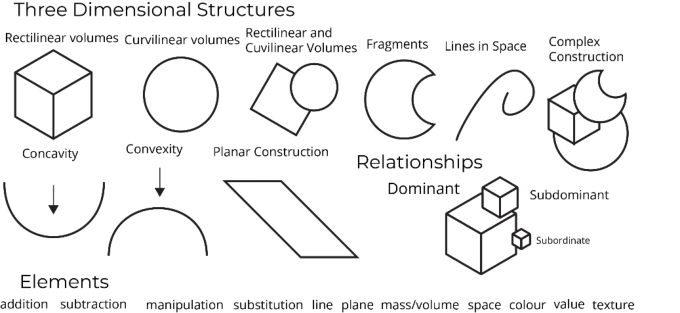
Step 1: Introducing the Pillow Fort Assignment At the heart of the pillow fort are foundational theories in three-dimensional design. We began by describing and interpreting Rowena Reed Kostellow’s theory outlined by Gail Greet Hannah (2002) that includes nine three- dimensional structures, relationships (or hierarchies) within these structu- res, and other well-known elements of three-dimensional design. Figure 1 summarizes the theories used for the pillow fort assignment.
Combined, the three-dimensional structures, relationships, and elements create a more holistic way of examining objects within spatial situations. Although there is no comprehensive way of teaching or learning structure with space, we believe that these theories provide an excellent introduction to junior level students.
In the weeks prior to this assignment the students were taught gestalt the- ory and the elements of two-dimensional design, which sets the stage for
Figure 1: Summary of the theories used for the pillow fort assignment.
70 Stielow and Strickfaden
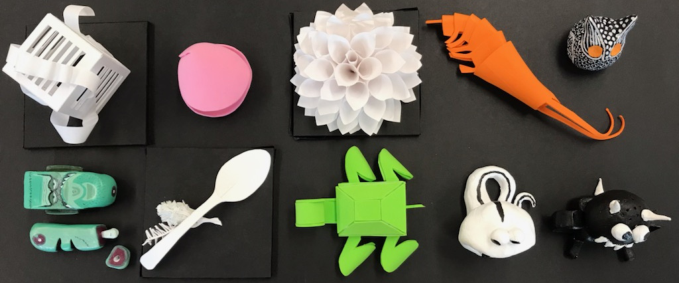
covering three-dimensional design theories. Along with lectures on the three- dimensional design theories we engaged in in-depth discussions focusing on how the theories related to everyday examples (e.g., furniture, clothing, products). These lectures and discussions were followed up in the studio environment by having the students look at and categorize a variety of three-dimensional hand-made models (see figure 2).
During our discussions and when categorizing the three-dimensional hand- made models we asked the students to look for the three-dimensional structu- res by determining what the dominant structure was and then looking into the subdominant and subordinate relationships within each model. Through- out the students’ exploration and categorization of the models and everyday objects, which meant the students’ pulled additional examples from the class- room that further connected the theories to the environment. By looking at and categorizing the models, the students are beginning to display their indi- vidual and collective understandings of the theories so they are better able to explore and incorporate these into their pillow fort.
Step 2: Constructing the Pillow Fort This is where the iterative play begins. Constructing the pillow fort is simple: students are asked to go to their current living environment is and build a pil- low fort out of any objects that support creating a three-dimensional space that they can crawl into. The central rules are: the pillow fort needs to use a variety of materials that help to explore the three-dimensional structures (e.g., sheets/blankets that are planar construction, broom handles that are curvilinear volumes, seat cushions that are rectilinear volumes, etc.); the pil- low fort must be large enough to fit at least one person inside (otherwise it is not a pillow fort); and the process of making the pillow fort must include playing and having fun.
It is important to note that the circumstances of each students living situ- ation can be vastly different, and so encouraging students to make the best out of what they have is key. Are they living in a student residence? If so, consider the different spaces in the residence, for example, consider invading the common room and making the pillow fort there (as long as they won’t
Figure 2: Examples of the three-dimensional hand-made models.
Pillow Forts: Teaching Design Through Play and Making 71
get in too much trouble). Are they living with their parents? Perhaps there’s a diverse range of furniture and pillows that can be used. Are they staying on a friend’s couch? Couches have cushions and other furniture in the room could be brought in to bring variety to the pillow fort. Along with a variety of different physical living situations, there are also different social situations. For instance, consider enlisting the help of a roommate, enlisting a friend or family member, or even consider making a pet-friendly area in the pillow fort. Flexibility is required of both the student and the instructor in this assi- gnment. There isn’t a right answer to the question of how to make a pillow fort. There are no right objects. In fact, the fort doesn’t need to include a sin- gle pillow, despite the name. Ultimately the pillow fort assignment is a little bit of a “wicked design problem” (Buchanan, 1992) that is best approached by playing with and through potential solutions.
Along the way and/or after the students have constructed their pillow forts, they are asked to photograph, sketch, and otherwise document their fort thoroughly. This documentation should have at least one overall shot (with a person and/or pet in the pillow fort for scale) and close-up photos or sketches that represent the theories. In order to present and critique the pillow fort assignment, the students are asked to make a well-designed poster using their photographs, sketches, and notes as content.
While constructing the pillow fort might take a single night, it is ideal if students can build it in stages and potentially leave it up for a while. In this way, across a week or two, the students can take time to play and be more actively engaged in the process including deep reflection on their learning.
Step 3: Critique and Presentation The pillow fort assignment is meant for a studio environment, and whether it is delivered online or in-person, presentation and critique maintain pivo- tal roles in the design process. Designers regularly submit their work to the approval of others. In the world outside of education, this often isn’t in a formal critique. Critique comes in many forms, often through casual conver- sations with peers, submitting work to a supervisor, or putting something out to the world and asking people to show their approval with their own hard- earned money. Interestingly, the students may encounter critiques from their friends or family before they come back into the design studio. We encourage them to talk with their peers, friends and family members to get tuned into discussion points for their more formal critique in studio.
In his book Art Critiques: A Guide, James Elkins (2014) reminds us that critiques are not tests, even though they have evaluative properties (p4). Cri- tiques are not simply conversations, but they should be conversational, not definitive (ibid, 6). While there is no right way to hold a critique (since cri- tiquing has no clear rules) it is important to establish expectations before each critique. Most design instructors will agree that, “criticism passes jud- gement, critique poses questions” (Christensen, 2016). In our critique for the pillow forts, we ask our students to discuss some of their key decisions, and to highlight the three-dimensional structures, relationships, and elements. We asked the students many questions including, for example: Which of the
72 Stielow and Strickfaden
three-dimensional structures were the hardest to find? Do the hierarchies change based on where you’re viewing your pillow fort from (above, below, side, back, etc.)? What were your limitations based on the materials you had at hand? Are there certain materials inherent to specific parts of the theories?
In general, an open-floor styled critique was used for the pillow fort assi- gnment to continue to promote play. The students were asked to put their posters up and then mingle around looking at each other’s posters and con- necting with common problems, solutions, and questions. Following this, the students were each asked to present their work capturing the highlights and examining the limitations of the three-dimensional design theories. The pillow fort was graded based on visual evidence of exploration, the content displayed on the poster, and the questions presented during critique.
The three steps outlined here that make up the method and implementa- tion of the pillow fort illustrate that deep learning is involved in the simple assignment of making a pillow fort. The next section elaborates on this deep learning.
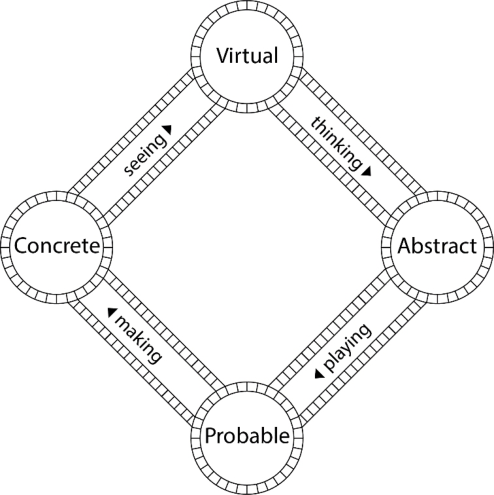
DEEP LEARNING THROUGH AN ONTOEPISTEMOLOGICAL METHODOLOGY The pillow fort assignment is created to support students to learn specific design content, in this case foundational three-dimensional design theories; however, it is also created to push students towards learning design pro- cesses that can be taken into other projects. The deep learning that our students engage in is described through an ontoepistemological methodology (see figure 3) that’s behind the pillow fort assignment.
Figure 3: The ontoepisemological methdology.
Pillow Forts: Teaching Design Through Play and Making 73
The central concept within this methodology is that the students become more aware of themselves as a designer, which is supported by the context of the assignment within their personal living environment. Although many design process methods, such as the Standford d.school’s Design Thinking Process (Balcaitis, 2019), start with empathy as their first step they do not provide specific ways to achieve greater empathy. One way that empathy can be better created with end-users and stakeholders is where “the designer is required to understand themselves in order to design better for others” (Strickfaden and Thomas, 2022, p. 26) The pillow fort assignment supports the students to explore and work through their own ontological states in experiential, three-dimensional, goal- oriented, and play-driven ways. Students begin with personal reflexivity and self-knowing in order to identify their biases when undertaking design for others. As Standford d.school’s Design Thinking Process is directed mainly toward designing for others, but without developing the designers understan- ding of the self alongside this, the designers (whether students or seasoned) will undoubtably unintentionally include their own values, beliefs, and biases into the design process.
The ontoepistemological methodology behind the pillow fort assignment combines Kolb’s experiential learning model (Kolb, 1981), the usage of Kolb’s model in deep learning (Gee, 2009; Ryan et al., 2012), and Shields’ Tetro- logy (Shields, 2006) interpreted through a design and material culture lens. For consistency, our methodological diagram is also made to look like a fort. The four major ontological states of Shields’ Tetrology are the towers. They act as points of entry, exit, and rest. The transitional actions between, interpreted form Kolb’s model, spans the distance between the ontological states as the wall-walks atop the wall. These serve as the means to move between the states while still being actively within the process. Kolb’s model uses four abilities for these transitional stages: “Concrete Experience, Refle- ctive Observation, Abstract Conceptualization, and Active Experimentation” (1981, pp. 235–236). The four ontological states of existence outlined by Shields, “Concrete, Virtual, Abstract, and Probable” (Shields, 2006, p. 285), line up with our ontoepistemological methodology very closely, but needed a little shift. In our methodology, we interpret Kolb’s “Concrete Experience” as ‘concrete’ followed by the experience that we identify as ‘seeing’. Kolb’s “Reflective Observation” now takes two steps, with an ontological state in the middle. We believe that the first thing a student does is ‘see’ something into the virtual space, and then they ‘think’ about them into abstraction. This also incorporates a portion of Kolb’s “Abstract Conceptualization”. Kolb’s “Active Experimentation” is replaced by ‘playing’ and the generation of pro- babilities, which is more of a change in vocabulary than a change in the process, as “Active Experimentation” has a similarly generative nature that incorporates both the formation of abstract concept and the testing of the new concepts. Finally, a return stage in which probabilities are made concrete though ‘making’.
Our ontoepistemological methodology creates a strong foundation for personal understanding, wherein:
74 Stielow and Strickfaden
students gain experience;
students can enter or exit the process from any ontological state;
a virtuality (e.g., a photo taken with a phone) can spark an idea or abstraction;
a probability (e.g., an illustration handed to them by a colleague) could be used to make a (concrete) prototype;
anything in this process can spark new ideas.
Each of the actions has a natural progression toward the next state, but it is not a strictly linear relationship. As with other design methodologies it is iterative: this process can be deconstructed, used in part, or used in reverse. Each action stage has an eddy-like quality of allowing movement in either direction between the states, especially play. As with eddies in water, the flow from one state to the next may be temporarily interrupted, or even flow backwards, but it will eventually move on or return to a normal flow.
By combining Kolb’s strictly linear model and Shield’s Tetrology into our ontoepistemological methodology, movement between states is supported. That is, when working in the pillow fort assignment, students experience an overall direction of movement while still accounting for activities that may move something back to a previous state (e.g., a pillow for collapsing because making didn’t go so well). The process of engaging in the pillow fort assignment provides space for student to develop their own flow while still giving a solid goal to keep them moving forward in the process. The following subsections deconstruct the five pillars of our ontoepistemological methodology: seeing, thinking, playing, making and reflexivity.
Seeing Seeing like a designer includes all forms of perception in some measure: tou- ching, smelling, hearing, and even taste because we all experience the world in an embodied way (Gibson, 1966). Seeing like a designer could also be cal- led perceiving like a designer, or even designerly perception. Before students can engage with the three-dimensional design theories they must be able to identify these elements in other concrete environments and virtualize them using some means of perception. This is why we begin by describing the the- ories, and then using everyday objects and small models as examples. Moving the assignment into the students living environment shifts it further. One of the major advantages to using a personal living environment is that it’s a concrete entry to a design process that is familiar and safe. Students know the objects in their personal space and how they are used, and don’t shy away from interacting with them. While using personal objects potentially makes students more subject to biases and key details being overlooked, the trade-off is that students will have the chance to reframe the use and inter- pretation of these objects. In contrast, if students were just presented with objects in a classroom, and asked to build a pillow fort from them, the stu- dents may not have seen or used the objects before and would have to make new associations with the object. This is where the beginnings of seeing like a designer happen. Shields characterizes memories as a virtuality, as things that
Pillow Forts: Teaching Design Through Play and Making 75
are virtual are both ideal, yet still real (2006, p. 285). What students are cre- ating by playing towards a pillow fort is a catalogue of short-term memories. Once the students begin to see objects that match with the three-dimensional design theories, they will create virtualities of those objects in their mind that are separate from the virtualities they already have of that object. Once they learn to perceive objects as more than the way they originally understood them to be, the next step is to shift these virtualities from something merely real, into that which is possible.
Thinking Designers are inherently forward thinking, because designing something that already exists is just history with extra steps. To think forward, or to think like a designer, requires taking a perceived reality and turning it into a pos- sibility. Until this point in the pillow forts assignment, we are asking the student to only focus on what is real, so how do we get them to abstract a virtuality and generate possibilities from it? This is where the chosen learning objectives of the assignment are extremely important. The simplest form of abstraction happens when the student applies the actions (listed in figure 1 as ‘elements’) to the virtuality. By adding to, subtracting from, manipulating, substituting, or otherwise combining virtualities, abstractions are generated. Could this cushion be considered a rectilinear volume? Possibly. Is this chair a planar construction? Possibly. Can I stack the two them together to make something different? Probably. That is where play becomes involved. Possi- bilities are still ideal; it is in playing with what is possible that students can actualize them into what will probably work.
Playing A designer who has forgotten how to play is a designer who has forgotten how to design. Play allows designers to rapidly actualize their ideas into pro- babilities. When a student is building a pillow fort, they are actually playing a kind of game. Legendary game designer Sid Meyer believes that games must have interesting choices, ones that are situational with trade-offs (Alexander, 2012). It is the rules of a game that make these choices interesting and Ryan et al. (2012) suggest that “Deep conceptual learning occurs when ideas are situated within a concrete task and driven by personal goals” (p. 6). For the pillow fort assignment, we gave students a game with concrete tasks (in a concrete space), but what are the students’ personal goals? The play that stu- dents engage in while building a pillow fort is the type of play characterized by Brian Sutton-Smith as both animal progress skill training and flexibility (Sutton-Smith, 1997, pp. 18–34). The robust ambiguity intrinsic to play lea- ves room for ideas to be removed from instinct and be opened to thought. In psychiatry, particularly acceptance and commitment therapy (ACT), this pro- cess is known as “defusion” (Gustafson, 2019, p. 7). In games, it is known as emergent gameplay. Pillow forts is, strictly speaking, not a game, but it does have a simple goal and rules (the learning objectives, the documenta- tion requirements, size, etc.) that make room for students to create their own interesting choices. Emergence exists best in spaces where there are rules, but
76 Stielow and Strickfaden
the rules may be bent creatively for the needs of individual players. In the design of a pillow fort, emergence happens as students find new roles for things that have another intended purpose originally. While the assignment may have stated goals, the interesting choices and personal goals will emerge as the student creates new probabilities from the possibilities they thought of. And while Ryan et al. (2012, p. 4) are correct in that learning, done correctly, is inherently fun, it truly becomes play as students progress across abstraction; testing their probabilities through making and experiencing how situations and trade-offs make designing full of interesting choices.
Making Depending on the available materials and desired probabilities, bringing a probability into the concrete, material world can be the greatest challenge of all. Some students may decide to take the path of least resistance and sim- ply put a bowl in the middle of the fort and call it a concave or convex, but others may use rope, lights, and a tea kettle to represent something more. The material sometimes does not want to cooperate, and no amount of duct tape will make that probability concrete. This process of concretization, fai- lure, and testing is what Pallasmaa refers to as “creative fusion”(Pallasmaa, 2009, p. 107). This is synonymous with the ACT concept of “fusing” an idea (Gustafson, 2019, p. 36) in that it deals with the mental concretization of a generated probability. Ingold describes how the flow of consciousness moves in parallel to the flow of material, and that stoppages in those flows, the image (virtual) and the object (concrete), are inextricably linked through our perspective. This mediates our growth within the streams of both con- sciousness and materiality through the constant interplay of observation and making (Ingold, 2013, p. 20). It is through making that the ontoepistemo- logical methodology loop is formalized, bringing ideas to the concrete state, making it easier to begin from observation again and start the process over.
Pillow Forts as a Reflexive Practice Kolb mentions that for experiential learning to work, students “must be able to involve themselves fully, openly and without bias”(Kolb, 1981, p. 235). Since bias is inevitable, the only thing we can do as students and designers is see and understand biases with reflexivity. Personal reflexivity is an active and ongoing process; more akin to a methodology than a method. The hum- ble pillow fort assignment is not a shortcut to a reflexive designer, but it is an assemblage of one’s material existence. People see the things in their living environments almost every day, but how much do we consider them? We like to use the example that humans can always see their nose, but our brains omit that information because it is always there. Omission is important in design. The things we choose to omit from a design are as important as the things we choose to show.
Living environments are typically very private spaces. Requiring students to present it to a group of peers gives them an opportunity actively decide what to present about themselves. People are accustomed to doing this regu- larly through our choices in clothing or hair, but it’s unlikely that someone
Pillow Forts: Teaching Design Through Play and Making 77
decided where to live based on what other people might think. Omission of this information is a default: most people don’t know anything about other people’s living situations, and so there is often no need to curate it to the degree that people curate with their clothes or cars. When required to show this space, and the objects in it, what do we choose to show? Not every stu- dent will be willing to present their bedroom to a class, so they will set up their pillow fort in a secondary space or edit things out in photos.
CONCLUSION
The future of pillow forts is uncertain because they are temporary. Pillow forts are meant to be put together and taken a part. Yet the pillow fort assi- gnment is as unlimited as the fort itself. It could be used to teach almost anything: colour theory, drawing, fabric draping, design processes, photo- graphy, advertising, design for disability, human centred designing, and even rich description. With the right criteria at the outset, the possibilities of what the pillow fort assignment can teach are endless. Even with a goal as sim- ple as basic three-dimensional design principles, students will learn how to observe, analyse, inventory, visualize, play, and make. While targeted at the introductory level, the reflexive nature of the pillow forts process could be useful in a variety of fields at all levels.
Furthermore, although the ontoepistemological methodology presented is to aid in describing the pillow fort assignment, it can be used to evaluate per- sonal design processes and other design assignments. This kind of descriptive methodology, like the pillow fort assignment, is not meant to be a conclu- sion, it’s meant to open up the way that we think about design and design education. With the emphasis that design thinking methodologies place on designing for others, it is significant to aid designers in becoming aware of their own role in the design process. It’s interesting that this can be accom- plished through an alternative methodology and by something as simple as building a pillow fort.
ACKNOWLEDGMENT
The authors would like to thank the Fall 2020, 2021 and 2022 students of HECOL 250 Introduction to Design Studies and Practices. Their parti- cipation in building pillow forts allowed us to conceive, reflect, refine, and analyse the assignment.
REFERENCES
Alexander, L., 2012. GDC 2012: Sid Meier on how to see games as sets of interesting decisions. Game Dev. URL https://www.gamedeveloper.com/design/gdc-2012-sid- meier-on-how-to-see-games-as sets-of-interesting-decisions (accessed 1.17.23). Balcaitis, R., 2019. Design Thinking models. Stanford d.school. Empathize IT.
URL https://empathizeit.com/design-thinking-models-stanford-d-school/ (acces- sed 1.26.23). Buchanan, R., 1992. Wicked Problems in Design Thinking. Des. Issues 8, 5–21.
https://doi.org/10.2307/1511637
78 Stielow and Strickfaden
Christensen, T., 2016. Four Things Working at Facebook Has Taught Me About Design Critique. Des. Meta. URL https://medium.com/designatmeta/critique-is- an-important-part-of-any-design-process-whether-you-work-as-part-of-a-team -or-solo-ef3dcb299ce3 (accessed 1.29.23). Elkins, J., 2014. Art Critiques: A Guide. New Academia Publishing. Gee, J. P., 2009. Deep Learning Properties of Good Digital Games: How Far Can
They Go?, in: Serious Games. Routledge. Gibson, J. J., 1966. The Senses Considered as Perceptual Systems, Houghton Mifflin, Boston. Gustafson, C., 2019. Reclaim Your Life: Acceptance and Commitment Therapy in 7
Weeks. Rockridge Press, California. Hannah, G. G., 2002. Elements of Design: Rowena Reed Kostellow and the Structure of Visual Relationships. Princeton Architectural Press. Ingold, T., 2013. Making | Anthropology, Archaeology, Art and Architecture.
Routledge. Kolb, D. A., 1981. Learning styles and disciplinary differences, in: The Modern American College. Jossey-Bass, San Francisco, California, pp. 232–255. Pallasmaa, J., 2009. The Thinking Hand: Existential and Embodied Wisdom in
Architecture. Wiley. Ryan, M., Costello, B., Stapleton, A., 2012. Deep Learning Games through the Lens of the Toy. Shields, R., 2006. Virtualities. Theory Cult. Soc. 23, 284–286. https://doi.org/10.
1177/026327640602300239 Strickfaden, M., Thomas, J., 2022. Designing in the Wild: Problem-solving for specialized apparel and soft products, in: Interdisciplinary Practice in Industrial Design. Presented at the AHFE (2022) International Conference, AHFE Open Acces. https://doi.org/10.54941/ahfe1002012 Sutton-Smith, B., 1997. The Ambiguity of Play. Harvard University Press, Cambridge, United States.
LISTED IN THE AHFE DIGITAL BOOKSTORE CATALOGUE
Explore the complete digital volume
Interdisciplinary Practice in Industrial Design
Read this individual research paper free through the original publisher, or explore the full digital proceedings book.
ISBN 978-1-958651-76-6
Explore this ISBN in the AHFE Bookstore ↗Listed in the July 2026 bookstore catalogue; search by ISBN to confirm current availability · Digital book purchase optional