Daniel Lock, David Gochfeld, Ben Kirman (2024). Hybrid Improvisational Theatre: A Thematic Review of the Production Processes. In: Human Interaction and Emerging Technologies (IHIET 2024). AHFE Open Access, vol. 157, pp. 345–354. https://doi.org/10.54941/ahfe1005494
Hybrid events, offering both in-person and online access, have become increasingly common, since the COVID-19 pandemic, as a way to make work and entertainment more accessible. Furthermore, growing uptake of modern consumer XR products has led to the development of a number of successful hybrid theatre productions. Such productions generally aim to offer an equally entertaining experience for both the in-person viewers and virtual, globe-spanning, audiences that attend performances online, through a range of different methods. However, while such theatre productions are being produced there has been limited academic work investigating its impact on the development of theatre production from the practitioner's perspective. This paper aims to rectify this by developing an in-depth understanding of the creative and technical challenges posed by hybrid theatre by examining the creation of one such production through interviews with the practitioners and audiences. For this purpose, researchers from the University of York collaborated with the theatre company FANDCO to develop a hybrid improvisational theatre production. To achieve this Unreal Engine, Motion Capture and projector screens were utilized to enable the actors to have a simultaneous in-person and virtual presence. The audience were similarly split, with the flexibility to view the performance either in-person at the theatre or online via a live video stream and a moderated interactive chat. After each showing the practitioners and in-person audience were invited to be interviewed and complete a questionnaire asking them to critically evaluate the overall experience. The online audience were sent a link to the questionnaire and provided the opportunity to be interviewed at a later date. To analyse the data a thematic analysis approach was adopted. The results in this paper highlight a clear understanding between the audience and the practitioners on how the process could be built upon to create captivating hybrid experiences. However, there is an interesting disparity between the two viewpoints on the difficulty of implementing change, setting an elevated expectation on what is viewed as possible compared to what can be achieved with the constraints of budget, time and resources. Overall it is clear that the process of creating hybrid performances could be improved to benefit both the audience and the practitioners but adopting such changes is limited by the resources available to the production team. We conclude that the use of hybrid technology positively affects the theatre space and provides opportunities for novel, exciting avenues for immersive and interactive productions. Furthermore, a rich understanding of the needs of practitioners and audiences can positively affect the theatrical production development process. The findings in this paper provide key insights into the challenges for creators and audience in the development of improvisational hybrid theatre productions and XR-based theatre more generally.
Hybrid events, offering both in-person and online access, have become increasingly common, since the COVID-19 pandemic as a way to make both work and entertainment more accessible (Vyas, 2022; Kurt, 2024). This global cultural shift along with the growing uptake in modern consumer XR products (Alsop, 2024) has contributed to the development of a number of well received hybrid theatre productions (Boosted, n.d.; Deakin, n.d.). Such productions generally aim to offer an entertaining experience for both in-person viewers and virtual, globe-spanning, audiences through the use of a range of different, often interactive, elements such as live steams, WebVR and live chats. This paper takes a different direction with a focus on understanding how the needs of both the practitioners
(Lock and Kirman, 2023) and audience may be realised to encourage co- beneficial development of future productions. To investigate these topics the researchers posed the following questions: What are the developmental challenges of hybrid theatre? What are the viewership challenges of hybrid theatre? What affordances can be made to support both perspectives? By concentrating on these questions; the outcomes of the study aimed to develop a rich understanding of the needs of both the practitioner and audiences. Through consideration of both perspectives; this paper identifies opportunities that may further the development of hybrid theatre productions while minimise compromises to quality, maximise viewer experience and reduce barriers faced by practitioners. For this purpose, researchers from the University of York collaborated with the theatre company FANDCO (Fandco, n.d.) to create a hybrid improvisational theatre production, from ideation to performance, interviewed both the production team and hybrid audience to and analysed the results through thematic analysis. The following paper will highlight nuances in hybrid theatre and related work within the area considering how the needs of both the practitioners and audiences are widely viewed in the immersive theatre space. The paper will then highlight the development process of ‘House of Masks’ the hybrid production developed in collaboration with FANDCO focusing on introducing how such productions are developed. Finally the paper will present a thematic analysis through data collected during interviews and via a questionnaire that highlight the needs of both practitioners and audiences. The main contribution of this paper is the rich understanding of how the development of hybrid production affect both the practitioners and audiences alike, highlighting how these two perspectives directly impact the other’s access to the space, focusing particularly on what can be achieved by a production with the correct tools and solutions available, allowing to captivate its audience through interaction and accessibility.
HOUSE OF MASKS House of Masks is a hybrid improvisational theatre production that was created for this research project through a collaboration between the researchers and the theatre company FANDCO (Fandco, n.d.). This section will provide a detailed overview of the production’s premise along with an outline of how the production work for the in-person and online audience members.
As an improvisational production the composition of this play was somewhat different to how regular plays are developed. A number of key areas of the performance, including the story, stage direction and locations, were not decided upon as part of the planning and development process. Instead, these details are decided upon during the live performance, with the audiences participation. This is common in improvisational theatre (Zaunbrecher, 2011) and is what forms part of the uniqueness of such productions, where no two shows are exactly the same. However, while such details did not exist an overarching story premise that outlined the world the
Hybrid Improvisational Theatre: A Thematic Review of the Production Processes 347
story was set in was created. This is often the case in large improvisational productions to ensure a high level of cohesion can be achieved. Within the premise of this production this was especially important as some aspects, such as the virtual set and atmosphere would need to be developed beforehand to ensure that their aesthetic matched the tone of the production.
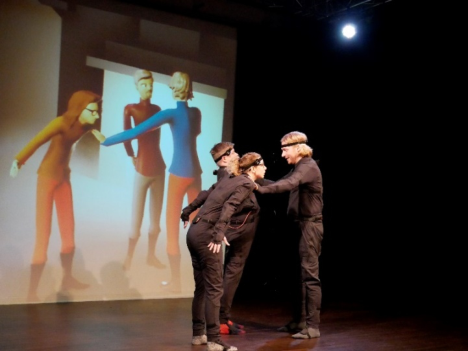
Figure 1: Actors preforming in the physical and virtual environments.
As a hybrid production the format can be expressed as two halves, the physical and the virtual. For the former the actors performed in a Black Box (Hannah, 2024) theatre with no props or costume. The only asset used was a projector screen that was placed behind the actors to show the virtual scene that the online audience were witnessing and to act as a backdrop adding further context to the production. In the latter, a virtual world created by FANDCO in Unreal Engine 4 (Unreal Engine 4, n.d.) was utilised. This consisted of two environments, a house and a cloud, and three avatars which were scans of the actors. To observe this environment the online audience were given a link to a YouTube live stream (Google, n.d.). To act between these two spaces simultaneously the actors wore Motion Capture suits and their movements were translated onto their virtual avatar providing accurate, one to one movements.
The development of the story as part of the live performance experience required a high level of collaboration between the actors and the audience. For this collaboration the audience were encouraged to provide prompts in the forms of phrases, actions and props that the actors would then build upon to steer and alter the direction of the story. This interaction was delivered via different formats to cater for the different audience viewing experience, the in-person audiences where provided with paper and asked to submit prompts before the show began whereas the online audience where actively asked throughout the production for prompts via an interactive live stream chat, theses prompts were then randomly selected. The researchers decided to create a new production for this project for two primary reasons, first to gain firsthand experience of the development process deepening their
understanding of the practitioners perspective enabling them to ask more meaningful questions during interviews. Second, to create an opportunity to collect first hand data from a production team and audience who had recently participated in a hybrid theatre production, be that via the development of said production or as a member of the audience, ensuring synergy in their responses to interview questions.
METHODS
Participant Recruitment Participants for this study were proactively recruited from both the in- person and online audiences. Both audiences were invited to participate in answering a questionnaire and were asked to participate through an informal invitation before they viewed the production, once the performance had concluded the researchers spoke to the in-person audience members directly and either interviewed them in the theatre or scheduled an interview for a later date. Online audience members where recruited in a similar way with the chat moderator offering a link to sign up to an interview. Both audiences where provided with a link to the questionnaire and asked to complete it. As discussed in the previous section, the choice of interviewing the audience of this production ensured that everyone has a similar definition and understanding of what a hybrid improvisational theatre production was. It would also ensure that the processes followed by the practitioners in creating this production would be critically reflected upon by the audiences enabling a rich discussion of how they could be altered and improved in the future.
Data Collection When conducting research on the audience two data collection methods were employed for this research project, questionnaires and semi-structured interviews. The questionnaire was created using Google Forms (Google Forms, n.d.) and consisted of a mix of questions that could be answered with either a multiple choice selection or though writing a short paragraph. Multiple choice questions where used to understand the status of the audience member responding to the questionnaire and included questions on their mode of viewership from the production and their overall experience in the area of hybrid improvisational theatre. The questions that required a short paragraph answer where directly related to the participants experience of the show and how they would critically evaluate the overall production.
The interviews were conducted using the video conference software Zoom (Zoom, n.d.). The use of semi structed interviews enabled research to keep on topic while opening up interesting areas discovered during the interview. Likewise, the practitioners were interviewed in the same manner as the audience, without the completion of a questionnaire. This decision was taken as the aim of the questionnaire was to enable the researchers to gain valuable and rich data from a large portion of the audience who might unavailable to take part in a longer interview. From the data collected
Hybrid Improvisational Theatre: A Thematic Review of the Production Processes 349
the questionnaire received 13 responses with 6 audience interviews and 7 practitioner interviews, due to the richness of the data in these interview no further interviews were conducted.
Data Analysis Once the interviews and questionnaires had been completed the data was prepared for analysis. To do this the interview recordings were transcribed and the questionnaire data extracted and formatted. To analyse the data the researchers preformed a thematic analysis using the processed developed by Braun and Clarke (Braun and Clarke, 2016). Utilising this method the researchers first read the formatted data multiple times to develop their familiarity of the data. This data was then analysed and coded by looking for patterns within the data which meant were in line with the research questions. After coding the data the codes were examined and 4 themes were developed that encompassed homogenous codes. After further coding of the data, the researchers developed 4 themes: Affective Collaboration, Opportunities Afforded by Improvisation, Disbalanced Hybridity and Positive Outlook on Production Issue. These themes highlight the critical feedback received from both the audience and practitioners with a focus on understanding their experiences of the hybrid production and where friction and opportunities for further collaboration between audiences and practitioners lay.
RESULTS
The four themes presented in this section provide insight into the developing relationship between the practitioners, the audience and their joint experience of a hybrid production. The rest of this section will break down the developed themes and provide context to the results.
Affective Collaboration An element running through the creation and viewing of the production is the development of a collaborative process between the improvisational actors and the audience where prompts are provided seamlessly before the production or through a live stream chat to steer the performance’s direction. This process requires a high level of trust between both parties in order to ensure the audience felt immersed in and part of the production. For the majority of the experience this goal was achieved leading to a high level of synergy between both the actors and the audience:
“The actors were talking after our first show and saying how we actually didn’t know that a lot of those suggestions were from the audience because they fit so beautifully.”
Furthermore it is clear that this deeper level of communal collaboration provided an positive increased level of immersion throughout the production for the audience in manner that may not be easily achieved in more non- hybrid improvisational production:
“It’s kind of like the audience is going ‘they [actors] are invested’ and they’re going on this with you or with them.”
Likewise, this is mirrored by the actors themselves who, without the use of technology, would have had to rely on the use of prompt given before the performance began, which could lack the context of the current pacing or may even result in short pauses in the production throughout to receive prompts which break the immersion for all: “Whereas what I think is beautiful about this [giving prompts through a chat] is it doesn’t break your immersion in the narrative and in the world and in the lives of these characters. Ah Yeah. So I think it’s that that seamlessness, that immersion … it’s not an interruption at all it just contributes to the flow.”
However, this collaborative method was not accessible to all audience members. With a focus on the live stream chat as a way to provide prompts during the performance the in-person audience were only able to observe the story progression. From the practitioner perspective this method is successful at allowing the pace and flow of the production to continue seamlessly: “In a live space to be able to facilitate, it would interrupt the flow, but by having it online and sort of a separate dedicated space, we’d have [Moderator] there filtering in case there is anything that is unhelpful.”
On the other hand, as this left a gap in the overall viewing experience for the in-person audience, which was not filled through a different interaction method. This led to several members of the in-person audience feeling dissociated with the collaborative process: “It was very interactive [at the] start obviously when they were like getting suggestions from the audience and bringing them all into it. I think afterwards it felt, it felt more like I was, you know, watching live theatre. I didn’t feel like I was in it, but I definitely was like invested in what was happening.”
Within this, several interviewed audience members suggested a solution that could be implemented with little to no extra resources required. The suggestion was to add a notification to the virtual scene that informed the audience what prompt had been selected; or was currently being used, which would help in person audiences identify the prompts easier and overcome any confusion created by the prompts in the scene: “An example of in what way they are being guided, what kind of suggestion they’re getting … it would just be good to know how fully improvised it all is and how much they’re being led by other people’s suggestions.”
Opportunities Afforded by Improvisation Improvisation is often utilised in productions that blend the line between theatre and technology. This is employed as a method to overcome issues
Hybrid Improvisational Theatre: A Thematic Review of the Production Processes 351
that may arise from working live with experimental technology, this was also present in this production: “At one point [actor’s] tracking broke and [their] head was in the floor, and that they took that as a as input for their improv and used that for a moment, until it got fixed. So I think there’s a lot of opportunities there that are really I’m excited to continue exploring it.”
However, House of Masks takes it a step further as a completely improvised performance. While this relies on the skill of the actors it also requires the technology to be robust and adapt to different prompts. Within these elements it is possible to argue that a difference in understanding can be found between the two perspectives as the audience wanted to see the two worlds, physical and virtual, more aligned: “The thing that I found most interesting was, when the actors were able to align with what was happening in the back, behind them. So I’d love to see more of that because it really connected the two, most of the time they were kind of just … disconnected.”
On the other hand, with the context of the actor’s constraints, it is clear that this is a direction the practitioners also wanted the production progress in, but due to limitations on what was possible with the technology used it could not be realised in the current format: “I’m ignoring the back screen. Because otherwise I’ll just stare at it And then my character will stare at it And it will go on forever in a kind of infinite loop.”
Ultimately this provides a starting point for investigating how and where improvements can be made to the hybrid improvisation theatre creative process both in terms of the setup, placement and feasibility of the technology and the high skill level of working within the space as an actor: “The director said he had taken the learning after to put monitors in front so they could interact.”
Disbalanced Hybridity Part of the process of creating a hybrid production is to ensure that an equal experience can be received by both in-person and online audiences. While this does not necessarily require both viewpoints to observe the production in a near identical way it does set an expectation that both audiences have a similar experience. Within the context of this research the practitioners aimed to deliver this by proving the in-person audience access to the virtual world though a projection which was met with a good level of success:
“Well as I say, for the first, for the first night I felt it was just, we’re just watching the actors because it doesn’t really matter what’s going on the screen. Whereas the second time I saw it, I felt like, oh, they are bringing more into what’s happening on screen so I can watch the screen and feel that’s like, I’m still getting the story, whereas I did it the first time.”
However, it is clear that the issue being faced by the audience is not the separation between the in-person and online viewing experience but the disparity in how the production are catering to the two leading to the audience to favour the in-person option to receive the full experience: “I think using that technology very much in the theatre space rather than just being something you can stream online is much more impressive and you get more it and it’s much more of a, of an experience. You come out and I’ve seen a show where there’s amazing aspects that are happening all around me. Whereas if you’re watching online, you don’t really know what’s going on.”
This does not suggest that the production provided unequal viewing experiences for the audience but rather that the process or ensuring the production itself is truly hybrid for all involved may require further immersive elements to be considered and included, as the practitioners have highlighted: “As an actor you still feel the presence of the audience and it affect the performance, and I think [you have to] sort of make that explicit and then look at how we take that out of the theatre building, because obviously it’s easier to have that connection if you’re in the same room with somebody.”
Positive Outlook on Production Issues The creation of anything new will come with issues and challenges that need to be addressed. This is no different with hybrid improvisational theatre where a degree of randomness through live prompts adds to the complexity of creating a robust experience. Factoring for such sets a high demand and causes strain on the resources, such as time, budget and expertise, available:
“From a technical perspective, obviously the overhead is significantly higher. We have to get in, set everything up much more in advance. Rehearsals are an interesting challenge where we have to kind of bear in mind where the tech may or may not be and then respond to that in the week when we get in [to the theatre].”
This can sometimes cause overestimations on what is possible within the space compared to the production itself as there is not often the context for what resources are available from the audience perspective: “I would’ve loved to see, to have more happen. Like if they, you went to different rooms in a house or, I don’t know, there was more there somehow.”
However, in the context of the House of Masks this was rarely seen. When discussing the issues in audience interviews, a deep level of understanding was exhibited: “It felt pioneering and so you were, you would forgive a lot of stuff, you know, which I think is a great way to do it because you know, you feel, as an audience member, like you’re seeing something really new.”
Hybrid Improvisational Theatre: A Thematic Review of the Production Processes 353
This may have been caused by the experimental nature of the production leading to a heightened interest from theatre and technology experts attending as audience members, nevertheless it suggest how audiences are developing an increasingly in-depth understating of what it can take to produce such technology lead productions: “It was very different from a, a normal improv show, but then they were doing something different. I think it will evolve. Over time as they become more used to it and we [the audience] become more used to it because it’s technological, that’s the thing.”
DISCUSSION
The results rationalised above provide an in-depth and rich investigation into the practitioner and audience perspectives on the creation, preforming and viewing of a hybrid improvisation theatre production. As an improvisational production the collaborative process of developing the story live, with prompts from the audience, is a highly important area of the production that required well developed improvisation methods to ensure it is implemented successfully. With this in mind there is a clear level of expectation from the audience on how this may be delivered, Whilst this was not identical across the two audience viewpoints, it did provide a well-developed and seamless way to send and receive prompts. As suggested by the audience, the collaboration could be further improved by providing the audience feedback in the form of a notification on what prompt was currently being used. It is also clear that the hybridity of the production could also be altered. Although the production worked well overall the experience of both the in-person and online audience was quite different. This is somewhat to be expected as, just like hybrid meeting using a mix of in-room and video conferencing software, there are parts of each viewing option that makes the experience unique. Although this is important to ensure that both viewpoints have an enjoyable and immersive experience, some areas such as giving prompts during the production, could be implemented for both audiences in a non-invasive and non-distracting way. With the use and combination of numerous, some experimental, technologies there is always a potential for technical issues to appear during the creative process. Although the majority of such issues are often resolved during the development of a production, it is somewhat inevitable that challenges may arise, more so in the case of improv productions due to the high level of randomness introduced by audience interaction and collaboration. In such instances, the strengths of improvisation can be seen and, in a similar way to VR theatre production (Lock, and Kirman, 2023) the use of improv enables the actors to overcome or explain away the problem by acknowledging it and proving context.
CONCLUSION
In conclusion, hybrid improvisational theatre is a novel form of theatre that combines the recent advances in immersive and interactive technology with the accessibility of hybrid and the timelessness of theatre. Through the analysis of data from practitioner and audience interviews there is a clear
path forward to continue the development and improvement of the creative hybrid improvisation theatre process.
FUTURE WORK
Throughout this paper it is clear that the area of hybrid improvisational theatre as both a mode of performance and an area of research is quite novel and has numerous areas that could be improved with a focus on its individual parts. With this in mind it is clear that the areas of technical implementation, prompt submission and hybrid integration are candidates for future studies that aim to develop a focused, in-depth understanding of how these areas could be enhanced, utilised and progressively built upon to improve the experience for both the practitioners and the audience.
ACKNOWLEDGMENT
The authors would like to thank FANDCO and Mary Stewart-David for the development and preforming of the House of Mask production, and StoryFutures for funding the research and development of the production.
REFERENCES
Alsop, T. (2024) VR headset unit sales worldwide 2024, Statista. Available at: https: //www.statista.com/statistics/677096/vr-headsets-worldwide/. Boosted. (no date). Crowdfunding Arts in New Zealand (no date) Boosted. Available
at: https://boosted.org.nz/projects/theatre-live-online Clarke, V. and Braun, V. (2016) ‘Thematic analysis’, The Journal of Positive Psychology, 12(3), pp. 297–298. doi: 10.1080/17439760.2016.1262613. Deakin, F. (no date) The galaxicle implosions, Fred Fandco. Available at: https://fred
deak.in/project/the-galaxicle-implosions/. Fandco (no date) FANDCO site. Available at: https://www.fandco.xyz/ Get started with live streaming - computer - youtube help (no date) Google.
Available at: https://support.google.com/youtube/answer/2474026?hl=en- GB&co=GENIE. Platform%3DDesktop. Google Forms (no date) Google forms: Online form creator | google workspace.
Available at: https://www.google.com/forms/about/ Hannah, D. (2024) ‘(I M) m a T E R (I a L I T Y) and the black-box theatre as an “empty space” of re-production’, idea journal, 4(1), pp. 23–33. doi: 10.37113/ideaj.vi0.229. Kurt, I. (2024) ‘Covid-19 and sociovirtualization: Exploring new ways to socialize’,
London Journal of Social Sciences, (7), pp. 23–36. doi: 10.31039/ljss.2024.7.186. Lock, D. and Kirman, B. (2023) ‘Identifying the developmental challenges of creating virtual reality theatre’, Proceedings of the 2023 ACM International Conference on Interactive Media Experiences [Preprint]. doi: 10.1145/3573381.3603359. Unreal Engine 4. (no date). The most powerful real-time 3D creation tool - unreal
engine (no date) Unreal Engine 4. Available at: https://www.unrealengine.com/e n-US. Vyas, L. (2022) “‘New normal” at work in a post-COVID world: Work–life balance and labor markets’, Policy and Society, 41(1), pp. 155–167. doi: 10.1093/polsoc/puab011. Zaunbrecher, N. J. (2011) ‘The elements of improvisation: Structural tools for spontaneous theatre’, Theatre Topics, 21(1), pp. 49–60. doi: 10.1353/tt.2011.0015. Zoom (no date) One platform to connect, Zoom. Available at: https://www.zoom.us/
LISTED IN THE AHFE DIGITAL BOOKSTORE CATALOGUE
Explore the complete digital volume
Human Interaction and Emerging Technologies (IHIET 2024)
Read this individual research paper free through the original publisher, or explore the full digital proceedings book.
ISBN 978-1-964867-33-5
Explore this ISBN in the AHFE Bookstore ↗Listed in the July 2026 bookstore catalogue; search by ISBN to confirm current availability · Digital book purchase optional