Letizia Artioli, Giovanni Borga, Pietro Costa (2026). Environmental Digital Twins: a review of challenges and opportunities. In: Human Interaction and Emerging Technologies (IHIET-FS 2026): Future Systems and Design Applications. AHFE Open Access, vol. 235, pp. 177–193. https://doi.org/10.54941/ahfe1007273
Digital Twin (DT) technology has emerged as a transformative paradigm for environmental monitoring, modelling, and sustainability governance, yet its development across ecological and territorial domains remains fragmented and unevenly documented in the literature. This review provides a systematic mapping of Ecological Digital Twin (EcoDT) and Environmental Digital Twin applications published between 2020 and 2025, analysing a corpus of 121 peer-reviewed studies spanning urban environments, agriculture, marine and coastal systems, river and lake networks, forestry, ecology, glaciers, Earth system science, and building sustainability. Drawing on a structured analytical matrix , the review focuses on Technology Readiness Level (TRL), remote sensing integration, data-related challenges, and future development priorities, interrogating Dts technological maturity, sustainability framing, and data readiness in practice. Results reveal a field in active but early-stage development: the TRL distribution is concentrated between levels 2 and 6, with no study in the corpus reaching deployment-ready status, and sustainability framing remains predominantly environmental in orientation, with social and economic co-benefits systematically underrepresented across nearly all application themes. Integration, interoperability, and calibration emerge as the most pervasive and structurally recurring technical constraints. Scaling and deployment, alongside governance and institutional alignment, dominate the stated future priorities of reviewed studies. The review concludes by advocating for the adoption of F.A.I.R., C.A.R.E., and T.R.U.S.T. data governance principles as a foundational framework for advancing EcoDTs and Environmental DTs towards integrated, equitable, and policy-relevant implementation at territorial and ecosystem scales.
Digital Twin (DT) technology has experienced marked growth in both scholarly attention and practical application since its inception within the manufacturing sector in 2002 (Grieves & Vickers, 2017), subsequently expanding into aerospace applications (Vickers et al., 2010, in Grieves, 2016) and, more recently, into ecological and environmental governance contexts. In its broadest formulation, a DT may be conceptualised as a triadic system comprising a physical entity, its digital counterpart, and the dynamic bidirectional connection enabling continuous interaction between the two (El Saddik, in Nativi et al., 2018). Since its inception, however, the concept has undergone considerable theoretical evolution, giving rise to a multiplicity of definitions that diverge according to structural configurations Received April 9, 2026; Revised April 23, 2026; Accepted May 13, 2026; Available online June 22, 2026
(Botín-Sanabria et al., 2022; Jones et al., 2020; Nativi et al., 2021; Saracco, 2019), application domains (Ferré-Bigorra et al., 2022; Kritzinger et al., 2018; Pylianidis et al., 2021), and sectoral priorities (Hazeleger et al., 2024; Nativi et al., 2021), an ambiguity that extends complexity in cross-domain comparison and comprehensive knowledge-building.
At the environmental scale, two domain-specific conceptualisations have begun to crystallise. The Ecological Digital Twin (EcoDT) is defined as “a dynamic digital representation of ecosystems integrating multi-scale ecological data, models, and feedback to explore interactions, predict trajectories, and inform management” (De Koning, 2025; De Koning et al., 2023). Complementarily, the Environmental Digital Twin (Environmental DT) is understood as “a continuously updated, data-driven virtual system integrating environmental observations, simulations, and decision-making frameworks to support sustainable management and policy” (Durden, 2025). Whilst sharing a commitment to data integration and dynamic updating, the two constructs are distinguishable by their primary object of representation: the ecosystem as a living, interacting whole (De Koning et al., 2023) versus the broader environmental and governance context (Durden, 2025); a distinction with material implications for system design, data requirements, and policy uptake. Both constructs are situated within major European and International policy frameworks, including the European Green Deal (European Commission, 2020; 2025) and the EU’s Destination Earth initiative (Hoffmann et al., 2023), and are increasingly recognised as transformative socio-technical tools capable of integrating heterogeneous datasets with artificial intelligence, assimilating real-time observations (De Koning et al., 2023; 2024), and supporting responses to anthropogenic pressures including climate change, biodiversity loss, and pollution (Purcell et al., 2023; Tzachor et al., 2023). Their contributions are further associated with circular economy transitions, the SDGs agenda (Ali Z.A. et al., 2025) and social sustainability dimensions (Hu et al., 2023; Omrany et al., 2024).Despite this momentum, DT applications for environmental and ecosystem monitoring remain insufficiently developed and systematically underrepresented in the literature (Blair, 2022; Durden, 2025). The existing body of work is dominated by conceptual frameworks, high-level roadmaps, and proof-of-concept demonstrations, with comparatively few studies achieving operational deployment or rigorous cross-contextual validation (Blair et al., 2019a; De Koning et al., 2023). This gap motivates the present review. Through a structured analysis of 121 peer-reviewed publications published between 2020 and 2025, spanning domains including urban environments, water systems, ecology, agriculture, marine ecosystems, forestry, and Earth system science, this paper interrogates not only what DTs are applied to, but how maturely, how sustainably framed, and how data-ready these applications are in practice. Two guiding research questions structure the analysis: (1) what is the definition of EcoDT and Environmental DT technologies and what are their defining characteristics? and (2) what are the principal features of the reviewed corpus in terms of Technology Readiness Levels (TRL) and identified challenges?
METHODOLOGY
This review follows a systematic literature review (SLR) protocol adapted from PRISMA guidelines to ensure transparency, reproducibility, and rigour in study identification and selection. A structured database search was conducted across Scopus and Google Scholar using Boolean strings centred on “digital twin” AND (“environment*” OR “sustainability” OR “urban” OR “ecology” OR “climate” OR “earth”), temporally bound to 2020–2025. The identification phase yielded 312 records. Following deduplication, 247 were retained for title and abstract screening; 69 were excluded for thematic irrelevance, yielding 178 papers for full-text assessment. A further 57 were excluded due to absent or insufficiently defined DT frameworks, producing a final corpus of 121 peer-reviewed publications (Figure 1). Each retained paper was coded against a structured analytical matrix (Excel Sheet) encompassing nine dimensions. Compound classifications were retained where dimensions were reported in combination; ambiguous entries were excluded from dimension-specific counts. Quantitative synthesis generated frequency distributions, cross-tabulations, and temporal trend analyses. Given the heterogeneity of included studies in methodology, scale, and disciplinary origin, results are presented as descriptive and comparative mappings aimed at identifying structural patterns and research gaps, with application themes serving as the primary contextual grouping variable.
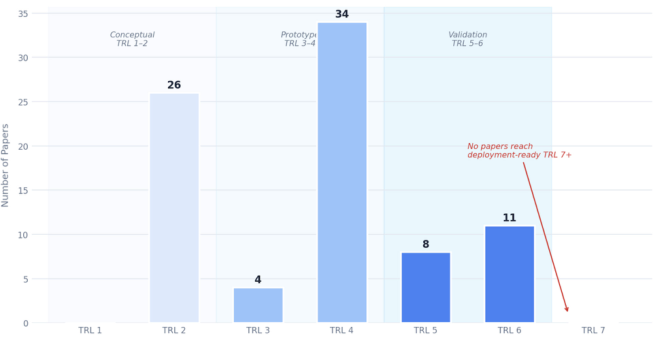
Figure 1: Technology Readiness Level (TRL) distribution across the corpus.
DISCUSSION
TRL Distribution, Data Challenges and Future Development Priorities Technological maturity and the deployment gap. The TRL distribution across the reviewed corpus reveals a field in active but early development, structurally concentrated between TRL 2 and TRL 6 (Figure 1). The modal range spanning conceptual formulation through validated prototype indicates that the dominant mode of contribution in the environmental DT literature
remains theoretical elaboration and small-scale demonstration, rather than operational deployment. Critically, no paper in the corpus reaches TRL 7 or above, the threshold at which a system is considered demonstrated in an operational environment. This finding carries significant implications for policy uptake: whilst the volume of DT-related publications has grown substantially since 2021, this growth has not been accompanied by a commensurate advance in implementation readiness. The concentration at TRL 3–4 (validated proof-of-concept) suggests that the field is producing a considerable volume of methodologically sound but practically premature outputs, a pattern consistent with the early phase of an emerging technology (Rotolo et al., 2015), characterised by high conceptual output and limited systemic diffusion. The absence of deployment-ready studies is particularly consequential in environmental governance contexts, where the translation of monitoring tools into actionable, institutionally embedded systems is a prerequisite for meaningful impact.
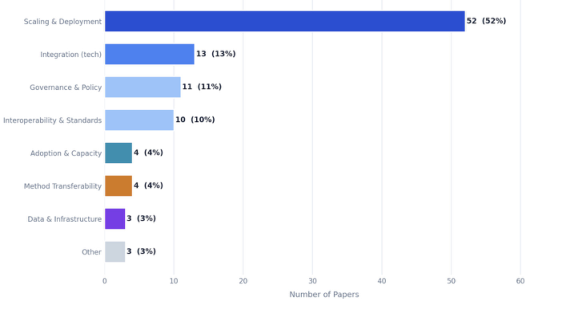
Challenges and future development priorities: scaling as the defining frontier. The categorised analysis of stated challenges and future development priorities (Figure 2) identifies Scaling and Deployment as the dominant unresolved concern across the corpus, a finding directly coherent with the TRL distribution: a field concentrated at proof-of-concept and prototype stages will naturally foreground the transition to operational deployment as its primary forward-looking priority. Critically, however, the prominence of Interoperability and Standards and Governance and Policy as the second and third most cited categories reveals that this transition is as much socio-institutional as it is technical. Individual DT implementations exist as largely isolated systems, unable to communicate across institutional and jurisdictional boundaries due to the absence of shared data standards and interoperable platforms, a structural impediment that directly echoes the integration barriers identified in Figure 2. The comparatively lower but analytically significant frequency of Adoption and Capacity challenges introduces a further undertheorised dimension: deployment readiness is not solely determined by technical maturity, but equally by the preparedness of the institutional and professional ecosystems into which DT systems must be embedded.
Figure 2: Challenges and future developments, categorised frequency across the corpus.
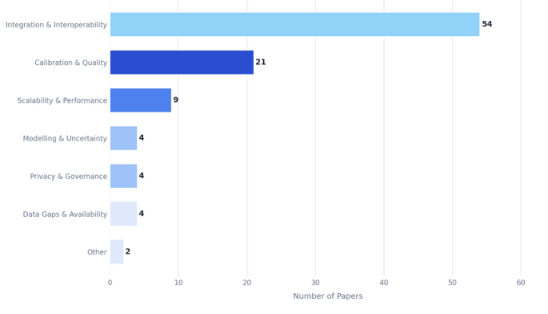
Environmental Digital Twins: A Review of Challenges and Opportunities 181 Data challenges as a systemic constraint. The categorised frequency of data-related challenges (Figure 3) reveals that Integration and Interoperability constitutes the single most prevalent barrier across the corpus, followed by Calibration and Quality, and Scalability and Performance. Taken together, these three categories account for the majority of reported constraints, and their co-occurrence across thematically distinct application domains (from urban systems to marine ecosystems and forestry) suggests that they are not domain-specific limitations but rather structural properties of the current EcoDT and Environmental DT development landscape. The recurrence of integration challenges is particularly revealing: it reflects the fundamental technical difficulty of operationalising the core DT “promise”: the fusion of heterogeneous, multi-source, multi-scale data streams into a coherent and continuously updated virtual representation. The prominence of governance and privacy challenges, whilst smaller in absolute frequency, deserves analytical attention disproportionate to its current representation in the literature. As DT systems scale towards operational deployment and begin to interface with institutional data infrastructures, questions of data ownership, access equity, and jurisdictional authority are likely to emerge as binding constraints of a non-technical nature. This finding aligns with Hazeleger et al. (2024) and Blair (2022), both emphasizing that the socio-institutional dimensions of DT governance remain systematically underdeveloped relative to their technical counterparts.
Figure 3: Data-related challenges across the corpus.
Across all three discussion dimensions(TRL maturity, data constraints, and future challenges priorities) the evidence consistently points to the same conclusion: advancing environmental DTs from conceptual promise to operational impact demands a coordinated response across technical, governance, and capacity dimensions simultaneously.
CONCLUSION AND FUTURE DIRECTIONS This review has provided a systematic mapping of 121 peer-reviewed EcoDT and Environmental Digital Twin applications published between 2020 and 2025 (full corpus listed in the References Section), revealing a
field of considerable conceptual vitality but persistent structural immaturity. Four findings emerge consistently across the analytical dimensions examined. First, the TRL distribution: concentrated between levels 2 and 6, with no study reaching operational deployment, confirms that the field is producing methodologically sound but practically premature outputs, whose translation into institutionally embedded systems remains the defining unmet challenge. Second, data-related constraints are not domain-specific but systemic: integration and interoperability, calibration and quality, and scalability recur across all application themes as structural barriers to the operationalisation of the core DT promise. Third, sustainability framing remains overwhelmingly environmental in orientation, with social and economic co-benefits systematically underrepresented, a paradox in a field that explicitly cites SDGs and sustainability transitions as primary objectives and aims. Fourth, scaling and deployment dominate stated future priorities, but the prominence of governance, institutional alignment, and adoption challenges confirms that the path to operational impact is as much socio- institutional as it is technical. Implementation, in environmental governance contexts, is the main challenge at the crossover of political, relational, and ethical dimensions related to data infrastructures. It is in this context that questions of data governance become foundational.
The present review therefore advocates the adoption of the F.A.I.R. (Findable, Accessible, Interoperable, Reusable) (Jacobsen et al., 2020; Wilkinson et al., 2016), C.A.R.E. (Collective Benefit, Authority to Control, Responsibility, Ethics) (Carroll et al., 2021), and T.R.U.S.T. (Transparency, Responsibility, User focus, Sustainability, Technology) (Lin et al., 2020) principles as an integrated governance framework for the next generation of EcoDT and Environmental DT development (Durden, 2025; Islam et al., 2024). These principles represent an evolving ethics of data stewardship that extends beyond accessibility towards epistemic justice, accountability, and relational integrity. The F.A.I.R. principles promote machine-actionable data infrastructures that enhance reproducibility and cross-disciplinary collaboration: directly addressing the integration and interoperability barriers identified in this review. The C.A.R.E. principles reframe openness as a situated practice requiring consent, reciprocity, and respect for collective rights, centring the social contexts in which environmental knowledge is produced and circulated. The T.R.U.S.T. principles further emphasise the institutional dimensions of stewardship, calling for enduring, transparent governance of data repositories that sustain both technical reliability and community confidence.
The relevance of this framework is amplified by the civic dimension of environmental DT data flows. Data in Environmental Dts systems shape governance, inform policy, and mediate participation. Citizens increasingly function as both producers and recipients of DT-generated knowledge, through citizen science initiatives, community monitoring programmes, and territorial co-mapping processes (Carroll et al., 2021; Jacobsen et al., 2020). This dual role carries profound implications: asymmetries in data ownership and governance risk positioning citizens as data subjects rather than data participants, reinforcing structural inequities in visibility, representation, and
Environmental Digital Twins: A Review of Challenges and Opportunities 183 decision-making (Floridi & Taddeo, 2018). By embedding F.A.I.R., C.A.R.E., and T.R.U.S.T. principles into DT system design from the outset,rather than retrofitting them at the governance stage future implementations can foster a civic data ethic in which transparency is understood not merely as technical openness, but as a practice of justice and mutual responsibility across epistemic, cultural, and technological domains (Han, 2015; Carroll et al., 2021).
ACKNOWLEDGMENT
The authors would like to acknowledge the use of Claude for syntax purpose and language clarity.
REFERENCES
A European strategy for data | Shaping Europe’s digital future. (n.d.). Retrieved 25 March 2026, from https://digital-strategy.ec.europa.eu/en/policies/strategy-data Abdeen, F. N., Shirowzhan, S., & Sepasgozar, S. M. E. (2023). Citizen-centric digital
twin development with machine learning and interfaces for maintaining urban infrastructure. Telematics and Informatics, 84, 102032. https://doi.org/10.1016/j. tele.2023.102032 Afsar, B., Eyvindson, K., Rossi, T., Versluijs, M., & Ovaskainen, O. (2024). Prototype Biodiversity Digital Twin: Forest Biodiversity Dynamics. Research Ideas and Outcomes, 10, e125086. https://doi.org/10.3897/rio.10.e125086 Aghdam, F. H., Rasti, M., Pongracz, E., & Anvari-Moghaddam, A. (2026). Digital
twin assisted real-time energy management system for smart homes. Energy and Buildings, 355, 116978. https://doi.org/10.1016/j.enbuild.2026.116978 Ali, Z. A., Zain, M., Raza, H., Pathan, M. S., AlSalman, H., & Almisned, F. A.
(2025). Digital twins: cornerstone to circular economy and sustainability goals. Environment, Development and Sustainability. https://doi.org/10.1007/s10668- 025-06221-4 Allen, T., Chen, Y.-H., Steiner, B., Mcleod, G., Katragadda, S., Terry, B., Baptist, J., Yetkin, O., Tahvildari, N., Han, S., Feldhaus, B., & Richter, H. (2024). An Open Data Cube Platform as a Coastal Digital Twin: Prototypes to Inform Flooding and Environmental Health (p. 2322). https://doi.org/10.1109/ IGARSS53475.2024.10641339 Ambarwari, A., Suwardhi, D., Rani, M. S., Husni, E., Junaidy, D. W., Agirachman,
F. A., Murtiyoso, A., & Griess, V. C. (2024). Conceptual Model of Graph-based Individual Tree and Its Utilization in Digital Twin and Metaverse of Urban Forest. The International Archives of the Photogrammetry, Remote Sensing and Spatial Information Sciences, XLVIII-4–2024, 7–12. https://doi.org/10.5194/isprs-archives- XLVIII-4-2024-7-2024 Arbizzani, E., Cangelli, E., Clemente, C., Cumo, F., Giofrè, F., Giovenale, A. M., Palme, M., & Paris, S. (Eds). (2023). Technological Imagination in the Green and Digital Transition. Springer International Publishing. https://doi.org/10.1007/978- 3-031-29515-7 Arsiwala, A., Elghaish, F., & Zoher, M. (2023). Digital twin with Machine learning
for predictive monitoring of CO2 equivalent from existing buildings. Energy and Buildings, 284, 112851. https://doi.org/10.1016/j.enbuild.2023.112851 Arts, K., Van Der Wal, R., & Adams, W. M. (2015). Digital technology and the conservation of nature. Ambio, 44(S4), 661–673. https://doi.org/10.1007/s13280- 015-0705-1
Banfi, F., Dellù, E., Stanga, C., Mandelli, A., Roncoroni, F., Sivilli, S., Pepe, G., & Cacudi, G. (2023). Representing Intangible Cultural Heritage of Humanity: From the Deep Abyss of the Past to Digital Twin and XR of the Neanderthal Man And Lamalunga Cave (Altamura, Apulia). The International Archives of the Photogrammetry, Remote Sensing and Spatial Information Sciences, XLVIII-M-2–2023, 171–181. https://doi.org/10.5194/isprs-archives-XLVIII-M-2-2023-171-2023 Barbie, A., Pech, N., Hasselbring, W., Flögel, S., Wenzhöfer, F., Walter, M., Shchekinova,
E., Busse, M., Türk, M., Hofbauer, M., & Sommer, S. (2022). Developing an Underwater Network of Ocean Observation Systems with Digital Twin Prototypes—A Field Report from the Baltic Sea. IEEE Internet Computing, 26(3), 33–42. https://doi.org/10.1109/MIC.2021.3065245 Barbier, E. B. (1987). The Concept of Sustainable Economic Development. Environmental Conservation, 14(2), 101–110. https://doi.org/10.1017/S0376892900011449 Barresi, A. (2023). Urban Digital Twin and urban planning for sustainable cities.
TECHNE - Journal of Technology for Architecture and Environment, (25), 78–83. https://doi.org/10.36253/techne-13568 Bartos, M., & Kerkez, B. (2021). Pipedream: An interactive digital twin model for natural and urban drainage systems. Environmental Modelling & Software, 144, 105120. https://doi.org/10.1016/j.envsoft.2021.105120 Biodiversity: State of habitats and species. (2025, December 11). https://www.eea.
europa.eu/en/topics/in-depth/biodiversity Blair, G. S. (2021). Digital twins of the natural environment. Patterns, 2(10), 100359.
https://doi.org/10.1016/j.patter.2021.100359 Blair, G. S., Henrys, P., Leeson, A., Watkins, J., Eastoe, E., Jarvis, S., & Young, P. J.
(2019). Data Science of the Natural Environment: A Research Roadmap. Frontiers in Environmental Science, 7, 121. https://doi.org/10.3389/fenvs.2019.00121 Botín-Sanabria, D. M., Mihaita, A.-S., Peimbert-García, R. E., Ramírez-Moreno, M. A., Ramírez-Mendoza, R. A., & Lozoya-Santos, J. D. J. (2022). Digital Twin Technology Challenges and Applications: A Comprehensive Review. Remote Sensing, 14(6), 1335. https://doi.org/10.3390/rs14061335 Buonocore, L., Yates, J., & Valentini, R. (2022). A Proposal for a Forest Digital Twin
Framework and Its Perspectives. Forests, 13(4), 498. https://doi.org/10.3390/ f13040498 Caprari, G., Castelli, G., Montuori, M., Camardelli, M., & Malvezzi, R. (2022). Digital Twin for Urban Planning in the Green Deal Era: A State of the Art and Future Perspectives. Sustainability, 14(10), 6263. https://doi.org/10.3390/su14106263 Carroll, S. R., Herczog, E., Hudson, M., Russell, K., & Stall, S. (2021). Operationalizing
the CARE and FAIR Principles for Indigenous data futures. Scientific Data, 8(1), 108. https://doi.org/10.1038/s41597-021-00892-0 Change (IPCC), I. P. on C. (2023). Climate Change 2022 – Impacts, Adaptation and Vulnerability: Working Group II Contribution to the Sixth Assessment Report of the Intergovernmental Panel on Climate Change. Cambridge University Press. Chen, G., Yang, J., Huang, B., Ma, C., Tian, F., Ge, L., Xia, L., & Li, J. (2023).
Toward digital twin of the ocean: From digitalization to cloning. Intelligent Marine Technology and Systems, 1(1), 3. https://doi.org/10.1007/s44295-023-00003-2 Chen, H., Fang, C., & Xiao, X. (2023). Visualization of Environmental Sensing Data in the Lake-Oriented Digital Twin World: Poyang Lake as an Example. Remote Sensing, 15(5), 1193. https://doi.org/10.3390/rs15051193 Chen, Y., Huang, H., Li, J., Zheng, Z., Gao, F., Han, X., & Gao, Y. (2025). Digital
twin comprehensive models: A study of ancient tree ecological environment quality assessment based on a cyber-physical system. Environmental Monitoring and Assessment, 197(4), 500. https://doi.org/10.1007/s10661-025-13923-9
Environmental Digital Twins: A Review of Challenges and Opportunities 185 Chinesta, F., El Khaldi, F., & Cueto, E. (2023). Hybrid Twin: An Intimate Alliance
of Knowledge and Data. In N. Crespi, A. T. Drobot, & R. Minerva (Eds), The Digital Twin (pp. 279–298). Springer International Publishing. https://doi. org/10.1007/978-3-031-21343-4_11 Chioni, C., Pezzica, C., & Favargiotti, S. (2024). Territorial Digital Twins: A key for increasing the community resilience of fragile mountain inner territories? Sustainable Development, 32(2), 1548–1563. https://doi.org/10.1002/sd.2688 Christin, S., Hervet, É., & Lecomte, N. (2019). Applications for deep learning in
ecology. Methods in Ecology and Evolution, 10(10), 1632–1644. https://doi. org/10.1111/2041-210X.13256 Cinquepalmi, F., & Piras, G. (2023). Earth Observation Technologies for Mitigating Urban Climate Changes. In E. Arbizzani, E. Cangelli, C. Clemente, F. Cumo, F. Giofrè, A. M. Giovenale, M. Palme, & S. Paris (Eds), Technological Imagination in the Green and Digital Transition (pp. 589–600). Springer International Publishing. Crespi, N., Drobot, A. T., & Minerva, R. (Eds). (2023). The Digital Twin. Springer
International Publishing. https://doi.org/10.1007/978-3-031-21343-4 Davison, A. M., De Koning, K., Taubert, F., & Schakel, J.-K. (2025a). Automated near real-time monitoring in ecology: Status quo and ways forward. Ecological Informatics, 89, 103157. https://doi.org/10.1016/j.ecoinf.2025.103157 Davison, A. M., De Koning, K., Taubert, F., & Schakel, J.-K. (2025b). Automated
near real-time monitoring in ecology: Status quo and ways forward. Ecological Informatics, 89, 103157. https://doi.org/10.1016/j.ecoinf.2025.103157 De Benedictis, R., Cesta, A., Pellegrini, R., Diez, M., Pinto, D. M., Ventura, P., Stecca, G., Felici, G., Scalas, A., Mortara, M., Cabiddu, D., Pittaluga, S., Spagnuolo, M., Silvestri, S., Damiano, E., Sicuranza, M., Ciampi, M., Tognola, G., Strambini, L., … Campana, E. F. (2025). Digital twins for intelligent cities: The case study of Matera. Journal of Reliable Intelligent Environments, 11(1), 6. https://doi.org/10.1007/s40860-025-00245-3 De Koning, K., Broekhuijsen, J., Kühn, I., Ovaskainen, O., Taubert, F., Endresen,
D., Schigel, D., & Grimm, V. (2023a). Digital twins: Dynamic model-data fusion for ecology. Trends in Ecology & Evolution, 38(10), 916–926. https://doi. org/10.1016/j.tree.2023.04.010 De Koning, K. The Crane Radar: Development and Deployment of an Operational Eco-Digital Twin. Ecological Informatics 2025, 85, 102938, doi:10.1016/j. ecoinf.2024.102938. Dembski, F., Wössner, U., Letzgus, M., Ruddat, M., & Yamu, C. (2020). Urban Digital
Twins for Smart Cities and Citizens: The Case Study of Herrenberg, Germany. Sustainability, 12(6), 2307. https://doi.org/10.3390/su12062307 Destination Earth. (n.d.). Destination Earth. Retrieved 24 March 2026, from https:// destination-earth.eu/ Duque, J. P., & Brovelli, M. A. (2022). Building a Digital Twin of the Italian Coasts.
The International Archives of the Photogrammetry, Remote Sensing and Spatial Information Sciences, XLVIII-4/W1-2022, 127–133. https://doi.org/10.5194/ isprs-archives-XLVIII-4-W1-2022-127-2022 Durden, J. M. (2025a). Environmental management using a digital twin. Environmental Science & Policy, 164, 104018. https://doi.org/10.1016/j.envsci.2025.104018 Easterday, D. W., Kelly. (2023, April 20). Environmental Digital Twins and Earth
Stewardship. Esri. https://www.esri.com/about/newsroom/blog/open-science- environmental-digital-twin European Commission. European Green Deal.Available online: Https://ec.europa.
eu/info/strategy/priorities-2019-2024/european-green-deal_ro (accessed on 25 February 2025). (n.d.).
European Digital Twin Ocean—Research and innovation—European Commission.
(2024, June 13). https://research-and-innovation.ec.europa.eu/funding/funding- opportunities/funding-programmes-and-open-calls/horizon-europe/eu-missions- horizon-europe/restore-our-ocean-and-waters/european-digital-twin-ocean_en Ewers, R. M. (2024). An audacious approach to conservation. Trends in Ecology & Evolution, 39(11), 995–1003. https://doi.org/10.1016/j.tree.2024.07.003 Fissore, V., Bovio, L., Perotti, L., Boccardo, P., & Borgogno-Mondino, E. (2023).
Towards a Digital Twin Prototype of Alpine Glaciers: Proposal for a Possible Theoretical Framework. Remote Sensing, 15(11), 2844. https://doi.org/10.3390/ rs15112844 Ferré-Bigorra, J.; Casals, M.; Gangolells, M. The Adoption of Urban Digital Twins.
Cities 2022, 131, 103905, doi:10.1016/j.cities.2022.103905. Flynn, K. J., Torres, R., Irigoien, X., & Blackford, J. C. (2022). Plankton digital twins—A new research tool. Journal of Plankton Research, 44(6), 805–805. https://doi.org/10.1093/plankt/fbac042 Fokaides, P., Jurelionis, A., & Spudys, P. (2022a). Boosting Research for a Smart
and Carbon Neutral Built Environment with Digital Twins (SmartWins). 2022 IEEE International Smart Cities Conference (ISC2), 1–4. https://doi.org/10.1109/ ISC255366.2022.9922513 Gallina, V., Torresan, S., Critto, A., Sperotto, A., Glade, T., & Marcomini, A. (2016).
A review of multi-risk methodologies for natural hazards: Consequences and challenges for a climate change impact assessment. Journal of Environmental Management, 168, 123–132. https://doi.org/10.1016/j.jenvman.2015.11.011 Gao, L., & Gao, Z. (2023). An optimal management architecture based on digital twin for smart solar-based islands incorporating deep learning and modified particle swarm optimization. Solar Energy, 262, 111872. https://doi.org/10.1016/j. solener.2023.111872 Garg, N., & Huang, S.-Y. (2023). Conjugated Materiality – Reinstating Material Circularity
via Digital Twins. 705–714. https://doi.org/10.52842/conf.caadria.2023.1.705 Ghandar, A., Ahmed, A., Zulfiqar, S., Hua, Z., Hanai, M., & Theodoropoulos, G.
(2021). A Decision Support System for Urban Agriculture Using Digital Twin: A Case Study With Aquaponics. IEEE Access, 9, 35691–35708. https://doi. org/10.1109/ACCESS.2021.3061722 Ghosh, S., Kayathri, V., Dickens, C., Retief, H., & Andarcia, M. G. (2025). Recent Drought Prevalence in the Limpopo River Basin: Insights from the Digital Twin Platform. Journal of the Indian Society of Remote Sensing. https://doi.org/10.1007/ s12524-025-02133-y Glatt, M., Kölsch, P., Siedler, C., Langlotz, P., Ehmsen, S., & Aurich, J. C. (2021). Edge-
based Digital Twin to trace and ensure sustainability in cross-company production networks. Procedia CIRP, 98, 276–281. https://doi.org/10.1016/j.procir.2021.01.103 Green, A. C., Lewis, E., Tong, X., & Wardle, R. (2025). A framework for incorporating rainfall data into a flooding digital twin. Journal of Hydrology, 656, 132893. https://doi.org/10.1016/j.jhydrol.2025.132893 Grieves, M. W. (2023). Digital Twins: Past, Present, and Future. In N. Crespi, A. T.
Drobot, & R. Minerva (Eds), The Digital Twin (pp. 97–121). Springer International Publishing. https://doi.org/10.1007/978-3-031-21343-4_4 Grieves, M. Origins of the Digital Twin Concept. 2016, doi:10.13140/ RG.2.2.26367.61609. Grieves, M.; Vickers, J. Digital Twin: Mitigating Unpredictable, Undesirable
Emergent Behavior in Complex Systems. In Transdisciplinary Perspectives on Complex Systems; Kahlen, F.-J., Flumerfelt, S., Alves, A., Eds.; Springer International Publishing: Cham, 2017; pp. 85–113 ISBN 978-3-319-38754-3.
Environmental Digital Twins: A Review of Challenges and Opportunities 187 Hämäläinen, M. (2021a). Urban development with dynamic digital twins in Helsinki
city. IET Smart Cities, 3(4), 201–210. https://doi.org/10.1049/smc2.12015 Hazeleger, W., Aerts, J. P. M., Bauer, P., Bierkens, M. F. P., Camps-Valls, G., Dekker, M. M., Doblas-Reyes, F. J., Eyring, V., Finkenauer, C., Grundner, A., Hachinger, S., Hall, D. M., Hartmann, T., Iglesias-Suarez, F., Janssens, M., Jones, E. R., Kölling, T., Lees, M., Lhermitte, S., … Vossepoel, F. C. (2024). Digital twins of the Earth with and for humans. Communications Earth & Environment, 5(1), 463. https:// doi.org/10.1038/s43247-024-01626-x Hejtmánek, L., Hůla, M., Herrová, A., & Surový, P. (2022). Forest digital twin as a
relaxation environment: A pilot study. Frontiers in Virtual Reality, 3, 1033708. https://doi.org/10.3389/frvir.2022.1033708 Hildebrandt, J., Leibl, L. M., Habich, D., & Lehner, W. (2024a). Development and Evaluation of a FIWARE-based Digital Twin Prototype for Road Systems: 1st International Workshop on Distributed Digital Twins, DiDit 2024. CEUR Workshop Proceedings, 3755. Hoffmann, J., Bauer, P., Sandu, I., Wedi, N., Geenen, T., & Thiemert, D. (2023).
Destination Earth – A digital twin in support of climate services. Climate Services, 30, 100394. https://doi.org/10.1016/j.cliser.2023.100394 Howard, D. A., Ma, Z., & Jorgensen, B. N. (2022). A Case Study of Digital Twin for Greenhouse Horticulture Production Flow. 2022 IEEE 2nd International Conference on Digital Twins and Parallel Intelligence (DTPI), 1–6. https://doi. org/10.1109/DTPI55838.2022.9998914 Huang, T., Chung, N. T., David, C. H., Hasheminassab, S., Kalashnikova, O. V.,
Perez, S., Roberts, J. T., Smith, B., Kumar, S. V., Biswas, N. K., Stackhouse, P., Borges, D., Baillarin, S., Bretar, F., & Rodriguez-Suquet, R. (2024). Open- Source Framework for Earth System Digital Twins. IGARSS 2024 - 2024 IEEE International Geoscience and Remote Sensing Symposium, 2323–2327. https:// doi.org/10.1109/IGARSS53475.2024.10642313 Huang, T., David, C. H., Oadia, C., Roberts, J. T., Kumar, S. V., Stackhouse, P. W., Borges, D., Baillarin, S., Blanchet, G., & Kettig, P. (2022). An Earth System Digital Twin for Flood Prediction and Analysis. IGARSS 2022-2022 IEEE International Geoscience and Remote Sensing Symposium, 4735–4738. Huang, T., Hasheminassab, S., Kalashnikova, O., Lee, H., & Roberts, J. (2024). An
Earth System Digital Twin for Air Quality Analysis (pp. 411–414). https://doi. org/10.1007/978-3-031-52670-1_41 Islam, S., Gordillo, J. L., Endresen, D., & Andrew, C. (2024). Bridging Data Standards and FAIR Principles in Biodiversity Digital Twinning: Prototyping, Challenges, Lessons Learned, and Future Plans. Biodiversity Information Science and Standards, 8, e133089. https://doi.org/10.3897/biss.8.133089 Jiang, F., Ma, L., Broyd, T., Chen, W., & Luo, H. (2022). Digital twin enabled
sustainable urban road planning. Sustainable Cities and Society, 78, 103645. https://doi.org/10.1016/j.scs.2021.103645 Jin, J., & Zhu, M. (2024). Towards Adaptive and Resilient Strategies Using Digital Twins: A Study on the Port of Tyne, UK. In A. Cheshmehzangi, M. Batty, Z. Allam, & D. S. Jones (Eds), City Information Modelling (pp. 165–184). Springer Nature Singapore. https://doi.org/10.1007/978-981-99-9014-6_9 Kang, T. W., & Mo, Y. (2024). A comprehensive digital twin framework for building
environment monitoring with emphasis on real-time data connectivity and predictability. Developments in the Built Environment, 17, 100309. https://doi. org/10.1016/j.dibe.2023.100309
Karolos, I. A., Bellos, K., Alexandridisale, V., Chrysafis, I., Georgiadis, H., Pikridas, C., Tsioukas, V., Patias, P., & Mallinis, G. (2024). Advancing forest biodiversity conservation with the EL-BIOS digital twin: An integration of LiDAR and multispectral earth observation data. In S. C. Michaelides, D. G. Hadjimitsis, C. Danezis, N. Kyriakides, A. Christofe, K. Themistocleous, & G. Schreier (Eds), Tenth International Conference on Remote Sensing and Geoinformation of the Environment (RSCy2024) (p. 40). SPIE. https://doi.org/10.1117/12.3037300 Klippel, A., Sajjadi, P., Zhao, J., Wallgrün, J. O., Huang, J., & Bagher, M.
M. (2021). EMBODIED DIGITAL TWINS FOR ENVIRONMENTAL APPLICATIONS. ISPRS Annals of the Photogrammetry, Remote Sensing and Spatial Information Sciences, V-4–2021, 193–200. https://doi.org/10.5194/ isprs-annals-V-4-2021-193-2021 Komninos, A., & Tsigkas, G. (2022). Prototyping a Digital Twin System for Environmental Education. Proceedings of the 26th Pan-Hellenic Conference on Informatics, 361–366. https://doi.org/10.1145/3575879.3576018 Korenhof, P., Blok, V., & Kloppenburg, S. (2021). Steering Representations—
Towards a Critical Understanding of Digital Twins. Philosophy & Technology, 34(4), 1751–1773. https://doi.org/10.1007/s13347-021-00484-1 Kritzinger, W., Karner, M., Traar, G., Henjes, J., & Sihn, W. (2018). Digital Twin in manufacturing: A categorical literature review and classification. IFAC- PapersOnLine, 51(11), 1016–1022. https://doi.org/10.1016/j.ifacol.2018.08.474 Lee, S., Kalmus, P., Ferraz, A., Goodman, A., Pearson, K., Doran, G., Platt, F., Hu, B.,
Ekanayaka, A., Chakraborty, S., Kang, E., Zhang, J., Dahiyat, S., & Cavanaugh, K. (2024). Ecopro: Ecological Projection Digital Twin. 2311–1214. https://doi. org/10.1109/IGARSS53475.2024.10640554 Lehtola, V. V., Koeva, M., Elberink, S. O., Raposo, P., Virtanen, J.-P., Vahdatikhaki, F., & Borsci, S. (2022). Digital twin of a city: Review of technology serving city needs. International Journal of Applied Earth Observation and Geoinformation, 114, 102915. https://doi.org/10.1016/j.jag.2022.102915 Li, X., Feng, M., Ran, Y., Su, Y., Liu, F., Huang, C., Shen, H., Xiao, Q., Su, J., Yuan,
S., & Guo, H. (2023). Big Data in Earth system science and progress towards a digital twin. Nature Reviews Earth & Environment, 4(5), 319–332. https://doi. org/10.1038/s43017-023-00409-w Li, Y., Zhang, T., Ding, Y., Wadhwani, R., & Huang, X. (2024). Review and perspectives of digital twin systems for wildland fire management. Journal of Forestry Research, 36(1), 14. https://doi.org/10.1007/s11676-024-01810-x Lin, D., Crabtree, J., Dillo, I., Downs, R. R., Edmunds, R., Giaretta, D., De Giusti, M.,
L’Hours, H., Hugo, W., Jenkyns, R., Khodiyar, V., Martone, M. E., Mokrane, M., Navale, V., Petters, J., Sierman, B., Sokolova, D. V., Stockhause, M., & Westbrook, J. (2020). The TRUST Principles for digital repositories. Scientific Data, 7(1), 144. https://doi.org/10.1038/s41597-020-0486-7 Lu, Q., Parlikad, A. K., Woodall, P., Don Ranasinghe, G., Xie, X., Liang, Z., Konstantinou, E., Heaton, J., & Schooling, J. (2020). Developing a Digital Twin at Building and City Levels: Case Study of West Cambridge Campus. Journal of Management in Engineering, 36(3), 05020004. https://doi.org/10.1061/(ASCE) ME.1943-5479.0000763 Maimour, M., Ahmed, A., & Rondeau, E. (2024). Survey on digital twins for natural
environments: A communication network perspective. Internet of Things, 25, 101070. https://doi.org/10.1016/j.iot.2024.101070 Martino, P. D., Ferraioli, E., Maragno, D., & Musco, F. (2026). Living with Water: Toward an amphibious planning paradigm for multi-risk territories. Contesti. Città, Territori, Progetti, 156–179. https://doi.org/10.36253/contest-16564
Environmental Digital Twins: A Review of Challenges and Opportunities 189 Miedtank, A., Schneider, J., Manss, C., & Zielinski, O. (2024). Marine digital twins
for enhanced ocean understanding. Remote Sensing Applications: Society and Environment, 36, 101268. https://doi.org/10.1016/j.rsase.2024.101268 Moigne, J. L. (2022). NASA’S Advanced Information Systems Technology (AIST): Combining New Observing Strategies and Analytics Frameworks to Build Earth System Digital Twins. IGARSS 2022 - 2022 IEEE International Geoscience and Remote Sensing Symposium, 4724–4727. Mondal, N., Anand, P., Khan, A., Deb, C., Cheong, D., Sekhar, C., Niyogi, D., &
Santamouris, M. (2024). Systematic review of the efficacy of data-driven urban building energy models during extreme heat in cities: Current trends and future outlook. Building Simulation, 17(5), 695–722. https://doi.org/10.1007/s12273- 024-1112-y Monserrate, S. G. (2022). The Cloud Is Material: On the Environmental Impacts of Computation and Data Storage. MIT Case Studies in Social and Ethical Responsibilities of Computing, (Winter 2022). https://doi.org/10.21428/2c646de5.031d4553 Mõttus, M., Dees, M., Astola, H., Dałek, S., Halme, E., Häme, T., Krzyżanowska, M.,
Mäkelä, A., Marin, G., Minunno, F., Pawlowski, G., Penttilä, J., & Rasinmäki, J. (2021). A Methodology for Implementing a Digital Twin of the Earth’s Forests to Match the Requirements of Different User Groups. GI_Forum, 1, 130–136. https://doi.org/10.1553/giscience2021_01_s130 Mrosla, L., Fabritius, H., Kupper, K., Dembski, F., & Fricker, P. (2025). What grows, adapts and lives in the digital sphere? Systematic literature review on the dynamic modelling of flora and fauna in digital twins. Ecological Modelling, 504, 111091. https://doi.org/10.1016/j.ecolmodel.2025.111091 Nativi, S., Mazzetti, P., & Craglia, M. (2021). Digital Ecosystems for Developing
Digital Twins of the Earth: The Destination Earth Case. Remote Sensing, 13(11), 2119. https://doi.org/10.3390/rs13112119 Nica, E., Popescu, G. H., Poliak, M., Kliestik, T., & Sabie, O.-M. (2023). Digital Twin Simulation Tools, Spatial Cognition Algorithms, and Multi-Sensor Fusion Technology in Sustainable Urban Governance Networks. Mathematics, 11(9), 1981. https://doi.org/10.3390/math11091981 Omrany, H., & Al-Obaidi, K. (2024). Application of digital twin technology for
Urban Heat Island mitigation: Review and conceptual framework. Smart and Sustainable Built Environment, 14. https://doi.org/10.1108/SASBE-05-2024-0189 Open-Source Framework for Earth System Digital Twins. (2024). IGARSS 2024 - 2024 IEEE International Geoscience and Remote Sensing Symposium, 2323–2327. Opoku, D.-G. J., Perera, S., Osei-Kyei, R., Rashidi, M., Bamdad, K., & Famakinwa,
T. (2024). Digital twin for indoor condition monitoring in living labs: University library case study. Automation in Construction, 157, 105188. https://doi. org/10.1016/j.autcon.2023.105188 Otsu, K., & Maso, J. (2024). Digital Twins for Research and Innovation in Support of the European Green Deal Data Space: A Systematic Review. Remote Sensing, 16(19), 3672. https://doi.org/10.3390/rs16193672 Ovaskainen, O., Lauha, P., Lopez Gordillo, J., Nokelainen, O., Rahman, A., Souza,
A., Talaskivi, J., Tikhonov, G., Vancraeyenest, A., & Lehtiö, A. (2024). Prototype Biodiversity Digital Twin: Real-time bird monitoring with citizen-science data. Research Ideas and Outcomes, 10, e125523. https://doi.org/10.3897/rio.10.e125523 Ovaskainen, O., Winter, S., Tikhonov, G., Lauha, P., Lehtiö, A., Nokelainen, O., Abrego, N., Aroluoma, A., Harrison, J. P., Heikkinen, M., Kallio, A., Koliseva, A., Lehikoinen, A., Roslin, T., Somervuo, P., Souza, A. T., Tahir, J., Talaskivi, J., Turunen, A., … Dunson, D. (2026a). A digital twin for real-time biodiversity forecasting with citizen science data. Nature Ecology & Evolution, 10(3), 481– 495. https://doi.org/10.1038/s41559-025-02966-3
Patel, U. R., Ghaffarianhoseini, A., Ghaffarianhoseini, A., & Burgess, A. (2024).
Digital Twin Technology for sustainable urban development: A review of its potential impact on SDG 11 in New Zealand. Cities, 155, 105484. https://doi. org/10.1016/j.cities.2024.105484 Perkl, D. D. W., Ryan. (2022, September 13). Protecting Point Conception, California—Maps and Sensors Aid Science. Esri. https://www.esri.com/about/ newsroom/blog/digital-twin-conserving-california-coast Pillai, U. P. A., Pinardi, N., Alessandri, J., Federico, I., Causio, S., Unguendoli,
S., Valentini, A., & Staneva, J. (2022). A Digital Twin modelling framework for the assessment of seagrass Nature Based Solutions against storm surges. Science of The Total Environment, 847, 157603. https://doi.org/10.1016/j. scitotenv.2022.157603 Popescu, D., Dragomir, M., Popescu, S., & Dragomir, D. (2022). Building Better Digital Twins for Production Systems by Incorporating Environmental Related Functions—Literature Analysis and Determining Alternatives. Applied Sciences, 12(17), 8657. https://doi.org/10.3390/app12178657 Purcell, W., & Neubauer, T. (2023). Digital Twins in Agriculture: A State-of-the-
art review. Smart Agricultural Technology, 3, 100094. https://doi.org/10.1016/j. atech.2022.100094 Purcell, W., Neubauer, T., & Mallinger, K. (2023). Digital Twins in agriculture: Challenges and opportunities for environmental sustainability. Current Opinion in Environmental Sustainability, 61, 101252. https://doi.org/10.1016/j. cosust.2022.101252 Purvis, B., Mao, Y., & Robinson, D. (2019). Three pillars of sustainability: In
search of conceptual origins. Sustainability Science, 14(3), 681–695. https://doi. org/10.1007/s11625-018-0627-5 Pylianidis, C., Osinga, S., & Athanasiadis, I. N. (2021a). Introducing digital twins to agriculture. Computers and Electronics in Agriculture, 184, 105942. https://doi. org/10.1016/j.compag.2020.105942 Rotilio, M., Villa, V., & Corneli, A. (2023). Digital Twin for a resilient management
of the built environment. 2023 IEEE International Workshop on Metrology for Living Environment (MetroLivEnv), 113–117. https://doi.org/10.1109/ MetroLivEnv56897.2023.10164033 Rouja, P., Schneider, C., Rissolo, D., Blasco, S., Petrovic, V., Lo, E., Lightbourne, M., Tucker, W., & Kuester, F. (2022). The Royal Naval Dockyard in Bermuda: Use of a novel biological indicator and historical photographs for measuring local sea- level rise. International Journal of Maritime History, 34, 634–657. https://doi. org/10.1177/08438714221143297 Saltelli, A., Gigerenzer, G., Hulme, M., Katsikopoulos, K. V., Melsen, L. A., Peters,
G. P., Pielke, R., Robertson, S., Stirling, A., Tavoni, M., & Puy, A. (2024). Bring digital twins back to Earth. WIREs Climate Change, 15(6), e915. https://doi. org/10.1002/wcc.915 Saracco, R. Digital Twins: Bridging Physical Space and Cyberspace. Computer 2019, 52, 58–64, doi:10.1109/MC.2019.2942803. Schneider, J., Klüner, A., & Zielinski, O. (2023). Towards Digital Twins of the Oceans:
The Potential of Machine Learning for Monitoring the Impacts of Offshore Wind Farms on Marine Environments. Sensors, 23(10), 4581. https://doi.org/10.3390/ s23104581 Schrotter, G., & Hürzeler, C. (2020). The Digital Twin of the City of Zurich for Urban Planning. PFG – Journal of Photogrammetry, Remote Sensing and Geoinformation Science, 88(1), 99–112. https://doi.org/10.1007/s41064-020-00092-2
Environmental Digital Twins: A Review of Challenges and Opportunities 191 Skákala, J., Awty-Carroll, K., Menon, P. P., Wang, K., & Lessin, G. (2023). Future
digital twins: Emulating a highly complex marine biogeochemical model with machine learning to predict hypoxia. Frontiers in Marine Science, 10, 1058837. https://doi.org/10.3389/fmars.2023.1058837 Skobelev, P., Tabachinskiy, A., Simonova, E., & Goryanin, O. (2022). Development of crop-simulation multiagent system for smart digital twin of plant. 2022 VIII International Conference on Information Technology and Nanotechnology (ITNT), 1–8. https://doi.org/10.1109/ITNT55410.2022.9848748 Soiland-Reyes, S., Goble, C., & Groth, P. (2024a). Evaluating FAIR Digital Object
and Linked Data as distributed object systems. PeerJ Computer Science, 10, e1781. https://doi.org/10.7717/peerj-cs.1781 Spreitzer, G., Schalko, I., Boes, R. M., & Weitbrecht, V. (2022). Towards a nonintrusive method employing digital twin models for the assessment of complex large wood accumulations in fluvial environments. Journal of Hydrology, 614, 128505. https://doi.org/10.1016/j.jhydrol.2022.128505 Steward, J., Furlong, J., Stutz, R., Cox, R., Highley, J., Wang, H., Johnstone, C.,
McBride, P., Noto, J., Kelly, R., Nguyen, R., Wilson, J., Shaxted, M., Long, M., Torreria, A., & Gary, S. (2024). Unleashing the Power of ‘What If’: Cloud- Enabled High Performance Computing Workflows in Digital Twins for Scenario Exploration (p. 2318). https://doi.org/10.1109/IGARSS53475.2024.10642587 Tarpanelli, A., Bonaccorsi, B., Sinagra, M., Domeneghetti, A., Brocca, L., & Barbetta, S. (2023). Flooding in the Digital Twin Earth: The Case Study of the Enza River Levee Breach in December 2017. Water, 15(9), 1644. https://doi.org/10.3390/ w15091644 Taubert, F., Rossi, T., Wohner, C., Venier, S., Martinovič, T., Khan, T., Gordillo, J.,
& Banitz, T. (2024). Prototype Biodiversity Digital Twin: Grassland biodiversity dynamics. Research Ideas and Outcomes, 10, e124168. https://doi.org/10.3897/ rio.10.e124168 Temple, L., Viale Pereira, G., & Klausner, L. D. (2024). Unravelling the Use of Digital Twins to Assist Decision- and Policy-Making in Smart Cities. Resilience Through Digital Innovation: Enabling the Twin Transition, 755–764. https://doi. org/10.18690/um.fov.4.2024.45 Teutscher, D., Bukreev, F., Kummerländer, A., Simonis, S., Bächler, P., Rezaee, A.,
Hermansdorfer, M., & Krause, M. J. (2025). A Digital Urban Twin Enabling Interactive Pollution Predictions and Enhanced Planning. SSRN. https://doi. org/10.2139/ssrn.5154970 The European Green Deal—European Commission. (n.d.). Retrieved 25 March 2026, from https://commission.europa.eu/strategy-and-policy/priorities-2019-2024/ european-green-deal_en The Universe of Trees: A Journey from Space to Earth. Sustainability and Digital Trees:
The Role of Satellites, In-Situ Sensors and Citizen Science. (n.d.). Proceedings.Com. Retrieved 24 March 2026, from https://www.proceedings.com/078366-0004.html Therias, A., & Rafiee, A. (2023). City digital twins for urban resilience. International Journal of Digital Earth, 16(2), 4164–4190. https://doi.org/10.1080/17538947.2 023.2264827 Trantas, A., Plug, R., Pileggi, P., & Lazovik, E. (2023). Digital twin challenges
in biodiversity modelling. Ecological Informatics, 78, 102357. https://doi. org/10.1016/j.ecoinf.2023.102357 Van Meerten, J., & Smit, K. (2024). The Impact of Digital Twin Technology on the Policy Lifecycle in Government Agencies and the Role of Value-Sensitive Design in Guiding its Ethical Development. Proceedings of the 2024 8th International Conference on Software and E-Business, 37–44. https://doi.org/10.1145/3715885.3715891
Vasilijevic, A., Brönner, U., Dunn, M., García-Valle, G., Fabrini, J., Stevenson-Jones, R., Bye, B. L., Mayer, I., Berre, A., Ludvigsen, M., & Nepstad, R. (2024). A Digital Twin of the Trondheim Fjord for Environmental Monitoring—A Pilot Case. Journal of Marine Science and Engineering, 12(9), 1530. https://doi.org/10.3390/ jmse12091530 Vasilikis, N., Geertsma, R., & Coraddu, A. (2023). A digital twin approach for
maritime carbon intensity evaluation accounting for operational and environmental uncertainty. Ocean Engineering, 288, 115927. https://doi.org/10.1016/j. oceaneng.2023.115927 Verdouw, C., Tekinerdogan, B., Beulens, A., & Wolfert, S. (2021). Digital twins in smart farming. Agricultural Systems, 189, 103046. https://doi.org/10.1016/j. agsy.2020.103046 Villani, L., Gugliermetti, L., Barucco, M. A., & Cinquepalmi, F. (2025). A Digital
Twin Framework to Improve Urban Sustainability and Resiliency: The Case Study of Venice. Land, 14(1), 83. https://doi.org/10.3390/land14010083 Wang, Z., Gupta, R., Han, K., Wang, H., Ganlath, A., Ammar, N., & Tiwari, P.
(2022). Mobility Digital Twin: Concept, Architecture, Case Study, and Future Challenges. IEEE Internet of Things Journal, 9(18), 17452–17467. https://doi. org/10.1109/JIOT.2022.3156028 Weil, C., Bibri, S. E., Longchamp, R., Golay, F., & Alahi, A. (2023). Urban Digital Twin Challenges: A Systematic Review and Perspectives for Sustainable Smart Cities. Sustainable Cities and Society, 99, 104862. https://doi.org/10.1016/j. scs.2023.104862 Weiland, C., Grieb, J., Bauer, D., Chala, D., Kusch, E., Andrew, C., & Endresen,
D. (2024). Dataspace Integration for Agrobiodiversity Digital Twins with RO-Crate. Biodiversity Information Science and Standards, 8, e134479. https:// doi.org/10.3897/biss.8.134479 White, G., Zink, A., Codecá, L., & Clarke, S. (2021). A digital twin smart city for citizen feedback. Cities, 110, 103064. https://doi.org/10.1016/j.cities.2020.103064 Wilkinson, M. D., Dumontier, M., Aalbersberg, Ij. J., Appleton, G., Axton, M., Baak,
A., Blomberg, N., Boiten, J.-W., Da Silva Santos, L. B., Bourne, P. E., Bouwman, J., Brookes, A. J., Clark, T., Crosas, M., Dillo, I., Dumon, O., Edmunds, S., Evelo, C. T., Finkers, R., … Mons, B. (2016). The FAIR Guiding Principles for scientific data management and stewardship. Scientific Data, 3(1), 160018. https://doi. org/10.1038/sdata.2016.18 Yang, T., Palattella, M., Chitu, C., Claudon, P., & Boukhebouze, M. (2024). Digital Twin as a Service for Sustainable Agriculture in Africa: A case study from the ESA DT4CMI project. 1–6. https://doi.org/10.1109/IHTC61819.2024.10855079 Yu, P., Lang, H., Galang, J. I., & Xu, Y. (2023). The Role of Digital Twin in Accelerating
the Digital Transformation of Smart Cities: Case Studies in China. In P. Yu, X. Hu, A. Prakash, N. W. Misuko, & G. Haiyue (Eds), Advances in Wireless Technologies and Telecommunication (pp. 155–177). IGI Global. https://doi.org/10.4018/978- 1-7998-9266-3.ch008 Yu, W., Patros, P., Young, B., Klinac, E., & Walmsley, T. G. (2022). Energy digital twin technology for industrial energy management: Classification, challenges and future. Renewable and Sustainable Energy Reviews, 161, 112407. https://doi. org/10.1016/j.rser.2022.112407 Zeng, Y., Verhoef, A., Vereecken, H., Ben-Dor, E., Veldkamp, T., Shaw, L., Van
Der Ploeg, M., Wang, Y., & Su, Z. (2025). Monitoring and Modeling the Soil- Plant System Toward Understanding Soil Health. Reviews of Geophysics, 63(1), e2024RG000836. https://doi.org/10.1029/2024RG000836
Environmental Digital Twins: A Review of Challenges and Opportunities 193 Zhang, A., Wang, F., Li, H., Pang, B., & Yang, J. (2024). Carbon emissions
accounting and estimation of carbon reduction potential in the operation phase of residential areas based on digital twin. Applied Energy, 376, 123155. https:// doi.org/10.1016/j.apenergy.2024.123155 Zhang, R., Hou, M., Dong, Y., & Li, Y. (2025). Digital twin-based risk assessment method for dynamic monitoring of heavy rain disasters in rammed earth city site: A case study of the Puzhou ancient city. Bulletin of Engineering Geology and the Environment, 84(6), 268. https://doi.org/10.1007/s10064-025-04274-3 Zhao, D., Li, X., Wang, X., Shen, X., & Gao, W. (2022). Applying Digital Twins to
Research the Relationship Between Urban Expansion and Vegetation Coverage: A Case Study of Natural Preserve. Frontiers in Plant Science, 13, 840471. https:// doi.org/10.3389/fpls.2022.840471 Zhivkov, P., Fidanova, S., & Dimov, I. (2025). Digital Twin-Based Framework for Real-Time Monitoring and Analysis of Urban Mobile-Source Emissions. Atmosphere, 16(6), 731. https://doi.org/10.3390/atmos16060731 Zlatev, Z., & Dimov, I. (2022). Using a Digital Twin to Study the Influence of Climatic
Changes on High Ozone Levels in Bulgaria and Europe. Atmosphere, 13(6), 932. https://doi.org/10.3390/atmos13060932
LISTED IN THE AHFE DIGITAL BOOKSTORE CATALOGUE
Explore the complete digital volume
Human Interaction and Emerging Technologies (IHIET-FS 2026): Future Systems and Design Applications
Read this individual research paper free through the original publisher, or explore the full digital proceedings book.
ISBN 979-8-950676-11-6
Explore this ISBN in the AHFE Bookstore ↗Listed in the July 2026 bookstore catalogue; search by ISBN to confirm current availability · Digital book purchase optional