Cheng Zhai, Jie Zhang, Tingting Cao (2024). Design of Intelligent Accompanying Playsets for ADHD Children under the Concept of STEAM Education. In: Training, Education, and Learning Sciences. AHFE Open Access, vol. 155, pp. 153–162. https://doi.org/10.54941/ahfe1005400
Under the education model that promotes independent learning and growth, children's intelligent educational toys have attracted much attention. Purpose of the study ADHD is a common psychological disease that hinders the learning and growth of school-age children, and the current smart companion toys make it challenging to meet the needs of children and parents practically. First, the design principles are summarized based on the design and development process of smart toy market research. Then, we analyze the demand level and psychological level of the dual-user groups of the child-raiser user and the school-age child user sides and determine the classification of the demand attributes of the intelligent accompanying toys for children with ADHD. Finally, the content framework is designed, and the principle and debugging are carried out based on STEAM education. A new intelligent companion product that meets the physiological and psychological development characteristics of ADHD children and focuses on the needs of dual users is designed. The product design model is constructed and the design strategy is refined from theme setting, emotional interaction, and appearance shaping, which provides a reference for the design of intelligent companion toys for children with ADHD.
Attention Deficit Hyperactivity Disorder (ADHD) is a behavioral disorder of childhood and is often referred to as ADHD by parents and teachers. The number of children with ADHD in China is more than 23 million, and the incidence rate is increasing year by year. The prevalence rate of this disorder is about 6.3%, and most of the children show the symptoms when they are at school age. Children with ADHD are affected by the maintenance of order in teaching and their learning, as they need attention, cognition, and self-control to enter the learning state at school age (Hua et al., 2020).
ADHD is a common psychological disorder that hinders learning and growth in school-age children, and there is a lack of sufficient attention and appropriate intervention methods for children with ADHD problems. Stud- ies have shown that the flexible use of multisensory channels to input sensory information can effectively train and intervene in the attention, behavior,
learning and other psychological and behavioral functions of children with ADHD (Yanhong, 2018). China has incorporated STEAM education into its domestic education goals since 2017, and the core of this pedagogy is to teach for fun and cultivate comprehensive quality skills. Therefore, the article com- bines the STEAM education concept for ADHD children to design a smart companion toy for systematic training.
RESEARCH BACKGROUND Behavioral interventions are more frequently used for children with ADHD, in addition to medication and physical therapy, to build muscle and relieve symptoms (see Table 1). Behavioral interventions focusing on different train- ing objectives are used to guide the behavior of children with ADHD and to improve their self-control and self-emotional control, thus improving the symptoms of ADHD (Chanrong, 2018).
Table 1. Existing intervention and training methods for children with ADHD.
Table available in the original PDF paper.
Training activities Training goal
Intervention training methods
Handling tasks/Stay focused
Attention training Tracking targets/Memory games/Problem-solving games
Self-awareness/Control behavior
Self-control training Counting method /Control of impulsive behavior/Task decomposition Social skill training Role-playing/Situational simulation/Feedback training
Set goals/Schedule Administrative time
Social communication skills Organization/time management training
STEAM education theory was first proposed by the United States, empha- sizing the integration of science, technology, engineering, art, mathematics, and other disciplines to promote interdisciplinary learning and creative think- ing. The theory of education focuses on developing a comprehensive quality of human resources and applying theoretical knowledge in an integrated manner. Integrate, and the lack of education foster children’s ability to solve real-world problems, promote multi-dimensional mastery of subject knowledge, and contribute to the overall development of comprehensive abilities.
There are some fits between the STEAM education philosophy and inter- vention training for children with ADHD. For one thing, both advocate comprehensive learning and encourage the integration of disciplines and the development of comprehensive thinking skills (Zhangwei et al., 2021). Intervention training for children with ADHD usually adopts the compre- hensive approach of the Mind-Brain Cognitive Training System to help children develop multifaceted skills and enhance comprehensive thinking and problem-solving abilities (Xin et al., 2023). Secondly, STEAM education
Design of Intelligent Accompanying Playsets for ADHD Children 155
incorporates hands-on learning with the age-specific characteristics of the learners, which helps them to acquire knowledge better and develop skills (Chunxia, 2020). ADHD children also train their neurological and cognitive abilities medically with interpersonal interactive games (Jianjun et al., 2019). Third, children with ADHD may have unique creative potential, and inter- vention training can promote the development of creative expression and thinking skills.
Adjustment of China’s fertility policy has led to an increase in the num- ber of children, bringing new opportunities for the children’s toy market and expanding the market space. Post-80s and 90s parents are keen on early edu- cation and smart toys and are concerned about children’s companionship. According to the 2020 imported mother and child consumption trend white paper report, the toy market shows potential, and the scale of early educa- tion toy sales is rising. In the e-commerce platform search for “smart toys” keywords, covering intelligent robots, experimental sets, blocks, and other products, the status analysis is summarized below:
1. China is the world’s second-largest toy consumer market, is also the largest toy producer and the best-selling products are primarily foreign toy brands, the domestic educational products’ independent innovation ability and production differentiation are insufficient, mostly imitation of foreign excellent design or color to attract consumers the first view, for the user’s needs and the actual interactive effect of the lack of in-depth study.
2. Combined with the current domestic market research on intelligent toys and according to the product activity area and children’s ability to exercise the perspective of analysis of the existing typical products are divided into intelligent education, command action class, the construction of products, different categories of toys can tend to have different characteristics: intelli- gent education class by the screen and anthropomorphic image, interactive feedback, highlighting the educational; intelligent command action class toys in the form of the structure of the joints can be active, the bottom has a driv- ing wheel for tracking The intelligent command action toys are in the form of movable structural joints, with driving wheels at the bottom for trajec- tory movement, highlighting the mobility of vitality; intelligent construction products are composed of removable block modules, highlighting the fun and play, and need to be studied in advance.
3. Based on Piaget’s age division theory, the toys analyzed in the current domestic market are arranged according to the two axes of play and age. It is found that smart toys for different age groups show significant differ- ences in function: toy design for 0–2 years old stage focuses on soft and safe, bright colors, non-toxic, and preventing accidental ingestion; toy design for 2–7 years old stage focuses on improving hands-on and verbal communica- tion skills; toy design for 7–11 years old stage emphasizes assembling and hearing enhancement, with a broader range of applications to assist chil- dren’s daily life. 7–11year-olds are in the concrete computing stage, and they gradually play a role in influencing purchase decisions in the family. The 7–11year-olds are in the concrete computing stage, and they gradually play a role in influencing the family’s purchasing decisions. Parents consider
children’s opinions, but the final purchase decision still rests with the par- ents; toy design for children over 12 promotes logical problem-solving and multi-modal assembly.
4. According to the analysis of functional components and technology, analyze all the functional components involved in intelligent toys and the technology used in each product. Provide the basis for the principle machine functions for the subsequent product design phase, see Table 2.
Table 2. Toy function element.
Table available in the original PDF paper.
Functional element Technique Power supply method USB Charging/DC Round Power Cord/Battery 7/Wireless Charging Metal Contact Port/Type-C Screen types Led dot matrix/Led display/IPS display User Interface Touch screens/Buttons/Cell phone screens/Tablet screens Wake-up method Vibration sensing/Voice recognition/ Infrared ranging/Acoustic distance sensing/Key switches/Metal contacts Feedback type Voice/Blinking/Vibration/Light flashing/Direction of movement/Music playback Interactive form Card placement/Building blocks/Remote control/Map planning/Action paths Learning style Instruction manual/App step-by-step guide/3d assembly step-by-step video/Voice guide/On-screen tutorial step-by-step
5. With the popularization of the STEAM education concept, smart toy design incorporating this concept has gradually become the first choice of users. The mainstream assembling products in the market have not fully cul- tivated children’s comprehensive ability, and overly complex play may also go against the original intention of education. On the other hand, when par- ents buy toys, they pay attention to the educational benefits and their impact on children’s psychology. Intelligent educational toys not only focus on edu- cation but also provide psychological accompaniment. The design focuses on balancing playability and education. Weakly emphasize the educational nature, fully consider the playability and fun, and create a pleasant and autonomous learning environment for children. Intelligent companion toys can enhance children’s interactivity, and it is easier for children to interact with them to create a sense of security and emotional support. The design should consider the results of children’s and parents’ research, consider chil- dren’s physiological and psychological development, and ensure that the degree of play and difficulty is realistic.
User Requirements Analysis The term “dual-user”is commonly used in the computer and cell phone fields to refer to two different user systems. In user research, “dual-user” refers to the study of a two-tiered network of user relationships. The “dual-user phe- nomenon” includes direct and indirect product consumers. Children’s toys
Design of Intelligent Accompanying Playsets for ADHD Children 157
are special products for both parents and children, and the main purchasing consumers are parents, whose purchasing decisions consider the children’s wishes, prices, and the parents’ subjective cultivation purposes. As the pri- mary users, children lack economic capacity and need the help of direct consumers (parents). Thus they are indirect consumers but direct users who use the product. In children’s toys, dual users involve dual users of guardians and children. In specific user studies, the needs and experiences of these two types of users are relatively independent, making it necessary to investigate and analyze them separately.
Children with ADHD exhibit hyperactivity, distractibility, and impulsive behaviors and have difficulty with concentration and self-control (Wei et al., 2013). In mid-childhood, myelin sheaths in the brain develop rapidly, which enhances communication with muscles and facilitates better control of move- ments. Thus, children should be able to perform refined and specialized movements during school age flexibly. However, the physical characteris- tics of school-age children with ADHD make it difficult for them to learn, socialize, and function in everyday life. Children with ADHD often need more companionship and support to resolve difficulties, unlock potential, and enhance their sense of self-efficacy. These children have difficulties with self-control and regulation and need adult guidance and supervision to effec- tively manage impulses, attention, and task completion. Companionship and support can help them control their emotions and develop positive emotion regulation strategies. School-age children have developing cognitive abilities, increased short-term memory capacity, and faster information processing. Children derive psychological satisfaction and motivation from the emotional value of relationships, which promotes physical and mental health and sus- tained learning behaviors (Ziqiang, 2021). Even though children spend more time in school and less time with their parents, parents remain important influential players in children’s lives. Effective parental presence can greatly influence parent-child emotions and subjective well-being, contributing to children’s development (Xingxu et al., 2019).
In the preliminary user data finding phase, we collected data through three channels, including academic research websites, news reports, and video observations of user use. We learned that the current research focuses on the relationship between accompaniment and children’s mental health. Sci- entific parenting is an effective accompaniment, such as assisting scientific parenting with the help of products; however, accompanying children with parents doing their things without joint interaction is inadequate. Through the field observation of offline children’s playgrounds, we have learned that there is a lack of effective accompaniment and interaction in the process of accompaniment, and it is difficult for parents to participate in the interaction. By analyzing the 76 valid responses collected from the online questionnaire, the preliminary findings suggest that the existing forms of accompaniment include playing with toys, outdoor activities, and teaching subjects. However, traditional toys are considered to have an average accompanying effect, while smart accompanying products are criticized for their prolonged exposure to screens, low interactivity, and limited intelligence. The survey results show
that parents prefer intelligent machine pets, learning machines, and compan- ion robots, outside of the expectation of children’s all-around development. Parents expect product features to enhance children’s visual-spatial, physical- motor, and language learning development, and expect fun and safety in play. Screen-less designs are favored for their hands-on experience. Parents pri- oritize toys that can be used in various scenarios and hope that toys will increase satisfaction with companionship, improve parent-child interactions, and meet children’s needs for companionship.
From user interviews with 4 parents and 4 children of the new generation of 80–90s, it was learned that dual-users have different concerns about toys, with parents preferring companion toys with hands-on experiences. In con- trast, children want parental involvement during play, seeking recognition and appreciation. The data collected encompassed a variety of demand fac- tors. We organize and analyze this data to extract demand keywords as in Table 3, which helps us to gain insights into users’ needs and provide basic directions for further research.
Table 3. Company demand reasons.
Table available in the original PDF paper.
Users Factor Reasons Direct users Learning needs Knowledge learning / Physical muscle building / Emotional intelligence development / Interest nurturing / Skill acquisition Accompaniment needs Emotional interaction/Verbal communication/safety issues of being alone/Emotional outpouring Socialization Social withdrawal/Exposure to physical/Virtual character interactions Buyers Emotional needs Lack of common topics/Inability to interact together/ Busy working and unable to stay with the child for an extended period of time/Wanting the child to have a holistic development
Design Practice of Intelligent Companion Toys for School-Age Children With ADHD While STEAM educational toys on the market are designed to impart knowl- edge and foster creativity, the high cost of learning, limited entry points for parental involvement, and the fact that children with ADHD have poorer ability to focus compared to the general population make the actual use of the products ineffective and the process experience of the users unsatisfactory. To address this issue, we propose design modifications to simplify learn- ing costs and make STEAM toys more accessible to children with ADHD, thereby facilitating the realization of practical learning experiences. The Smart Companion Toys are designed to promote logical cognition in children
Design of Intelligent Accompanying Playsets for ADHD Children 159
with ADHD, help busy parents accompany their children’s healthy devel- opment, and enrich parent-child interaction. The toys incorporate animal elements that increase affinity and create a sense of an electronic pet compan- ion. Skin-friendly and safe materials enhance children’s willingness to interact with these toys. Product development and design are based on preliminary research results, focusing on age-appropriate design and maintaining educa- tional value while improving playability and companionship. The following functional settings were obtained after refining the needs of both parents and children as shown in Table 4.
Table 4. Demand factors correspond to the specific content.
Table available in the original PDF paper.
Demand factors Specific content Manipulative ability Toolkit Attention Coherent Steps/Motivation for Success Logicality Step-by-step instruction guide/Guidance video Playability Staged Play/Follow-up skill learning Educative Characteristic Parts Cognition/Teaching Animal Habits and Characteristics Self-efficacy Level Incentives/Achievement Rewards
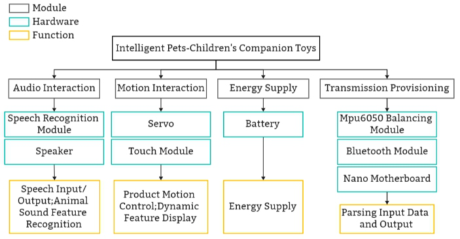
Provide tutorial steps to guide children to assemble various parts of the board through snapping, magnetic suction, and pasting to complete the over- all appearance of the shape of the assembly creation and exercise children’s hands-on ability. Through voice interaction or touch interaction, feel the life characteristics of different pets, precautions, and parenting characteristics to enter the pet system. The accompanying toy’s play is characterized by the ability to freely switch between different pets’ activity mode characteristics, gait, character, and children in play to exercise children’s logical ability and learn relevant pet knowledge. Hardware systems to add different animals belong to the biological function of the components of the animal character characteristics, limb dynamic characteristics of the characteristics of cogni- tive learning, and ultimately, the overall presentation. The overall framework of the principle machine hardware is shown in Figure 1.
The principle machine simulation test is based on the Arduino Nyb- ble framework for motion experimentation and testing. The dynamic test (Figure 2) verifies that the schematic machine is able to realize the set basic dynamic actions.
Figure 2: The dynamic test.
Figure available in the original PDF paper.
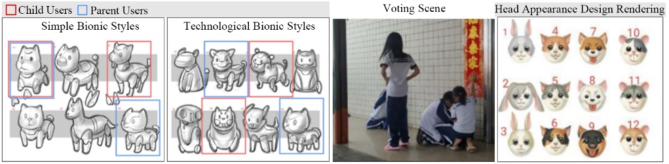
The prototype’s complexity in assembly, particularly the figurative main module with exposed joints, raises concerns about potential misconduct and misoperation. In order to solve this problem, we collected common pet cat- egories for feature extraction. Then we divided them into two design styles, simple and technological bionic styles, to draw sketches and distribute them to users for voting and research. In the first round, 57 children with mild ADHD participated in the poll, and in the second round, 24 parents of chil- dren participated. Double users each vote for four favorite models.12 The refined sketches were presented to 21 school-age students with mild ADHD for voting (Figure 3). Rabbit look #1, cat look #4, dog look #7, and hamster look #12 were favored.
Figure 3: Shape design and the study process.
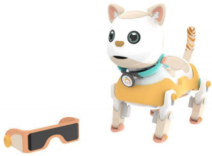
The final shape design was completed, incorporating insights from the pre- liminary prototype and research data (Figure 4), ensuring a balanced and well-received design for potential users.
Figure 4: Final shape design.
Design of Intelligent Accompanying Playsets for ADHD Children 161
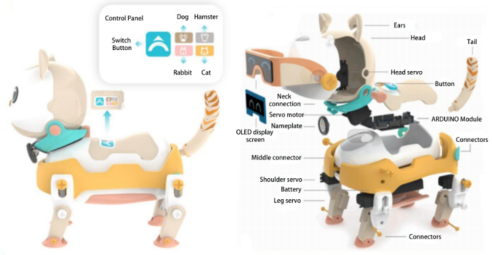
The final shape of the design to avoid an animal shape is too figurative; the external servo will be hidden as much as possible, and other functional components to complement the integrity of the control panel designed in the back of the pet toy can be directly manipulated to switch (Figure 5).
Figure 5: Detailed presentation of the design scheme.
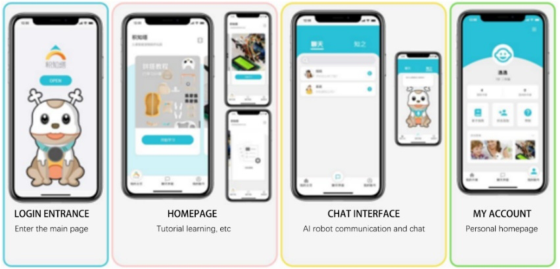
In the children’s interactive interface design, the navigation bar can be switched to the four main pages, simplifying the use of steps and compo- nent functions, reducing the number of cumbersome functional components, and retaining the core components of the function (Figure 6).
In the development and design process of JIZHITA intelligent pet toys, the author concentrated on the product’s play structure, styling design, and functional implementation, reducing the engineering training difficulty of tra- ditional STEAM educational toys in a hierarchical manner to train the ADHD children’s concentration and hands-on skills. Intelligent modules facilitate parent-child interaction to assist ADHD children in developing logical cogni- tion and promoting their overall well-being. While initial design results have shown promise, the therapeutic efficacy remains untested and unquantified,
highlighting the need for further refinement in debugging aspects. Designing toys for children with ADHD is a complex task that involves considering both the toy’s appearance and the parent’s and child’s dual needs, with particular attention to the child’s emotional needs. Existing children’s companion toys predominantly feature plush and light intelligent-based designs, emphasizing knowledge companionship, parent-child interaction, and modular flexibility. Intelligent companion toys are not meant to replace parental companionship but rather aid parents in better attending to children’s physical, mental health, and developmental needs. They serve as unique products that alleviate the lack of emotional support from busy work schedules, addressing parenting, entertainment, and educational aspects. This area will be explored in greater depth as technology evolves and the number of dual-career families increases.
REFERENCES
Chen Jianjun, Mu Yanfang, Huang Xiuping, et al. (2019). Rehabilitation effect of computer–assisted cognitive training on attention disorder in stroke patients. Anhui Medical Journal. 40, (08). 865–868. Fu Chanrong, Lyu Lanqiu, Ren Yingying, et al. (2018). Effect of sensory integration
training combined with psychological and behavioral interventions on children with attention deficit hyperactivity disorder. Chinese Journal of General Practice. 16, (11). 1931–1933. Ju Wei, Ban Huihui, Zhang Chi. (2013). A review on treating ADHD of children in TCM. Clinical Journal of Chinese Medicine. 5, (40). 118–120. doi: 10.3969/j.issn.1674–7860.2013.09.065. Lu Chunxia. (2020). Effective support for children’s block games under STEAM
education philosophy. Jiaoyu Guancha. 9, (40). 47–48, 66. Tang Xin, Ding Li, Kong Dejiao. (2023). Effects of psychological behavior intervention combined with cardio-brain cognitive training system on psychological behavior, adaptive behavior and executive ability of children with attention deficit and hyperactivity disorder. J Clin Psychosom Dis, Jan. 29, (01). 42–46. Wang Yanhong. (2018). Effective Treatment on Children with Attention Deficit
Hyperactivity Disorder by Sensory Integration Function Training. Genomics and Applied Biology. 37, (1). 199–204. Yang Zhangwei, Zhang Wanwan, Xiao Junyu. (2021). Research on Cultivating Educational Technology Innovation Ability of Normal University Students under the STEAM Concept. Education Research Monthly. (12). 66–71, 94. Zhang Hua, Han Chengxiu. (2020). Effective teaching interventions to improve
learning in children with ADHD. Journal of Nanyang Normal University. 19, (4). 39–42. Zhang Xingxu, Guo Haiying, Lin Danhua. (2019). A Study on the Relationship between Parent-child, Peer, Teacher Student Relationships and Subjective Happiness of Adolescents. Psychological Development and Education. 35, (4). 458–466. Zhang Ziqiang. (2021). Research on the Design of Ceramic Tea Set from the
Perspective of Maslow’s Hierarchy of Needs. Design Research. 11, (5). 149–152.
LISTED IN THE AHFE DIGITAL BOOKSTORE CATALOGUE
Explore the complete digital volume
Training, Education, and Learning Sciences
Read this individual research paper free through the original publisher, or explore the full digital proceedings book.
ISBN 978-1-964867-31-1
Explore this ISBN in the AHFE Bookstore ↗Listed in the July 2026 bookstore catalogue; search by ISBN to confirm current availability · Digital book purchase optional