Juha Kontio (2024). Human Factors in improving engineering education with CDIO framework. In: Training, Education, and Learning Sciences. AHFE Open Access, vol. 155, pp. 114–122. https://doi.org/10.54941/ahfe1005396
The CDIO initiative is the largest worldwide engineering education organization with over 200 universities and institutes. The main idea of CDIO is to improve engineering education by providing tools and community to develop degree programs. The CDIO framework provides an idea of what engineering students should learn and how. It offers a methodology for engineering education reform with the CDIO Syllabus and the CDIO Standards. CDIO standards describe a set of principles (best practices) on how to implement modern engineering education. There are altogether 12 core standards and 4 optional standards. Two of these standards focus on human factors and the importance of personnel in making the change and development. Standard 9 is about actions that enhance faculty competence in personal and interpersonal skills, product, process, system, and service building skills, as well as disciplinary fundamentals. Standard 10 is about actions that enhance faculty competence in providing integrated learning experiences, in using active and experiential learning methods, and in assessing student learning. The competencies on which these two standards focus, are essential to promote goals of the other CDIO standards. However, there are very few documented cases on working with these standards suggesting that it is easier to focus the development activities to other parts of the CDIO guidelines than faculty competences. There is also lack of evidence on successful implementation on these standards not to mention the impact of the implementations on overall program success. It is important that the understanding of human factors and faculty development activities are further studied, explored and their impact is documented.
Engineering education is an influencer on economic successes. Engineering supports the growth and development of a country’s economy and improves the quality of life for citizens (Centre for Economics and Business Research, 2016). Furthermore, engineering education create technological innovations by integrating scientific principles with practically oriented research, pro- viding systems and processes that create ways of acquiring new knowledge. Engineering plays a key role in achieving the Sustainable Development Goals (SDGs) too (UNESCO & International Centre for Engineering Education, 2021). Thus, engineering is crucial for addressing basic human needs such as alleviating poverty, supplying clean water and energy, responding to natural hazards, constructing resilient infrastructure, and bridging the development divide. The UNESCO report also writes that achieving these objectives
Human Factors in Improving Engineering Education With CDIO Framework 115
necessitates a shift in engineering education towards much broader inter- disciplinary and complex problem-solving approach that combines societal and sustainable problem analyses with academic technical knowledge and solutions.
There are thousands of engineering educators around the world, but what makes engineering education good? Graham (2018) studied engineer- ing education globally and found in her case study that the ‘emerging leader’ programs have benefitted from strong and visionary academic leadership, a faculty culture of educational innovation and new tools that support educa- tional exploration and student assessment. Altogether the study emphasized three dimensions of institutional capacity: the institutional leadership in and commitment to education, the educational culture such as the willingness to innovate and try new things and the extent to which faculty are informed and actively discussing teaching with colleagues. Graham’s latest report (2022) emphasized the personal commitment of faculty across their institutions to their quality of teaching and the learning experience of their students. Part of the change process requires strengthening the competence of faculty in engi- neering skills and in active and experiential learning and student assessment (Crawley, Malmqvist, Östlund, Brodeur & Edström, 2014). Unfortunately, there is still need to wider changes in pedagogical practices and cultures as well as wider adoption of active and collaborative learning which influences assessment methods too (Graham, 2022).
The CDIO initiative is the largest worldwide engineering education organi- zation with over 200 universities and institutes (CDIO, 2024). The main idea of CDIO is to improve engineering education by providing tools and commu- nity to develop degree programs. The CDIO framework provides an idea of what engineering students should learn and how. It offers a methodology for engineering education reform with the CDIO Syllabus and the CDIO Stan- dards. CDIO standards describe a set of principles (best practices) on how to implement modern engineering education. The move from teaching focused education to learning focused education means that the current faculty must be supported in their personal development and the use of new pedagogi- cal methods (Crawley et al., 2014). According to recent studies (Malmqvist, Machado, Meikleham & Hugo, 2019; Meikleham, Hugo & Kamp, 2018; O’Connor, Power & Blom, 2023) the universities in CDIO community have focused their attention on active learning, integrated learning experiences, integrated curriculum, and design-implement experiences with fewer analysis on other CDIO features like faculty competence and learning assessment. At the same time there has been some discussion that more attention should be placed on those underreported standards such as faculty development (Kamp, 2021; Meikleham et al., 2018) even though there also examples of universi- ties that have started special training programs for their faculty to support the change with CDIO (Papadopoulou, Bhadani, Hulthén, Malmqvist & Kristina, 2019). On the other hand, when the main reasons for joining CDIO was studied very few justified their applications to join CDIO with human factors (Kontio, 2017).
Faculty development is a critical aspect of academic institutions, aiming to enhance the skills, competencies, and knowledge of faculty members. It is a continuous process that supports faculty members in their roles as edu- cators, researchers, and administrators. Faculty development programs are
116 Kontio
essential for improving teaching effectiveness, fostering academic leadership, and promoting the professional growth of faculty members. They provide opportunities for faculty to learn about new teaching strategies, technolo- gies, and pedagogical research. Furthermore, they can help faculty members to adapt to changing student demographics, expectations, and learning styles. While the importance of faculty development is understood we also need to remember that human factors play a significant role in faculty develop- ment. Typical human factors are motivation, learning styles, workload, and organizational culture. As the challenges in higher education are accelerat- ing the faculty competence and human factors become even more important. Graham (2022) listed several possible changes lurking into higher education such as blended learning, social and environmental responsibility, global col- laboration and partnerships, digital learning, and lifelong learning. Finally, the persons belong to organizations and changes might need introduced to the way how organizations operate as it might be possible to create organi- zations that draw out more of our human potential (Laloux, 2014). It is also interesting to think how an initiative such as CDIO might be able to help here.
In this paper, we first describe the CDIO framework and initiative fol- lowed by the human factors in CDIO. These opportunities of CDIO are then discussed and challenged and finally some conclusions will be provided.
CDIO FRAMEWORK CDIO (Conceive Design Implement Operate) started as a project in 2000 and in 2004 CDIO initiative was formed as a worldwide collaboration in engi- neering education. CDIO aims at educating student who understand how to conceive-design-implement-operate complex value-added engineering sys- tems in a modern team-based engineering environment and are mature and thoughtful individuals. The collaboration is built on professional network- ing, shared knowledge, and practices. Its members come from all over the world and share a common goal of enhancing teaching and learning in higher education.
The main idea of CDIO is to improve engineering education by pro- viding tools and community to develop degree programs. CDIO supports education development by focusing on three key questions: 1) What is the professional role and practical context of the profession(al) (need)?, 2) What knowledge, skills and attitudes should students possess as they graduate from our programs (program learning outcomes)? and 3) How can we do better at ensuring that students learn these skills (curriculum, teaching, learning, workspaces, assessment)? The goal of CDIO approach (Crawley et al., 2014) is to (a) educate students that have deep working knowledge of the technical fundaments, (b) are able to lead in the creation and operation of new products and system and (c) are able to understand the importance and strategic value of their work. The CDIO approach is adaptable to all engineering schools, but other fields of education can learn from CDIO approach too (Malmqvist, Huay, Kontio & Minh, 2016). The key elements of teaching and learning in CDIO are the connection to the working life and real engineering practices and active involvement of students in their learning.
Human Factors in Improving Engineering Education With CDIO Framework 117
The CDIO approach supports universities and programs in education development by offering tools (CDIO standards and CDIO syllabus) for continuous improvement. CDIO standards describe a set of principles (best practices) on how to implement modern engineering education. There are altogether 12 core standards and 4 optional standards. The 12 core Stan- dards address program philosophy (Standard 1), curriculum development (Standards 2, 3 and 4), design-implement experiences and workspaces (Stan- dards 5 and 6), methods of teaching and learning (Standards 7 and 8), faculty development (Standards 9 and 10), and assessment and evaluation (Standards 11 and 12) (Crawley, Malmqvist, Östlund, Brodeur & Edström, 2014). The four optional standard focus on sustainable development, internationaliza- tion, entrepreneurship, and mathematical skills (Malmqvist, Edström, Rosén, Hugo & Campbell, 2020).
The CDIO syllabus provides key competences for engineering programs besides the core technical topics (CDIO, 2023). The general objective of the CDIO Syllabus is to describe a set of knowledge, skills and attitudes desired in a future generation of young engineers. It offers rational, complete, universal, and generalizable goals for undergraduate engineering education.
HUMAN FACTORS IN CDIO The CDIO Standards have two key standards that focus on faculty develop- ment, which is closely related to human factors. These two standards empha- size the importance of personnel in making the change and development at higher education institutes. The two standards are:
Standard 9. Enhancement of Faculty Competence and
Standard 10. Enhancement of Faculty Teaching Competence.
Standard 9 is about actions that enhance faculty competence in personal and interpersonal skills, product, process, system, and service building skills, as well as disciplinary fundamentals. From a human factors’ perspective, this standard recognizes that faculty members are not just technical experts, but also role models and mentors for students. They need to demonstrate effec- tive communication, teamwork, and problem-solving skills. Furthermore, they should be competent in the CDIO processes themselves, as they guide students through these processes in their projects.
Standard 10 focuses on the enhancement of faculty teaching competence. This standard acknowledges the importance of pedagogical skills in engi- neering education. Faculty members need to be effective educators, not just subject matter experts. They should be familiar with active learning strategies, assessment techniques, and curriculum design principles. They should also be able to adapt their teaching methods to cater to diverse learning styles, which is a key human factor in education.
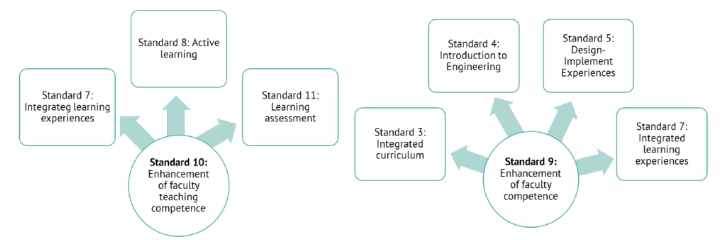
Both these standards and the competences they emphasize are essential to promote goals of the other CDIO standards as shown in the Figure 1. They also highlight the importance of faculty development in engineering education. They recognize that faculty members play a crucial role in imple- menting the CDIO approach. By enhancing their competence and teaching
118 Kontio
skills, we can create a more effective and inclusive learning environment. This is where understanding and considering human factors become essential. The full description of the CDIO standards is available in the CDIO website (CDIO, 2023).
In addition to the core standards, optional standards also rely on the faculty competences. For example, the optional standard on Sustainable development says that enhancement of faculty competences for sustainability and related teaching competences should be actively promoted.
All CDIO standards have a rubric, which is a scoring guide used to evaluate levels of performance. It is a six-point rating scale (5 – 0) for assessing levels of compliance with each standard. The rubrics of standards 9 and 10 are pre- sented in the Table 1. The criteria for each level are based on the description and rationale of the standard in question. The rubric can help programs to evaluate their current state in faculty development and possible help them to initiate development activities.
Figure 1: Connections of standards 9 & 10 to other standards.Table 1. Rubrics of CDIO standards 9 and 10.
Table available in the original PDF paper.
Scale Standard 9 Standard 10
Faculty competence in teaching, learning, and assessment methods is regularly evaluated and updated where appropriate.
5 Faculty competence in personal, interpersonal, product, process, and system building skills is regularly evaluated and updated where appropriate.
4 There is evidence that the collective faculty is competent in personal, interpersonal, product, process, and system building skills.
There is evidence that the faculty is collective working on their competences in teaching, learning, and assessment methods. 3 Where needed, the faculty participates in faculty development in personal, interpersonal, product, process, and system building skills.
Faculty members participate continuously in faculty development in teaching, learning, and assessment methods. 2 Where needed, there is a systematic plan of faculty development in personal, interpersonal, product, process, and system building skills.
A need for enhancing teaching competences is recognized and accepted within the team.
A systematic plan of faculty development in teaching, learning, and assessment methods is developed and budgeted. 1 The need of faculty competence development plan in personal, interpersonal, product, process, and system building skills is recognized.
There are no programs or practices to enhance faculty teaching competence.
0 There are no programs or practices to enhance faculty competence in personal, interpersonal, product, process, and system building skills
Human Factors in Improving Engineering Education With CDIO Framework 119
DISCUSSION
Implementing CDIO Standards 9 and 10 effectively requires a strategic approach that considers the unique context of each institution. The imple- mentation of these standards is not a one-size-fits-all approach. Each institu- tion should adapt these strategies based on their specific context and needs. It’s also important to involve faculty members in the planning and implemen- tation process, as their buy-in and engagement are crucial for the success of these initiatives.
Several different strategies can be used in helping faculty in the areas of standards 9 and 10. Institution can provide faculty training with sessions to enhance faculty competence in personal, interpersonal, and product and system building skills. These sessions could include workshops, seminars, and online courses. Another possibility is to encourage peer learning where faculty members learn from each other through mentoring programs, peer observations and collaborative projects. Within CDIO peer-to-peer support activity has been started in 2022 to support learning from another pro- grams. This concept has been tried in smaller scale already before with two Nordplus-funded projects (Kontio, Granholm et al., 2012; Kontio, Roslöf et al., 2012) and one Erasmus+ funded project (Bennedsen et al., 2018; Jens Bennedsen & Schrey-Niemenmaa, 2016; Clark, Kontio, Roslöf, Steinby & Thomson, 2016). Furthermore, institutions should support faculty members in experimenting with new teaching methods and technologies. This could be done by providing resources, time, and recognition for pedagogical inno- vation. Finally, institutions should regularly review and update their faculty development programs. This allows them to adapt to changing needs and to incorporate the latest research on effective teaching. Using CDIO self- evaluation on standards 9 and 10 can help universities and programs to analyse their levels and discuss on necessary actions to improve.
While planning the implementation of standard 9 and 10 as well as the CDIO approach altogether, it is important to understand that there can be several challenges too. Change can be difficult, and some faculty members may resist the shift towards the CDIO approach. This resistance can stem from a variety of factors, including a lack of understanding of the CDIO approach, concerns about increased workload, or a preference for tradi- tional teaching methods. Faculty members might have heavy workloads too, and finding time for additional training and development can be challenging. Balancing the demands of teaching, research, and administrative duties can make it difficult for faculty members to fully engage in the CDIO process. Furthermore, the CDIO approach requires faculty members to have a broad range of skills, including technical expertise, pedagogical knowledge, and interpersonal skills. However, not all faculty members may have this range of expertise, and developing these skills can take time. To overcome these challenges, institutions need to provide strong leadership, clear communica- tion, adequate resources, and ongoing support for faculty members. It’s also important to involve faculty members in the planning and implementation process, as their buy-in and engagement are crucial for the success of the ini- tiative. The CDIO initiative organizes different introductory workshops as
120 Kontio
part of the community meetings and conferences. These workshops give an overview of CDIO to the faculty members and provide an opportunity to discuss and reflect different situations in different countries and universities.
On the other hand, succeeding in the implementation of standards 9 and 10 can bring several benefits to the institutions and faculty members. As stan- dard 10 focuses on teaching competence it can lead to improved teaching quality and better learning outcomes for students. Similarly, as standard 9 emphasizes continuous professional development it can help faculty mem- bers to stay up to date with the latest developments in their field. Both standards can lead to more engaging and effective learning experiences for students. From a broader perspective, these changes can lead to overall institutional improvement with improved reputation and attractivity as well overall cultural change to excellence and innovations in teaching and learn- ing. Furthermore, the industry and working life readiness of students can improve as CDIO approach prepares students for the engineering industry by providing them with the necessary technical knowledge and skills, as well as the ability to conceive, design, implement, and operate systems in the real world.
CONCLUSION
The CDIO initiative is a worldwide engineering community which provides tools for universities and programs to develop their education. This paper presented the overall idea of CDIO and described in detail how human fac- tors are built in the CDIO standards. The CDIO initiative has identified the importance of faculty development in the core of its’ guidelines. The role of standards 9. Enhancement of Faculty Competence and 10. Enhance- ment of Faculty Teaching Competence is essential in implementing the whole CDIO approach into the programs and universities. At the same time, there are very few documented cases on working with these standards suggest- ing that it is easier to focus the development activities to other parts of the CDIO guidelines than faculty competences. Still, focusing on faculty compe- tences could have bigger impact on the overall development of the program than focusing on the other topics. Furthermore, using the CDIO rubrics and self-evaluation the development can be evaluated and supported for lasting improvements. It is also important that the understanding of human factors and faculty development activities are further studied, explored and their impact is documented.
REFERENCES
Bennedsen, J., Rouvrais, S., Roslöf, J., Kontio, J., Georgsson, F., & McCartan, C. D.
(2018). Collaborative quality enhancement in engineering education: An overview of operational models at a programme level. European Journal of Engineering Education, 1–16. doi: 10.1080/03043797.2018.1443058. Bennedsen, J., & Schrey-Niemenmaa, K. (2016, June 12–16). Using Self-Evaluations for Collaborative Quality Enhancement - A Case Study of Aarhus University and Helsinki Metropolia University of Applied Sciences. Paper presented at the 12th International CDIO conference, Turku, Finland.
Human Factors in Improving Engineering Education With CDIO Framework 121
CDIO. (2023). CDIO Standards 3.0. Retrieved from https://cdio.org/content/cdio-st andards-30. CDIO. (2024). The CDIO initiative. Retrieved from www.cdio.org. Centre for Economics and Business Research. (2016). Engineering and economic
growth: A global view. Retrieved from London. Clark, R., Kontio, E., Roslöf, J., Steinby, P., & Thomson, G. (2016, June 12–16).
Experiences on Collaborative Quality Enhancement using Cross-sparring between two Universities. Paper presented at the 12th International CDIO conference, Turku, Finland. Crawley, E., Malmqvist, J., Östlund, S., Brodeur, D., & Edström, K. (2014).
Rethinking engineering education - the CDIO approach (Second edition ed.): Springer. Graham, R. (2018). The global state of the art in engineering education: Massachusetts Institute of Technology. Graham, R. (2022). Crisis and catalyst: The impact of COVID-19 on global practice in engineering education. Retrieved from Cambridge, USA: https://www.rhgrah am.org/resources/Crisis-and-catalyst.pdf. Kamp, A. (2021, June 21–23). CDIO. Can we continue the way we are? Paper pre-
sented at the 17th International CDIO Conference [online], Bangkok, Thailand. Kontio, J. (2017, 18.-22.6.2017). Why Universities want to join CDIO? Paper presented at the 13th International CDIO Conference, Calgary, Canada. Kontio, J., Granholm, P., Valmu, H., Mäntykoski, J., Kruusamäe, K., Aukstuoline,
M.,... Edström, K. (2012, 30 July–3 August). Supporting Programme Develop- ment with Self- and Cross-evaluations – Results from an International Quality Assurance Project. Paper presented at the International Conference on Engineering Education, Turku, Finland. Kontio, J., Roslöf, J., Edström, K., Thyberg Naumann, S., Munkebo Hussman, P., Karhu, M., & Schrey-Niemenmaa, K. (2012). Improving Quality Assurance with CDIO Self-Evaluation: Experiences From a Nordic Project. International Journal of Quality Assurance in Engineering and Technology Education, 2(2), 54–65. Malmqvist, J., Edström, K., Rosén, A., Hugo, R., & Campbell, D. (2020).
Optional CDIO Standards: Sustainable Development, Simulation-based Math- ematics, Engineering Entrepreneurship, Internationalisation & Mobility. Paper presented at the 16th International CDIO Conference, on-line by Chalmers University of Technology, Gothenburg, Sweden. Malmqvist, J., Huay, J., Kontio, J., & Minh, T. (2016). Application of CDIO in Non-Engineering Programmes – Motives, Implementation and Experiences. Paper presented at the 12th International CDIO Conference, Turku, Finland. Malmqvist, J., Machado, T., Meikleham, A., & Hugo, R. (2019, June 25–27).
Bibilographic Data Analysis of CDIO Conference Papers from 2005–2018. Paper presented at the 15th International CDIO Conference, Aarhus, Denmark. Meikleham, A., Hugo, R., & Kamp, A. (2018). Visualizing 17 years of CDIO influence via bibliometric data analysis. Paper presented at the 14th International CDIO Conference, Kanazawa, Japan. O’Connor, S., Power, J., & Blom, N. (2023). A systematic review of CDIO
knowledge library publications (2010–2020): An Overview of trends and recom- mendations for future research. Australasian Journal of Engineering Education. doi: 10.1080/22054952.2023.2220265.
122 Kontio
Papadopoulou, P., Bhadani, K., Hulthén, E., Malmqvist, J., & Kristina, E. (2019, 25.-27.6.2019). CDIO Faculty Development Course – Built-In Implementation. Paper presented at the 15th International CDIO Conference, Aarhus, Denmark. UNESCO, & International Centre for Engineering Education. (2021). Engineering
for sustainable development: Delivering on the Sustainable Development Goals. Retrieved from https://unesdoc.unesco.org/ark:/48223/pf0000375644.
LISTED IN THE AHFE DIGITAL BOOKSTORE CATALOGUE
Explore the complete digital volume
Training, Education, and Learning Sciences
Read this individual research paper free through the original publisher, or explore the full digital proceedings book.
ISBN 978-1-964867-31-1
Explore this ISBN in the AHFE Bookstore ↗Listed in the July 2026 bookstore catalogue; search by ISBN to confirm current availability · Digital book purchase optional