James Badu, Rune Elvegard, Salman Nazir, Natalia Andreassen (2024). Situation Awareness in Crisis Management – A Case Study from the Arctic Region. In: Training, Education, and Learning Sciences. AHFE Open Access, vol. 155, pp. 102–113. https://doi.org/10.54941/ahfe1005395
As the traffic of nuclear-propelled vessels and vessels carrying nuclear cargo is increasing in the Norwegian Sea and the adjacent Arctic Sea, the potential for accidents near the coastal regions poses a significant risk of air and sea emissions. Eventually, it will have far-reaching consequences in Norway and its neighbouring countries if such an event occurs. Hence, effective coordination and communication among diverse organizations and stakeholders are required to prevent the escalation of emergency situations. Maintaining robust situation awareness (SA) to manage such crises is crucial. This presentation investigates a case study on maritime nuclear safety preparedness, where such a detailed scenario has developed. Participants from various stakeholders collaborate to analyse and handle this crisis. Utilizing questionnaires, we evaluate three levels of Situation Awareness and investigate how the background and expertise of such individuals influence situation awareness. Furthermore, we have provided some suggestions for maintaining good situation awareness in a given crisis management scenario.
In today’s interconnected world, crises management, especially in the vul- nerable environment in the Arctic, demands subtle understanding of human cognition and decision-making processes. After the introduction of nuclear- propelled ships and cargo ships carrying nuclear substances navigating along the Norwegian coast and in the Arctic region, there is an urgent necessity for robust crisis management strategies to mitigate the potential risks asso- ciated with accidents and emergencies in these challenging environments. New organizational structures have been adopted to react quickly to the changing environment. For instance, team and distributed structures enable organizations to achieve quick responses (Priest et al., 2006).
Situation Awareness in Crisis Management – A Case Study From the Arctic Region 103
In dynamic and complex scenarios like maritime nuclear safety prepared- ness, maintaining a high level of Situational Awareness (SA) is vital for making informed decisions and implementing timely interventions. How- ever, information sharing between different stakeholders is often a problem (Van Santen et al., 2009). For effective sharing of information, team situa- tion awareness is necessary. SA is often a problem because team members do not always understand which information is needed by other team members. Sometimes, they may not have the appropriate tools to exchange information, they may not have shared mental models, or they may not have the commu- nication skills necessary to exchange pertinent information (Schraagen et al., 2010). Given this context, this paper aims to investigate the details of situation awareness in crisis management, specifically focusing on a case study con- ducted in the Arctic region. The study analysed a tabletop exercise conducted at Nord University’s Center for Crisis Management and Collaboration with a simulated scenario involving a reactor accident on a nuclear-powered ice- breaker, NS EXERCISE, navigating along the Norwegian coast. Based on this, we seek to answer the research question: How does Situational Awareness (SA) reflect the participants’ overall performance?
To answer this research question, we have organized the paper as follows. Next, the theoretical background is presented before the method section. After this, we present the results and discussions. Then, the conclusion section follows accordingly.
THEORETICAL BACKGROUND Performance and Importance of Situation Awareness
Humans have a limited capacity for processing information, constrained by our attention, existing knowledge, mental models and available men- tal resources (Gary et al., 2008). Consequently, when a particular task demands more than the available cognitive resources, individuals may expe- rience a state of cognitive overload. This condition has been associated with a decrement in task performance efficiency, as documented in the research by Wickens (2013).
Considering the increasing complexity of modern systems, it is criti- cal to incorporate human operators with digital agents, especially when it comes to the field of maritime nuclear safety preparedness. It frequently requires constant involvement and conversation to avert an escalating sit- uation (Veitch et al., 2022). The maritime sector is dynamic and occasionally unpredictable; therefore, it necessitates continuous collaboration between the decision-making capabilities of various stakeholders. This is critical when we consider nuclear-propelled vessels in Norwegian and adjacent Arctic Sea areas. The probability of accidents and the potential consequences involving nuclear reactors or nuclear cargo, calls for a synergistic approach with human expertise and various background and experience in concert to mitigate risks.
A well-known construct related to human performance is Situation Aware- ness (SA). SA is largely corelated to understanding human performance
(Endsley, 2000). It holds particular significance in fields like human fac- tors and cognitive psychology, especially in high-stakes settings like maritime nuclear safety preparedness. It refers to the ability of individuals to accurately perceive and understand their environment, to process this information in a timely manner, and to predict future states of the environment. This con- cept is crucial in decision-making processes, especially in complex, dynamic settings where rapid and accurate responses are vital. SA comprise of three levels: perception of the elements in the environment (Level 1 SA), compre- hension of the current situation (Level 2 SA), and projection of future status (Level 3 SA). These levels are well explained by the work of Endsley (2000).
Numerous studies have explored the connections among SA and various cognitive and performance outcomes, including decision-making capabilities (Endsley, 2000), the attention of first responders (Sanquist et al., 2016), and cognitive workload (Friedrisch et al., 2018; Choudhury and Asan, 2022). These investigations commonly link SA to metrics of safe behaviour. For example, the foundational importance of the first level of SA is underscored in some research (e.g., Catherwood et al., 2014), with Endsley (2000) not- ing that the initial level’s basic perception of crucial information is essential for accurately understanding a situation. This stage is crucial as most errors identified in the empirical studies by Jones & Endsley (1996) resulted from perception-related issues. The subsequent second level of SA is associated with fewer errors and is pivotal for both subjective interpretations and under- standing the objective situation. Meanwhile, the ability to anticipate future states at the third level of SA is deemed crucial for making timely decisions, which, in turn, impacts the efficacy of actions. This is particularly rele- vant in dynamic contexts such as maritime nuclear emergency management, where effective anticipation and decision-making can significantly influence outcomes.
METHOD
Scenario and Exercise Design The starting point of the scenario was a nuclear-powered icebreaker, NS EXERCISE, that was on route from Murmansk to the Gulf of Finland.
The emergency starts with a message received by the Coastal Radio North: “Mayday, Mayday, Mayday. This is NS EXECISE in position 68
50’11.9”N 11
46’03.4”E. Wind NNE 5m/s, Sea 2m, cloudy and no precipitation. We are a nuclear-powered icebreaker, 152 m in length, 20,000-ton displacement, and 120 crew onboard. We are currently fighting a fire and have two severely injured crew with life-threatening injuries. Fire has severely damaged multiple systems onboard. Commu- nications are unreliable. We are dead in the water and cannot make way” (Exercise directive).
The situation is a somewhat ordinary SAR operation without emissions to air or water, or any information on damages of nuclear reactor. Five hours later the situation becomes more complex. NS EXERCISE reports on reactor damage and emissions to sea or air unavoidable:
Situation Awareness in Crisis Management – A Case Study From the Arctic Region 105
“We are experiencing a loss of coolant with our nuclear reactor. This has resulted in damage to the reactor’s core fuel elements. We are unable to contain the release of fission products to the environment. They are escaping the BALDRON through the atmosphere and seawater. We have an additional critical casualty who is contaminated. He must be evacuated immediately.” (Exercise directive).
The complexity allowed for a discussion of responding to a SAR operation in a radiologically hazardous environment and some of the most signifi- cant aspects of nuclear emergency response in an Arctic environment. The discussions in groups of mixed emergency preparedness professional back- grounds, the existing knowledge of the training audience, their positions in first responders’ organizations, and their professional interests lead to dif- ferent perception, comprehension of the situation and projection of possible response action.
Participants Forty-three (43) people participated in the tabletop exercise. This diverse group comprised representatives from various sectors, including the police service, fire service, defence, and the public sector. Among these participants, 26 (60%) were male and 17 (40%) were female. The majority, 37 partic- ipants, were affiliated with a single profession, whereas 6 participants had experience across multiple sectors. In terms of professional tenure, 23 partic- ipants had less than 10 years of experience in their respective fields, while 20 had been engaged in their professions for over a decade.
Questionnaire Following the exercise, participants completed a questionnaire designed to assess their SA of the previously discussed scenario. This questionnaire collected demographic information (including gender, age group, and pro- fession) and posed questions aligned with the three levels of SA: perception, comprehension, and projection respectively. For SA Level 1, participants were required to recount the details of the exercise, with a focus on recalling the status of radioactive contamination as understood from initial discussions. At SA Level 2, the aim was to assess participants’ understanding of the scenario’s specifics, including the incident’s location and the nature of the event. Ques- tions such as “In which area did the incident occur?” and “What type of event is this?” were emphasized. For SA Level 3, the questionnaire sought to evalu- ate participants’ ability to foresee future developments regarding radioactive contamination, with significant attention given to questions like “How do you foresee the progression of radioactive contamination?”
Evaluation performance in a scenario like this is intrinsically challenging. Therefore, we tried to find an optimal solution during a workshop among authors, where it was concluded that specific questions, when consid- ered with their relative impact, can indirectly reflect overall performance. Hence, we developed the following equation for this scenario to calculate the
Equation reproduced from the original PDF.
6Wi Where:
Wi is the weight of the ith assessment
Mi is the mark obtained in the ith assessment
The sum in the numerator is the overall assessment, multiplying each mark (Mi) by its corresponding weight (Wi)
The sum in the denominator is overall weights of the assessment.
This equation provides a weighted average of marks, where each mark is multiplied by its weight before summing, and the total is divided by the sum of all weights, ensuring that assessments with higher weights contribute more to the final coefficient.
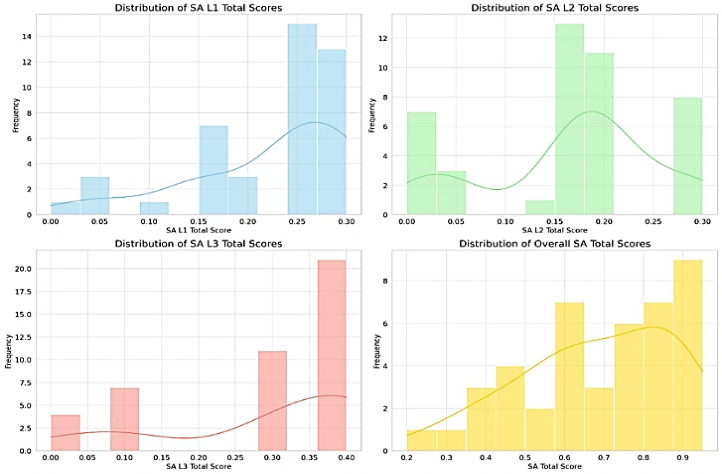
Analysis As we aimed to explore the participants’ SA performance in crisis manage- ment, we considered two keys approaches during our analysis. First, we assigned weights to each of the questions answered by the participants. Then, we analysed the distribution of total scores and performance ratings for each level and overall SA performance. This involved a series of methodological steps designed to provide a comprehensive understanding of how individ- uals perform across different metrics. This analysis helps identify patterns, outliers, and potential areas for improvement. A descriptive statistic for the total scores of each level and the overall SA performance was calculated. This includes measures such as mean, median, mode, standard deviation, minimum, and maximum values. The descriptive statistics provide a quick snapshot of the data, including the central tendency and variability of scores. This helps in understanding the general performance landscape and iden- tifying any immediate anomalies or points of interest. We then presented the distributions of total scores for each level and overall SA performance (Figure 1). Visualizing the distribution helps in understanding the shape of the data (e.g., normal distribution, skewed, bimodal) and identifying outliers. It also highlights differences in performance variability across levels. We also rated the performance into categories (High and Average). The distributions and descriptive statistics across levels were compared with the overall SA performance to identify any notable differences or patterns.
Second, we explored correlations between the total scores of each level and the overall SA total score to see how performance in each level relates to overall performance. To do this, we calculated the Pearson correlation coef- ficients between the total scores of each level (L1, L2, L3) and the overall SA total score. Pearson’s correlation coefficient measures the linear relationship between two continuous variables. It is appropriate for this analysis because it quantifies the degree to which changes in one variable are associated with changes in another. By calculating this coefficient, we assess how performance in each level relates to overall SA performance. The coefficient’s value ranges from −1 to 1, where 1 means a perfect positive linear correlation, −1 means
Situation Awareness in Crisis Management – A Case Study From the Arctic Region 107
a perfect negative linear correlation, and 0 indicates no linear correlation. Thus, a positive correlation indicates that higher performance in a given level is associated with higher overall SA performance, suggesting that skills or knowledge assessed at that level are important contributors to situational awareness. The strength of the correlation (how close the coefficient is to 1 or −1) indicates how strongly the performances are related.
We would like to mention that some contextual factors, such as participant experience levels, training received, or the nature of the tasks in each level, could influence the correlations observed. Such factors could influence the inherent relationships between performance levels and overall SA or probably they might be influenced by external factors unknown to us.
RESULTS AND DISCUSSIONS Summary Statistics
The mean, median, and standard deviation for the total scores of each level (L1, L2, L3) and the overall SA (Situational Awareness) performance are as follows.
Table 1. Summary statistics for participants SA performance.
Table available in the original PDF paper.
Metric SA L1 Total SA L2 Total SA L3 Total Overall SA Mean 0.222 0.168 0.288 0.678 Median 0.250 0.175 0.300 0.725 Standard Deviation 0.082 0.087 0.142 0.194
Figure 1: Distribution of total scores for each level and the overall SA performance.
The distributions of total scores for each level (L1, L2, L3) and the overall SA performance have been visualized. Here are some observations in line with the mean, median, and standard deviations computed.
Level 1 (L1) Total Scores: The mean (0.222) is slightly lower than the median (0.250), suggesting a slight left skew in the distribution. This indicates that more participants scored above the mean, pulling the median higher. The relatively low standard deviation (0.082) indicates that the scores are moderately spread around the mean, showing some consistency in participant performance at this level, albeit with a tendency for scores to cluster slightly above the mean.
Level 2 (L2) Total Scores: With a mean (0.168) slightly lower than the median (0.175), the distribution here also suggests a slight left skew. Similar to L1, this indicates that a number of participants scored above the mean, slightly pushing the median higher. The standard deviation (0.087) is slightly higher than in L1, indicating a bit more variability in the scores. Participants’ performance in Level 2 appears to be slightly more spread out, suggesting varied levels of expertise or comfort with the content assessed at this level.
Level 3 (L3) Total Scores: The mean (0.288) and median (0.300) are very close, yet the median is slightly higher. This could suggest a very mild left skew but is closer to a symmetric distribution, indicating that the scores are more evenly distributed across the spectrum. The higher standard deviation (0.142) compared to L1 and L2 indicates a greater spread of scores. This suggests that participant performance at Level 3 is more varied, reflecting potentially differing levels of advanced skills or knowledge among participants.
Overall SA Performance: The mean (0.678) is slightly lower than the median (0.725), which could indicate a mild left skew in the overall per- formance scores. The higher median suggests that a majority of participants have scored above the mean, indicating generally good performance across the participants. The highest standard deviation (0.194) among all the scores indicates the broadest variability in overall SA performance. This reflects the cumulative effect of the varying levels of performance across L1, L2, and L3, showing that when all aspects of situational awareness are combined, participant performance diverges more widely.
We also identified the following observations: Skewness: The slight left skew observed in L1 and L2, and to a lesser extent in L3 and overall SA performance, suggests that while there are participants across the spectrum, a larger number are scoring above the mean, especially in L3 and overall SA. This could indicate that the assessments are challenging but manageable for a significant portion of participants.
Variability: The increasing standard deviation from L1 to L3 and then to the overall SA performance suggests that as the complexity or scope of the assessment increases, so does the variability in participant scores. This could reflect the cumulative nature of situational awareness, where individual differences in knowledge, skills, and experience become more pronounced when assessed in a comprehensive manner.
Performance Distribution: The close mean and median values, especially in L3 and overall SA, along with the observed variability, suggest that while par- ticipants tend to perform reasonably well, there’s a significant range in how
Situation Awareness in Crisis Management – A Case Study From the Arctic Region 109
well they do so. This range might offer opportunities for targeted training and development, particularly for those scoring below the mean or median, to improve overall situational awareness skills.
These observations provide valuable insights for understanding partici- pant performance across different levels and overall situational awareness, highlighting areas for targeted improvement and further investigation.
Correlation Analysis Between SA Levels and Overall SA Indirect Performance We explored the correlations between the total scores of each level (L1, L2, L3) and the overall SA total score to understand how performance in individual levels relates to overall situational awareness performance. This helped us to assess if high performance in a specific level is strongly associated with high overall SA performance.
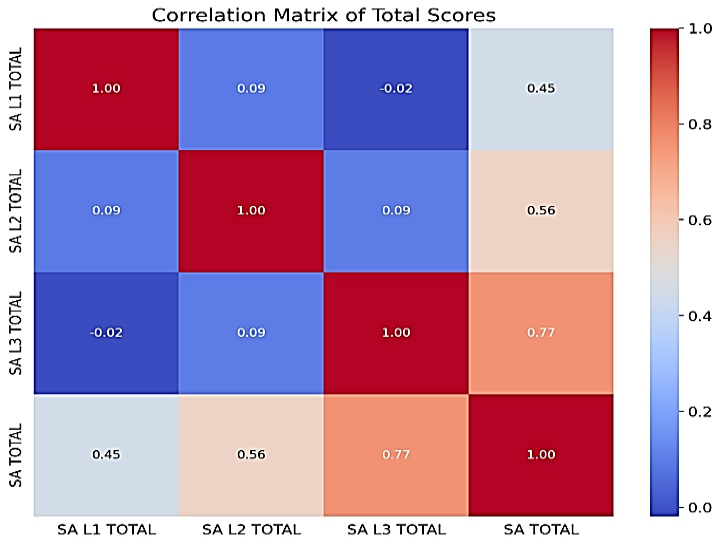
Figure 2: Correlation matrix for total scores of each SA level (L1, L2, L3) and the overall SA total score.
The correlation matrix for the total scores across different levels (L1, L2, L3) and the overall SA performance reveals the following insights:
1. SA L1 Total has a positive correlation (0.45) with SA Total, indicating that higher scores in Level 1 are associated with higher overall SA per- formance. The correlation coefficient is significant, suggesting a strong relationship.
2. SA L2 Total also shows a positive correlation (0.56) with SA Total. This suggests that performance in Level 2 contributes positively towards overall SA performance, with the strength of this relationship being notable as well. 3. SA L3 Total exhibits a positive correlation (0.77) with SA Total, indi- cating that high scores in Level 3 are associated with higher overall SA performance. The correlation here is also significant, highlighting the importance of Level 3 performance in the overall assessment. 4. SA L1 Total had a low correlation (0.09) with SA L2 Total, suggesting that there is little to no linear relationship between how participants perform in Level 1 compared to Level 2. 5. Similar low correlation (0.09) was identified with SA L2 Total and SA L3 Total, indicating that performance in Level 2 does not necessarily predict performance in Level 3. 6. SA L1 Total and SA L3 Total had a negative correlation (-0.02), imply- ing that little to no direct relationship between performances in Level 1 and Level 3.
These correlations suggest that performance in each level is positively associated with overall SA performance, with each level contributing to the aggregate measure of situational awareness. The strengths of these correla- tions indicate that improvements or declines in performance at any level could have a meaningful impact on overall SA performance. For example, a high correlation coefficient between SA L1 TOTAL and SA TOTAL suggests that participants who perform well in Level 1 are likely to have a high overall SA performance score. This pattern holds true for Levels 2 and 3 as well.
Given the strong link between performance at each level and overall SA, educational and pedagogical strategies might need to emphasize mastery learning at each stage. Techniques could include differentiated instruction to meet diverse learner needs, formative assessments to provide ongoing feedback, and targeted interventions for learners struggling with founda- tional concepts. This also suggests the importance of curriculum design and complexity, highlighting the need for a well-structured and challenging cur- riculum that effectively consolidates and builds upon earlier learning. Thus, curriculum design and training activities should encourage the integration of knowledge across levels, fostering a deep and comprehensive understanding of situational awareness.
Of particular concern, given the strong link between Level 3 performance and overall SA, it’s clear that training at this stage should emphasize higher- order thinking skills, such as analysis, evaluation, and synthesis. Training methods might include complex simulations, real-world problem-solving tasks, and assessments that require learners to apply their situational aware- ness in varied and challenging contexts. Such assessments are crucial for evaluating the readiness of learners to apply their situational awareness skills in real-world settings effectively.
Insights from the correlation analysis (given that there were low and negative correlations among the levels) imply that participants may need additional support or resources to bridge gaps in knowledge or skill between
Situation Awareness in Crisis Management – A Case Study From the Arctic Region 111
levels, as performance in foundational levels does not automatically trans- late to success in more advanced levels. This might also highlight the need to review assessment strategies, helping educators and trainers to identify key areas of focus for evaluating participant progress and adjusting the difficulty or focus of assessments accordingly.
The importance of the correlation analysis is that the correlation matrix is crucial for understanding how different variables (in this case, performance scores at various levels and overall SA performance) relate to each other. By identifying these relationships, we can pinpoint which levels have the most impact on overall performance and potentially focus training or improvement efforts on those areas. However, it’s important to state that the correlation does not imply causation; it simply indicates the presence of a relationship between variables.
Limitations of the Study While the study involved a diverse group of participants from various sectors, the total number of participants (43) might limit the statistical power of the findings. Also, the scenario was conducted in a controlled, simulated environ- ment, which may not fully capture the complexities and unpredictabilities of a real-world crisis. Thus, the study’s reliance on a tabletop exercise and questionnaire to assess SA performance may have limitations in capturing the complexities and nuances of real-world crisis scenarios. We acknowledge that such limitations may have potential implications for the study’s findings.
CONCLUSION
This study illustrates the critical role of situational awareness (SA) in enhanc- ing maritime nuclear safety preparedness, highlighting the positive correla- tion between performance in SA levels and overall situational awareness. Our findings, derived from a tabletop exercise simulating a reactor accident on a nuclear icebreaker, advocate for targeted training to strengthen SA across perception, comprehension, and projection levels. The diversity in partic- ipant backgrounds underscores the value of a comprehensive approach to crisis management, where varying perspectives contribute to a more effective response. The correlation analysis between individual SA levels and overall SA performance sheds light on the interconnectedness of these components. It suggests that enhancements in any single level of SA could potentially lead to significant improvements in overall situational awareness. This finding points to the importance of a holistic approach to SA training, one that addresses the cognitive, communicative, and collaborative aspects of cri- sis management. This research contributes valuable insights into the role of situational awareness in maritime nuclear safety crisis management. By elucidating the complex dynamics of SA and its impact on crisis outcomes, this study provides a foundation for future research and practice in the field. It underscores the necessity of continuous improvement in SA training and assessment, advocating for strategies that are adaptive, inclusive, and com- prehensive in addressing the challenges of crisis management in the Arctic and beyond.
ACKNOWLEDGMENT
The authors would like to acknowledge help of subject matter experts from the Joint Rescue Coordination Centre Norway, Norwegian Radiation and Nuclear Safety Authority and County governor, as well as students at Nord university’s program Master in preparedness and emergency management, who gave consent and participated in the study.
The third author acknowledges the support of the project “Enhancing Human Performance in the Complex Socio-technical Systems (ENHANCE)” funded by the European Union’s Horizon 2020 research and innovation pro- gram under the Marie Skłodowska-Curie grant agreement No. 823904 for this paper.
The second and fourth authors acknowledge the support of the project “Collaboration Complexity in Nuclear Emergency Preparedness in the Mar- itime Arctic” (ATOMEX), funded by the Research Council of Norway, grant agreement No. 336285.
REFERENCES
Catherwood, D. et al., 2014. Mapping brain activity during loss of situation awareness: An EEG investigation of a basis for top-down influence on perception. Human factors, 56(8), pp. 1428–1452. Choudhury, A. & Asan, O., 2023. Impact of cognitive workload and situation aware-
ness on clinicians’ willingness to use an artificial intelligence system in clinical practice. IISE Transactions on Healthcare Systems Engineering, 13(2), pp. 89–100. Endsley, M. R., 2000. Theoretical underpinnings of situation awareness: a critical review. In: Situation Awareness Analysis and Measurement. s.l.: Mahwah, NJ: Lawrence Erlbaum Associates. Friedrich, M. et al., 2018. The influence of task load on situation awareness and
control strategy in the ATC tower environment. Cognition, Technology & Work, Volume 20, pp. 205–217. Gary, M. S. & Wood, R. E., 2008. Mental Models, Decision Rules, Strategies and Performance Heterogeneity. s.l., Atlanta Competitive Advantage Conference Paper. Jones, D. G. & Endsley, M. R., 1996. Sources of situation awareness errors in
aviation. Aviation, space, and environmental medicine, 67(6), pp. 507–512. Priest, H. A., Stagl, K. C., Klein, C. & Salas, E., 2006. Virtual Teams: Creating Context for Distributed Teamwork. In: Creating high-tech teams: Practical guidance on work performance and technology. s.l.: American Psychological Association, pp. 185–212. Sanquist, T. F., Brisbois, B. R. & Baucum, M., 2016. Attention and situational aware-
ness in first responder operations. In: s.l.: Pacific Northwest National Laboratory Richland, Washington 99352. Schraagen, J. M., de Koning, L., Hof, T. & van Dongen, K., 2010. Development of a self-rating instrument to measure team situation awareness. s.l., 15th International Command and Control Research and Technology Symposium: Proceedings of the 15th International Command and Control Research and Technology Symposium. Van Santen, W., Jonker, C. & Wijngaards, N., 2009. Crisis decision making through a
shared integrative negotiation mental model. International Journal of Emergency Management, 6(3–4), pp. 342–355.
Situation Awareness in Crisis Management – A Case Study From the Arctic Region 113
Veitch, E. & Alsos, O. A., 2022. A systematic review of human-AI interaction in autonomous ship systems. Safety science, Volume 152, p. 105778. Wickens, C. D., 2013. Attention. In: The Oxford handbook of cognitive engineering.
s.l.: Oxford University Press, pp. 36–56.
LISTED IN THE AHFE DIGITAL BOOKSTORE CATALOGUE
Explore the complete digital volume
Training, Education, and Learning Sciences
Read this individual research paper free through the original publisher, or explore the full digital proceedings book.
ISBN 978-1-964867-31-1
Explore this ISBN in the AHFE Bookstore ↗Listed in the July 2026 bookstore catalogue; search by ISBN to confirm current availability · Digital book purchase optional