Thi Diem My Ta, Salman Nazir, Per Haavardtun, Leif Inge Magnussen (2026). From Tutor to Co-Instructor: AI–Human Instructor Roles in Maritime Simulator Training and Assessment. In: Training, Education, and Learning Sciences. AHFE Open Access, vol. 231, pp. 60–67. https://doi.org/10.54941/ahfe1007996
Artificial intelligence (AI) has become increasingly prevalent across diverse domains, including maritime operations, where its potential to enhance training and assessment is gradually recognised. AI-enabled adaptive learning platforms can tailor simulator training to learners’ performance, delivering dynamic feedback loops that enhance continuous improvement. Such platforms enhance engagement, knowledge retention, and competency development benefits particularly relevant to complex maritime tasks including cargo handling, route optimisation, and machinery maintenance. While previous research demonstrates AI’s potential for adaptive learning and assessment, the pedagogical role of AI relative to human instructors remains unclear in maritime education and training. We conducted twelve semi-structured interviews with experienced practitioners in simulator-based training and assessment in the maritime domain. The interviews were transcribed and thematically analysed. The findings of our research demonstrated (1) instructors’ perceptions of possibilities and concerns of integrating AI into simulator-based maritime, (2) the relational dynamics between AI and human instructors and (3) types of AI-integrated simulator training. We highlight the AI affordances across simulator-based training continuum, in the preparatory, scenario and debriefing, post-simulation phases. Additionally, we propose three types of AI-integrated simulator training: AI supported, AI augmented and AI instructed. Although AI has potential to alleviate instructor’s workload in designing, implementing and assessing instructional practice, AI remains scaffolding rather than a replacement of human instructors in facilitating professional training.
Traditional simulator-based training has long played a central role in preparing maritime professionals, offering a controlled environment for Received February 20, 2026; Revised April 11, 2026; Accepted April 25, 2026; Available online July 20, 2026
From Tutor to Co-Instructor: AI–Human Instructor Roles in Maritime Simulator 61 learners to develop essential technical skills, intellectual and social competence (Kandemir et al., 2018; Kim et al., 2021). This simulator-based training approach enables learners to develop their understanding and operational competence through active exploration, reflective thinking and experiential engagement (Kolb, 2014). In simulator-based training processes and context, instructors play an indispensable role with their personal expertise and pedagogical skills through a variety of stages from planning, developing simulation training to provide feedback and evaluation. Such processes is in alignment with the Standards of Training, Certification and Watch keeping (STCW) (Sellberg, 2018). The capability of maritime instructors to integrate innovative teaching practices and emerging technologies can significantly influence the quality of maritime education and training (MET) and ensure that graduates are adequately prepared to meet industry demands (Sellberg, 2018; Vujičić et al., 2022). In our analysis, the instructors understanding of AI will be seen in the light of the phenomenological critique stating that AI is not in a body (Dreyfus & Dreyfus, 1986), neither is AI a “being-in-the world” (Heidegger, 1962). Hence, AI follows the context free rules with little ethical consideration or shared human concerns about the future. Introna (2005, p. 12) suggest seeing AI as an “artifact or tool”, a social constructivist, where the technology and society co-construct, and the phenomenological approach where technology and society co-constitute each other. Previous research demonstrates AI-enabled adaptive learning platforms can tailor simulator training to learners’ performance, delivering dynamic feedback loops that can enhance continuous improvement (Karimi et al., 2024; Munim et al., 2025). Such platforms may enhance engagement, knowledge retention, and competency development benefits particularly relevant to complex maritime tasks including cargo handling, route optimisation, and machinery maintenance (Chen et al., 2020). However, the pedagogical role of AI relative to human instructors remains unclear in maritime training and assessment.
This research addresses this gap by examining how the integration of AI into maritime simulator-based training redefines roles and responsibilities of instructors and by conceptualising the role typology of AI-human instructor within the maritime pedagogical practice: should AI act as a tutor, assessor, co-instructor, or even as a partial replacement for the human instructors? Besides, we explore the instructor’s perspective on the possibilities of using AI in maritime simulator-based training.
The research is based on the interpretations of twelve semi-structured interviews with practitioners experienced in simulator-based training. Our analysis highlights the affordances of AI across the simulation continuum, encompassing AIs roles before, during, and after simulator exercises. Additionally, we propose three types of AI-integrated training where the role of human instructors and AI is interdependent.
METHOD
Research Approach We used an explorative qualitative approach to explore the perceived possibilities, and implications of using AI on maritime simulator-based
training practices and the evolving role of maritime instructors. Qualitative method gives advantages to investigate contemporary events and provide ground for theory building when the researched phenomenon is emergent (Eisenhardt, 2021).
Data Collection The data were collected through individual in-depth interviews with twelve experts (2 females, 10 males) experienced in simulator-based training. Ethical approval was obtained from the Norwegian Agency for Shared Services in Education and Research (Sikt). All of the interviews were recorded. Informants were explicitly informed about the recording procedure, their rights to withdraw at any time without penalty, and that all the information will be treated anonymously and confidentially. We developed a semi- structure interview guide, giving us the flexibility to probe deeper into specific aspects of the interviewed topic and allowed the respondents to freely elaborate on topics that were of special importance to them. The interviews were conducted in person/ digital with an average duration of 40 minutes. Table 1 summarised the profile of informants.
Table 1: Profile of informants.
Table available in the original PDF paper.
No. Current
Simulator Types
Profession
Specialization of Expertise
Simulator Training Experience
Desktop simulator
1 Lecturer 7 years Electrical engineering
3 years Navigation Full-bridge mission
2 Deputy Executive director
3 Assistant Professor
7 years Marine engineering
Desktop, VR, full-bridge mission
4 Lecturer 13 years Navigation Full-bridge mission
5 Lecturer 25 years Navigation Full-bridge mission
17 years Manoeuvring Full-bridge mission
6 Associated professor
Desktop, full-bridge mission
7 Lecturer 12 years Navigation & marine engineering
Full-bridge mission
8 Lecturer 17 years Communication & cooperation
9 Lecturer 7 years Navigation Full-bridge mission
10 Professor 17 years Navigation Full-bridge mission
11 Associated Professor
14 years Navigation Desktop simulator, full- bridge mission
12 Lecturer 15 years Navigation & teamwork
Desktop simulator, full- bridge mission
From Tutor to Co-Instructor: AI–Human Instructor Roles in Maritime Simulator 63 Data Analysis
Our data analysis followed a thematic analysis approach, consisting of six recursive phases familiarisation, initial coding, searching for themes, reviewing, looking for aggregate themes, refining and reporting (Braun & Clarke, 2006). This explorative approach allows us to identify pattern across data sets while preserving empirical grounding in the data and to generate unanticipated insights. Interviews were analysed through open coding, informed by our research questions. The authors independently went through the material coding the sections, focusing on the potential avenues for integrating AI into maritime simulator-based training.
RESULTS
Our findings indicate that AI has not yet been incorporated into simulator-based training at the institutions where our informants are employed. Current instructional practices are conducted by human instructors, but informants anticipate several functionalities through which AI might support their work. Informants also express their thought about how AI could be used in simulator-based training. Accordingly, the findings are presented as follow: AI Affordance – Before, During and After Simulation
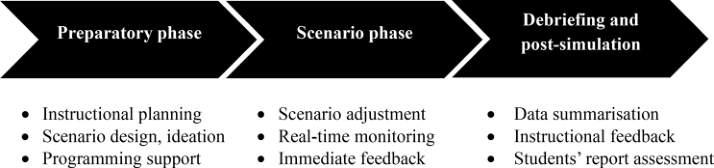
Although simulator training in maritime sector is governed by STCW convention, the responsibility to design and execute the simulator training remains with instructors. Research shows instructors play a significant role in achieving learning objectives by organising and facilitating the learning activities before, during and after simulation (Sellberg, 2018). With the emergence of AI and machine learning, these phases may shift from being solely human-driven practices to becoming collaboration between human instructors and AI systems. In this research, we conceptualise simulator- based training as three-interlinked phases: the preparatory phase, scenario phase and debriefing, post-simulation phase. We define AI affordance as the functionalities that AI supports for instructors to enhance their capability for conducting a specific task. Our data reveal that AI has potential to be integrated across all phases of this simulator-based training continuum. Figure 1 summarises the results.
Figure 1: AI integration across simulator-based training continuum.
AI Affordance in the Preparatory Phase In the preparatory phase, AI is considered potential to reduce the cognitive and temporal load associated with instructional planning and designing. One instructor suggested AI could support the development of theoretical framework with AI-generated media, “You can easily make a movie with AI, and the movie explains what we are going to do in the right context.” (P1). Currently, all of scenario exercises from initial design through to testing demand considerable manual work, as informants noted “you need to manually program with building logic blocks, and it takes forever per exercise” (P3). In this context, AI can ease the instructional effort for design and preparation of simulator-based training tasks, “maybe AI could help you set up the programming”(P3), “suggesting that you could use… different kinds of role play” and “propose steps in a learning plan” (P6), “make an assessment guide” (P1), “improve our materials”(P6), “create scenario” (P5, 7, 8, 9, 12) and suggest a certain scenario to train a specific topic” (P5). Additionally, instructors play an important role in aligning training programs and learning environments with learners’ existing levels of competence and prior knowledge. This responsibility demands careful selection of appropriate assessment tools and the design of scenarios, in which cognitive and operational demands are properly calibrated to support meaningful educational outcomes for each individual. Within this pedagogical framework, AI appears promising as a tool for profiling learners for more effective scenario selection. As one informant noted, AI could support this process by “organising the individual data, so that professors or instructors select the best appropriate method for the education of individual students” (P2).
AI Affordance in the Scenario Phase During the scenario phase, AI could be embedded into simulator programs and act as an adaptive supervisory system, which has the capability to monitor learners’ activities and assist instructors in regulating the dynamic simulation scenarios. As informants noted, “AI can give the correct feedback in the simulator while they’re pushing buttons” (P5) and could respond to learners’ queries about “how to act” or “what their rights are in a given scenario” (P6). In addition, informants highlighted that operating and monitoring a simulation exercise demands substantial cognitive effort. Here, AI was seen as a potential means of reducing this operational burden for instance, by maintaining rulebased behaviours such as “keeping the COLREGs active within the scenario we have set up” (P4) or by enabling autonomous traffic patterns, including “ships sailing along the coastline and returning” (P6).
AI in the Debriefing and Post-Simulation Phase In the debriefing and post-simulation phase, AI was considered particularly potential for synthesis and evaluation tasks. AI can transform large volumes of performance data into actionable insight by examining “what the student
From Tutor to Co-Instructor: AI–Human Instructor Roles in Maritime Simulator 65 did under the exercises and how the student responded on the feedback it got under the exercise” (P1). One informant noted that it would involve “downloading the data from the environment, data analysis. So, this would be the area for summarisation” (P11). From the instructor perspective, AI could serve as a reflective instrument of their own practice. Several informants noted that AI can “assess me… help me maybe become better in assessing…giving feedback on what I’m doing” (P1). AI has potential to indicate whether instructors were acting appropriately “from the point of view of learner” (P10). Such that, AI contributes to enhancing the quality of evaluative practice. Informants further suggested that AI could support the assessment-related tasks including evaluating learners’ post-exercise reports and programming of assessment exercises. Given the technical and cognitive demands of post-simulation assessment, “very few instructors actually use these assessment tools, because it’s so time consuming” (P7). Informants envisioned being able to specify assessment criteria and “tell AI to make an automatic assessment” (P7).
AI-Integrated Simulator Training Drawing on the affordances of AI systems, we propose three types of AIintegrated training (Table 2). Each typology reflects the interdependent relationship between human instructor and AI and contributes to different phases of the simulator-based training continuum.
Table 2: Types of AI-integrated simulator training (adapted from Ostrom et al. (2018).
Table available in the original PDF paper.
Type Instructor Role AI role Training Style Involvement Phase AI-supported Lead Tool Instructor- centred Preparator Debriefing, post simulation
AI-augmented Collaborate Assistant
Scenario
Instructor- centred + assistance from AI AI-Instructed Assure quality Instructor Autonomous training Scenario Debriefing, post simulation
AI-supported training positions AI as a tool that enhances instructional tasks in the preparatory and postsimulation phases while human instructors remain central in delivering instructional knowledge. For example, AI creates and tests scenarios for simulator training under the supervision of human instructors in the preparatory phase. AI has also potential to summarise and analyse the performance data from simulator training tasks, while human instructors interpret and validate the results in the debriefing phase.
AI-augmented training positions AI as an assistant that complements human instructors during the scenario phase. For example, AI monitors and flags COLREG violation to instructors or maintain the COLREG.
Finally, AI-instructed training positions AI as an autonomous instructor, capable of delivering immediate feedback and managing training processes with minimal human intervention. This type of training may be feasible in procedural machine engineering tasks or with basic navigation scenario with predefine solutions. However, human instructors While human instructors remain central to learner interaction in the first two types, the third shifts the human role towards quality assurance particularly in the design, validation, and continuous oversight of AIautonomous training.
CONCLUSION
Our research contributes to the existing literature by highlighting the possibility of integrating AI into simulator-based training and assessment within the maritime domain. Our findings demonstrate that AI has potential to be integrated across the simulator-based training continuum, especially the preparatory phase where tasks related to scenario development and instructional planning remain labour-intensive and time-consuming. These challenges stem primarily from non–human-centred software design and the inherent complexity of simulation scenarios. Additionally, we propose three types of AI-instructed simulator-based training: AI-supported, AI-augmented and AI-instructed, where AI can function as a tool to enhance training quality, as an assistant to human instructors during scenario phase or as an instructor itself for autonomous training with human oversight over the scenario design, development and validation. We also highlight areas where AI can provide meaningful support and where human instructors remain indispensable.
LIMITATION AND FUTURE RESEARCH DIRECTION Our findings are limited to the simulator-based training in maritime domain. Hence, future research could examine the generalisability of our results in other high-risk sectors such as aviation and healthcare. Moreover, our research focuses on qualitative approach to explore the possibility of AI integration from the perspectives of maritime practitioners with simulator- based training expertise. Future research could extend our research by incorporating the perspectives of learners and examining the factors shaping the adoption of AI in simulator-based training using quantitative design to provide empirical rigour.
ACKNOWLEDGEMENT
The data used in this research belong to the project with Sikt reference number 386903.
REFERENCES
Braun, V., & Clarke, V. (2006). Using thematic analysis in psychology. Qualitative research in psychology, 3(2), 77–101. Chen, L., Chen, P., & Lin, Z. (2020). Artificial intelligence in education: A review.
IEEE Access, 8, 75264–75278.
From Tutor to Co-Instructor: AI–Human Instructor Roles in Maritime Simulator 67 Dreyfus, H., & Dreyfus, S. E. (1986). Mind over machine. Simon and Schuster. Eisenhardt, K. M. (2021). What is the Eisenhardt Method, really? Strategic
organization, 19(1), 147–160. Heidegger, M. (1962). Being and time. Basil Blackwell. Introna, L. (2005). Phenomenological Approaches to Ethics and Information Technology. Metaphysics Research Lab, Stanford University. Kandemir, C., Soner, O., & Celik, M. (2018). Proposing a practical training assessment
technique to adopt simulators into marine engineering education. WMU Journal of Maritime Affairs, 17(1), 1–15. Karimi, E., Smith, J., Billard, R., & Veitch, B. (2024). AI-based adaptive instructional systems for maritime safety training: A systematic literature review. Discover Artificial Intelligence, 4(1), 51. Kim, T.-e., Sharma, A., Bustgaard, M., Gyldensten, W. C., Nymoen, O. K., Tusher, H.
M., & Nazir, S. (2021). The continuum of simulator-based maritime training and education. WMU Journal of Maritime Affairs, 20(2), 135–150. Kolb, D. A. (2014). Experiential learning: Experience as the source of learning and development. FT press. Munim, Z. H., Kjeldsberg, F., Kim, T.-E., & Bustgaard, M. (2025). Prediction
accuracy in maritime simulator training performance assessment with varying data frequency. Array, 100489. Ostrom, A. L., Fotheringham, D., & Bitner, M. J. (2018). Customer acceptance of AI in service encounters: understanding antecedents and consequences. In Handbook of service science, volume II (pp. 77–103). Springer. Sellberg, C. (2018). From briefing, through scenario, to debriefing: The maritime
instructor’s work during simulator-based training. Cognition, Technology & Work, 20(1), 49–62. Vujičić, S., Hasanspahić, N., Gundić, A., & Maglić, L. (2022). Analysis of factors influencing the effectiveness of MET instructors. WMU Journal of Maritime Affairs, 21(4), 549–570.
LISTED IN THE AHFE DIGITAL BOOKSTORE CATALOGUE
Explore the complete digital volume
Training, Education, and Learning Sciences
Read this individual research paper free through the original publisher, or explore the full digital proceedings book.
ISBN 979-8-950676-07-9
Explore this ISBN in the AHFE Bookstore ↗Listed in the July 2026 bookstore catalogue; search by ISBN to confirm current availability · Digital book purchase optional