Jingjing Wang, Jiaxin Qin, Duoduo Zhang (2026). AI and Unplugged Creativity: Reimagining Accessible Intelligence through AI-Scaffolded Paper-Cutting for Marginalized Communities. In: Training, Education, and Learning Sciences. AHFE Open Access, vol. 231, pp. 160–169. https://doi.org/10.54941/ahfe1008007
Background: While generative AI holds transformative potential for creative education, it often exacerbates the digital divide for children in the Global South. Its 'screen-centered' paradigm reinforces algorithmic colonialism, where result-oriented outputs often marginalize local narratives and impose alien cultural frameworks, further isolating those in low-resource environments.Objective: This study proposes an unplugged, AI-scaffolded intervention paradigm to stimulate creativity and critical thinking among rural children in low-tech environments. Methods: Guided by the "3E" principles (Embedded, Embodied, Emergent), we developed an AI-integrated toolkit that transforms a single A3 paper into a creative "Zine" through non-electronic paper-cutting activities. A study was conducted with 40 students in rural China, using AI as a heuristic scaffold to provide cultural imagery through questioning rather than direct answers. Data were collected via coded artworks. Results: Findings indicate that: (1) AI-scaffolding significantly enhances narrative complexity and personalized creative expression; (2) Compared with "answer-oriented" outputs, AI’s guided intervention triggers more iterative thinking and reflective dialogue, fostering creative agency rather than technological dependence; and (3) highly embodied interactions increase creative autonomy and immersion. Conclusion: This research demonstrates a scalable, new inclusive design framework that activates local cognition through low-tech human-AI collaboration, providing a viable model for culturally adaptive intelligence in marginalized communities.
Digital Divide and Algorithmic Colonization Generative AI (AIGC), exemplified by ChatGPT, has revolutionized education by enhancing learning efficiency and innovation (Alasadi & Baiz, 2023). Digital technology enables systematic solutions—integrating AI, equity, and pedagogical coherence—to dynamically address diverse student needs (Ayas, 2026), making Inclusive AI a global educational trend. Despite these advancements, a significant “digital divide” persists. Kleemann and Semrau (2025) note that rising ICT adoption often reinforces
AI and Unplugged Creativity 161 “information constraints” and inequality among marginalized groups, particularly isolated small farmers. In the Global South, rural areas remain disadvantaged by inadequate infrastructure (electricity/network) and high hardware costs. Furthermore, AI research exhibits geographical imbalance, dominated by developed nations (Chen et al., 2024). This concentration risks “algorithmic colonization,” as AIGC tools trained on Global North corpora dilute indigenous knowledge (Oztig, 2022). Currently, AI education remains theoretical, lacking sufficient empirical validation (Chen et al., 2024).
Technical Dislocation Phenomenon “Screen centralization” in AI education often triggers a lack of embodied cognition, visual fatigue, and social isolation. Current AIGC tools rely heavily on Graphical User Interfaces (GUIs), which foster “digital disconnection” in resource-poor areas while limiting learners’ spatial perception and material experience (Dai et al., 2024). Thailand’s “One Tablet Per Child” policy demonstrated that without addressing underlying technical anxiety and support, distributing devices can increase rural students’ anxiety and psychological burden rather than promoting equity (Pruet et al., 2016).
Furthermore, concerns persist regarding marginalized groups’ ability to utilize prompts effectively and the potential for AI-dependency to erode critical thinking and research quality (Abubakar et al., 2025; Malik et al., 2025). Consequently, the core challenge lies in designing low-tech, inclusive, and accessible interfaces that position AI as a “scaffolding” tool rather than a replacement for active participation.
THEORETICAL FRAMEWORK The “3E” Principles
This study has developed a set of “unplugged” educational toolkit based on AIGC, aiming to achieve guided intelligent intervention through the physical structure of an A3 sheet of paper, and to stimulate children’s creative expression through embodied physical behaviors. The design of the toolkit is based on the following “3E” principles (Embedded, Embodied, Emergent): Embedded: Effective AI education must integrate core cultural dimensions, including local languages, ethnicities, and traditions (Nyaaba et al., 2024). We utilize the visual symbols and Tang Dynasty poetry of “Changsha Kiln” as a “cultural input source” for AI logic. Given that users often misjudge deceptive AIGC content—with students achieving only a 70% identification success rate (Cui & Zhang, 2025)—incorporating familiar cultural “genes” enhances recognizability and fosters psychological credibility through cultural belonging. By connecting AI to familiar cultural objects, children can better evaluate “cultural authenticity,” evolving from passive recipients into critical creators. This strategy positions AI as a culturally-imprinted “dialogue partner,” encouraging critical examination and mitigating the risks of algorithmic colonization.
Embodied: Shapiro and Stolz (2019) contend that cognition emerges from the interaction between the body and environment rather than occurring
solely within the brain. By utilizing paper-cutting as a medium, tactile feedback and rhythmic cutting facilitate cognitive processing. This “de-centralized” cognition addresses the “screen centralization” gap faced by marginalized groups. Integrating the “embodied scaffolding” concept (Price et al., 2023), our toolkit converts AIGC content into physical structures. Through folding, cutting, painting, and collaging, children leverage bodily movements to stimulate complex narratives, transforming abstract algorithmic outputs into perceivable, operable material interventions (Dai et al., 2024).
Emergent: AI offers open-ended narrative guidance rather than definitive answers. This toolkit serves as scaffolding for AI intervention; when students transition from blind reliance to collaborative partnership with clear creative intentions, learning outcomes significantly improve (Yang et al., 2025). By lowering technical barriers for rural children, the toolkit facilitates intuitive collaboration. Consequently, their outputs are not mechanical reproductions of AI training data, but creative manifestations of autonomous agency and individual aesthetic decisions emerged during the physical making process.
Human-AI Co-Creation in Education AI education should position artificial intelligence as a collaborative partner for complex tasks rather than a replacement for teachers or students (Brusilovsky, 2024). In the AIGC era, design agency has shifted from human- centric to post-humanist perspectives, elevating the significance of “design collaboration” within complex cultural contexts (Galkin & Wei, 2025). Rather than a mere instruction executor, AI facilitates systemic innovation. Consequently, toolkit design must provide narrative support and aesthetic inspiration, empowering children’s subjective creation.
METHODOLOGY
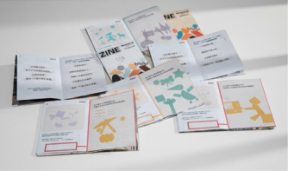
Designing the A3 Zine Toolkit The toolkit utilizes a single sheet of paper as the primary medium. The reverse side features traditional cultural illustrations, while the front is partitioned into eight sections that form a “Zine” upon folding and cutting. This layout includes a cover, a back cover, and a three-step guided narrative. To facilitate personalized creation, the system provides AI-generated collage text and geometric stickers , enabling children to weave individualized stories into their paper-cutting artworks.
The Uniqueness of AI in the Toolkit Constraints of the “unplugged” toolkit shift AI education from real-time dialog boxes to an “invisible scaffold” that guides and inspires creativity. A key challenge lies in translating AI’s unique characteristics—specifically its ability to restructure traditional “artistic initiative” through non-human visual logics (Chatterjee, 2022)—into the “Changsha Kiln” theme.
Our process begins by prompting LLMs to generate “unexpected story scenarios” that juxtapose traditional imagery with modern fast-paced
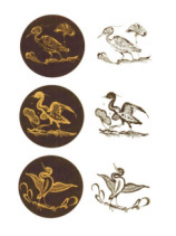
AI and Unplugged Creativity 163 lifestyles. These narratives are then converted into heuristic images via tools like Midjourney and JiMeng AI. We deliberately retain the “uncertainty” of AI outputs to trigger children’s narrative and aesthetic associations. To address the lack of localized Southern knowledge in global AIGC databases, we first train the AI to extract specific “Changsha Kiln” patterns , followed by “low-intervention” image generation to ensure precise cultural translation.
Figure 1: Photos taken with the toolkit.Figure 2: The classic bird patterns on the Changsha Kiln ware.
The specific guiding steps of Zine 01 Cognition and feelings Exploring the Characteristics of AI-generated pictures. 02 Narrative telling Compose one’s own short poem by piecing together the words generated by AI. 03 Graphical expression Use geometrically shaped pieces to collage the story you want to tell.
Figure 3: The physical usage method of the toolkit.
Research Design The Basic Information of the Experimenters
Sample characteristics: Participants included 40 fourth-grade students (balanced gender ratio) from rural primary schools in Changsha, Hunan, China. All participants possessed foundational knowledge of local intangible cultural heritage paper-cutting; notably, the cohort included several “left- behind” children, reflecting the specific socio-demographic context of rural education.
Reason for selection: Positioned at the edge of the “digital divide,” this group lacks advanced electronic devices and connectivity but maintains strong local paper-cutting traditions. Consequently, they represent an ideal sample for validating “unplugged AI education” models.
Experimental Procedure Participants (N = 40) were randomly assigned to a Control Group (G0, n=20) and an Experimental Group (G1, n=20). The workshop followed a three- stage protocol to compare traditional teaching with AI toolkit intervention:
Stage I: Introduction (8 min). Both groups received standardized briefings on “Changsha Kiln” cultural history.
Stage II: Intervention (35 min). G0 performed free creation based on memory and verbal guidance. G1 utilized the A3 Zine toolkit, engaging with AI-facilitated physical scaffolding.
Stage III: Production (35 min). All students finalized their paper-cutting works, translating their developed narratives into physical artistic outputs.
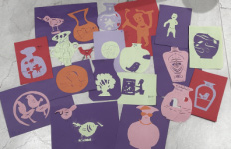
Data Collection and Processing From the initial outputs, 25 high-quality works were selected for final analysis. Samples that remained incomplete due to time constraints were excluded to ensure data validity.
Figure 4: The children’s paper-cutting works.
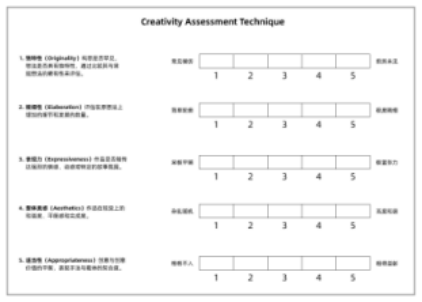
AI and Unplugged Creativity 165 To evaluate the toolkit’s efficacy in stimulating creativity, a five-point Likert scale was developed (Fig. 1), synthesized from Torrance’s (1966) creative thinking dimensions and Sternberg’s (2012) assessment framework. Creativity was quantified across five dimensions: originality, elaboration, expressiveness, aesthetics, and appropriateness.
Figure 5: Five-level scoring scale.
RESULTS & ANALYSIS Consistency and Reliability Test of Ratings
Before conducting a formal analysis of the differences between groups, we conducted a reliability test on the results of the three expert raters:
Table 1: The degree of consistency among the judges for each dimension.
High reliability dimension: The consistency of precision and overall aesthetic appeal after mean processing is extremely high. The ICC(2,k) values for these dimensions reach 0.838 and 0.801 respectively, indicating that the scoring results of these dimensions are highly reliable.
Dimension with relatively weak consistency: The consistency of uniqueness is relatively low (ICC(2,k) = 0.487), which may be related to the significantly stricter evaluation scale of scorer B (whose average score was only 2.76).
Overall reliability of the scale: The Cronbach’s alpha coefficient of the five dimensions reached 0.930, indicating that the scale has extremely high internal consistency and supports the use of the composite total score for overall evaluation.
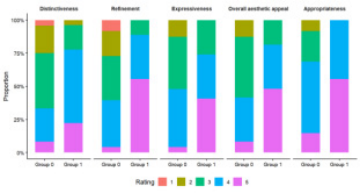
Descriptive Statistical Analysis The data clearly show that the experimental group (Group 1) performed better than the control group (Group 0) in all evaluation dimensions.
Score improvement: The overall mean score of the five items in the experimental group (4.281 ± 0.485) was significantly higher than that of the control group (3.346 ± 0.514).
High score proportion: The proportion of “4 or 5 points” in the original scores showed a leapfrog increase. For example, the proportion of high scores for “Precision” increased from 39.6% in the control group to 88.9% in the experimental group; the improvement in “Appropriateness” was particularly significant, with all scores of the experimental group works reaching 4 points or above.
Figure 6: Data analysis result table.
Improvement of Unplugged Creativity To quantify the enhancement effect of the unplugged AI scaffolding, a Mann–Whitney U test with Holm’s multiple comparison correction was conducted (G1, n=20; G0, n=20). The experimental group (G1) significantly outperformed the control group (G0) across all five dimensions (p < 0.05). Notably, elaboration, appropriateness, and originality exhibited substantial effect sizes (A≈ 0.78 - 0.81), indicating an 89%–90% probability that a randomly selected work from G1 would surpass one from G0 in quality.
Beyond higher mean scores, G1data showed lower dispersion, demonstrating the framework’s robustness. This suggests that AI scaffolding serves as an “equally distributed” catalyst, pulling ordinary students in marginalized groups toward higher creative achievement rather than benefiting only a talented few. The high performance in appropriateness (X > 4.0) further indicates that the toolkit successfully bridges narrative logic gaps in rural children’s work, balancing cultural uniqueness with enhanced communicative and aesthetic value.
DISCUSSION
AI-Scaffolded Design Technology with Warmth: Addressing the “High-Tech Dislocation.” Our results challenge the “high-tech dislocation” prevalent in the Global South’s AI education. By transforming abstract algorithms into tangible, foldable, and scalable physical paper, the toolkit mitigates the technical anxiety previously
AI and Unplugged Creativity 167 observed in rural students (Pruet et al., 2016). This low-cost, A3-paper-based intervention demonstrates high robustness, offering a new HCI paradigm for achieving genuine educational equity through lowered access thresholds.
AI as Scaffold: From Humanism to Human-AI Collaboration. The experimental group’s superior performance in “appropriateness” confirms that AI functions as a supportive scaffold rather than a prescriptive answer. This “constrained freedom” provides high-quality intelligent guidance within low-tech environments without displacing student autonomy. Consequently, creative agency shifts from traditional humanism to a collaborative model, where outputs are defined neither by human limitations nor by AI’s result- oriented nature, but by synergistic Human-AI interaction.
Cultural Localization Cultural Belonging as the Catalyst for Technical Trust. Cultural belonging forms the bedrock of “technical trust.” When AI content resonates with rural lived experiences and intangible heritage, students can critically filter and refine outputs through the lens of “cultural authenticity.” By imbuing traditional heritage with modern narrative vitality, AI ensures that marginalized communities retain their voices and cultural roots. Ultimately, this approach serves as a strategic defense against the “colonial crisis” of the digital wave, empowering local knowledge within the global AI landscape.
CONCLUSION
Contributions Addressing the “digital divide” and “screen-centralization” challenges in the Global South, this study proposes and validates an unplugged AI scaffolding model grounded in the “3E” principles. By deconstructing and reconfiguring generative AI logic into tangible paper-based toolkits, we demonstrate the feasibility of high-quality intelligent education in low-tech environments. Experimental results confirm that this model significantly enhances rural children’s elaboration and originality in creative expression.
Practical Significance This study challenges the assumption that AI education necessitates high- computational power and bandwidth, presenting a low-cost, inclusive “unplugged” strategy. It establishes an empirical paradigm to mitigate algorithmic isolation and cultural marginalization in resource-constrained regions. By prioritizing embodied creation, this interactive mode emphasizes physical engagement as a driver of creativity in Human-AI collaboration. Consequently, the advantages of AI are liberated from “screen-centralization” and “result-oriented” constraints, transforming abstract intelligence into concrete.
Limitations and Future Prospects While this short-term intervention yielded significant results, limitations remain regarding sample size and duration, which are insufficient to evaluate
long-term impacts on students’ AI literacy and creative development. Additionally, the completely “unplugged” nature of the model—while solving access issues—introduces delays in interaction feedback, preventing real-time dynamic adjustments based on student responses.
Future research will explore a broader range of physical media integrated with AI to enhance real-time embodied feedback. We also aim to develop localized LLMs that more precisely adapt to diverse ethnic and regional cultural contexts. Ultimately, our goal is to scale this framework across the Global South, fostering a “Human-AI Cultural Community” where marginalized groups transition from passive digital consumers to critical, empowered creators.
ACKNOWLEDGMENT
The project is sponsored by the Student Innovation and Entrepreneurship Training Program (SIT) of Hunan University (No. S202310532174).
The author would like to express their sincere gratitude to Mrs. Zhang Xun, an expert from the Changsha Paper-cutting Association, for her invaluable professional guidance and technical expertise. Her support was instrumental in the cultural authenticating of the toolkit design and the successful implementation of the experimental workshops.
REFERENCES
Abubakar, S., Jeilani, A., & Yusuf, M. (2025). The role of over-reliance on AI in the negative consequences of student learning: The moderating effects of ethical concerns and institutional policies. Cogent Education, 12(1), Article 2591503. https://doi.org/10.1080/2331186X.2025.2591503 Alasadi, E. A. A., & Baiz, C. R. (2023). Generative AI in education and research:
Opportunities, concerns, and solutions. Journal of Chemical Education, 100(8), 2965–2971. https://doi.org/10.1021/acs.jchemed.3c00323 Amabile, T. M. (1982). Social psychology of creativity: A consensual assessment technique. Journal of Personality and Social Psychology, 43(5), 997–1013. https:// doi.org/10.1037/0022-3514.43.5.997 Ayas, B. D. (2026). Reflections on ‘Enhancing heart anatomy education in middle
schools’: Integrating artificial intelligence, educational equity, and instructional coherence. Anatomical Science International, 101(1), 110–112. https://doi.org/ 10.1007/s12565-025-00865-y Brusilovsky, P. (2024). AI in education, learner control, and human-AI collaboration.
International Journal of Artificial Intelligence in Education, 34(1), 122–135. https://doi.org/10.1007/s40593-023-00356-z Chatterjee, A. (2022). Art in an age of artificial intelligence. Frontiers in Psychology, 13, Article 1024449. https://doi.org/10.3389/fpsyg.2022.1024449 Chen, X. J., Hu, Z. B., & Wang, C. L. (2024). Empowering education development
through AIGC: A systematic literature review. Education and Information Technologies, 29(13), 17485–17537. https://doi.org/10.1007/s10639-024-12549-7 Cui, Y. L., & Zhang, H. (2025). Can student accurately identify artificial intelligence generated content? An exploration of AIGC credibility from user perspective in education. Education and Information Technologies, 30(12), 16321–16346. https://doi.org/10.1007/s10639-025-13448-1
AI and Unplugged Creativity 169 Dai, S. D., Davidson, J., Ullmer, B., Newman, W. E., & Konkel, M. K. (2024).
Generative AI syntheses of platform, content, visuals, and kinetics for cyberphysical computationally-mediated posters and broader applications. In Companion Proceedings of the 2024 29th Annual Conference on Intelligent User Interfaces (IUI ‘24 Companion) (pp. 45–49). https://doi.org/10.1145/3640544.3645225 Galera-Rodríguez, A., & Cabrera-García, G. (2022, November 17-18). Frente al bloqueo creativo, el collage como medio de expresión plástico-gráfica. X Jornadas sobre Innovación Docente en Arquitectura (JIDA’22), Reus, Spain. https://doi.org/ 10.5821/ jida.2022.11616 Galkin, D. V., & Wei, W. (2025). The role of generative artificial intelligence in
modern design: Theoretical considerations. Vestnik Tomskogo Gosudarstvennogo Universiteta-Kulturologiya i Iskusstvovedenie, 57(3). https://doi.org/10.17223/ 22220836/57/3 Kleemann, L., & Semrau, F. O. (2025). Connecting the unconnected? Social ties and ICT adoption among smallholder farmers in developing countries. Technolo-gical Forecasting and Social Change, 213, Article 123985. https://doi.org/10.1016/j. techfore.2025.123985 Malik, A., Khan, M. L., Hussain, K., Qadir, J., & Tarhini, A. (2025). AI in higher
education: Unveiling academicians’ perspectives on teaching, research, and ethics in the age of ChatGPT. Interactive Learning Environments, 33(3), 2390–2406. https://doi.org/10.1080/10494820.2024.2409407 Nyaaba, M., Zhai, X., & Faison, M. Z. (2024). Generative AI for culturally responsive science assessment: A conceptual framework. Education Sciences, 14(12), Article 1325. https://doi.org/10.3390/educsci14121325 Oztig, L. I. (2022). The Global North/South inequalities in the IR discipline: Some
reflectionsandinsights. Alternatives, 47(2), 123–127. https://doi.org/10.1177 /03043754221095304 Price, S., Jewitt, C., & Yiannoutsou, N. (2023). The role of embodied scaffolding in revealing “enactive potentialities” in intergenerational science exploration. Science Education, 107(1), 178–206. https://doi.org/10.1002/sce.21845 Pruet, P., Ang, C. S., & Farzin, D. (2016). Understanding tablet computer usage
among primary school students in underdeveloped areas: Students’ technology experience, learning styles and attitudes. Computers in Human Behavior, 55, 1131–1144. https://doi.org/10.1016/j.chb.2014.09.063 Shapiro, L., & Stolz, S. A. (2019). Embodied cognition and its implications for education. Cognitive Research: Principles and Implications, 4(1), 1–10. https:// doi.org/10.1186/s41235-018-0092-9 Sternberg, R. J. (2012). The assessment of creativity: An investment-based approach.
Creativity Research Journal, 24(1), 3–12. https://doi.org/10.1080/10400419. 2012.643447 Torrance, E. P. (1966). The Torrance Tests of Creative Thinking. Scholastic Testing Service. Yang, W., Lu, Z., Li, Z., Cui, Y., Dai, L., Li, Y., Ma, X., & Zhu, H. (2025). The impact
of human-AIGC tools collaboration on the learning effect of college students: A key factor for future education? Kybernetes, 54(15), 7746–7763. https://doi. org/10.1108/K-03-2024-0613
LISTED IN THE AHFE DIGITAL BOOKSTORE CATALOGUE
Explore the complete digital volume
Training, Education, and Learning Sciences
Read this individual research paper free through the original publisher, or explore the full digital proceedings book.
ISBN 979-8-950676-07-9
Explore this ISBN in the AHFE Bookstore ↗Listed in the July 2026 bookstore catalogue; search by ISBN to confirm current availability · Digital book purchase optional