Jiaxin Zhou, Duoduo Zhang (2023). Stimulating Everyday Creativity: Mediating Role of New Tools in DIY Craft. In: Ergonomics In Design. AHFE Open Access, vol. 77, pp. 383–393. https://doi.org/10.54941/ahfe1003396
Everyday creativity has been shown to help people consciously develop themselves, respond to challenges, feel more in control of their destiny, and maintain a healthy state of mind and body. Through creative practices, people's possibility thinking is strengthened, they can adapt to the changes of the environment more flexibly, and actively participate in actions that promote social change. However, the current research on daily creativity mostly regards it as a holistic concept, lacking in depth in specific fields and attention to the characteristics of the current era, which makes it often difficult for designers to find effective ways to promote the benefits of creative activity.This paper focuses on the popularity of contemporary DIY crafts in urban areas and try to understand how the renewal of tools has an impact on everyday creativity. On the one hand, DIY crafts are an important part of everyday creative activities. On the other hand, the application of digital and mechanical tools has injected vitality into the design innovation in this field. Based on the perspective of post-phenomenology theory, this research pays attention to how technological objects affect human perception and behavior patterns in specific situations, and mediate the relationship between people and the world. For designers, the term "technology" in post-phenomenology can be regarded as "designing artifacts", its mediating role can be understood and anticipated, and the "advanced" design method that moralizes technology can help bring users more positive use experience and contribute to a better life world.The study takes the new tufting experience as a case. It is typified by the use of tufting guns, which makes it different from the traditional weaving behavior. Such activities are widely spread on the Internet, attracting large numbers of young people. Using practice-led research and ethnographic methods to collect data and conduct qualitative analysis, the author elaborates that technological interventions not only functionally enhance people's ability, but also shape actions and experiences. According to Ihde’s discussion of four “human-technology-world relations”, in tufting activities, the first embodied relation between tools and participants mobilizes more sensory participation, and the “ready-to-hand” state of the tufting gun brings about a different embodied perception from that of traditional crafts. Secondly, the hermeneutic relation influences people's perception of the difficulty of crafts, and the connection between wool and cloth has been translated into the vibration and sound of the gun. The third is the alterity relation, which represents people's actions and ways of thinking are changed in the interaction with tools. Finally, the background relation makes pop culture permeate into the creative process. In general, participants’ sensory experiences, as well as their ways of seeing and making are reshaped by modern tools, and new experiences and skills are acquired. At the same time, people are encouraged to go beyond the limits of skills and rules for creative exploration and personalized expression.The potential negative aspects of tool upgrading in creative practice are also concerned. For example, the simplification of the process bridges the gap between novice and expert, preventing most participants from reaching a higher level of skills that underlie a more subtle and diverse insight into the world. Moreover, while tools help reduce the occurrence of errors, they also limit the possibilities for creativity. Finally, the article identifies the opportunities and challenges for designers in this new era that encourages everyone to create, and suggests strategies for incorporating the mediating role of artifacts into the design process to help users stimulate their creativity in everyday creative practices.
While the technological development has brought positive changes to human society, it has also sown various hidden dangers. The excessive pursuit of new technologies has led to an overall crisis of ecology, economy, and culture, and modern people are facing a double alienation of labor and consumption (Zhong, 2021). The rapid changes in society and the shroud of instrumental rationality have plunged people into uneasiness and anxiety (Veeber, Syrjäläi- nen and Lind, 2015), and the impact of COVID-19 pandemic has forced us to face the sense of out-of-control in life.
Creativity is one of the core qualities to meet contemporary challenges and is considered a powerful driver of personal and social development (Gan et al., 2020). Everyday creativity, which is the focus of this paper, emphasizes the view of creativity as an innate potential of ordinary people. It encourages personal growth, allows people to deal with problems in a more resilient and creative way and adapt to the evolving social environment, thus promoting people’s all-round development and physical and mental health (Richards, 2010; Villanova and Cunha, 2021). However, current research on everyday
creativity is still insufficient in specific areas and lacks attention to the chara- cteristics of the current era. This study is based on craft activities, one of the core areas of everyday creativity (Benedek, Bruckdorfer and Jauk, 2020), and actively responds to the modernization of DIY crafts in the context of techno- logical development, in order to explore a more contemporary perception of everyday creativity. The combination of “DIY” and “craft” aims to highlight the attention to the process of making rather than the results (Tanenbaum et al., 2013). Drawing on postphenomenological theory, the authors check how technological objects affect human perceptual and behavioral patterns in specific situations, exploring how the use of new tools can stimulate or inhibit the possibility of creativity.
RELATEAD WORKS Everyday Creativity
Everyday creativity is often considered as a potential shared by human beings, helping to clear the misunderstanding that creativity belongs to only a few individuals (Zieli´nska, 2020). Furthermore, Kaufman and Beghetto (2009) proposed the Four C Model of Creativity, pointing to a potential developmen- tal track of creativity. Conceptually, everyday creativity is “a phenomenon in which a person habitually responds to daily tasks in an original and meaning- ful way”, and the outcome can be a creative product or personal experience (Villanova and Cunha, 2021). A recent study of home-based arts identified everyday creativity as “(i) self-actualization; (ii) time, process and immersion; (iii) relationship building and connection; (iv) learning and development” (Mansfield et al., 2022). These views reflect a materialization turn in creati- vity research that distinguishes it from the traditional cognitivist perception of creativity, and hold that creativity comes from the concrete processes of practices (Tanggaard, 2013). Developments of cognitive science provide the theoretical basis for this claim, such as embodied cognition, which belie- ves that mental processes are actually “distributed between brain and body, person and environment” (Glaveanu, 2013b; Malinin, 2019). The Five A’s framework of creativity, based on these opinions, integrates the dynamic rela- tionships between the components of creativity, highlighting the distributed nature of creativity and its expression in specific cultural contexts (Glaveanu, 2013b).
Technology, Tools and Creativity in DIY Craft Rooted in the optimistic idea of reusing modern technology, benefiting from breakthroughs of manufacturing technology and the promotion of network technology, DIY culture embodies the pursuit of craft production methods and values (Tanenbaum et al., 2013) and has gradually developed into a way of life (Lu, 2017). In this process, new tools have influenced people’s behavior and expanded their understanding of craft (Posch and Fitzpatrick, 2021). Makers tend to regard the use of advanced tools as a symbol to reshape their self-identity (Song, 2022).
Stimulating Everyday Creativity: Mediating Role of New Tools 385
From a participatory perspective, technology democratizes design and pro- duction (Tanenbaum et al., 2013). First, new tools are more novice-friendly; second, standardized material resources, as represented by IKEA products, facilitate collaboration and sharing and serve as a starting point for many people to create, but reliance on standard components can also undermine creativity; and third, the Internet promotes community building and know- ledge sharing. From a process perspective, the development of technology has helped people to continuously break through design and making limita- tions (Philpott, 2012; Zhong, 2021), opening up new spaces for creativity. But many studies in HCI have also noted the detrimental effects of high-tech tools on sensory experience and improvisation, and tried to compensate by drawing inspiration from traditional craft practices (Deshpande, Takahashi and Kim, 2021; Devendorf and Ryokai, 2015; Falin et al., 2021; Tokac et al., 2022). As “the workmanship of risk”, the creativity of craft is reflected in the unpredictability of its processes and the embodied participation that faci- litates that unpredictability (March and Glaveanu, 2020). Thus, the concepts of embodiment, improvisation, serendipity, and reflection are integrated into the design of hybrid production systems (Devendorf and Ryokai, 2015; Tokac et al., 2022) to promote creativity in the process.
Postphenomenological Theory Design scholars have begun to apply post phenomenology as an effective way to understand technology and experience (Fallman, 2011) and reflect on design (Dongen et al., 2019; Secomandi and Snelders, 2013). One of the central arguments of postphenomenology, pioneered by Don Ihde, is that technology can form “intentionality” and actively mediate the relationship between people and the world. The concept of magnification/reduction has been used to describe the non-neutral feature of technology, i.e., the extension of technology to some human capacity or sensation is always accompanied by some simultaneously reduction (O’Brien, 2017). Therefore, when paying attention to the relationship between technological development and creati- vity, the dual impact of technology should be considered. And the impact of technology also requires us to have a forward-looking attitude at the design stage (Zhou and Dai, 2022).
Drawing on and developing Heidegger’s analysis of tools, Don Ihde (1990) distinguished four “human-technology-world relations”, structurally descri- bing the various ways in which people interact with their environment through technology. The embodiment relation implies the incorporation of technology into our perceptual-body experience, such as crutches, glasses, etc., where technology becomes an extension of the body. In contrast, techno- logy itself becomes the focus of perception in hermeneutic relation, such as a dashboard, and people can use technology to “read”the world. In the alterity relation, the technology-as-other deals with the user and the world beco- mes the context of interaction. Finally, technologies in background relation are out of people’s consciousness, such as refrigerators and air conditioners, and implicitly influence the way people experience the world (Don Ihde, 1990). The postphenomenological theory helps us to recognize the diversity
386 Zhou and Zhang
of human-technology relationships, where the “opacity” of the tool does not imply malfunctioning, but rather facilitates more diverse experiences (Secomandi and Snelders, 2013).
METHODOLOGY
Next, the paper explores the mediating intentions of technology in DIY crafts and how this relates to everyday creativity through a case study of tufting acti- vities. Tufting was chosen because it emerged precisely due to the emergence of a new tool (the tufting gun - a handheld electric machine that shoots yarn into fabric at high speeds) in the mass-consumption sector (Stone, 2021), allowing us to observe and analyse the use of the tool and the transfor- mation of people in depth. The maker usually projects the selected pattern onto the fabric and traces it with a marker, then fills it with a tufting gun, and finally seal the yarn with glue and leaves it to dry before removing and trimming it.
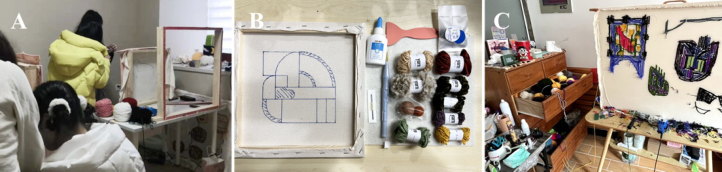
The study was conducted in three sessions (see Figure 1). Session 1 was located in a DIY experience store, where the first author participated as a novice and recorded the whole process. Session 2 did not directly involve a tufting gun, but instead used a rug hooking kit. The kit comes with a handh- eld needle-type tool that helps punch the yarn into the fabric, and the tufting gun is actually a mechanized version of it. The author invited three partici- pants to use the toolkit and compared it with the first session, which helped to understand how changes in tools mediate the cognition and behave or of cre- ators. Session 3 was held at the studio of a tufting enthusiast with more than a year of experience. The author hopes to learn about more skilled makers by observing the process of her free creation and explore whether the influence of tools differs between different types of participants.
The author’s personal experience follows a practice-led approach, where the researcher and the research subject are the same person, due to the fact that the study involves embodied cognition and personal experience that are more likely to be conducted through practice (Groth, 2016). When other participants are involved, ethnographic methods are mainly used to gain more information from the case (see Table 1). The data collected included the researcher’s reflective diary, observation and interview notes, as well as photographs and videos to help construct knowledge and repeatedly review the practice process (Akta¸s and Mäkelä, 2019).
Figure 1: Settings of different sessions: (A) DIY experience store in Session 1 (B) All materials in the kit in Session 2 (C) The tufting enthusiast’s studio in Session 3.
Stimulating Everyday Creativity: Mediating Role of New Tools 387
Table 1. Study design: Three sessions.
Table available in the original PDF paper.
Methods of collecting data Documentation
Sessions Observed participants
1. Tufting in a DIY experience store
Novice Practice-led approach and ethnographic methods Novice Practice-led approach and ethnographic methods
Diary, photographs, videos, field notes
Diary, photographs, videos, field notes 2. Using the embroidery punch toolkit
3. Tufting at own studio
Skilled enthusiast
Ethnographic methods Photographs, videos, field notes
HUMAN-TECHNOLOGY RELATIONS IN TUFTING ACTIVITIES This article focuses on the “mediation role” of technology to understand emerging tools in DIY crafts. Using the four relationships between human and technology in postphenomenology — embodiment, hermeneutic, alte- rity and background — it helps the author to understand the various specific technical phenomena in tufting activities (see Table 2).
Table 2. Overview of the four human-technology relations in tufting activities.
Embodiment Relation In terms of embodiment relationship, the physical nature of the tufting gun requires us to hold it with both hands and to control its movement by adjusting our posture. After constant practice, the tufting gun is gradually integrated into our bodily experience, in what Heidegger describes as the “ready-to-hand” state. At this point, our physical sensations extend to the surface of the gun, feeling the yarn through vibration and resistance as it penetrates the fabric. Since this requires people to adapt to the new machine, it is richer than the senses that need to be mobilized when using a poking needle, and eventually such embodied experience will be transformed into the tacit knowledge of the participants. Meanwhile, the weight of the tufting gun can be strenuous for the user, and the high speed of the gun is dange- rous, which means that it can never be completely “transparent” and always remains at the edge of our attention.
388 Zhou and Zhang
Hermeneutic Relation Understood through hermeneutic relation, the tufting gun becomes a direct perceptual object of tufting activities. In online communication, communica- tors often use the onomatopoeic word that mimic the operation of the gun to refer to this activity, showing its fun nature. In production, the translation and rotation of the machine replaces the more direct touch and control of the material. What people get here is an indirect experience. This to some extent hides the interactions among yarn, fabric and needle, making them invisible to the user and leading to a partial loss of material experience. As observed in the study,Wang emphasizes her dedication to detail when using the needle by showing how she tries to align the stitches, while Qian who use the gun pay more attention to the overall effect. The user is invisibly manipulated by the design of the tool, but accordingly, the activity becomes fun and simple to engage the public. The transformation of perception also reinterprets the aura of craft. Zheng (the tufting enthusiast in Session 3) posted her works on social platforms and was happy to be called an “artist”, demonstrating her self-identity and social identity.
Alterity Relation The alterity relation emphasizes the tool-as-other prompting one to adapt to its prescribed ways of thinking and acting. For example, participants formed different habits when trying to solve the problem of yarn always fal- ling out of the gun: Qian (a DIY experience store consumer in Session 1) would pull out more threads in advance; the author found that using thi- cker threads or combining multiple strands of thin threads would reduce the frequency of falling out; and Zheng embedded a metal ring on the side of the wooden frame through which the yarn could pass to reduce the tension of gravity on the yarn. Although the influence of technology is irresisti- ble, people do not react in the same way. Another example is that Web search and projector assistance can help participants with inadequate dra- wing skills take the first step toward participating in tufting, but at the same time weaken their pictorial re-creation of their own lived experiences and implicitly created a design-before-make logic that limited ongoing creative thinking.
Background Relation Turning to technology in the background, the Internet and industrial produ- ction facilities (Zhong, 2021) expand people’s resources for communication and action, and contribute to collective creativity. Moreover, people’s crea- tive inspirations are no longer limited to embodied experiences or national knowledge (Chen, 2022), but are increasingly influenced by online pop culture, as evidenced by the proliferation of virtual IP images and brand logos in tufting patterns, reflecting the construction of people by absent technologies.
Stimulating Everyday Creativity: Mediating Role of New Tools 389
Table 3. Two making modes of the participant.
Table available in the original PDF paper.
TWO MAKING MODES In the studio of Zheng, a tufting enthusiast, the author observed that her making mode is completely different from that of a novice in a DIY expe- rience store (see Table 3). Instead of following the steps of conceptualizing, tracing, filling, and adjusting, she experimented randomly first, then consi- dered the style, and readily adjusted based on her subjective experience of the stability and harmony of the image. Such mode embodies Ingold’s view of making to the extreme, where the creator gives herself over to the corre- spondence with the “active material”. It is shaped both by the tufting gun’s affordance to quickly realize ideas and by Zheng’s ability as a skilled user to control the direction of the tool and as an experienced creator to find harmo- nious forms in the initial chaos. Zheng enjoys this kind of “brainstorming” process that requires constant active adjustment, and the tools are fully inte- grated into her body and consciousness. In contrast, the making mode in the DIY store maximizes the technical advantages of the new tools, especially for novices to create their own desired products. Qian describes the process as a “mindless, self-relieving experience,” where participants are shaped by the tools. These two modes present the differentiated demands of participants with different motivations, skill levels and creative abilities.
DISCUSSION
The Mediating Role of New Tools With the help of postphenomenology, this study recognizes the different rela- tionships of the participants with the tufting tool. Their physical abilities are expanded and they interpret the indirect experiences provided by the tool. Their behavior and way of thinking are shaped by tools, not only in their interaction with tools, but also because the world of influenced by technology is the background of the activities. The entire creative process is dynamically constituted by these relationships, and participants with dif- ferent skill levels and motivations are able to develop their own modes of making. The concept of mediation also leads us to consider the capabilities
390 Zhou and Zhang
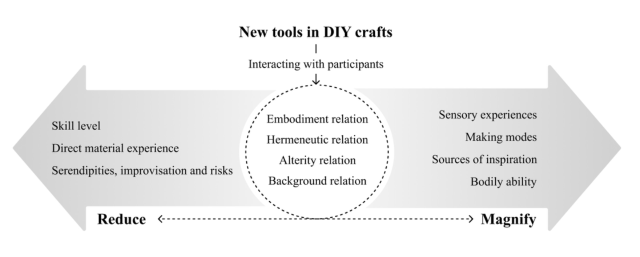
and limitations of technology. The diversified sensory experiences in tufting helps people to understand and adapt to the speed and operation of machines, while expanding their bodily abilities, transcending the limits of their skills, and broadening their sources of inspiration, thus encouraging mass partici- pation and free expression, and inspiring their creative expression. With this comes limitations in usage, neglect of details, lack of experience with direct materials, etc. Participants cannot reach higher levels of skill, and this simpli- stic tendency circumvents some of the serendipities and risks, thus inhibiting creativity (see Figure 2).
Design Reflection Today, DIY craft activities are being redefined by the renewal of tools, and technology has made possible the sharing of knowledge and the revival of crafts (Luckman and Phillipov, 2020), providing new contexts to stimulate creativity. Therefore, designers need to rethink the use of technology to define more valuable craft experiences. First of all, considering design in terms of variability and diversity of relationships provides a more engaging experie- nce, and different making modes allow creativity to emerge at any time during the process. Sacrificing the “invisibility” of some technology can make the experience more interesting (Don Ihde, 1990; Verbeek, 2005). This can be achieved by keeping or setting up some obstacles that draw the user’s atten- tion to the tool as a physical entity and lead them to creatively solve the problems that may occur. It is also in line with the characteristics of every- day creativity, which has no set criteria for evaluation but is generated in the process. Second, we need to balance the ability of the body and the tools through design, so as to stimulate people’s initiative while allowing techno- logy to transform people to some extent. This requires placing the active contact between people and materials at the core and configuring diverse forms of contact through technological tools. We should attach importance to the development of technology and the value of manual forms at the same time, which not only encourages the creative participation of the public and promotes the wide dissemination of creative practice, but also stimulates the emergence of creativity in the process, showing rich characteristics among participants at different levels.
Figure 2: The way new tools mediate creativity in DIY craft.
Stimulating Everyday Creativity: Mediating Role of New Tools 391
CONCLUSION
Taking tufting activity as a case, this paper discusses the mediating role of new tools in DIY crafts with the help of postphenomenological theory, paying spe- cial attention to the impact on everyday creativity. By identifying the multiple relationships between new tools and people and comparing them with tradi- tional tools, the study illustrates their impact on participants’ behavior and experience, summarizes the ways in which they stimulate creativity as well as possible negative effects, and reflects on the role of design. The field of craft serves as a connection point between tradition and the future, where there is a great tension between the body and technology. This paper contributes to the exploration of how people’s free creativity can be achieved while utilizing technology, and helps designers to imagine and build more creative lifestyles for people.
ACKNOWLEDGEMENT
The project is funded by Social Science Fund of Hunan Province, P.R.C, under project No. 19YBA086.
REFERENCES
Akta¸s, B. M. and Mäkelä, M. (2019). ‘Negotiation between the Maker and Material: Observations on Material Interactions in Felting Studio’, International Journal of Design, 13(2). Benedek, M., Bruckdorfer, R. and Jauk, E. (2020) ‘Motives for Creativity: Exploring
the What and Why of Everyday Creativity’, Journal of Creative Behavior, 54(3), pp. 610–625. Chen, Y. (2017) ‘Research on the creative thinking of Huayao craftsmen from the perspective of embodied cognition’, MA thesis, Hunan University. (Chinese) Deshpande, H., Takahashi, H. and Kim, J. (2021) ‘EscapeLoom: Fabricating New
Affordances for Hand Weaving’, In Proceedings of the 2021 CHI Conference on Human Factors in Computing Systems (pp. 1–13). Devendorf, L. and Ryokai, K. (2015) ‘Being the machine: Reconfiguring agency and control in hybrid fabrication’, In Proceedings of the 33rd Annual ACM Conference on Human Factors in Computing Systems , pp. 2477-2486. Don Ihde. (1990) Technology and the Lifeworld: From Garden to Earth. Illinois:
Indiana University Press Dongen, P. et al. (2019) ‘Towards a postphenomenological approach to wearable technology through design journeys’, Loughborough University. Falin, P. et al. (2021) ‘Practitioners’ Experience in Clay 3D Printing: Metaphorical
viewing for gaining embodied understanding’, FormAkademisk, 14(2). Fallman, D. (2011) ‘The new good: exploring the potential of philosophy of technology to contribute to human-computer interaction’, In Proceedings of the SIGCHI conference on human factors in computing systems, pp. 1051–1060. Gan, Q. L. et al. (2020) Innovation literacy: the third of the 5C model of core literacy
in the 21st century. Huadong shifan daxue xuebao, (02), pp. 57–70. Glaveanu, V. P. (2013a) ‘Creativity and Folk Art: A Study of Creative Action in Traditional Craft’, Psychology of Aesthetics Creativity and the Arts, 7(2), pp. 140–154.
392 Zhou and Zhang
Glaveanu, V. P. (2013b) ‘Rewriting the Language of Creativity: The Five A’s Framework’, Review of General Psychology, 17(1), pp. 69–81. Groth, C. (2016) ‘Design- and Craft thinking analysed as Embodied Cognition’, For-
mAkademisk, 9(1). Ingold, T. (2013) Making: Anthropology, Archaeology, Art and Architecture. London: Routledge. Kaufman, J. C. and Beghetto, R. A. (2009). ‘Beyond Big and Little: The Four C Model
of Creativity’, Review of General Psychology, 13(1), pp. 1–12. Lu, Y. L. (2017) ‘Philosophical Exploration of DIY Culture’, MA thesis, Central China Normal University. (Chinese) Luckman, S. and Phillipov, M. (2020) ‘I’d (still) rather be a cyborg: The artisa-
nal dispositif and the return of the (domestic) goddess’, International journal of cultural studies, 23(4), pp. 458-474. Malinin, L. H. (2019). How radical is embodied creativity? Implications of 4E approaches for creativity research and teaching. Frontiers in psychology, 10: 2372 Mansfield, L. et al. (2022) ‘Understanding everyday creativity: a framework drawn
from a qualitative evidence review of home-based arts’, Annals of Leisure Research, 32. March, P. L. and Glaveanu, V. (2020). Craft. In Encyclopedia of Creativity. Boston: Elsevier, pp. 215–221. Moens, B. G. (2018) ‘Aesthetic experience in virtual museums: A postphenomenolo-
gical perspective’, Studies in Digital Heritage, 2(1), pp. 68–79. O’Brien, D. P. (2017). Postphenomenological Performance in Interactive Narrative. International Journal of E-Politics (IJEP), 8(2), pp. 40-55. Philpott, R. (2012). ‘Crafting innovation: The intersection of craft and technology in
the production of contemporary textiles’, craft Research, 3(1), pp. 53–74. Posch, I. and Fitzpatrick, G. (2021) ‘The Matter of Tools: Designing, Using and Reflecting on New Tools for Emerging eTextile Craft Practices’, Acm Transactions on Computer-Human Interaction, 28(1), p.38. Richards, R. (2010) ‘Everyday Creativity: Process and Way of Life – Four Key
Issues’, in Kaufman, J. C. and Sternberg, R. J. (eds) The Cambridge Handbook of Creativity. Cambridge: Cambridge University Press (Cambridge Handbooks in Psychology), pp. 189–215. Secomandi, F. and Snelders, D. (2013) ‘Interface design in services: A postphenomenological approach’, Design Issues, 29(1), pp. 3–13. Song, M. J. (2022). ‘Craftspeople’s new identity: The impact of digital fabrication
technologies on craft practices’, International Journal of Technology and Design Education, 32(4), pp. 2365–2383. Stone, L. (March 9, 2021) Meet the Makers Behind the Tufted Rug Renaissance.
Metropolis. Retrieved from: https://metropolismag.com/products/meet-the-make rs-behind-the-tufted-rug-renaissance/ Tanenbaum, T. et al. (2013) ‘Democratizing technology: pleasure, utility and expressiveness in DIY and maker practice’, In Proceedings of the SIGCHI conference on human factors in computing systems, pp. 2603-2612. Tanggaard, L. (2013) ‘The sociomateriality of creativity in everyday life’, Culture &
Psychology, 19(1), pp. 20–32. Tokac, I. et al. (2022) ‘Craft-Inspired Digital Fabrication: A Study of Interactive Robotic Clay Carving’, In Proceedings of the 7th Annual ACM Symposium on Computational Fabrication, pp. 1–14.
Stimulating Everyday Creativity: Mediating Role of New Tools 393
Veeber, E., Syrjäläinen, E. och Lind, E. (2015) ‘A discussion of the necessity of craft education in the 21st century’, Techne serien - Forskning i slöjdpedagogik och slöjdvetenskap, 22(1). Verbeek, P. P. (2005) ‘Artifacts and attachment: A post-script philosophy of media-
tion’, in Harbers, H. (eds.) Inside the politics of technology. Chicago: University of Chicago Press, pp. 125-146. Villanova, A. L. I. and Cunha, M. P. E. (2021) ‘Everyday Creativity: A Systematic Literature Review’, Journal of Creative Behavior, 55(3), pp. 673–695. Zhou, X. and Dai, R. (2022) ‘Research on epistemological issues of design from the
perspective of post-phenomenological philosophy of technology’, Hunan Social Sciences, (05), pp. 42–17. (Chinese) Zhong, Z. P. (2021) Genetic theory of cultural industries. Beijing: China Social Sciences Press. (Chinese) Zieli´nska, A. (2020) ‘Mapping adolescents’ everyday creativity’, Creativity Theories–
Research-Applications, 7(1), pp. 208–229.
LISTED IN THE AHFE DIGITAL BOOKSTORE CATALOGUE
Explore the complete digital volume
Ergonomics In Design
Read this individual research paper free through the original publisher, or explore the full digital proceedings book.
ISBN 978-1-958651-53-7
Explore this ISBN in the AHFE Bookstore ↗Listed in the July 2026 bookstore catalogue; search by ISBN to confirm current availability · Digital book purchase optional