Patrik Schuler, Peioneti Lam, Blake Mitchell (2024). Evaluating Fundamental and Operational Marksmanship Performance Across Head-Borne Equipment. In: Training, Education, and Learning Sciences. AHFE Open Access, vol. 155, pp. 1–10. https://doi.org/10.54941/ahfe1005384
Warfighter clothing and individual equipment (CIE) can impede the ability of a Warfighter to rapidly identify, engage, and hit their target. This paper describes a laboratory experiment where 32 Soldiers completed a simulated marksmanship scenario in four head-borne CIE conditions. Conditions included the M50 military respirator gas mask, sand-wind-dust (SWD) goggles, the Advanced Combat Helmet (ACH): with eye protection, and the ACH alone. The scenario consisted of two sequential marksmanship tasks, referred to collectively as the Individual Shooting Scenario (ISS), consisting of a traditional and a novel marksmanship task. Our results illustrated that the ISS could capture marksmanship performance differences with enough sensitivity to distinguish across head-borne CIE equipment. Of the four CIE conditions, Soldiers generally performed worst while donning the M50 mask while results for other conditions varied by marksmanship measurement. The p(hit) for the traditional marksmanship task was significantly different across all conditions and post hoc testing found that the ACH with eye protection and SWD goggles were significantly better than the M50 condition. The findings collectively indicate a relationship between increased burdensomeness of head-borne equipment and its impact on the application of marksmanship fundamentals, consequently resulting in adverse effects on marksmanship outcomes. Further investigation is warranted to comprehensively probe the relationship and limitations of this finding. Understanding the influence of CIE on marksmanship performance can aid equipment designers to prepare for a wider variety of environments; in addition, it also can improve marksmanship training for Warfighters in equipment, the same equipment which saves lives in diverse and harsh combat environments.
One of the highest priorities of a basically trained Soldier is marksman- ship proficiency, more specifically, the ability to maintain, engage with, and accurately shoot their assigned weapon (Headquarters DOA, 2012). Warfighter-borne clothing and individual equipment (CIE) can reduce the Warfighter’s lethality and consequentially, reduce overall mission effective- ness (Mitchell, 2017; Hasselquist et al., 2018; Davis, 2016; Bossi, Jones, Kelly & Tack, 2016; Choi et al., 2016). CIE should not interfere with
marksmanship performance more than the absolute minimum amount nec- essary; interference can be reduced when designers and engineers consider environmental, mission-based, and anthropometric design factors.
Live-fire scenarios have traditionally been used to test CIE’s influence on marksmanship performance and to evaluate products in operational envi- ronments (Bensel, 1997; Harper et al., 2011; Johnson & Kobrick, 1997; Johnson, McMenemy & Dauphinee, 1990). It is becoming more common to evaluate CIE with marksmanship trainers and simulators, as they can predict live-fire scores, evaluate the influence of CIE on marksmanship outcomes, and provide experimental control associated with laboratory environments (Brown, Villa, Hussey, Ramsay & Mitchell, 2019; Crowley, Hallmark, Shanley & Sollinger, 2014; Hagman, 2000; McNamara et al., 2016). Addi- tionally, marksmanship simulators promise the benefits of improved safety and reduced training costs (Brown et al., 2019; McNamara, Burcham, Ortega & Hennessy, 2016). Understanding the effect of CIE in operational marks- manship scenarios is important because the Warfighter will adapt to CIE interferences, resulting in an accuracy and timing trade-off (USAME, 2015).
Marksmanship evaluations typically require shooters to hold one of four postures (prone, kneeling, siting, and/or standing) while engaging station- ary targets. They minimize variability sources around marksmanship and allow for the evaluation of marksmanship fundamentals. Therefore, these tasks are denoted as fundamental marksmanship tasks. Fundamental tasks lack important operational components, such as time constraints, a mobile shooter, a mobile target, environmental effects, and decision-making, leading military leadership to consider traditional marksmanship tasks unrepresenta- tive of battlefield conditions (Aguilastratt, Facchini, & Ahle, 2018). The U.S. Army recently shifted their annual weapons qualification to increase focus on operational marksmanship aspects (Headquarters DOA, 2019). To comple- ment this shift, researchers created and evaluated marksmanship simulators that can measure marksmanship performance during both fundamental and operational marksmanship tasks (Brown, McNamara & Mitchell, 2017).
We build upon the research by Brown et al. (2019), by examining head- borne equipment’s influence on marksmanship. For this research, partici- pants completed a simulated marksmanship scenario called the Individual Shooting Scenario (ISS) 4 times. Each time they wore a different piece of head-borne CIE and the equipment differed in anticipated burdensomeness. We compared performance across equipment and focused on the participant’s ability to identify, engage with, and hit targets. The goal of this experiment was to address the following research questions: RQ1: Does the ISS capture data with enough sensitivity to measure the degradation in marksmanship performance across head-borne products?
RQ2: If so, how do the various equipment affect marksmanship outcomes?
METHODS
Participants: 32 male active-duty U.S. Army Soldiers were recruited. All participants were male, had infantry jobs, and their military service time was under 1 year. Prior to the experiment, participants met a minimum
Evaluating Fundamental and Operational Marksmanship Performance 3
level of marksmanship competency, which was assessed through the Army’s annual rifle qualification. Participants were briefed on the study and provided informed consent at least 24 hours prior to the study day.
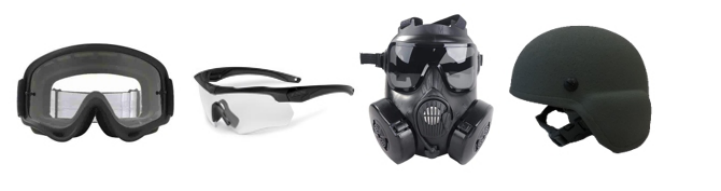
Equipment and Apparatus: Participants conducted a simulated marksman- ship scenario in four conditions that differed by headgear equipment, which included an Advanced Combat Helmet (ACH) (considered bare condition), the ACH with standard issue protective glasses (eye-pro) from the Authorized Protective Eyewear List (APEL), a standard issue sun-wind-dust (SWD) gog- gles also from the APEL, and a M50 military respirator gas mask. If required, participants provided their own corrective inserts. The headgear can be seen in Figure 1 below and the ordering of equipment conditions was random.
Figure 1: Left to right, examples of the SWD goggles, protective glasses, M50 military respirator gas mask, and ACH worn by participants for study.
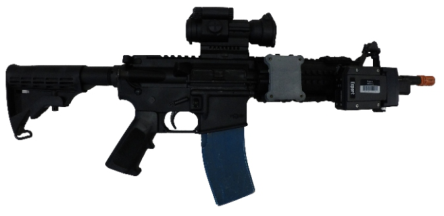
Participants completed the marksmanship scenario using a de-militarized M4 carbine (see Figure 2 below) with a mounted M68 Close Combat Optic. Simulated recoil was integrated through a carbon dioxide (CO2) system that was manufactured by LaserShot. FN-Expert sensors and inertial mea- surement units (IMUs) were attached on the right of the weapon barrel to capture marksmanship performance metrics. E-silhouette target patterns and the accompanying software were custom made by the research organization and were displayed on 6 commercial off-the-shelf (COTS) tablets (10-inch × 7-inch) which were mounted on COTS tripods. Reflective rings were placed on the front of the tablets surrounding the e-silhouette targets to reflect lasers emitted by the FN-sensor and collect aim data. The cut-point visual cue was initiated by a light-beam trigger made by the research organization.
Figure 2: LaserShot rifle used in study.
Procedures: Participants completed an individual simulated shooting sce- nario adapted from Brown et al. (2022), referred to as the individual shooting
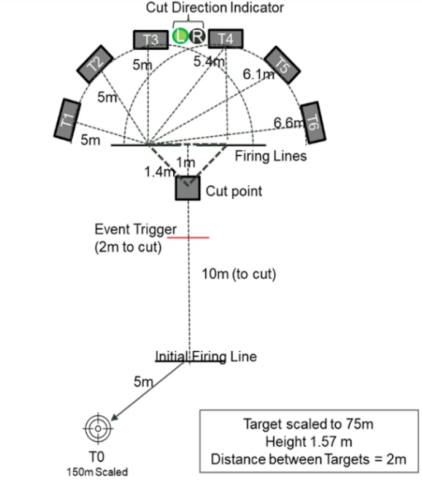
scenario (ISS) with each of the four-headgear donned. After arrival, partici- pants were re-briefed on the study and were assigned the order of headgear they would wear during the study. The scenario layout can be seen in Figure 3. Participants were then trained on the task and completed practice trials until they reported feeling sufficiently familiar with the task to proceed. The trial for each CIE condition began after the participant donned the headgear and zeroed their weapon using software calibration. A trial ended after both the fundamental and operational portions of the task were completed. For each ISS trial, participants began on the fundamental portion, where they first aimed at a ring target 7.5 meters away (scaled to 150 meters), and when verbally cued by the researcher, took five controlled shots. Partici- pants emphasized accuracy and precision during the fundamental portion. Immediately after the fifth controlled shot was taken, participants began the operational marksmanship task by running 10 meters to the cut point. Once at the cut point, participants received a visual cue indicating to cut left or right, and immediately cut diagonally to the firing line, which was 1.4 meters away. At the firing line, participants scanned the six targets, which were arranged in an arc and scaled to simulate a 75-meter distance.
Figure 3: Visualization of the ISS layout (image curtosey of Brown et al., 2022).
E-silhouette targets appeared on the tablets randomly for three seconds, and when detected, participants engaged each target in controlled pairs. Six targets appeared during the operational portion for each trial. No feedback was provided to participants regarding marksmanship performance. Partici- pants completed four trials, donned the next assigned condition, zeroed their weapon, and repeated the ISS task until all conditions were completed.
Evaluating Fundamental and Operational Marksmanship Performance 5
Marksmanship Measures and Analyses: The measures below were cap- tured separately for the fundamental and operational portions of the ISS task; p(engage) was only captured for the dynamic portion of the ISS task, as all participants engaged with all static targets.
Rifle Stability: Stability quantifies rifle movement prior to each shot and measures the participants weapons handling and barrel stability. The FN Expert collected aim data at a rate of 6.67 Hz (0.15 s) starting at 2.99 seconds before the shot. Consistent with prior work (Brown et al., 2019), stability is measured during the last 0.6 to 0.2 seconds before the shot and reflects an area of movement (measured in mm2).
Trigger Control: Total distance the rifle’s aim changed between the last 0.2 seconds and the shot time (mm).
Aiming Time: Time required for aimimg prior to shot (s).
Shot Accuracy: Accuracy was calculated as the Euclidian distance (mm) between the target’s centered to the shot placement.
Shot Group Precision: Precision was calculated as the sum of Euclidian distances (mm) for each shot from that trial’s group shot center.
P(engagement): The probably of engagement quantifies the number of tar- gets identified, acquired, and engaged with. It was measured using the percentage of targets shot at (out of 12 dynamic shots required).
P(hit): The probability of hit quantifies the percentage of the time that participants shot at and hit the target.
Prior to analyses, assumptions for Analysis of Variance (ANOVA) test- ing were checked. Homogeneity of variance for each condition was tested through Levene’s test. The Shapiro-Wilk test was conducted for each depen- dent variable. ANOVA tests were conducted with orthogonal contrasts when applicable, see specific comparisons in Table 1 below. If the Shapiro-Wilk test was significant, the Kruskal-Wallace test was used for the non-normally dis- tributed data. The Mann-Whitney U test was performed post-hoc to conduct pairwise comparisons and alpha for all statistical test was set to 0.05.
Table 1. The 3 orthogonal contrasts, each contrast tested for significant differences between the control group/s and the experimental group.
Table available in the original PDF paper.
Contrast # Control Groups Experimental Groups Contrast 1 SWD Goggles, M50 Mask, and ACH (eyepro) ACH (bare) Contrast 2 SWD Goggles and ACH (eyepro) M50 Mask Contrast 3 SWD Goggles ACH (eyepro)
RESULTS
Fundamental Marksmanship Task Results: Descriptive statistics of the marksmanship fundamental task are shown below in Table 2.
Table 2. Marksmanship fundamental measure’s mean and SD for each piece of headborne equipment, presented as: mean (SD). A lower value indicates better performance in all measures except for p(hit).
Table available in the original PDF paper.
ACH (bare) ACH (eyepro) SWD Goggles M50 Mask 215.81 (46.28) 205.11 (41.5) 221.99 (50.13) 228.68 (47.13) Stability (mm2) 44722.2 (16274) 58415.4 (50649.5) 50353.1 (29979.7) 58968.0 (27557.1) Trigger Control (mm)
Stability: Participants were the most stable in the ACH bare condition (44722.2 mm2) and the least stable in the M50 mask condition (58968 mm2). However, these differences were not found to be significant (p = 0.22).
Trigger Control: Participants had the best trigger control in the ACH (eye-pro) condition (205.11 mm) and the worst in the M50 mask con- dition (228.68 mm). The ANOVA test across conditions was significant F(78) = 32.07, p < 0.0001. However, post hoc testing did not reach significance for the planned contrasts.
Aiming Time: Aiming time was similar across conditions and no significant differences were found (p = 0.89).
Shot Accuracy: Accuracy ranged from the most accurate SWD Goggles condition (352.55 mm) to the worst accuracy – M50 mask condition (435.93 mm). There were significant differences between the conditions, Kruskal- Wallis Chi-squared (3) = 10.125, p = 0.017. Post-hoc testing found signif- icant differences between the SWD Goggles and M50 mask (p=0.018), the ACH (eyepro) and M50 mask (p=0.018), and marginal differences between the ACH (bare) and the M50 mask (p=0.06) conditions.
Shot Group Precision: Shot group precision was worst for the M50 con- dition (156.9 mm) and similar for other conditions (each mean within ±1 of 134 mm). These differences were found to be of marginal significance, Kruskal-Wallis Chi-squared (3) = 6.87, p = 0.076.
P(hit): The probability of hit was highest in the SWD Goggles condition (81%) and lowest in the M50 mask condition (65%). The differences were found to be significant, Kruskal-Wallis Chi-squared (3) = 10.545, p = 0.014. Post-hoc testing found significant differences between the SWD Goggles and M50 mask (p = 0.012), and the ACH (eyepro) and M50 mask (p = 0.022) conditions.
Operational Marksmanship Task Results: Descriptive statistics of the marksmanship operational task are shown below in Table 3.
Evaluating Fundamental and Operational Marksmanship Performance 7
Table 3. Marksmanship operational measure’s mean and SD for each piece of headborne equipment, presented as: mean (SD). A lower value indicates better performance in all measures except for p(engagement) and p(hit).
Table available in the original PDF paper.
ACH (bare) ACH (eyepro) SWD Goggles M50 Mask 445.3 (99.28) 444.27 (130.31) 433.08 (109.5) 463.8 (128.16) Stability (mm2) 375964 (165942.4) 315339 (100207) 379148 (112570.8) 334458 (160660.6) Trigger Control (mm)
Stability: Participants’ rifles were the most stable in the ACH eyepro con- dition (315339 mm2) and the least stable in the SWD Goggles condition (379148 mm2). However, these differences were not found to be significant, p = 0.28.
Trigger Control: Participants had the best trigger control in the SWD con- dition (433.08 mm) and the worst in the M50 mask condition (463.8 mm). The ANOVA test was significant F(70) = 19.79, p < 0.0001. Post hoc testing did not find significance for the planned contrasts.
Aiming Time: Aiming time was similar across conditions (around 0.4 seconds) and no significant differences were found (p = 0.97). Shot Accuracy: Accuracy was best in the ACH (eyepro) condition (368.76 mm) and worst in the M50 mask condition (451.08 mm). These differences were found to be significant, Kruskal-Wallis Chi-squared (3) = 10.59, p = 0.014. Post-hoc testing found significant differences between the ACH (eyepro) and M50 mask conditions (p = 0.013). Marginal differ- ences were found between ACH (bare) and ACH (eyepro) (p = 0.082), and SWD Goggles and M50 mask (p = 0.082) conditions.
Precision: Shot group precision was best for the ACH eye-pro condition (309.91 mm) and worst for the M50 condition (352.5 mm). ANOVA testing found significant differences across conditions F(70) = 30.48, p < 0.001. The second contrast, which compared the M50 mask against the group of SWD Goggles plus ACH (eyepro), was significiant (p = 0.001).
P(engage): The probability of engagement was found to be the lowest in the M50 mask condition (56%) and similar for other conditions (66%). The ANOVA test was significant F(70) = 25.06, p < 0.001. The first contrast, comparing the ACH without eyepro against all other conditions was signifi- cant (p = 0.04). The second contrast (comparing M50 mask against the group of SWD Goggles plus ACH (eyepro)) was also significant (p = 0.002).
P(hit): The dynamic probability of hit was found to be highest in the ACH (eyepro) condition (0.54) and lowest in the M50 mask condi- tion (0.42). ANOVA testing found significant differences across conditions F(70) = 18.56, p <0.0001. There was a significant difference for contrast 2, between the M50 mask condition and the group of SWD Goggles plus ACH
(eyepro), t(70) = 2.93, p = 0.0046. Finally, there was a significant differ- ence for contrast 3, between the ACH (eyepro) and SWD Goggles conditions, t(70) = 2.18, p = 0.032.
DISCUSSION
This paper evaluates the influence of head-borne CIE on marksmanship performance. We found that the marksmanship task was able to detect per- formance differences between the conditions, with sensitivity to performance differences increasing as CIE burdensomeness increases. Modification to the task may be needed to identify more subtle impacts of equipment’s’ effects onto marksmanship performance. Of the four CIE conditions, Soldiers gen- erally performed worst while donning the M50 mask, while results for other conditions varied by marksmanship measurement. When considering equip- ment design’s potential burdensomeness and impact on performance, the M50 mask condition imposed the most restriction onto the shooter. The mask’s full-face encapsulation significantly restricted the shooter’s view. In addition, it covered the shooter’s cheek, likely interfering with aiming pro- cedure; specifically affecting the shooter’s ability to properly use the rifle’s sights and their ability to align the rifle buttstock correctly into the should pocket. Further research could indicate the focal limitations that equipment elicits on scanning and engagement marksmanship tasks.
The fundamental marksmanship results found that participants performed slightly better in the SWD goggles and ACH (eyepro) conditions when com- pared to our baseline. This was surprising and it may be attributed to several factors, including personal eyewear design or lense condition. Participants wore their personal corrective eyeglasses, which varied in design and may have been smudged or scratched. Furthermore, an increased sample size could mitigate the impact of statistical randomness to which sampling data are susceptible.
There are several noteworthy limitations in our methodology. Weapon simulators have reduced recoil (about 30% of live-fire’s recoil), reduced psy- chological impact on the Soldier (a quiet gunshot and no muzzle flash), and no environmental conditions when compared to live-fire scenarios – meaning that Soldiers do not need to adapt to wind velocity, temperature, distance, or barometric pressure. Future work could investigate the role of head-borne CIE equipment on marksmanship decision-making, as friend vs foe detection is directly impacted by what a Soldier sees and perceives.
CONCLUSION
Developing a operationally relevant scenario for the assessment of different head-borne equipment configurations is important for understanding how this equipment can impact the Warfighter’s operational marksmanship per- formances. Marksmanship is a key factor needed for a strong operational military performance. Head-borne equipment can protect a Warfighter, how- ever, it also limits the wearer’s field of view, thus limiting the ability to identify, engage with, and hit targets. Simulated marksmanship scenarios demonstrate
Evaluating Fundamental and Operational Marksmanship Performance 9
promise to enhance, not replace, live fire evaluations. Additionally, they can be used as a training tool to enhance marksmanship fundamentals or as a research tool to understand the interactions and limitations of equipment on specific tasks. Understanding the influence of head-borne equipment on a simulated shooting scenario can support the expansion of simulated marks- manship trainers for product design, product testing, and improve Soldier training.
REFERENCES
Aguilastratt, A., Facchini, P., & Ahle, J. (2018). Lethality has a shelf life. Retrieved on 1/29/2024 from https://www.armyupress.army.mil/Portals/7/nc o-journal/docs/Lethality.pdf. Bensel, C. K. (1997). Soldier performance and functionality: Impact of chemical protective clothing. Military Psychology, 9(4), 287–300. Brown, S. A., Christopher, J. J., Villa, J. D., Goodenough, R. R., Hancock, C. L.,
O’Donovan, M., & Mitchell, K. B. (2022). Methodology to Assess Individual Shooting Skills that is Predictive of Squad Level Performance in a Close Combat Training Engagement. In Proceedings of the Human Factors and Ergonomics Soci- ety Annual Meeting (Vol. 66, No. 1, pp. 1487–1491). Sage CA: Los Angeles, CA: SAGE Publications. Brown, S. A. T, McNamara, J. A., Choi, H. J., & Mitchell, K. B. (2016). Assessment of a marksmanship simulator as a tool for clothing and individual equipment evaluation. In Proceedings of the Human Factors Society 60th Annual Meeting, 60(1), 1424–1428. Brown, S. A., McNamara, J. A., & Blake Mitchell, K. (2017, September). Dynamic
marksmanship: a novel methodology to evaluate the effects of clothing and indi- vidual equipment on mission performance. In Proceedings of the human factors and ergonomics society annual meeting (Vol. 61, No. 1, pp. 2020–2024). Sage CA: Los Angeles, CA: SAGE Publications. Brown, S. A. T., Villa, J., Hussey, E. K., Ramsay, J. W., Blake Mitchell, K. (2019). Simulated Marksmanship Performance Methodology: Assessing Lethality, Mobility and Stability Across the Preparation, Execution and Recovery Stages of a Mili- tary Field Training Exercise. In: Cassenti, D. (eds) Advances in Human Factors and Simulation. AHFE 2019. Advances in Intelligent Systems and Computing, vol. 958. Springer, Cham. https://doi.org/10.1007/978-3-030-20148-7_1 Choi, HJ, Mitchell, K. B, Garlie, T. N, McNamara, J. Hennessy, E. & Car-
son, J. (2016). Effects of Body Armor Fit on Marksmanship Performance, In R. Goonetilleke and W. Karwowski (eds.), Advances in Physical Ergonomics and Human Factors, Volume 489 of the series Advances in Intelligent Systems and Computing. pp. 341–354. doi: 10.1007/978-3-319-41694-6_35. Crowley, J. C., Hallmark, B. W., Shanley, M. G., & Sollinger J. M. (2014). Changing the army’s weapon training strategies to meet operational requirements more efficiently and effectively. RAND Corporation Research Report, RAND Arroyo Center, Santa Monica, CA. Hagman, J. D. (2000). Basic rifle marksmanship train- ing with the laser marksmanship training system. US Army Research Institute for the Behavioral and Social Sciences. Harper, W., Morelli, F., Ortega, S., Wiley, P., & Army Research Lab Aberdeen Proving
Ground MD Human Research and Engineering Directorate. (2011). The effect of modified eye position on shooting performance (p. 0050). ARL-TR-5518.
Headquarters DOA. (2012). Soldier’s manual of common tasks: Warrior skills level 1.
(STP 21-1-SMCT). Washington, DC. Headquarters DOA. (2019). Training and qualification – individual weapons. (TC 3–20.40). Washington, DC. Johnson, R. F., & Kobrick, J. L. (1997). Effects of wearing chemical protective
clothing on rifle marksmanship and on sensory and psychomotor tasks. Military Psychology, 9(4), 301–314. Johnson, R. F., McMenemy, D. J., & Dauphinee, D. T. (1990). Rifle marksmanship with three types of combat clothing. In Proceedings of the Human Factors Society 34th Annual Meeting, 1529–1532. Johnson, R. F., & Kobrick, J. L. (1997). Effects of wearing chemical protective
clothing on rifle marksmanship and on sensory and psychomotor tasks. Military Psychology, 9(4), 301–314. Mitchell, K. B. (2017, Aug). Load effects assessment program (LEAP) obstacle course data collection with 82nd airborne division [Memorandum]. Natick Soldier Research, Development, and Engineering Center (NSRDEC); Natick, MA. McNamara, J. A., Choi, H. J., Brown, S. A., Hennessy, E. R., & Mitchell, K. B.
(2016, September). Evaluating the effects of clothing and individual equipment on marksmanship performance using a novel five target methodology. In Proceedings of the human factors and ergonomics society annual meeting (Vol. 60, No. 1, pp. 2043–2047). Sage CA: Los Angeles, CA: SAGE Publications. McNamara, J., Burcham, P., Ortega, S., Hennessy, E., & US Army Natick Soldier Research, Development and Engineering Center Natick United States. (2015). Weapon simulator test methodology investigation: Comparison of live-fire and weapon simulator test methodologies and the effects of clothing and individual equipment on marksmanship. US Army Natick Soldier Research, Development, and Engineering Center: Natick, MA. U.S. Army Marksmanship Unit (USAMU) Fort Benning. (2015, January 13). Meeting
on marksmanship training and performance. Natick Soldier Research Develop- ment and Engineering Center, Natick, MA.
LISTED IN THE AHFE DIGITAL BOOKSTORE CATALOGUE
Explore the complete digital volume
Training, Education, and Learning Sciences
Read this individual research paper free through the original publisher, or explore the full digital proceedings book.
ISBN 978-1-964867-31-1
Explore this ISBN in the AHFE Bookstore ↗Listed in the July 2026 bookstore catalogue; search by ISBN to confirm current availability · Digital book purchase optional