Alina Sersch, Christian Sauder, Tobias Steger, Peter Gust (2024). Competency-based learning in the teaching of Geometrical Product Specifications (GPS). In: Training, Education, and Learning Sciences. AHFE Open Access, vol. 155, pp. 92–101. https://doi.org/10.54941/ahfe1005394
The application of the standards system of the Geometrical Product Specifications (GPS) within technical product documentation is associated with challenges. The reasons for this can be seen in the dynamics of standardization, its complexity and the small number of current teaching approaches.In this paper, the learning outcomes and competencies in the field of ISO-GPS are analyzed based on a study on the current state of teaching at universities with mechanical engineering degree programs throughout Germany. A total of 115 universities and 743 potentially relevant courses were identified, with responses from 85 universities being evaluated. What details on learning outcomes are formulated in the module handbooks? Which subject areas of the GPS are they linked to? Which competencies are considered necessary by lecturers or students? In addition to a list of learning outcomes, a competency wheel is presented that includes the learning objective taxonomy, associated verbs and potential methods of teaching. A comparison of the actual and the target status is described. Overall, the study is intended to provide the basis for the assessment and (further) development of teaching approaches for GPS. Selected examples of competencies from the competency wheel are used to illustrate concepts for teaching.
In the age of globalization and internationalization of companies, the impor- tance of clear technical product documentation is constantly increasing. The language used to describe components in technical drawings with a focus on their function is the Geometrical Product Specifications (GPS) standards sys- tem published by the International Organization for Standardization (ISO, 2024) or the ASME Y14.5 standard published by the American Society of Mechanical Engineers (ASME, 2024). In the field of GPS, there are cur- rently 147 ISO standards valid, which are subject to continuous revision (ISO, 2024). Due to the increasing digitalization, the desire for mathemat- ical unambiguity, and the complete coverage of all specification options, the system can be considered dynamic and complex (Gust and Sersch, 2020).
However, this leads to challenges in application that have been highlighted in several studies. For example, in a study by Sersch and Gust (2018), a
lack of expertise and skills was identified as the main issue for employees in Germany. Blaszczyk and Humienny (2023) were able to demonstrate a low level of understanding of the GPS system for suppliers in Poland like Toteva and Koleva (2019) for companies in Bulgaria. With regard to training at technical vocational colleges in Germany, it was also confirmed that there are gaps in teachers’ knowledge of the GPS system and that the relevance of the topic is often underestimated (Gust et al., 2022). What approaches are emerging to address these challenges? An approach to integrating the GPS system into companies, especially small and medium-sized enterprises, by using agile methods and a maturity model is presented by Schuldt et al. (2020).
When analyzing approaches to GPS teaching, studies in various countries such as China (Kong, 2022) and Germany (Gust and Sersch, 2020) con- clude that existing teaching approaches do not fit the needs of learners and are almost never aligned with current GPS content. For the research area of GPS, learner competencies are also rarely the focus of interest. However, as part of the development of the integration concept mentioned above, a training concept is introduced to support the integration process (Schuldt and Gröger, 2023). This includes the idea of GPS competencies assigned to different training levels.
With regard to the training of engineers in general, design training and training in product development were analyzed and recommendations made (acatech, 2012; WiGeP e.V., 2018). As part of the competence approach, problems in the education of future engineers are also identified interna- tionally in order to develop innovative approaches and advance teaching (Almetov, 2020; Caeiro-Rodríguez et al., 2021).
METHOD
The aim of this study is to analyze learning outcomes and competencies in the field of GPS based on a study on the current state of teaching at universities with mechanical engineering degree programs throughout Germany (Sersch et al., 2023). A total of 115 universities and 743 potentially relevant courses were identified, with the responses from 85 universities being evaluated. Then the module handbooks of these universities were examined manually with regard to the learning outcomes specified for the respective courses.
In order to be able to assign the learning outcomes to their related subject areas of the GPS based on the context of the sentences, the classification into the eight categories of the GPS system was used (Sersch et al., 2023). These are:
1. Concepts, principles and rules 2. Tolerances of form, orientation, location and run-out 3. ISO code system for tolerances on linear sizes 4. Dimensional tolerancing 5. Surface texture 6. Datums and datum systems 7. General tolerances 8. Verification.
When listing the learning outcomes, Bloom’s taxonomy of learning objec- tives (1956) was used in the slightly modified version by Anderson et al. (2001). Furthermore, when considering the types of competence, the defini- tion according to Heyse et al. (2004) is applied, which includes the four basic competences of “personal, social-communicative, professional and method- ological as well as activity and action competences”. Based on the study by Sersch et al. (2023) and the analysis of the related module handbooks, the following questions are to be answered:
What details on learning outcomes are formulated in the module hand- books?
Which subject areas of the GPS are they linked to?
Which competencies are considered necessary by lecturers or students?
In a next step, a competency wheel for GPS is created based on Brägger and Steiner (2024). It contains the learning objective taxonomy, associated verbs and potential methods of teaching. Lecturers’ and students’ desires were examined in terms of the competence types. This was followed by a compar- ison of the results with the competency classification by Schuldt and Gröger (2023) to point out potential discrepancies in regard to the desired learn- ing outcomes and the actual description in the module handbooks. Finally, selected examples of competencies from the competency wheel are used to illustrate concepts for teaching.
RESULTS AND DISCUSSION
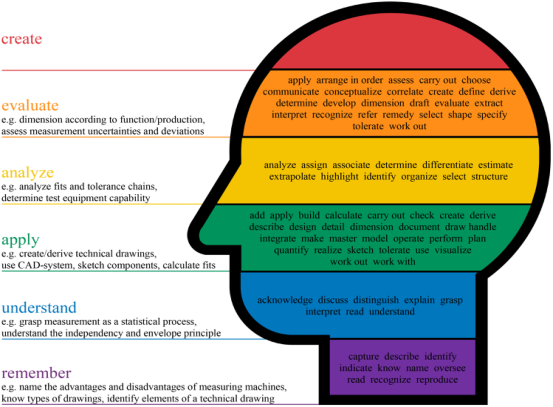
The competency analysis of the module handbooks resulted in the verb assignment in Figure 1, where not only active verbs were assigned to the six categories according to Anderson, but also nouns according to Bloom’s definition, but formulated as a verb as well.
Figure 1: Classification of verbs from the module handbooks.
Competency-Based Learning in the Teaching 95
A total of 196 individual courses with at least one of the aforementioned categories of the GPS system as teaching content were reviewed in the sections qualification objectives/intended learning outcomes/competences.
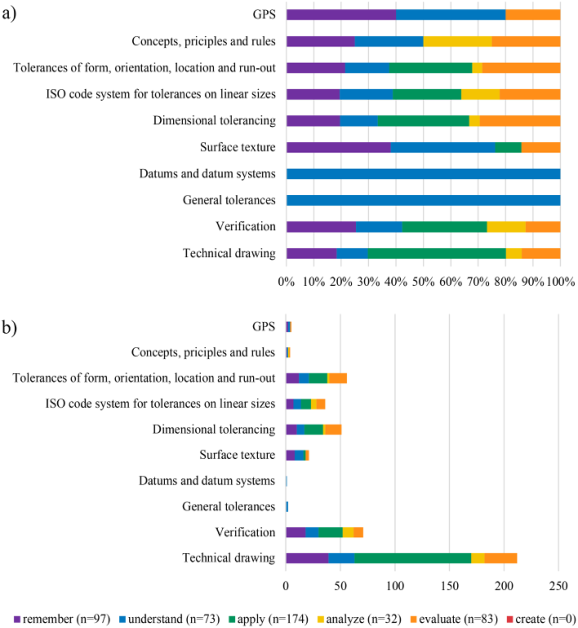
The verbs were assigned subjectively and in relation to the context of the formulation. For example, the verb “tolerate” can be found in the taxonomy levels apply and evaluate. Since “tolerate components” is vaguely formulated and lacks context it has been classified as just the application of tolerancing, whereas “tolerate for functional and manufacturing-compliance”includes an evaluation with regard to functional and manufacturing requirements. No verbs were assigned to the taxonomy level create, because in the field of GPS, it is not the creation of technical drawings that is considered, but the amend- ment of the standards themselves and their teaching (cf. Schuldt and Gröger, 2023). In Figure 2 the assigned frequency of words for each taxonomy level to the GPS categories (see section METHOD) is shown. In a) as relative and in b) as absolute frequency. Two further categories have been added, “GPS” and “Technical drawing”, because they often are mentioned in general meaning within the module descriptions but could not be automatically assigned to all categories.
Figure 2: Frequency of words for each taxonomy level assigned to the GPS categories a) relative and b) absolute.
Nevertheless, there were learning objectives in the evaluation that could be assigned to several categories, such as in the sentence “Students are able to analyze required fits and tolerance chains”. In this case, an assignment was made to “Tolerances of form, orientation, location and run-out”, “Dimen- sional tolerancing”as well as “ISO code system for tolerances on linear sizes”. Focusing on the colors of each taxonomy level, it is noticeable that there are no verbs for the taxonomy level apply in the categories “GPS”and “Concepts, principles and rules”. Similarly, no learning outcomes were found that specify that students are able to analyze surface texture after the course. As shown in Figure 2b), the GPS categories “Datums and datum systems” and “Gen- eral tolerances” appear explicitly once and twice, respectively, in the module descriptions. These formulations contain only verbs that can be assigned to the level understand. Overall, formulations of the learning objectives using the term technical drawing were widespread and therefore general. To clarify how the context of the sentences was evaluated, examples of verbs assigned to the GPS categories are presented in Table 1.
Table 1. Examples of verbs from the module handbooks assigned to the GPS categories.
Table available in the original PDF paper.
GPS
understand the basics of Geometrical Product Specifications
know the ISO-GPS-system
derive the advantages and limitations of the GPS application Concepts, principles and rules
know the independency and envelope principle and their indication
understand the independency and envelope principle
determine the fundamental tolerancing principle
define components without any doubt and according to the rules of the GPS Tolerances of form, orientation, location and run-out
identify tolerances
understand tolerances of form, orientation, location and run-out
tolerate components
differentiate standards about tolerances
recognize functions of surfaces from tolerances of form, orientation, location and run-out ISO code system for tolerances on linear sizes
name types of fits
understand the ISO system for limits and fits
calculate fits
analyze fits
Select fits for functional and manufacturing-compliance Dimensional tolerancing
know the need for dimensional tolerances
understand the specification of tolerances
apply tolerance calculation
analyze tolerance chains
work out suitable tolerances Surface texture
know the symbols for surface indications
interpret indications for technical surfaces
apply surface roughness
determine tolerances for surface Datums and datum systems
understand datums and concepts of alignment (Continued)
Competency-Based Learning in the Teaching 97
Table 1. Continued General tolerances • understand general tolerances Verification • know the measurement of geometrical deviations • grasp measurement as a statistical process • plan machine and process capability tests • evaluate surface, shape and position measurements • correlate measurement uncertainties with requirements Technical drawing • know types of drawings • understand technical drawings as a basis for communication • visualize components in the form of technical drawings in accordance with standards • analyze technical drawings
Table available in the original PDF paper.
carry out drawing critique
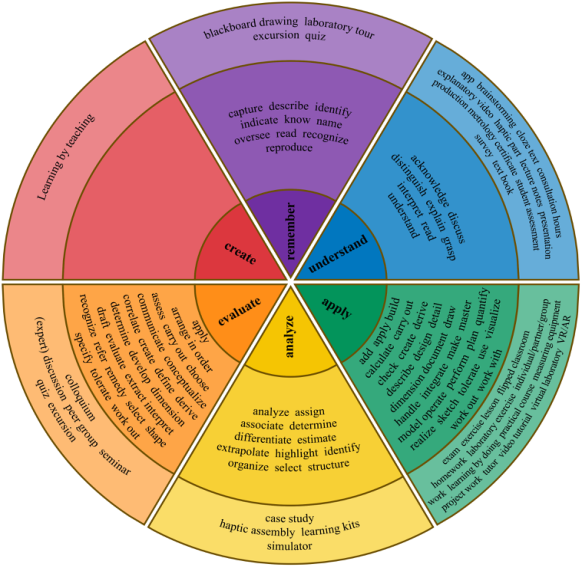
The competency wheel developed for GPS is shown in Figure 3. The learn- ing objective taxonomy can be found in the innermost ring and the associated verbs in the second ring. Potential methods of teaching were derived both from the survey from the lecturers’ free responses to the prompt “Please describe your method/s for the course.” as well as from publications on GPS teaching (Gust and Sersch, 2020; Li et al., 2022). Subsequently, the methods were assigned to the taxonomy levels subjectively. A notable feature is that the method learning by teaching can be assigned to the level create, as GPS content is passed on to other people.
Figure 3: GPS-competency wheel according to Brägger and Steiner (2024).
If the assignment of the methods to the competence types according to Heyse et al. (2004) is examined more closely, the difficulty is further increased. Only individual indications of possible categorizations can be iden- tified. Therefore, the assignment in Table 2 has been done using the desires named by lecturers and students in the survey by Sersch et al. (2023). Even though there are mixed forms of competences referring to more than one of the basic competences in Heyse et al. (2004). In the scope of this research and, because of a lack of context given in the answers, the assignment refers only to the main basic competence. Lecturers want the students to have a holistic thinking approach and an interdisciplinary understanding. In their opinion, not only functional requirements for a component, but also manufacturing and assembly considerations should be included in the students’ thought pro- cess. On the other hand, the students focus more on exams and professional experience as well as sustainable topics. They demand general examples, that cover the main issues rather than highly complex ones.
Table 2. Assignment of desires of lecturers (grey) and students (blue) to the competences specified by Heyse et al. (2004).
Table available in the original PDF paper.
Personal responsibility Deal with content independently (even learning curve of) independence self-management self-organization independence independent learning preparation Personal competence commitment commitment creative activity creativity of the design process holistic thinking more comprehensive system considerations own designs understanding the interrelationships in complex assemblies recognize the practical benefits of the lecture content Social-communicative competence
ability to experiment learning by trial and error problem-solving ability problem-based learning discipline participation in voluntary events Professional and methodological competence
interdisciplinary understanding cross-modular functionality of products as well as manufacturing and assembly processes better linkage expertise relevant, no pigeonholing professional experience systematic and methodical approach
design high-performance technical systems awareness of consequences understanding the interrelationships in complex assemblies valuable insights for later working life teaching ability own “teaching” analytical abilities understanding the interrelationships in complex assemblies recognize errors haptically knowledge orientation professional experience sustainable topics (Continued)
Competency-Based Learning in the Teaching 99
Table 2. Continued readiness for implementation practical disposition Activity and action competence motivate put into practice what you have learned initiative interested students design capability design high-performance technical systems optimism enjoyment of the design process density of content is perceived as pressure, fear of failure results-oriented action standardized tasks clearer focus on the exam receive action plans
Table available in the original PDF paper.
Limitations of the findings are, for example, subjectivity and a potential bias due to the translation into English. Furthermore, the survey did not explicitly ask about competencies, which brings additional interpretation to the statements. The analysis also only covered the Bachelor’s degree courses in mechanical engineering in Germany with different focus areas, which can- not be precisely assigned here. Only the module handbooks of courses with an answer in the survey were analyzed. The development of the compe- tency wheel and the competence tables was based on data from the survey and selected publications. Complete coverage of all possible methods in the adapted competency wheel is therefore not guaranteed.
CONCLUSION
This study looks at learning outcomes and competencies in the field of GPS. A comparison of the results of previous studies, such as the competency classi- fication by Schuldt and Gröger (2023), highlights the different perspective of this study. Module handbooks are examined with regard to the description of courses in the bachelor’s degree program in mechanical engineering and the results of a previous survey at German universities (Sersch et al., 2023) are used as a further basis, whereas Schuldt and Gröger (2023) focus on the pro- fessional GPS application. Bloom’s interpretation of the levels is similar, but they consider the taxonomy levels evaluate and create (synthesis) together. The create level in the sense of creating/changing standards and transferring content is understood in the same way. An overlay of the two approaches shows that the create level is required in the profession but is not achieved or focused in academic teaching. According to the survey results, the reasons for this are that GPS is usually taught in the first three semesters of the studies and that lecturers have too little time to teach it.
For further studies in the field of GPS teaching it should be considered that students want to learn in a result- and practice-oriented way. At the same time, they demand a level of complexity that does not overwhelm. This can be a major challenge for the development of teaching examples. When the iden- tified learning outcomes, teaching and learning activities, and assessment are considered together according to Biggs and Tang’s (2011) constructive align- ment approach, the assessment should not necessarily be designed for the
first three levels of the taxonomy. Transfer achievements and consideration of the level create must subsequently be planned for the descriptions in the module handbooks, for example by means of learning by teaching and more time for teaching. Holistic and interdisciplinary thinking can be expanded as a competence by coordinating with other modules or optional courses. A fundamental finding is that the formulations in the module handbooks are not consistently implemented in a competence-oriented manner and are not linked to all relevant subject areas of the GPS system.
Learning by teaching, discussions, excursions and haptic assemblies appear to be potentially promising methods. These also might help to promote the types of competences described by Heyse et al. among the students. Other known methods need to be evaluated for use with GPS teaching in future studies and surveys. For example, a survey on competences and competencies in the teaching of GPS as well as an analysis of all module handbooks of relevant engineering courses in Germany should be conducted as it was a limitation before.
REFERENCES
acatech (2012). Faszination Konstruktion – Berufsbild und Tätigkeitsfeld im Wandel.
Empfehlungen zur Ausbildung qualifizierter Fachkräfte in Deutschland (acatech POSITION). Springer Verlag Heidelberg. Available at: https://www.acatech.de/p ublikation/faszination-konstruktion-berufsbild-und-taetigkeitsfeld-im-wandel/ (accessed 08.01.2024). Anderson, L. W. and Krathwohl, D. R. (2001). Taxonomy for Learning Teaching and Assessing. A Revision of Bloom’s Taxonomy of Educational Objec- tives. New York: Longman. Almetov, N., Zhorabekova, A., Sagdullayev, I.; Abilhairova, Z., Tulenova, K. (2020).
Engineering Education: Problems of Modernization in the Context of a Com- petence Approach, International Journal of Engineering Pedagogy (iJEP), 10(6), 7–20. https://doi.org/10.3991/ijep.v10i6.14043 ASME (American Society of Mechanical Engineers) (2024). ASME Y14 | Y14 Standards. Available at: https://asme.org/codes-standards/y14-standards (accessed 08.01.2024). Biggs, J. & Tang, C. (2011). Teaching for Quality at University – What the Student
Does. (4th Edition) Open University Press. Blaszczyk, M. and Humienny, Z. (2023). Assessment of the Candidate Suppliers’ Fluency in ISO GPS Standards Essential Principles, Rules and Indications. Journal of Machine Engineering, 23(3), 179–192. https://doi.org/10.36897/jme/168074 Bloom, B. S., Engelhart, M. D., Furst, E. J., Hill, W. H., Krathwohl, D. R. (1956).
Taxonomy of educational objectives – The classification of educational goals. Handbook I: Cognitive domain. New York: David McKay Company. Brägger, G. and Steiner, N. (2024). IQES Competency Wheel digital. Available at: https://www.iqesonline.net/mediathek/suche/?&search=competency%20wheel (accessed 08.01.2024). Caeiro-Rodríguez, M., Manso-Vázquez, M., Mikic-Fonte, F. A., Llamas-Nistal, M.,
Férnandez-Iglesias, M. J., Tsalapatas, H., Heidmann, O., Vaz de Carvalho, C., Jesmin, T., Terasmaa, J., Tolstrup Sørensen, L. (2021). Teaching Soft Skills in Engineering Education: An European Perspective, IEEE Access, 9, 29222–29242, https://doi.org/10.1109/ACCESS.2021.3059516.
Competency-Based Learning in the Teaching 101
Gust, P., Sersch, A., Grafen, N. (2022). Geometrische Produktspezifikation (GPS) – Analyse der Anwendungssituation an technischen Berufskollegs in NRW. Journal of Technical Education (JOTED), 10(1), 72–87. Gust, P. and Sersch, A. (2020). Geometrical Product Specifications (GPS): A Review
of Teaching Approaches, Procedia CIRP, 92, 123–128. Heyse, V., Erpenbeck, J., Max, H. (2004). Kompetenzen erkennen, bilanzieren und entwickeln. Münster: Waxmann. ISO International Organization for Standardization (2024). ISO/ TC 213 – Dimen-
sional and geometrical product specifications and verification. Available at: https: //www.iso.org/committee/54924.html (accessed 01.04.2024). Kong, C., Li, T., Zhang, Z., Xu, Y., Luo, J., Fu, H., Zhu, Y., Ming, C., Yu, J.
(2022). The status of delivery of ISO GPS in China: A survey, Procedia CIRP, 114, 100–105. Li, T., Gai, Q., Kong, C., Song, K., Xu, Y., Luo, J., Fu, H., Fillery-Travis, A. (2022).
The framework of a Tiktok-Style Education APP for ISO Geometrical Production Specification, Procedia CIRP, 114, 25–29. Sersch, A., Sauder, C., Steger, T., Gust, P. Praxisbericht: Geometrische Produktspezifikation (GPS) ⣓ Eine Analyse der Vermittlung im Maschinenbaustudium an Hochschulen in Deutschland. Journal of Technical Education (JOTED), 2024, 12(2), 81–99. Sersch, A. and Gust, P. (2018). Empirische Untersuchung zur Überprüfung des
Anwendungsgrades der Geometrischen Produktspezifikation (GPS). 8. Workshop Arbeitsgemeinschaft Toleranzmanagement (ATOL). Schuldt, J. and Gröger, S. (2023). “Ausbildungskonzept und Reifegradmodell für die ISO GPS-Integration in KMU”, in: Nachhaltiges Qualitätsdatenmanagement, Gröger, S. (Ed.). pp. 234–252. https://doi.org/10.1007/978-3-658-40588-5_13 Schuldt, J., Hofmann, R., Gröger, S. (2020). Introduction of a maturity model for the
assessment of the integration of the GPS system in companies, Procedia CIRP, 92, 129–133. Toteva, P. and Koleva, K. (2019). Application of New Generation Geometrical Product Specifications in the practice in Small and Medium Sized enterprises. MATEC Web of Conferences. Modern Technologies in Manufacturing (MTeM), 299, 04006. https://doi.org/10.1051/matecconf/201929904006 WiGeP e. V. (2018). Universitäre Lehre in der Produktentwicklung: Leitfaden der
Wissenschaftlichen Gesellschaft für Produktentwicklung (WiGeP). Available at: https://wigep.de/veroeffentlichungen/#leitfaeden (08.01.2024).
LISTED IN THE AHFE DIGITAL BOOKSTORE CATALOGUE
Explore the complete digital volume
Training, Education, and Learning Sciences
Read this individual research paper free through the original publisher, or explore the full digital proceedings book.
ISBN 978-1-964867-31-1
Explore this ISBN in the AHFE Bookstore ↗Listed in the July 2026 bookstore catalogue; search by ISBN to confirm current availability · Digital book purchase optional