Deike Hessler, Thomas Hofmann (2023). An approach to designing an ergnomic handheld 3D laser scanner. In: Ergonomics In Design. AHFE Open Access, vol. 77, pp. 403–413. https://doi.org/10.54941/ahfe1003398
Due to ever higher quality and safety standards, the demands on the flexibility of 3D scanners are also growing. Mobile scanning is particularly interesting for confined situations.The need for a hand-held product with which the user should be able to work comfortably for as long as possible expands the interest of a technical advance by the need for good ergonomics. While a team of engineers from ZEISS oversaw the technical implementation, industrial designers were brought into the process to support the ergonomic implementation and the adaptation to the corporate design of the ZEISS company.Taking anthropometric data into account, various options were first identified to enable good ergonomics that take into account the existing technical conditions of the prototype for the optical measurement sensor. More than 60 physical concept models in the actual scale of the sensor, some of them built only as a partial area, characterize the process flow. The models were implemented from semi-finished products, cardboard, Styrofoam or clay and in some cases weights were added. The large number of models made it possible to find the best possible grip concepts for the sensor. By having a real, tangible artifact, the application of ergonomic guiding principles could be well explained to the team. By evaluating it with their own experience, the interdisciplinary team was able to collaborate at eye level. The development of the models was supplemented by computer-aided design, VR models, 3D prints, and prototypes.Subjective acceptance tests were conducted with all models, as well as qualitative interviews with potential users. Of course, these continuous testing cycles included hand sizes of different sizes to accommodate the widest possible user group. In addition, new people were regularly introduced into the circle of test subjects in order to avoid the typical phenomenon of 'burnt users' emerging. As a result of the high number of models, very valid statements could be made about the smallest changes.Due to years of collaboration between engineering and design and the corresponding trust between the disciplines, the process was able to be dynamic and communicative. Weekly meetings and interdisciplinary workshops resulted in a large number of ergonomic variants being discussed and recombined and improved. The relationship of trust between the disciplines also meant that the 'childlike curiosity'' of all those involved in the process could be encouraged and even unusual ideas could be developed and tested. The design team also developed usability and interaction concepts for the operation of the hand-held sensor. Two-dimensional representations of workflows and click dummies supported the process.
The goal of the project is to develop an ergonomic, lightweight handheld 3D laser scanner that allows for long use with low physical strain in an indu- strial context. Mobile scanning is interesting in manufacturing and quality control, especially for confined situations, non-serial measurements and ad hoc applications and cannot be replaced by robot-guided systems.
For the design of a mobile sensor, the ergonomic requirements for the pro- duct are also growing. To make use as comfortable as possible for the user, physical models are made to be evaluated with the help of test persons. In the course of product development, more than 60 low-fidelity models were made on a 1:1 scale. Most of the models were made from model building foam in a cost- and time-efficient way and offered the possibility to adapt them to the findings of the interdisciplinary team by ad hoc modifications. The focus was not solely on the ergonomics of the product. Creating a fusion of ergo- nomics and a clear, modern design language was a particular challenge. The many models that could be experienced haptically enabled uncomplicated user testing and subjective acceptance tests and were able to include the views of many people. This approach to idea generation and rapid validation of the ideas made it possible to strive for an iterative process implementation that allows for regression and considers all possible solution approaches. In the process, models that could be experienced tactilely interacted with computer- aided designs. This paper is intended to provide insights into a very hands-on process in an interdisciplinary team.
A SEEMINGLY SIMPLE DESIGN TASK The ZEISS company wants to rethink the concept of the handheld 3d laser scanner and optimize it for its application. In order to provide the customer with the best quality and usability, the development of the sensor was started from scratch. To this end, an iterative approach is being sought that allows for regressions and gives the opportunity to reconsider what already exists.
Since it is a hand-held device, ergonomics plays a crucial role in the acce- ptance, usability and user experience of this product (Lin, S., 2018). The lightweight and compact device should be adapted to a variety of different hands and allow the user to work with it for a longer period of time with- out falling into a forced posture (Deutsches Institut für Normung, 2009). In order to quickly achieve the goal of a technically and ergonomically perfect hand-held sensor, an interdisciplinary team from ZEISS product development worked closely with industrial designers from the very beginning.
The core question of the project was how this sensor, which should be as compact and ergonomic as possible, could look and function for the optical detection of objects and how such a product could fit into the ZEISS product lines. Within this framework, as many ideas as possible were to be generated in order to be sure that no potential solution approach was left out. Further- more, it was particularly interesting to look at how the possibilities of a large interdisciplinary team could be exploited. The way in which the design and ergonomics proposals were submitted to the other competence groups was also analyzed. In addition, the best way to make the opinions of the team
An Approach to Designing an Ergonomic Handheld 3D Laser Scanner 405
members understandable to each other was investigated. Attention was also paid to the tight schedule.
THE BASIS Due to the relationship of trust between the working groups, the technical development team is open to the new ways in the process suggested by the design team. The flat hierarchy and long-standing collaboration mean that even short phone calls and online conferences can take place openly and spontaneously, and decisions could be made without complications. This also encouraged the team’s childlike curiosity.
Because design was involved at this early stage of the project, the design perspective could be brought to bear on both the design and the consolidation of the concept. This allowed a less corrective approach to be integrated into the process and enabled free and iterative process steps familiar from design thinking (Hasso Plattner Institute for Digital Engineering).
GETTING STARTED In the initial phase of the project, less emphasis was placed on extended theo- retical research into the design and shaping of the handheld scanner. Instead, in keeping with the principle of “hands on” (ZEISS, 2021), with which the 3D scanning division of the ZEISS Group advertises, a direct entry into idea generation was to be permitted. Due to the constant association between the technical development department from Braunschweig and the design team, the communication channels were already known.
Right at the beginning, the basic design and technical requirements were explained by the technical development department to the design team. At this early stage of the project, the design specifications are limited only to a stable profile to which the technical components are attached. Laser pointers are located in the center for projection, and cameras are located on the outside of each profile to capture the projection and thus determine 3D data.
In order to understand the context of use and the way the operators of the new scanner work, the expert knowledge of the working group was consul- ted, who have years of experience in the development with the sensors, as well as the users from the industry. In particular, a lower load weight and a favorable handle design can be influenced in the development process (Win- del, et al. 2017, p. 61 ff.). This significantly improves the handling of the sensor. Since a scan can take longer, or the device must be used over a longer period of time depending on the application, the user should not fall into a restrained or forced posture. The user group could not be clearly limited to a stereotypical human being and thus both people with small and large hands had to be considered. The basis for the work was antropometric data (Windel, et al. 2017), as well as observation and comparison of one’s own handling of the object.
The importance of the involvement of haptic models already became clear for the design team in other projects (Hofmann, T., 2023). The tactilely perce- ptible models enabled each team member to quickly form an opinion about
406 Heßler and Hofmann
the object on a low-complexity level and precise statements could be made. The models were also used to confirm or refute the user’s Mental Model (Nielsen, J., 2010) of operation. By examining the multiple influences, one acquires as a human via the use of other technical devices, it was possible to verify which hand posture and operation were suitable for adoption from other semiotically related contexts.
The inclusion of haptic models was based on the concept of human- centered design according to DIN EN ISO 9241–210 (DIN Deutsches Institut für Normung e.V., 2019) and thus enabled an early evaluation of the design approach so that iterations could be allowed in time. By taking into account the context of use, such as the user, goals and tasks, resources, and the envi- ronment, a high level of usability was achieved (DIN Deutsches Institut für Normung e.V., 2018). Achieving this goal was helped by an extended part of users, whose evaluation in this case could be introduced in an uncomplicated way through grip studies on models.
HOW TO DESIGN AN ERGONOMIC, HAND-HELD, HIGH-TECH 3D LASER SCANNER The creative start of the project took place on site in Braunschweig with the entire team. The first models consisted of metal elements from a modu- lar system assembled in different ways to show how differently a grip area can be attached to profiles. These models could be adjusted with a hexagon socket tool and thus modified directly in the workshop by all team mem- bers - a valuable method for participatory development. The “hands on” situation allowed for direct ad hoc modifications during the discussion. The independent manipulation of the models resulted in all contributors being able to present their perceptions and interests. As a result, all stakeholders involved in the project became designers of the product themselves (Nor- man, D. A., 2004). Each stakeholder thus has some control over pointing out which approaches suit them in the technical implementation and which situations build less optimally on the design. The direct and rather unconven- tional approach also made each participant involved in the process aware of the high importance of ergonomics in the project. The advantage of simply presenting the research field of human-centered design in the development of a measuring machine is that attention to anthropometric data is perceived as an asset rather than a burden. In the process, less attention was paid to follo- wing a scientific research approach than to including all individuals involved in the process and their interaction with the sensor (Beck, 2001). Adapting the process to the project and transparent and constant communication was prioritized over sticking to strict procedures and complicating approaches (Knothe, 2021). Therefore, much emphasis was placed in the process on an agile approach and ease of communication among stakeholders and their deliverables.
FINDING AN OVERALL DIRECTION All groups were able to process the results of the kick-off event separately and develop further solutions. After the desire for a particularly compact
An Approach to Designing an Ergonomic Handheld 3D Laser Scanner 407
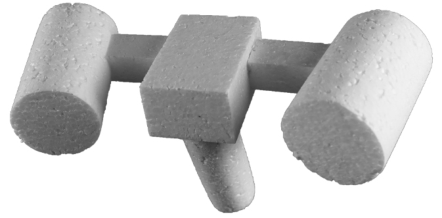
system became clear, the further focus was particularly on designs without a separate handle. In the course of development, models were initially built from cardboard with a filling of sand, and later mainly model construction foam was used. The advantages of model building foam, in this case foamed polystyrene, were that it was easy to work with and inexpensive. With the help of a thermo saw, snap-off blade knife and files, the model building foam can be shaped and curves can be mapped. The material’s ease of machining allowed designs to be iteratively adjusted and merged (Figure 1). Special glue additionally enabled model areas to be joined together. Model construction was supported by CAD models in combination with virtual anthropometric models. In all models of the sensor, the focus in this phase was primarily on ergonomics and less on the shape of the object.
Figure 1: First model in foamed polystyrene.
In a further on-site meeting, the models were examined and evaluated by all team members. The large number of models generated meant that valid state- ments could be made quickly within the team as to which grip concepts were suitable for use in this area. In particular, the flexibility of the wrist during the scanning process was important for the evaluation. During the meeting, there was again the possibility of editing the models, which was made possi- ble by using a cutter knife and gluing on elements. The designs were further consolidated by computer-aided representations of possible geometries of the sensor. The favorite turned out to be enclosures that allow easy enclosure of part of the profile of the basic structure. Nevertheless, there were some points of friction between the participants in the selection of the designs, especially in the initial phase, as their own design was often considered the best. As a second-order observer who is very convinced of his or her own idea, it is difficult to regain more flexibility of thought. But it was precisely through the models that the different opinions of the team members could be brought together quickly through compromises. With the help of a subsequently pro- duced technical prototype of the design, the handling of the finalized concept could be realistically reproduced. Using the low-fidelity models, the advan- tages of the design could be explained to everyone on the team in a simple way, and the handling of the sensor convinced everyone involved.
Due to the dimensions of the first prototype, the next models could now be formed realistically. Based on the construction, initial studies were made on the shape in combination with the way of gripping the model. Through
408 Heßler and Hofmann
very early user studies with people with different hand sizes, it was deter- mined that the space available in the design for gripping was not sufficient for people with very large hands, if one were to make the usual assumptions about hand posture of comparable products. Therefore, sub-areas of the sen- sor were mocked up from model building foam and clay, considering only the grip area. Since laser pointers must be centered and cameras must be a cer- tain distance apart in order to take accurate measurements, only compromise solutions could be created initially. The profile was extended by two centi- meters and the laser pointers could be moved a small distance out of the grip area. However, the grip area was still not sufficient, so alternative solutions were developed to fit a large hand to the sensor. This involved experimenting with the effect of extending the grip area. It would be possible to extend it in the direction of the laser pointers. As a result, the lateral surface in this area was beveled in the direction of the grip. This allows the index finger to be placed outside the grip profile - an approach that had not been considered by engineering up to this point and was only influenced by the ‘naive’ influence of the design team. Small hands would thus have the freedom to use a full five fingers to hold on to the profile, while people with large hands would grip the profile with only four fingers and let the index finger rest on its side. Around the grip area, all edges have been beveled so that it is comfortable to hold in both hand positions (likewise for left- and right-handers). Acceptance tests with people with hands of different sizes showed that the solution of the extended grip area was accepted by many people with large hands, and the posture evoked the association of interpreting in the direction of the object to be scanned for many.
When transferring the first original CAD data of the individual com- ponents, it was noticed that the laser pointers were further forward than expected and the cameras protruded further to the rear, which meant that the package was changed decisively during the design process, which would normally mean a very serious delay in finding the shape.
KEEP WORKING WITH CHANGES Based on this data, some further design drafts were made in the second ite- ration. In the exchange with engineering, it became clear that changes had to be made to the design. Not only from a design perspective, but also to save size and surface area on the housing and make the whole thing look more compact. So the laser pointers became smaller and the cameras moved fur- ther forward. This meant that the design could now be fitted into a simpler shape again. However, this resulted in the conflict that users with large hands and long index fingers would have grasped the laser pointers at the front.
With the help of additional models made of modeling foam, different ways were sought to shape the area on the side of the laser pointers so that this would no longer happen. In particular, widening this area resulted in many people in User Testing no longer grasping the front of the laser pointers. Also, additional structures added around the profile meant that users could grip the sensor more securely and had to apply less holding force with their index finger.
An Approach to Designing an Ergonomic Handheld 3D Laser Scanner 409
The team decided against applying finger depressions or the like so as not to impose a forced posture on the user, who would have to operate the device over a long period of time (reversible or irreversible postural damage could result). The design based on the new ergonomic geometry was reminiscent of early cell phones, although the ergonomics were very good. For a more modern appearance, a higher contrast was created in the object. By separating the grip area from the rest of the sensor in color, the product was perceived differently. With clean lines and clear separation of the individual areas from each other, the product now appeared more modern. Clear chamfers instead of soft fillets and the placement of the cable on the back of the lower camera area also supported this effect. In order to represent this contrast and the camera lenses in the model as well, a dark accent was placed on the light material in terms of color. The dark areas were often more easily identified by the test subjects in user testing as the grip area than was previously the case with the plain light-colored models. This was helped by the fact that aluminum plates were to be incorporated into the plastic case, which provide better material cooling. This already created a material separation without the use of paint. The model construction was now also supplemented with light gray cardboard, which represented the aluminum plates. The cardboard made it possible to test many possibilities for forming attached metal plates with little time and effort.
Simultaneously, the results of the model construction were transferred back into CAD models, which could then be passed on to the development depar- tment. During the entire process, the models were repeatedly checked by the designers themselves and by people from outside the project. By involving different people with different hands again and again, incorrect postures and incorrect handling could be uncovered. In particular, people who do not know the project at all (naive, unbiased users) and have never seen a model for it were most likely to point out what could be operated incorre- ctly when using the sensor for the first time. This allowed the grip area to be modified until the error rate was very low. In parallel, the development department produced the first 3D prints of the housing, which allowed the ergonomic correctness to be verified. Meanwhile, several studies were con- ducted on the optical shaping of the sensor, incorporating the findings of the grip studies. Some of the models made from model building foam were subsequently weighted down with metal rods inserted inside to simulate a realistic working situation with the full weight of the sensor. The design team also now made some 3D prints that better replicated the materiality of the final injection-molded handle area than the foamed polystyrene models. The individual original components were inserted into the 3D prints made by engineering in such a way that there was a prototype usable first 3D laser scanner in the project. With this prototype, it was first discussed that there was no good solution for placing the sensor. Rubberized areas were applied to the front of the device so that it could be put down without risk of damage to the optical elements and without hard impacts.
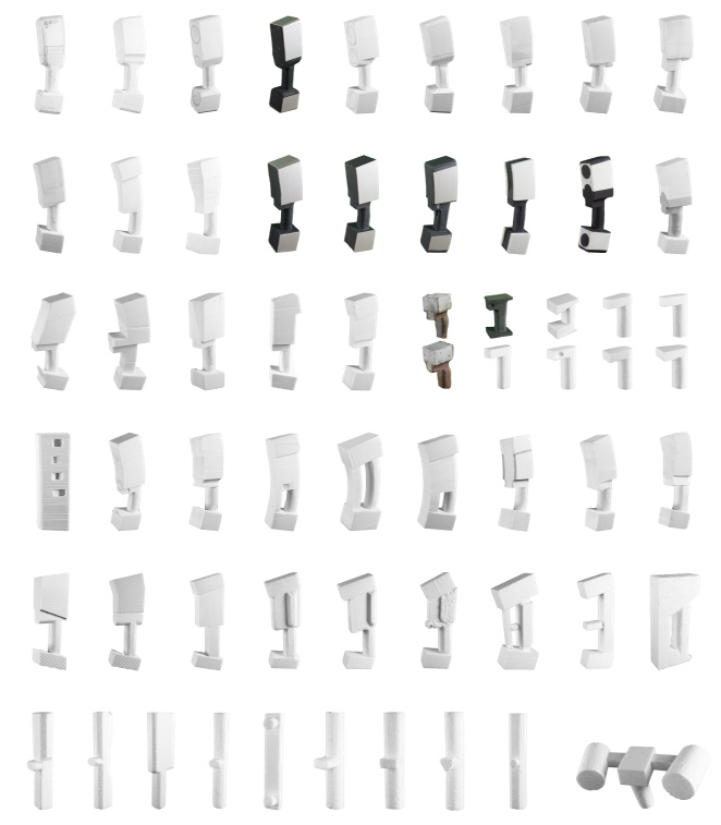
Now that the basic shape of the sensor had been roughly defined after more than 60 physical models (Figure 2), the design team investigated the usabi- lity and control of the sensor. For this purpose, the individual input options
410 Heßler and Hofmann
were combined with the aim of operation and converted into flowcharts. With the help of click dummies in digital prototyping tools, all scenarios and workflows were represented once and could be simulated clicked through to check their correctness. The shape, size and labeling of the buttons of a possible control pad were also examined.
Figure 2: Overview of all models of foamed polystyrene.
SOLUTION At the end of the development process, the 3D scanner was ready for series production, and its light weight and well thought-out grip area enable it to be used for a long time. The finished 3D laser scanner consists of black injection- molded plastic shells surrounded on the outside by a light-colored aluminum shell for better cooling. The width of the 3D laser scanner is determined by
An Approach to Designing an Ergonomic Handheld 3D Laser Scanner 411
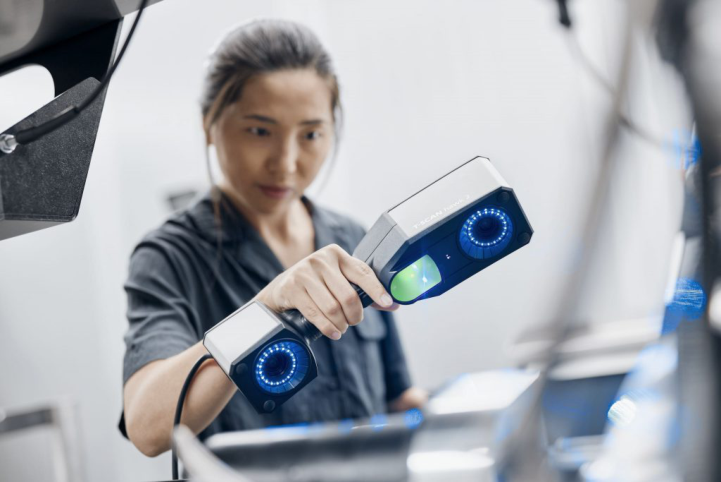
the widely spaced cameras. In the center are the laser pointers (Figure 3). Between the upper camera and the grip area, there is space in the housing for the installation of technical components. In the grip area between the laser pointers and the lower camera, a structure is applied to prevent slipping and semantically guide the user. The grip area has been extended over the sides of the housing in the part of the sensor where the laser pointers are located. The edges in this area are beveled to make the grip area less sharp. On the back of the sensor, just above the span between the thumb and index finger is a control pad for operation. On the back of the build space around the lower camera is the cable outlet.
Figure 3: Application of the finished industrial series product. Source: ZEISS, 2023, https://www.handsonmetrology.com/?utm_source=zeiss_com.
CONCLUSION
In summary, it can be said that the relationship of trust was the basis for the possibility of such an open design process. Flat hierarchies meant that decisions could be made quickly. Restrictions and technical specifications were interpreted by the design team more as a “thrown ball” and proces- sed in different models and many discussions. Design suggestions from the designers could in turn be incorporated by the technical development depar- tment and thus a synergy was formed between the results of all members of the interdisciplinary team.
Due to the early involvement of the designers in the process, this mutual influence was possible directly at the start of the project and it was still possi- ble to influence the design from a design and ergonomic point of view. In this project in particular, ergonomics played such an important role that involving
412 Heßler and Hofmann
the user in the process too late would have resulted in less pleasant handling. A change to the design and package, such as increasing the size of the laser pointer cluster in this project, usually leads to a serious delay in form fin- ding. In this project, a solution to the problem was always found due to the many models and the willingness of the technical development department to compromise.
Compared to the haptic experience, digital models have their limits when it comes to adapting to the hand. Therefore, this project shows how the use of many low fidelity prototypes can speed up a process, as the designs become tangible and every involved tester can express his opinion in an easily understandable and uncomplicated way. Even skeptics of the designs could understand decisions in direct comparison. Due to the many possible accepta- nce tests, missteps can be eliminated and valid statements about the suitability of a design can be made. In particular, the ad hoc modification of the model in the process drove the development forward quickly, as ideas could be com- municated in a comprehensible and simple way by everyone in the team. In addition, everyone involved in the project became aware of the high importa- nce of ergonomics, as a direct haptic approach with the sensor was possible. This made the application of an iterative process, in which regressions are allowed in order to arrive at something new, understandable for everyone.
The final product can be seen here: https://www.handsonmetrology.com/d e/loesungen/t-scan-hawk-2/.
REFERENCES
Beck, K. et al. (2021). Manifesto for Agile Software Development. https://agilemanifesto.org/, last accessed 14. 08. 2021 DIN Deutsches Institut für Normung e. V. (2009). DIN EN 1005-1: Sicherheit von Maschinen – Menschliche körperliche Leistung – Teil 1: Begriffe. Beuth: Berlin. DIN Deutsches Institut für Normung e. V. (2018). DIN EN ISO 9241-11: Ergonomie
der Mensch-System Interaktion – Teil 11: Gebrauchstauglichkeit: Begriffe und Konzepte. Beuth: Berlin. DIN Deutsches Institut für Normung e. V. (2019). DIN EN ISO 9241-210: Ergonomie der Mensch-System Interaktion – Teil 210: Menschzentrierte Gestaltung interaktiver Systeme. Beuth: Berlin. Hasso-Plattner-Institut: Was ist Design Thinking? https://hpi-academy.de/design-th
inking/was-ist-design-thinking/ Hofmann, T. et al. (2023) New Scientific Methods and Old School Models in Ergonomic System Development. In Karanikas, N. & Pazell, S., Ergonomic Insi- ghts – Successes and Failures of Work Design (pp. 227–242). Boca Raton: CRC Press. Knothe, S., Hofmann, T., Bleßmann, C. (2021). Theory & Practice in UX Design –
Identification of discrepancies in the development process of user-oriented HMI. HCI International 2021: Washington. Lin, S. (2018). Ergonomics in Product Design. SendPoints: Hong Kong. Nielsen, J. (October 17, 2010) Mental Models. Nielsen Norman Group: Fremont.
NNGs Website: https://www.nngroup.com/articles/mental-models/ Norman, D. A. (2004). We are all Designers. In Emotional Design (pp. 213–227).
Basic Books: New York.
An Approach to Designing an Ergonomic Handheld 3D Laser Scanner 413
Windel, A. et al (2019) Kleine Ergonomische Datensammlung. Köln: TÜV Media GmbH. ZEISS (2023). https://www.handsonmetrology.com/?utm_source=zeiss_com ZEISS. de: https://www.zeiss.de/messtechnik/home.html ZEISS (April 30, 2021) ZEISS Innovation Magazine: #HandsOnMetrology. https://www.zeiss.de/messtechnik/magazin/2021/handsonmetrology.html
LISTED IN THE AHFE DIGITAL BOOKSTORE CATALOGUE
Explore the complete digital volume
Ergonomics In Design
Read this individual research paper free through the original publisher, or explore the full digital proceedings book.
ISBN 978-1-958651-53-7
Explore this ISBN in the AHFE Bookstore ↗Listed in the July 2026 bookstore catalogue; search by ISBN to confirm current availability · Digital book purchase optional