Tina Haase, Thu Ha Claudia Vuong, Julia C Arlinghaus (2024). A case stucy on technology selection and didactical design for immersive learning and dialog spaces. In: Training, Education, and Learning Sciences. AHFE Open Access, vol. 155, pp. 11–17. https://doi.org/10.54941/ahfe1005385
Increasingly automated work environments lead to changes in the tasks and activities of humans in these work systems. On the one hand, activities have an increasingly controlling and monitoring character (Dregger et al. 2018) and, on the other hand, require rapid and competent human intervention in case of errors. On the other hand, there is a lack of learning opportunities to build up the necessary knowledge and experience, a phenomenon known as the ironies of automation. (Bainbridge 1983)Learning processes are therefore increasingly being transferred to virtual worlds. Learning situations that are rare, dangerous or difficult to access in practice can also be simulated here. When designing virtual learning applications, the main focus is usually on technical feasibility, while the didactic design of the learning content and the learning setting tend to be neglected. This also explains why many lighthouse projects are still being created, but are not successfully established in practice. A systematic approach to technology selection and design is required. (Haase et al. 2020)The Elbedome is a mixed-reality laboratory for the large-scale presentation of interactive visualizations on a 360° panorama and floor projection surface. It enables the collaborative reception, design and discussion of learning content in a hybrid setting. Compared to virtual reality glasses, the Elbedome allows a number of people to come together physically and simultaneously in an immersive learning and dialog space (Keller & Haase 2019).The submitted paper presents the unique large-scale projection system "Elbedome" and uses selected examples to underline the special features of this technology compared to common solutions such as mobile devices or VR glasses. In particular, the special potential of the Elbedome for collaborative learning processes as well as participatory design and decision-making processes of interdisciplinary stakeholders is highlighted. In addition, the article provides insights into the scalability of the technology, which is essential for the successful use of such a solution (Scavarelli et al. 2021), and makes recommendations for practical use by various target groups based on systematic criteria.References:Bainbridge, L. (1983). Ironies of automation. In Analysis, design and evaluation of man–machine systems (pp. 129-135). Pergamon.Dregger, J., Niehaus, J., Ittermann, P., Hirsch-Kreinsen, H., & Ten Hompel, M. (2018). Challenges for the future of industrial labor in manufacturing and logistics using the example of order picking systems. Procedia cirp, 67, 140-143.Haase, T., Radde, J., Keller, A., Berndt, D., & Dick, M. (2020). Integrated Learning and Assistive Systems for Manual Work in Production-Proposal for a Systematic Approach to Technology Selection and Design. In International Conference on Applied Human Factors and Ergonomics (pp. 853-859). Springer, Cham.Keller, A., & Haase, T. (2019). Lernen und kreativ planen in einem 360-Projektionsraum. In: Digitalisierung und Fachkräftesicherung: Herausforderung für die gewerblich-technischen Wissenschaften und ihre Didaktiken, 53, 63.Scavarelli, A., Arya, A., & Teather, R. J. (2021). Virtual reality and augmented reality in social learning spaces: a literature review. Virtual Reality, 25, 257-277.
Increasingly automated work environments lead to changes in the tasks and activities of humans in these work systems. On the one hand, activities have an increasingly controlling and monitoring nature (Dregger et al., 2018) but also require rapid and competent human intervention in case of errors. On the other hand, there is a lack of learning opportunities to build up the necessary knowledge and experience, a phenomenon known as the ironies of automa- tion (Bainbridge, 1983). Learning processes are therefore increasingly being transferred to virtual worlds. Learning situations that are rare, dangerous or difficult to access in practice can also be simulated here.
When designing virtual learning applications, the main focus is usually on technical feasibility, while the didactic design of the learning content and the learning setting tend to be neglected. This also explains why many lighthouse projects are still being created, but are not successfully established in prac- tice. A systematic approach to technology selection and design is required (Haase et al., 2020).
In this context, this paper at hand aims to present the capabilities of a spe- cific immersive learning and dialog space called Elbedome based on hands-on examples.
THE ELBEDOME The Elbedome is a unique mixed-reality laboratory for the large-scale pre- sentation of interactive visualizations on a 360-degree panorama and floor projection surface. In addition to projecting on the walls and floor, objects can be viewed stereoscopically with the help of shutter glasses. This gives visitors the impression of an additional three-dimensional hologram within the projected 3D content on the surrounding surfaces. In particular, larger models such as steam engines and even cities can be displayed in the high- est quality with original size on the wall and floor projection surface with a height of 4.5 meters and a diameter of 16 meters (Elbedome, 2024). These high-resolution displays and smooth transitions are ensured by 30 high-end computers with a total output of more than 400 TFlop/s and over 50 fiber optic connections to the projectors. In combination with a modern sensor and tracking system consisting of 15 infrared cameras, six permanently installed and nine mobile IR tracking cameras, it is also possible to track real peo- ple and objects in real time as well as to depict their natural movements and interactions. In this way, a fluid transition of real and virtual elements is created in the Elbedome, which facilitates immersion in the experience. To support and amplify the visual content, the Elbedome also possesses a Dolby 7.1 sound system consisting of 20 tweeters and mid-range drivers as well as three woofers. With their help, three-dimensional sounds can be generated in the room to make the experience in the Elbedome extremely realistic.
While large projection systems similar to the Elbedome exist across Europe and internationally, their use is concentrated mainly on entertainment (Project-syntropy, 2024a) and military simulation (Project-syntropy, 2024b). In the industrial sector classic projection systems such as CAVEs are widely utilized for simulations and training (Project-syntropy, 2024c). In addition, different projection-based solutions are used internationally for research pur- poses. The Toronto Institute for Rehabilitation in Canada, Toronto, for example, works with the “VR Dome”, a virtual reality projection system for rehabilitation research. Together with its treadmill interface, the VR Dome enables a simulation of movement through Toronto’s downtown (Project- syntropy, 2024d). However, it is limited by its dimensions and can only be used by one person at a time.
Potentials of Several Technologies for Immersive Learning and Dialog Nowadays, various technologies and output devices for three-dimensional content can be used for immersive training or collaboration purposes. Apart from the most common ones (personal computers with desktops, smart- phones and tablets) Virtual Reality glasses (or Head-mounted displays) and Augmented Reality glasses have become established tools in many fields (Doerner et al., 2022). Whereas Virtual Reality glasses can enable a fully immersive view, Augmented Reality devices are see-through in various ways. In this manner, VR glasses can provide access to an almost unlimited virtual learning environment, which is independent from the real time and space. Therefore, they are often used for e. g. off-the-job training situations in the medical area (Luiz et al., 2023) and industry or for entertainment purposes,
A Case Study on Technology Selection and Didactical Design 13
by single-users as well as multiple users. In contrast, AR devices let the users perceive the real world while adding virtual elements to their field of view at the same time. As a result, tablets or AR glasses are more often used for on-the-job training where the differentiation between virtual and real world is desired. Typical areas of application are e.g. smart or remote maintenance or interior design and planning.
In order to illustrate the potentials of the Elbedome compared to the afore- mentioned technologies example applications and projects are introduced in detail in the following sections: In cooperation with the 50Hertz Transmission GmbH, the Fraunhofer IFF has developed a digital tool that helps to optimally plan energy transition routes and analyse how their acceptance is rated by the population in advance (Fraunhofer IFF, 2013). In the project new methods of public participation were successfully tested. Here, the Elbedome offered various interest groups (e.g. citizens and specialist authorities such as the forestry administration) a new opportunity to actively participate in decision-making processes, for example by using the software to select desired masts from a component cat- alogue and interactively place them in the virtual environment. The effects (advantages and disadvantages) were then presented visually on the large pro- jection surfaces so that an objective view of the planning was made possible and fears as well as reservations could be eliminated. The cooperation clearly demonstrates the relevance of the Elbedome for participation and acceptance.
In another project the Elbedome was designed as a learning and creative space, which intended to support employees at different functional and hier- archical levels in designing and changing logistics and assembly processes (Fraunhofer IFF, 2024a). To this end, creative methods and large-scale visu- alizations using innovative interaction techniques were combined and utilized in moderated workshop settings. As a result, the Elbedome offers the collabo- rative reception, design and discussion of learning content in a hybrid setting. The effects of new designs and redesigns could thus be made directly visi- ble and promote a shared understanding among the heterogeneous group of participants. Functional and modern seating furniture as well as a dedicated room design that promotes learning and creativity additionally supported the process. Compared to e. g. Virtual Reality glasses, the Elbedome allows mul- tiple people to physically and simultaneously come together in an immersive learning and dialog space (Keller and Haase, 2019). Therefore, the technol- ogy can support both research and education. The project depicts that the Elbedome is capable of strengthening social exchange and interdisciplinary discourse and decision-making processes of different stakeholders in hybrid settings.
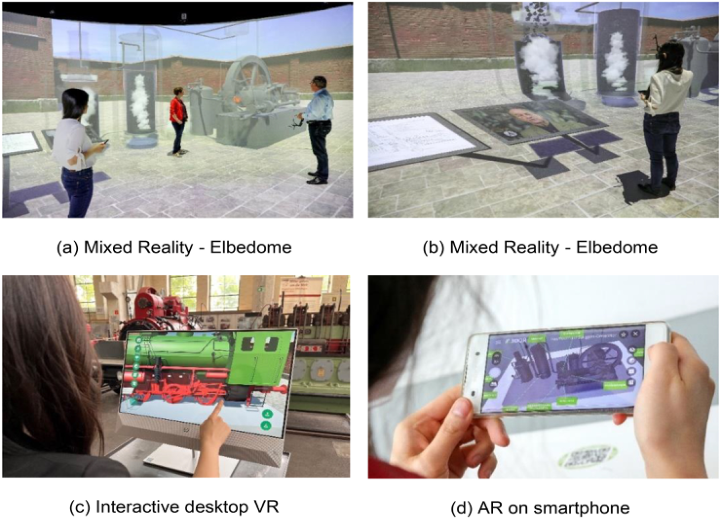
Besides the mentioned examples, the team of the Fraunhofer IFF digitized selected machines from the Museum of Technology Magdeburg and provided the interactive solutions in various Virtual Reality (VR) and Augmented Real- ity (AR) formats (Fraunhofer IFF, 2024b) (Fig. 1). The interactive models show the different physical-technical operating principles of each individual object via touchscreens or VR glasses and projection solutions on the exhibit or by scanning a special QR code directly via smartphone. In the project, the digital content was also integrated into the Elbedome. The VR visualization
in the Elbedome complements the Museum of Technology’s learning loca- tions and gives visitors and interested parties not only a deeper insight into the machinery through the realistic display and three-dimensional sounds, but also creates a social learning setting. Pupils, vocational school pupils and students in particular can use these solutions as extracurricular edu- cational opportunities and benefit from the aforementioned advantages of the Elbedome. This project shows that the Elbedome has the ability to over- come its infrastructural limits. Although it struggles in terms of mobility, the Elbedome’s content is highly scalable and can be adapted to miscellaneous platforms via the software that is created via Unity 3D or Unreal Engine (Aust and Masik, 2022).
Figure 1: Scalable application on different platforms.
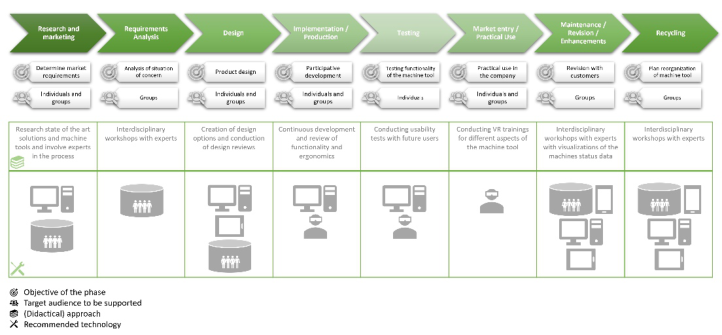
SELECTING THE PROPER TECHNOLOGY To promote the successful establishment of (learning) applications based on Virtual Reality, Augmented Reality and Mixed Reality the authors present their attempt to map the introduced technologies to their recommended use cases as decision-making aid. Since the Fraunhofer IFF possesses many years of experience and expertise in the development of solutions for the produc- tion and acquired profound knowledge in the fields of digitalization and automation, it stands to reason that these recommendations are given in the context of the general product process phases (Vajna et al., 2018). In this regard, Figure 2 shows the potential of the before mentioned technologies along the product life cycle. The systematic approach and criteria utilized
A Case Study on Technology Selection and Didactical Design 15
for the classification is inspired by the technological and educational design dimensions for digital learning and assistance systems proposed by Haase et al. (Haase et al., 2020). For each phase of the product process the rec- ommended technology is therefore determined by (a) the objective of the phase, (b) the target audience to be supported in the specific phase and (c) an example (didactical) approach to reach the objective.
As an example, assuming that an imaginary company would like to come up with a new machine tool to machine metallic workpieces with e. g. by water jet cutting, the (a) objective of the design phase of the machine tools life cycle would be to design the machines functions, ergonomics et cetera. Because it is desirable to consider different perspectives from (b) individual employees and stakeholder groups (c) multiple design options should be cre- ated and design reviews conducted respectively. The creation of those design options for the machine could be supported by hand-drawn drafts of the visual machine tool design prepared through tablets. Additionally, profes- sional Computer Aided Design software could be used on classic desktop computers with mouse and keyboard as input devices which allow the neces- sary precise controls. Since the Elbedome enhances interdisciplinary discourse (see the last section) it is reasonable to choose this technology to this end. When considering the subsequent phase of the practical use the prerequisites change. Here, the objective shifts to (a) using the produced machine in real operations. Thus, (b) employees should be qualified for the proper handling of the machine for example via (c) VR trainings and courses that convey its functionality through visual information on the digital twin. Due to the ben- efits of Virtual Reality VR glasses are more suitable to help enhancing the understanding of interdependencies of individual parts in this case.
In a nutshell, there is no general guide that fits every use case since there are many ways to achieve each phases’ objective. But clearly, (1) the Elbedome is most suitable for highly social settings and (2) sometimes the combination of different technologies offers more benefits.
Figure 2: Example for technology selection and didactical design.
CONCLUSION
The paper at hand aimed to serve as a guide for selecting and designing the proper technology for different use cases. For this purpose, the unique Mixed Reality laboratory called Elbedome along with its potentials was presented and compared to other solutions. As a result, the authors showcased recom- mendations for the practical use based on systematic criteria. The key findings can be summarized as follows:
The Elbedome unfolds its full potential in social settings where dis- course is substantial and therefore offers much potential for education via collaborative and social learning.
The Elbedome can make a major contribution to supporting cooperative work tasks where participation is fundamental.
In general, the scalability of technologies is crucial to cover the whole product engineering process. Based on one’s objective and target group there are multiple suitable options for the didactical approach and proper technology.
Since the findings are based on hands-on experience the future work will focus on gaining more insights into further applicable domains and long- term benefits of the Elbedome through upcoming projects. For instance, it is planned to study those effects by implementing a learning application for historical sites or fundamentals or examine further participatory approaches with a local agency of urban planning.
REFERENCES
Aust, M., Masik, S. (2022). “Immersive Participation Lab und Elbedome”, in: Bildhafte Räume, begehbare Bilder. Nakas, K., Reinfeld, P. (Eds.). Volume 2, pp. 65–80. Paderborn: Brill Fink. Bainbridge, L. (1983). Ironies of automation. Automatica. Volume 19, Issue 6,
pp. 775–779. Great Britian: Pergamon Press. Doerner, R., Broll, W., Grimm, P. and Jung, B. (2022). Virtual and Augmented Reality (VR/AR): Foundations and Methods of Extended Realities (XR). Cham: Springer. doi: https://doi.org/10.1007/978-3-030-79062-2. Elbedome (January, 2024). Website: https://www.elbedome.de/info/ (Accessed: 01
February 2024). Fraunhofer IFF (October, 2013). Erfahrungsraum: Digitale Welt. IFFocus. Volume 2, pp. 16–19. Magdeburg: Fraunhofer- Institut für Fabrikbetrieb und -automatisierung IFF. Website: https://www.iff.fraunhofer.de/content/dam/iff/de/dokumente/publikationen/iffocu s-2013-2-erfahrungsraum-digitale-welt-fraunhofer-iff.pdf (Accessed: 01 February 2024). Fraunhofer IFF (January, 2024a). Limo-Raum - Logistik- und Montage- prozesse nutzerorientiert gestalten: Interaktiver Lern- und Kreativraum. Web- site: https://www.iff.fraunhofer.de/de/geschaeftsbereiche/fertigungsmesstechnik- digitale-assistenzsysteme/limo-raum.html (Accessed: 01 February 2024). Fraunhofer IFF (January, 2024b). Digitalisierung historischer Industriemaschinen im Technikmuseum Magdeburg (Projekte DIGI-TECH-MA und InkuMa-Digital). Website: https://www.iff.fraunhofer.de/de/geschaeftsbereiche/fertigungsmesstech nik-digitale-assistenzsysteme/digi-tech-ma.html (Accessed: 01 February 2024).
A Case Study on Technology Selection and Didactical Design 17
Haase, T., Radde, J., Keller, A., Berndt, D., and Dick, M. (2020). “Integrated Learning and Assistive Systems for Manual Work in Production-Proposal for a System- atic Approach to Technology Selection and Design”, in: Advances in Usability, User Experience, Wearable and Assistive Technology. AHFE 2020. Advances in Intelligent Systems and Computing. Ahram, T., Falcão, C. (Eds.). Volume 1217, pp. 853–859. Cham: Springer. doi: https://link.springer.com/chapter/10. 1007/978-3-030-51828-8_113. Keller, A., Haase, T. (2019). “Lernen und kreativ planen in einem 360-Projektionsraum.”, in: Digitalisierung und Fachkräftesicherung: Heraus- forderung für die gewerblich-technischen Wissenschaften und ihre Didaktiken. pp. 53–63. Bielefeld: wbv. Luiz, T., Elsenbast, C. and Breckwoldt, J. (2023). “Der Notfall – undendliche
Welten? Extended reality als Medium in der notfallmedizinischen Aus-, Fort- und Weiterbildung.”, in: Die Anaesthesiologie. Volume 8, pp. 596–607. Springer Medizin. Project-syntropy (January, 2024a). Stadtplanungsmuseum Shanghai – Immersives interaktives 5D-Stadtmodell. Website: https://www.project-syntropy.de/portfoli o-item/stadtplanungsmuseum-shanghai-immersives-interaktives-5d-stadtmodell/ (Accessed: 01 February 2024). Project-syntropy (January, 2024b). Alenia Aermacchi M-346 CPT Cockpitsimu-
lator. Website: https://www.project-syntropy.de/portfolio-item/alenia-aermacchi- m-346-cpt-cockpitsimulator/ (Accessed: 01 February 2024). Project-syntropy (January, 2024c). Kongsberg Maritime Training – Schiffsbrückenund Kransimulator. Website: https://www.project-syntropy.de/portfolio-item/kon gsberg-schiffsbrucken-und-kransimulator/ (Accessed: 01 February 2024). Project-syntropy (January, 2024d). Toronto Inst. für Rehabilitation CEAL, iDAPT
StreetLab. Website: https://www.project-syntropy.de/portfolio-item/toronto-inst- fur-rehabilitation-ceal-idapt-zentrum/ (Accessed: 01 February 2024). Scavarelli, A., Arya, A., and Teather, R. J. (2021). Virtual reality and augmented reality in social learning spaces: a literature review. Virtual Reality. Volume 25, Issue 1, pp. 257–277. Springer-Verlag London. doi: https://link.springer.com/arti cle/10.1007/s10055-020-00444-8. Vajna, S., Weber, C., Zeman, K., Hehenberger, P., Gerhard, D., and Wartzack, S.
(2018). CAx für Ingenieure. Heidelberg: Springer-Verlag.
LISTED IN THE AHFE DIGITAL BOOKSTORE CATALOGUE
Explore the complete digital volume
Training, Education, and Learning Sciences
Read this individual research paper free through the original publisher, or explore the full digital proceedings book.
ISBN 978-1-964867-31-1
Explore this ISBN in the AHFE Bookstore ↗Listed in the July 2026 bookstore catalogue; search by ISBN to confirm current availability · Digital book purchase optional