Mi Tian, Jie Zhang, Ming Li, Xiaori Dong (2022). Design of Smart Curtain Based on Affordance. In: Intelligent Human Systems Integration (IHSI 2022): Integrating People and Intelligent Systems. AHFE Open Access, vol. 22. https://doi.org/10.54941/ahfe1001006
Nowadays, product design emphasizes to start from user experience, excavate us-er's own behavior characteristics, realize self-perception of people and environment, so as to better show the use experience of products. In this paper, based on the theory of affordance and behavior logic as the clue, through the analysis of the affordance matrix of home smart curtain, the possible affordance relationship be-tween components and people is extracted. Based on this, the whole cycle process of intelligent curtain is explored, and many problems of curtain in structure longi-tudinal and control panel are analyzed. Based on the design method, the hierarchical relationship and gap in the behavioral logic are reflected, and a behavior design method based on affordance is proposed, which is to identify the environment, improve the use process, find common characteristics, and enhance the hierarchical relationship of the perception of affordance. Through affordance, it is possible to form a good interaction relationship based on human-thing-environment and promote the iteration of product design.
Intelligent Human Systems Integration (IHSI 2022): Integrating People and Intelligent Systems https://openaccess.cms-conferences.org/#/publications/book/978-1-7923-8988-7
ABOUT AFFORDANCE With the advancement of computer science and various technological means, smart homes have gradually entered the lives of the people, changing many people's past lifestyles and habits, and providing convenience for family life. Therefore, in contemporary design, the nature of design has shifted from "creation" to "planning", centering on users, exploring the characteristics of users' own behaviors, combining user behaviors and needs to design products, in order to achieve a good Human- computer interaction relationship between people and products. The research method of affordance is based on the self-perception of "biology" and the environment as the research focus, in order to realize the rationality of human-computer interaction. The introduction of affordance design research methods is conducive to the further exploration of human-computer interaction.
Affordance theory is an important constituent theory of ecological psychology, which was first proposed by Gibson. He believes that what people perceive is the possibility of behavior provided by things rather than the nature of things, and this behavior may be called affordance.(Gibson, 1979) The theory of affordance was really introduced into the field of design from Donald A. Norman. He believed that the perception of affordance between humans and artifacts is related to things, and that this kind of affordance is relevant. Existence is subject to the basic use attributes of the object, such as form, material or color, and it is believed that the form feature of the product matches this feature of availability, which can improve the ease of use of the product and achieve a good interactive experience.(Norman, 1999) Therefore, the user gesture recognition to obtain the corresponding available objects is an important way to realize the iterative upgrade of the product.
THE BEHAVIORAL LOGIC OF AFFORDANCE The Level of Guiding Behavior
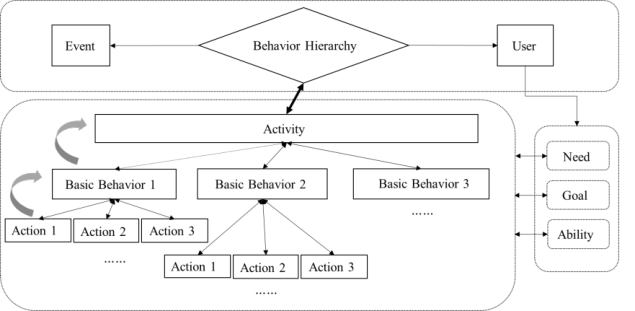
The hierarchical structure of behavior can be regarded as an intermediary relationship, which connects a subject and an object, and aims to achieve the goal of guiding and shaping the sequence. Due to the user's intervention, this relationship of affordance becomes possible and can be presented by products that fulfill the user's intention. With the continuous improvement of details, human behavior can be decomposed into simpler action components, as shown in the figure. Activity refers to a series of complex and staggered whole event cycles performed by a person for one thing, with clear motivation. This activity needs to cooperate with multiple basic behaviors from materials, proportioning and starting to complete the "activity" goal. This is based on the process of behavior that the event needs to experience. During the process, the form, color, and control layout of the product will become the availability conditions for the occurrence of the action and affect the event.
Intelligent Human Systems Integration (IHSI 2022): Integrating People and Intelligent Systems https://openaccess.cms-conferences.org/#/publications/book/978-1-7923-8988-7
On the other hand, during the entire behavior, the user completes several actions at each level, and then enters the next behavior, until the end of the entire process of using the product once. There are gaps in the occurrence of these behavior levels.(Maier et al., 2007, Shuai and Hui, 2020) These gaps usually bring lengthy troubles to users and reduce the user's sense of experience. Therefore, in product design, it is a way to improve the good user experience of products by grasping the continuous transformation of behavior between different scenes. (See Figure 1)
Figure 1. The logic of affordance Variety of induced behaviors
The affordance of objects will trigger multiple affordance of objects depending on the person and the environment. The chair mentioned in Gibson's work is in people’s common perception that it appears as the ability to support sitting. When environmental factors change, for example, people need to reach high places. Things, that chair bears the possibility of stepping, and people's behavior immediately occurs as standing. In the eyes of babies, the height of the chair is not enough to support their sitting behavior, so the chair provides a large toy supply. When the baby approaches it, its behavior is mostly grasping, gripping, and climbing.(Kuo and Teng, 2009) Therefore, people of different levels and cultural backgrounds, in different environments, have different perceptions of the affordance provided by items, and their behaviors will also be diverse. Driven by refined design, t the experience of direct interaction with people in the product environment is an important guiding ideology for the improvement of product design.
Intelligent Human Systems Integration (IHSI 2022): Integrating People and Intelligent Systems https://openaccess.cms-conferences.org/#/publications/book/978-1-7923-8988-7
Research on availability of intervening smart curtains Smart curtain analysis
The development of smart curtains is still in the stage of continuous improvement. The smart curtains on the market mainly use motors to realize the electric power of the curtain switch mode. The main types include electric opening and closing curtains, electric lifting curtains, and electric ceiling curtains (Outdoor electric canopy and indoor electric canopy), electric sun visor, electric sun awning and other series, the main structures involved in the realization of electric process are: brake system, curtain cloth and control panel closely related to the track.
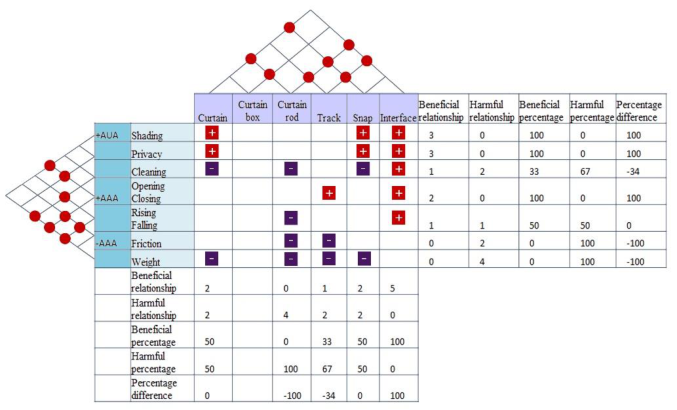
Affordance structure matrix analysis of smart curtains According to the attributes of availability proposed by Maier & Fadel,(Maier and Fadel, 2005, Maier and Fadel, 2009b, Maier and Fadel, 2009a) different interaction relationships can be established: AAA (artifact-artifact-affordances), AUA (artifact- user-affordance), AEA (artifact-environment-affordance). The designer digs out characteristic information through the multiple interactions between hu-man-artifact- environment, and sorts out the relationship between the corresponding product components and human behavior through the mining of affordance, and find the motivation and conditions.
In the design of smart curtains, with the help of the availability structure matrix, the relationship of +AUA, -AUA, +AAA, -AAA is established to form the affordance structure matrix of smart curtains. The roof of the matrix represents the component relationship of the smart curtain, and the left wall is the affordance of the smart curtain system.(Ma et al., 2018, Shang and Dong-yan, 2013) Fill in the relationship between the smart curtain components and affordance in the matrix room, "+" means positive interaction, and "-" means negative interaction. For example, curtain cloth can play a good shading effect, so there is a positive correlation between them. Curtain fabric will have a certain impact on the load-bearing. If the curtain fabric is too heavy and the curtain rod is too thin, it may cause problems due to insufficient load-bearing. Therefore, there is a negative correlation between curtain fabric, curtain rod and load- bearing.
The right wall of the matrix is the statistics of the degree of affordance supported by the various components of the curtain. The beneficial relationship is the statistics of the positive effect of the components on a certain availability, which corresponds to the "+" in the room; Similarly, the harmful relationship corresponds to "-" in the room.(Shang and Dong-yan, 2013) The percentage difference reflects the degree of difference between the beneficial support and the harmful support of the system components within a certain range of affordance.
The floor of the matrix expresses the statistics of the degree of support provided by
Intelligent Human Systems Integration (IHSI 2022): Integrating People and Intelligent Systems https://openaccess.cms-conferences.org/#/publications/book/978-1-7923-8988-7 each component of the curtain. For example, curtain cloth has two "+" supports and two "-" supports for the listed affordance. The percentage difference is the degree of difference that a component presents to the provision of affordance. The smaller the value, the more prominent the harmful elements it produces, and it is also an aspect that needs to be paid attention to when reviewing the product.
It can be seen outside the left wall that there will be a certain mutual influence between affordance. When designing and deriving a certain affordance, it is necessary to pay attention to the changes in related items at the same time. In the same way, in the curtain system, each component also has mutual influence. In the process of improving the components, it is also necessary to consider the combination relationship.
Through the affordance structural matrix of smart curtains, it can be seen that cleaning is a problem worthy of attention in the relationship of AUA; in the relationship of AAA, friction and load-bearing itself are negative relationships in the system, and they have always been concerned. problem lies in. As for the attention to components, curtain rods and rails are also the focus of the design. (See Figure 2)
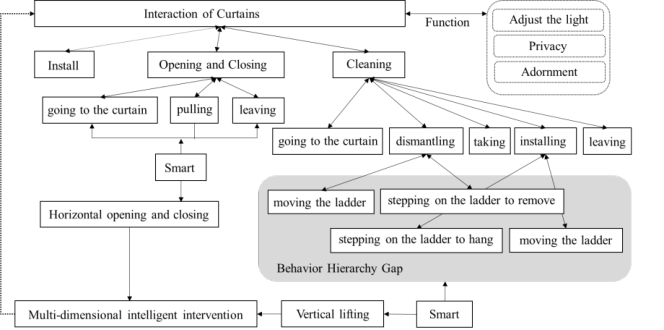
Relying on the derivation of the design process of sexually affordance behaviors, the occurrence level of behavior is divided into two aspects from the whole process of the interaction between the user and the smart curtain. On the one hand, during daily
Intelligent Human Systems Integration (IHSI 2022): Integrating People and Intelligent Systems https://openaccess.cms-conferences.org/#/publications/book/978-1-7923-8988-7 use, with the help of smart interface operations (including physical panels, remote control panels, mobile phone interfaces, etc.), curtains can be opened and closed, so as to realize the adjustment of light and privacy achieved by curtains in home life. On the other hand, in the update of smart curtains, this process usually includes two dimensions, the smart memory of smart curtains, the update of smart programs, and the cleaning and maintenance of curtains. Based on the consideration of affordance, a behavioral interaction model in these two aspects is formed.
(1) Horizontal opening and closing In the model, the daily use of smart curtains mainly comes from the opening and closing processing on the horizontal scale. In the use of ordinary curtains, people need to complete the behavior of "going to the curtain-pulling-leaving", in many home environments, People have obstacles to the curtain-drawing behavior due to inertia, obstacles (such as sofas) around, or limited arm strength. Based on this, the smart curtains on the market can basically solve such problems, realize the automatic opening and closing of the curtains, and, with the continuous maturity of computer algorithms, the smart curtains can learn the living habits of the house owner by themselves, and realize the timing opening and closing and half-opening. The closed state control makes it convenient for users to have a good experience of using curtains.
(2) Vertical lifting From the perspective of curtain cleaning, the behavioral process of curtains includes "going to the curtain-dismantling-taking-installing-leaving", and to complete this activity process, it needs to include the next level of action events, how to realize the dismantling Kimono. Because the hanging places of the curtains are all at high places, under normal circumstances, to complete this action process, it is necessary to resort to external objects, such as indoor ladders. The series of behaviors triggered by it are "moving the ladder - stepping on the ladder to remove - moving the ladder", "moving the ladder - stepping on the ladder to hang - moving the ladder".
In this interaction process, there is an obvious behavior gap in the behavior that occurs with the curtain, which makes it necessary to waste extra time to do other behaviors to realize the operation of taking off the curtain. At the same time, for the elderly and some women, climbing is inherently dangerous, which virtually increases safety risks.
From the behavior analysis of smart curtains, it can be seen that in the affordance structure matrix, the conclusion obtained by AUA is consistent with the structure obtained by analyzing the behavior. This is also an important consideration for product iteration. (See Figure 3)
Intelligent Human Systems Integration (IHSI 2022): Integrating People and Intelligent Systems https://openaccess.cms-conferences.org/#/publications/book/978-1-7923-8988-7
Figure 3. Derivation of smart curtain design based on affordance Intelligent curtain behavior interaction analysis
It can be seen from the behavioral interaction of smart curtains that the design of smart curtains is mainly aimed at the horizontal opening and closing processing, which basically completes the daily normal use needs. In the interaction relationship with people, the scenes used by different groups of people and different spaces need to be further improved. Digging, the future multi-modal design will better monitor environmental information, so that smart curtains can not only implement interface operations, but also recognize gestures and voice processing within the effective range, so that the interaction between humans and smart curtains is more direct and effective. To reduce the loading of unnecessary error messages.
Almost none of the existing smart curtain products are equipped with a vertical lifting system. Through analysis, it is found that there are obvious behavior gaps in vertical activities. Overcoming this behavior gap process is an aspect of improving the full intelligence of smart curtains. In analogy behavior, it is found that smart lifting clothes rails are quite common. With this design thinking, vertical design elements can be added to the design update of smart curtains to make the process of curtain cleaning easier and safer. The curtain components realize horizontal and vertical multi-dimensional intelligence, and enhance the interactive experience of people using smart curtains.
CONCLUSIONS
Thinking is often compressed in behavior. For product designers, it is particularly important to provide users with accurate behavioral experiences to realize product functions. In this paper, with the aid of research methods of affordance, from the
Intelligent Human Systems Integration (IHSI 2022): Integrating People and Intelligent Systems https://openaccess.cms-conferences.org/#/publications/book/978-1-7923-8988-7 perspective of design behavior, the product is judged to find the main points and common points of product design. Taking smart curtains as an example, based on the affordance structure matrix, with the aid of behavioral logic design to determine, find the problems of its products, and propose certain solutions. As an important tool for design behavior, affordance provides practical methods for future intervention in design behavior. It is worthy of further discussion in future design research that combines data and computers.
REFERENCES
GIBSON, J. J. (1979). The theory of affordances. perceiving acting & knowing. NORMAN, D. A. (1999). Affordance, conventions, and design. interactions, 6, 38-
43. MAIER, J. R. A., EZHILAN, T. & FADEL, G. M. (2007). The Affordance Structure Matrix: A Concept Exploration and Attention Directing Tool for Affordance Based Design. Asme International Design Engineering Technical Conferences & Computers & Information in Engineering Conference, 277-287. SHUAI, L. & HUI, F. (2020). Application of Affordance in Product Design.
Packaging Engineering, 41, 228-231+238. KUO, Y.-T. & TENG, J.-G. (2009). Design From the observations of behaviorsettings--the application of affordance concept in product design. Design++ International Symposium, 35-45. MAIER, J. R. A. & FADEL, G. M. (2005). A case study contrasting German
systematic engineering design with affordance based design. Proceedings of the ASME International Design Engineering Technical Conferences and Computers and Information in Engineering Conference, Vol 5, 103-115. MAIER, J. R. A. & FADEL, G. M. (2009b). Affordance based design: a relational theory for design. Research in Engineering Design, 20, 13-27. MAIER, J. R. A. & FADEL, G. M. (2009a). Affordance-based design methods for
innovative design, redesign and reverse engineering. Research in Engineering Design, 20, 225-239. MA, X.-M., SONG, T.-M. & WANG, Y. (2018). External Space Design Research from the Perspective of Affordance. Chinese Landscape Architecture, 34, 93-97. SHANG, L. & DONG-YAN, S. (2013). Research on technical system ideality
improving method based on affordance analysis. Journal of Machine Design, 30, 12-16.
Intelligent Human Systems Integration (IHSI 2022): Integrating People and Intelligent Systems https://openaccess.cms-conferences.org/#/publications/book/978-1-7923-8988-7
LISTED IN THE AHFE DIGITAL BOOKSTORE CATALOGUE
Explore the complete digital volume
Intelligent Human Systems Integration (IHSI 2022): Integrating People and Intelligent Systems
Read this individual research paper free through the original publisher, or explore the full digital proceedings book.
ISBN 978-1-7923-8988-7
Explore this ISBN in the AHFE Bookstore ↗Listed in the July 2026 bookstore catalogue; search by ISBN to confirm current availability · Digital book purchase optional