Gabriele Goretti, BENEDETTA TERENZI (2024). Innovating ceramic products through digitalization and additive manufacturing: two Made in Italy case studies. In: Human Aspects of Advanced Manufacturing, Production Management and Process Control. AHFE Open Access, vol. 146, pp. 87–96. https://doi.org/10.54941/ahfe1005154
The research addresses contemporary trends in the ceramic sector in Italy, emphasizing formal, emotional, and functional innovation through the application of digital tools in two case studies. The digital transition in the Italian manufacturing sector involves multiple aspects, such as the automation of production processes, the adoption of advanced technologies, the digitization of supply chains and the implementation of artificial intelligence solutions. The adoption of advanced technologies such as the Internet of Things (IoT), artificial intelligence (AI) and augmented reality (AR) is also becoming increasingly common in this in the context, enabling real-time data collection and analysis, process optimization, improved product quality and, in general, improved efficiency and innovation.Therefore, in both case studies, the goal is to demonstrate the development possibilities of new formal and chromatic solutions for ceramic artefacts, facilitating new product customization models, emotional values and functions.
MADE IN ITALY SMES IN THE DIGITAL TRANSITION Made in Italy product, born from the fusion of design culture and Italian manufacturing systems, embodies a constant creative tension between tradi- tional knowledge and serial production processes. According to D’Amato, the “Italian style” owes its form to a “third productive force,” halfway between craftsmanship and industry. Despite its inclination towards seriality, this pro- duction method has redefined the concept by leveraging advanced machine tools, more complex than traditional tools but less expensive and restrictive than large industrial machinery (D’Amato, 2005; Goretti, 2023).
Within this context of creative synergy, characterized by the dichotomy between connections to local territories, craftsmanship, and openness to con- temporary languages, the “landscape” of Italian design emerges. It is marked by a constant tension between historicized craftsmanship, immaterial values of the product, and technical production innovation (Follesa, 2016; Terenzi, 2022).
The advent of digital technologies has progressively influenced Italian design culture, emphasizing the experimental value of the creative pro- cess. The relationship between design, high craftsmanship, and technologies enables the development of new poetics and approaches to product system values.
Innovative digital technologies enable new creative and productive path- ways by blending artisanal quality with industrial processes (Micelli, 2011), emphasizing human factors as fundamental values for savoir-faire. Conse- quently, digital tools support craftsmanship rather than replace it (Fischman, 2010). Moreover, craftsmen’s acceptance of this integration stems from technologies’ ability to harmonize with human-centered mastery, rooted in historical production methods and a connection with distinct genius loci. Significant examples of this evolving operational landscape include the intro- duction of free-form and parametric modelling software, creative digital configurators, additive 3D printing, and the utilization of AI in the design process (Terenzi et al., 2024).
THE ITALIAN ‘SAPER FARE’ BETWEEN ARTISANSHIP AND DIGITAL TECHNOLOGIES IN CERAMIC SECTOR Ceramics have always been associated with a rich artisanal and cultural tra- dition, often integrated into industrial or semi-industrial processes. Today, thanks to new technologies and expanded functional possibilities, ceramic production assumes a new relevance in the landscape of Italian and interna- tional design (Palmieri, 2017). Pottery, known since prehistoric times, has always been used for the production of simple artifacts, and the history of material culture teaches us that the simpler the tools, the longer the time sequences they mark (Sacco, 2019). Therefore, ceramic products, with a strong functional character and with the dignity of the unique piece in them, have always been a field of fruitful experimentation between design and craftsmanship, in order to identify a common design logic, to express a new modernity (Busti and Cocchi, 2004; Orlandi, 2021).
In terms of production, 3D printing techniques have also taken a promi- nent role in the ceramic sector, adding ceramics to the list of materials that can be additively printed. Starting from digital data processed by software, com- plex forms can be created, complementing – and not replacing - traditional craftsmanship with human-centred advanced techniques (Fry et al., 2016; Goretti, 2017). In parallel, improved digitization of decoration processes today also makes it possible to create detailed graphics, different textures and three-dimensional effects, transforming the ceramic material and introducing new aesthetic, emotional and functional values. It is evident that ceramics represent not only one of the noblest materials from our past but, thanks to the integration of new technologies with traditional knowledge, also one of the materials with the greatest potential for the future.
Innovating Ceramic Products Through Digitalization and Additive Manufacturing 89
INNOVATION IN CERAMIC PRODUCTS: MULTISENSORIALITY AND PRODUCT PERSONALISATION Synaesthesia, poly-sensoriality, and multi-sensoriality are related but distinct concepts. The term “synesthesia” derives from the combination of the Greek words syn (together) and aesthesis (sensation). Specifically, synaesthesia is a phenomenon in which there is an overlap or integration of sensations from different senses. Individuals with synesthesia may experience automatic asso- ciations between different senses, such as associating colours with numbers or perceiving sounds as geometric shapes. Synaesthesia is a subjective expe- rience and can vary significantly in terms of types of sensory correlation and intensity. Poly-sensoriality, or multi-sensoriality, on the other hand, refers to the ability to perceive or experience through more than one sense simultane- ously. The brain can integrate information from different senses to create a more complete and enriched representation of the surrounding world. Poly- sensoriality emphasizes the synergistic interaction between the senses and how they contribute to our perceptual experience. In summary, synaesthesia is a specific phenomenon where there is an overlap between the senses, while poly-sensoriality and multi-sensoriality refer more generally to the ability to perceive and integrate sensory information from different senses.
The relationship between the design process, the production process, and the knowledge of materials is crucial in the development of multisensory products (Terenzi & Puglia, 2020). Conscious interaction allows the real- ization of a product that offers a unique and engaging user experience. Challenges may involve innovative aesthetics, technical feasibility, reducing production costs, or the possibility of product customization or personal- ization. It’s interesting to specify the difference between customization and personalization. In customization, modifications are made to the existing product or service to make it more suitable for customer needs or to meet specific requests. Customization can involve various characteristics such as colour, shape, additional functionalities, or the arrangement of elements. In contrast, personalization refers to the creation of a product or service tailored to an individual. This process implies creating a unique and personalized experience based on the user’s desires and preferences. In personalization, the product or service is created from the beginning to reflect specific needs and provide a high degree of adaptability.
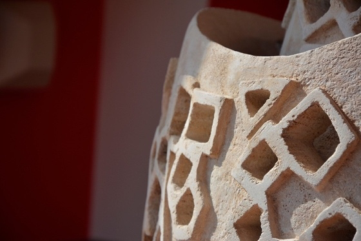
Among the analysed case studies, in terms of multisensory interaction, the company Desamanera (www.desamanera.com) is interesting because it utilizes 3D additive processes for the production of rocky conglomerates, through the combination of marble powder or sand with natural binders. This solution allows the creation of products characterized by strong expres- sive and tactile qualities of the surfaces. In particular, the company has evolved the “powder bed” technology using natural binders, patented, for the creation of large-scale stone and marble works and objects with high levels of flexibility and efficiency, where digital manufacturing and artisanal craftsmanship converge (Fig. 1).
90 Goretti and Terenzi
Figure 1: Desamanera “pelle di pietra” project, created by powder-based technologies.
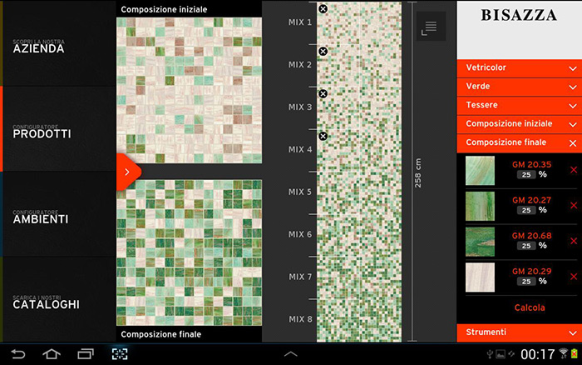
The synesthetic contexts of ceramic products find particular support in the digitization processes and Product Lifecycle Management (PLM) char- acterizing the ongoing transformation in the SMEs of the Made In Italy districts. An interesting case is that of the Bisazza configurator system (https://bisazzaapp.bisazza.com), which allows personalized selection of glass mosaic tiles by the user. Through interactive catalogs and emotional mood boards, the customer can choose the preferred chromatic effect and texture (Fig. 2).
Figure 2: Bisazza configurator.
CLAY INTERREG EUROPEAN PROJECT The CLAY Interreg Europe project (2018–2023) led by Umbria (https://www. interregeurope.eu/clay/) aimed to enhance the competitiveness of SMEs in the ceramic sector through the adoption of interregional policies supporting the innovation of technologies, processes, and products. By sharing best practices and solutions among partners, united by the presence of significant ceramic traditions and a substantial number of SMEs, the region sought to bolster the
Innovating Ceramic Products Through Digitalization and Additive Manufacturing 91
ceramic sector by prioritizing new technologies and innovative production processes. The CLAY project involves the University of Perugia, with the participation of the Bachelor’s degree program in Design at the Department of Civil and Environmental Engineering, led by professors Paolo Belardi, Valeria Menchetelli and Benedetta Terenzi.
The project aimed to accelerate and enhance the way new products, industrial processes, and services are conceived, developed, produced, and accessed. After an initial phase of broad-spectrum desk research aimed at highlighting emerging trends and process innovations characterizing both the national and international ceramic production scenarios, the research focused on exploring the tradition, characteristics, and specificities that define ceramic production in Umbria. To address the emerging crisis in the sector and respond to demands for competitiveness in the global market, the overarching objective of the research was to reaffirm/redefine/reinvent the current characteristics of ceramic production compared to the past, evoking the essence of origins and the deep layering of material and immaterial val- ues associated with it, encompassing history, contemporary scenarios, and possible future developments.
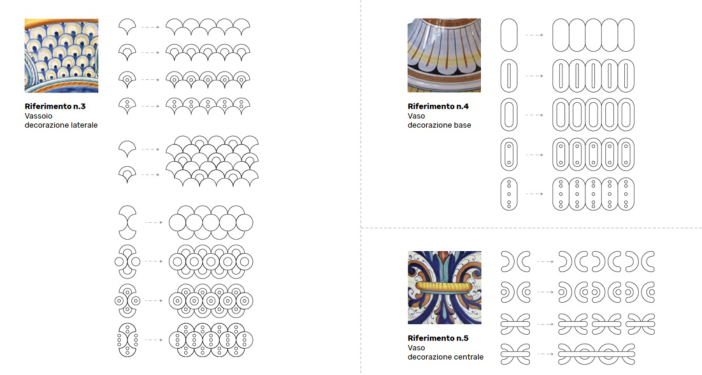
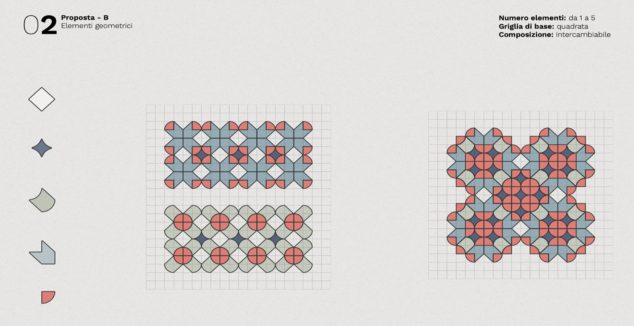
In particular, among the companies involved in targeted actions aimed at process, product, and decoration innovation, the research conducted for Sambuco Company explored the possibilities of innovation resulting from expanding the application of ceramic material beyond the areas currently explored by the company to identify new scenarios, including exploring new expressive forms related to decoration and surface finishes. The goal was to tap into a broad market, primarily interested in the traditional product for the reference territory, in order to make it receptive to new expressive possibilities through targeted and effective operations. The proposed decorations were designed starting from the isolation of a single element extrapolated from the traditional decorations of Umbrian ceramics, proceeding with geometric reworking (Fig. 3).
92 Goretti and Terenzi
Figure 3: Definition and codification of decorative elements.
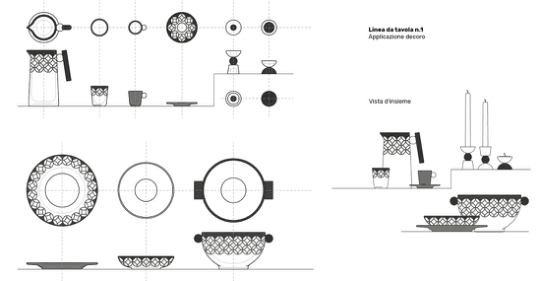
If it is true, indeed, that some scholars have explored the vast and articu- lated world of ceramics from a historical-knowledge perspective or to deduce reflections according to traditional logics in disciplines other than design, it is equally true that design is capable of providing an effective response to the sector through a reinterpretation of the material and the production process (Terenzi & Furin, 2020). With the intention of developing current formal solutions in line with market trends, and offering a unique user experience, without forgetting the material and immaterial values that ceramic products carry, the idea of a digital configurator has been developed to allow customers to select different options, such as colors and dimensions of decorations, overlapping them with a line of products specifically designed, with simple and geometric lines, suitable for accommodating such decorations (Fig. 4). Through interaction with the digital configurator, users can see in real-time how the product’s characteristics will change based on their choices, to create a unique product.
Figure 4: Example of application of decoration personalization, on which it will be possible to overlap color choices, starting from a wide range of color palettes available.
Innovating Ceramic Products Through Digitalization and Additive Manufacturing 93
Based on these same assumptions, the research also worked with the com- pany Unuslab, with the aim of offering a customization service for ceramic coatings. Leveraging their strong know-how and great production flexibil- ity, lines of products were identified that would reinterpret the trends of the sector, introducing elements of formal and aesthetic innovation related to geometries, colours, and the materiality of the surface (Fig. 5).
Figure 5: Personalization systems for ceramic coating elements.
FORMAL AND FUNCTIONAL INNOVATION IN CERAMICS SURFACES THROUGH PARAMETRIC DESIGN AND 3D PRINTING WITH CERAMIC EXTRUSION. MATERIA PROJECT Artex, the Center for Artistic and Traditional Crafts of Tuscany, has been operating since 1987 to protect, develop, innovate, and promote artistic and traditional productions in Italy and in the main foreign markets. Artex is the reference institution for the Italian edition of the Crafting Europe project in 2020–2021 (www.craftingeurope.com) within the framework of the New European Bauhaus program (European Commission, 2021).
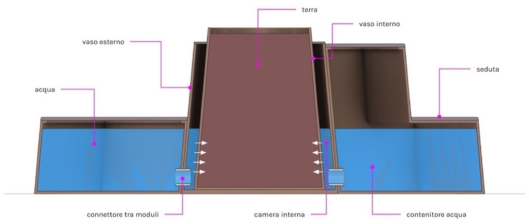
Within this framework, Materia is born, the result of synergy between Studio Giusti (www.ceramicagiusti.com), a historic ceramic laboratory in the Florentine area, active in the experimentation of ceramic compounds suitable for 3D printing, and Lorenzo Masini (www.supermateria.net), a designer highly interested in digital technologies and design-driven innova- tion processes, an expert in parametric design and digitalization processes of production in high-end craftsmanship (Goretti, 2023). The scientific supervi- sion of the project was carried out by Prof. Gabriele Goretti of the University of Pisa, DESTEC Department. Materia is a system of urban green furniture with constant water absorption that works thanks to the porosity principle of ceramic material. Composed of a series of 3D printed clay pots integrated to modular seats that serve as water containers produced with traditional techniques, it provides plants with continuous water supply to ensure their survival and reduce maintenance in high complexity contexts such as urban areas (Fig. 6).
94 Goretti and Terenzi
Figure 6: Materia project operating scheme.
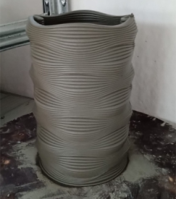
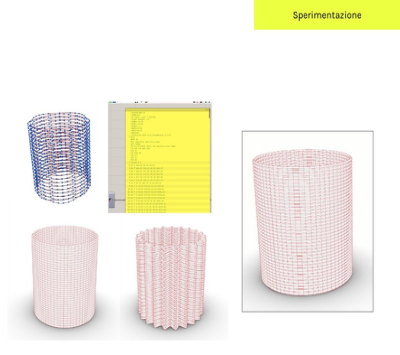
The ceramic 3D printing technology in this case appears as “enabling” (Buono et al., 2018) to create a system of pots whose design changes through an algorithm based on the water needs of the plant, increasing or decreas- ing the surface of the pot in contact with water to modify its absorption rate (Fig. 7). The parametrization of the different formal developments of the surface in contact with water has allowed defining different degrees of permeability corresponding to different algorithmic solutions and therefore different formal developments (Fig. 8). Through parametric modelling, it was then possible to manage ceramic 3D extrusion printing, thus allowing the creation of surfaces with different porosity and therefore different water per- meability. Furthermore, different formal solutions correspond to different degrees of permeability, giving the metamorphic shapes of the pot surface an emotional bionic inspiration effect (Thallemer, 2004). Thanks to its for- mal definition based on parameters, the surface can control the percentages of irrigation to transfer to the soil inside the pot according to objective needs. In fact, the water, placed in the container in contact with the surface of the plant-containing pot, can penetrate and irrigate the interior according to the needs of the plant body. For each type of plant, therefore, the Mate- ria project defines an appropriate ceramic porosity and a different degree of water permeability to allow different levels of irrigation.
Materia can represent a smart irrigation system that does not require any type of hardware or sensor and is scalable in numerous other applica- tions, both public and private. The final development of ceramic 3D extru- sion printing was supported by the company WASP (www.3dwasp.com), a national leader in the development of large-format 3D ceramic prints.
Figure 7: Materia project. Detail of the surface of the vase in the prototyping phase through ceramic 3D extrusion printing at WASP (source: WASP – 3dwasp.com).
Innovating Ceramic Products Through Digitalization and Additive Manufacturing 95
Figure 8: Materia project. Parametric design of surfaces. By modifying the texture of the ceramic extrusion from the 3D printer, different degrees of ceramic surface permeability are developed.
CONCLUSION
The ceramic product addresses a renewed plasticity and a renewed rela- tionship with the synesthetic value of the forms and usage scenarios of the product.
The increasing emotional significance of the product, determined by a dis- tinctive value at both cultural and market levels, occurs at both visceral and behavioural levels as well as at a reflective level (Desmet et al., 2007), allow- ing access to new modes of interaction with the artifact and understanding of the values it carries. The tactile and chromatic surface of the ceramic product and its aesthetic characterization represents a crucial interactive level in the development of these emotional values.
In this context, a significant contribution can be offered by the digitiza- tion processes of manufacturing that are increasingly characterizing Made in Italy craftsmanship. The introduction of advanced logistical technologies and enabling technologies in production can provide, on one hand, organiza- tional improvements and time-to-market improvements, on the other hand, they can allow other levels of innovation related to the user-centred sphere of the product system (Verganti, 2009).
The design outcomes of the research aim to demonstrate how emerg- ing Product Lifecycle Management (PLM) programs and related Customer Satisfaction Management (CSM) systems allow the development of new customization and personalization platforms that can provide new paths of knowledge, selection, and interpretation of the formal and functional contents of the product, even in traditional ceramic products.
Moreover, digitization processes and parametric modelling can develop new formal solutions that emphasize sensory value and also include func- tional and meaningful innovations of the product.
96 Goretti and Terenzi
REFERENCES
Buono, M., Capece, S. and Laudante, E. (2018). Design e Artigianato 4.0. Identità culturale territoriale e innovazione. MD Journal (5). Media MD. Busti, G. and Cocchi, F. (2004). La ceramica umbra al tempo di Perugino, Milano,
Silvana Editoriale. D’Amato, G. (2005). Storia del Design. Milano, Bruno Mondadori. Desmet, P., and Hekkert, P. (2007). Framework of Product Experience. IJDesign, N.
5 (1), pp. 57–66. European Commission (2021). https://ec.europa.eu/regional_policy/it/newsroom/n ews/2021/09/15-09-2021-new-european-bauhaus-new-actions-and-funding-to- link-sustainability-to-style-and-inclusion Fischman. J. (2010) Merging man and machine: The bionic age. National Geo-
graphic, January, 35–53. Follesa, S. (2016). La Rinascita del progetto lento. Firenze, SdT Edizioni. Fry, A., Goretti, G., Ladhib, S., Cianfanelli, E. and Overby, C. (2016). “Advanced craft”integrated with the saper fare; the role of intangible value, and the centrality of the artisan in highquality 21st century artisanship. Cuadernos del Centro de Estudios en Diseño y Comunicación. Ensayos, pp. 255–276. Goretti, G. (2023). Design e artigianalità avanzata. Il progetto Crafting Europe. Per-
corsi esplorativi di co–design tra designer e artigiani supportati dalle tecnologie digitali. Roma, Aracne. Goretti, G. (2017). Advanced Craftsmanship, percorsi di progetto tra innovazione e tradizione nei sistemi manifatturieri toscani. Roma, Aracne. Micelli, S. (2011). Futuro Artigiano. L’innovazione nelle mani degli italiani. Venezia,
Marsilio. Orlando, S. (2021). L’artigianato e l’arte nella ceramica fra tradizione e innovazione.
MIC, Faenza. Palmieri, S. (2017). La ceramica tra design e innovazione. 2nd International Conference on Environmental Design – MDA Mediterranean Design Association, Milano. Sacco, V. A. (a cura di) (2019). La ceramica nel tempo. Pistoia, Gli Ori, 2019, p. 176. Sottsass, E. (1963). Le ceramiche delle tenebre. Milano, East 128, 1963, p. 28. Terenzi, B. and Furin, E. (2020). Dal design Made in Italy al design Made in…
Umbria. L’identità territoriale per l’innovazione del settore ceramico. MDJournal n. 9/2020, pp. 74–85. Terenzi, B., Menchetelli, V., Pagnotta, G. and Avallone, L. (2024) Connection Between AI and ProductDesign. Potentials and Critical Issues inthe Text-to-Image Software-AssistedDesign Experience. Intelligent Human Systems Integration (IHSI 2024), Vol. 119, 2024, 465–475, https://doi.org/10.54941/ahfe1004511. Puglia, D. and Terenzi, B. (2020). Nanotechnology, Additive manufacturing and
Genius Loci. A case of jewellery design. Agathón no. 7/2020, pp. 210–219. Terenzi, B. (2022). Hybrid Territorial-Artificial Systems. Opportunities in Design for Territories. In: Tareq Ahram, Waldemar Karwowski, Pepetto Di Bucchianico, Redha Taiar, Luca Casarotto and Pietro Costa (eds) Intelligent Human Systems Integration (IHSI 2022): Integrating People and Intelligent Systems. AHFE (2022) International Conference. AHFE Open Access, vol. 22. AHFE International, USA. https://doi.org/10.54941/ahfe1001058 Thallemer, A. (2004). Bionic Design – The human Touch of Technology. International
Design Conference Dubrovnik. Verganti, R. (2009). Design-driven innovation: Changing the rules of competition by radically innovating what things mean. Harvard Business Press.
LISTED IN THE AHFE DIGITAL BOOKSTORE CATALOGUE
Explore the complete digital volume
Human Aspects of Advanced Manufacturing, Production Management and Process Control
Read this individual research paper free through the original publisher, or explore the full digital proceedings book.
ISBN 978-1-964867-22-9
Explore this ISBN in the AHFE Bookstore ↗Listed in the July 2026 bookstore catalogue; search by ISBN to confirm current availability · Digital book purchase optional