Benedetta Terenzi, Valeria Menchetelli, Giacomo Pagnotta, Ludovica Avallone (2024). Connection between AI and product design - Potentials and critical issues in the text-to-image software-assisted design experience. In: Intelligent Human Systems Integration (IHSI 2024): Integrating People and Intelligent Systems. AHFE Open Access, vol. 119, pp. 465–475. https://doi.org/10.54941/ahfe1004511
Driven by the demand for innovation, design is constantly evolving and is increasingly focused on integrating new technologies into design processes. Technological innovations have proven to be of fundamental importance, both in speeding up and improving production processes and managing and enriching the ideational process.We are now surrounded by software in which the participation of artificial intelligence is constant, but although it has become pervasive, we often do not even notice its presence. In the field of product design, several software exploiting artificial intelligence have been diffused to provide us with virtual products at the two-dimensional level. These software are capable of transforming the ideational stages of a project, as they generate original idea proposals in a matter of minutes. One of the most popular software is Midjourney, which is based on the key text-to-image concept, and can create images from prompts, and descriptive keywords provided by the designer. There are also interesting examples in this regard. Think of the work done by Filippo Nassetti, a British architect and designer, who came up with a series of sunglasses and eyeglasses by going through Midjourney, to obtain zoomorphic-inspired products that recall the textures of biological and mineral microstructures. The surreal collection of biomorphically shaped glasses is an example of the exploration of the creative potential of Midjourney software.Another interesting project is the one tackled by the Oio company for the Spawns spoon collection, in collaboration with Giosanpietro Jewelry. According to Simone Rebaudengo, director and co-founder together with Matteo Loglio of the Oio company, the products in the Spawns collection derive from an ongoing dialogue between different skills that has led to the collaboration between man and algorithm, resulting in an expansion of the handmade, merging the ancient world of craftsmanship with that of advanced technology, defining what they call 'craft intelligence.The paper aims to explore the relationships, potentials and limitations of integrating artificial intelligence into the design process through a design experience that tests the innovative potential of text-to-image software in product ideation and reflects on the redefinition of the designer's role in this rapidly and continuous changing scenario.The case study presented therefore experiments with a design process in which the ideation phase is supported by AI, particularly by text-to-image software, which allows textual descriptions to be translated into visual representations, generating highly detailed images and offering new creative possibilities. The work addressed outlines perspectives and critical issues, which deserve further investigation. On the one hand, one potential that is being outlined is the possibility of visualizing even complex ideas by entrusting the imaginative component to the software, having a multiplicity of alternatives and expanding the ideational range with novel solutions from which to make more informed design choices. Text-to-image software also simulates effective virtual prototyping, allowing a concept to be prefigured and visualized in a three-dimensional context before committing to physical production.On the other hand, text-to-image software has some significant limitations, for example in the poor correspondence of generated images with design intentions and the designer's need to acquire technical skills to effectively use text-to-image software, going on to delineate the possibility of a figure such as that of the prompt designer.Therefore, the presented project aims to contribute to the contemporary debate on the integration of AI into design processes with the collaboration of text-to-image software as another avenue for innovation in product design. The scenario sketched out defines an area in which the role of the designer and human creativities proves irreplaceable, leaving one to understand how more and more a process of understanding and collaboration with AI technologies is needed, and how the skills required of future designers are going to vary and expand.Nozaki, N., Konno, E., Sato, M., Sakairi, M., Shibuya, T., Kanazawa, Y., & Georgescu, S., 2017, Application of artificial intelligence technology in product design. Fujitsu Sci. Tech. J, 53(4), 43-51.F. Morace, Design più umano. Quello che l’intelligenza artificiale non potrà mai darci. Egea, 2018S. Quintarelli, Intelligenza artificiale: cos'è davvero, come funziona, che effetti avrà. Bollati Boringhieri, Torino, 2020G. E. Valori, Intelligenza artificiale tra mito e realtà. Motore di sviluppo o pericolo imminente? Rubbettino, 2021L. Keeheon, A Systematic Review on Social Sustainability of Artificial Intelligence in Product Design. Sustainability 2021, 13(5), 2668; https://doi.org/10.3390/su13052668M. Mitchell, L'intelligenza artificiale: una guida per esseri umani pensanti. Einaudi, 2022
The human-machine relationship has changed dramatically over time, achiev- ing results that were unthinkable only a few years ago. If one compares the purposes for which the computer was invented with its use today, one can easily see how its significance has shifted considerably. Nowadays, the use of machines accompanies human beings in actions, thoughts and decisions of their daily lives, taking the form of a real-life partner. Thus, its role is no longer limited to that of a passive tool used simply to return outputs from the inputs received; rather, today these tools see their role elevated to an active part of person-machine communication, becoming themselves participants in the processes of creation. Artificial Intelligence (AI) has become increasingly present and widespread, influencing and changing society and the design world in profound and lasting ways. Its ability to analyze vast amounts of data, learn from past experiences and make “autonomous” decisions has revolutionized numerous fields, including medicine, industrial automation, finance and many others. But the impact of AI goes far beyond these specific
areas, coming to change how people interact with technology and each other. Defining what AI is, and more importantly, what it is not, is not such an easy task. Certainly, historical analysis allows us to return an idea of it, as well as to understand how complex it is to summarize in a single definition an area of scientific research that is not limited to the technological field but rather ranges between philosophy and anthropology, literature and medicine with spillovers in the most diverse fields.
The origin of the history of AIs can be found in the publication of Alan Turing’s article in Mind magazine (Turing, 1950) under the title Computing Machinery and Intelligence, in which for the first time the subject of intelli- gence is addressed from the perspective of the modern digital computer. For this reason, this paper is generally recognized as the first publication con- cerning Artificial Intelligence, although to witness the first examples of AI will have to wait until the late 1950s. Credit for the birth of a true discipline goes to John McCarthy, professor of mathematics at the Rockefeller Institute. McCarthy in 1955 proposed that the university fund the Dartmouth Summer Research Project, which was a summer of study specifically to explore the topic of AI with other researchers. In the explanation of the program, for the first time in history the term Artificial Intelligence appeared in a formal paper (it would be poetic to say that it was the first time in general that the term appeared, but Marvin Minsky used it as early as 1952). Although the Dartmouth Summer Research Project had not led to any noteworthy break- throughs, for the first time an institution had approved and funded research on Artificial Intelligence, and this designation was so successful that it was chosen for the establishment of this new discipline.
Today, the definition of Artificial Intelligence is something that depends strictly on the historical context and the state of the art in which it is placed, and only after a view of it can then proceed in defining it.
We start with the following definition of Artificial Intelligence (AI), as proposed within the European Commission’s Communication on AI: “Arti- ficial Intelligence (AI) refers to systems that display intelligent behaviour by analysing their environment and taking actions – with some degree of autonomy – to achieve specific goals. Artificial intelligence (AI) systems are software (and possibly also hardware) systems designed by humans 3 that, given a complex goal, act in the physical or digital dimension by perceiving their environment through data acquisition, interpreting the collected struc- tured or unstructured data, reasoning on the knowledge, or processing the information, derived from this data and deciding the best action(s) to take to achieve the given goal. AI systems can either use symbolic rules or learn a numeric model, and they can also adapt their behaviour by analysing how the environment is affected by their previous actions. As a scientific discipline, AI includes several approaches and techniques, such as machine learning (of which deep learning and reinforcement learning are specific examples), machine reasoning (which includes planning, scheduling, knowledge rep- resentation and reasoning, search, and optimization), and robotics (which includes control, perception, sensors and actuators, as well as the integration of all other techniques into cyber-physical systems).” Wanting to provide a
Connection Between AI and Product Design 467
broad definition of the discipline, it is possible to say that “Artificial Intel- ligence (AI) is the ability of a machine to exhibit human capabilities such as reasoning, learning, planning and creativity. It enables systems to under- stand its environment, to relate to what it perceives and to solve problems, and to act toward a specific goal. The computer receives data [...], processes it and responds. AI systems are able to adapt their behaviour by analysing the effects of previous actions and working autonomously” (European Par- liament, 2020, p. 3). This definition correctly summarizes what underlies AIs, and introduces the absolute, as well as necessary, players in the realization of Artificial Intelligence: data and devices.
THE RELATIONSHIP BETWEEN AI AND CREATIVITY The historical analysis of AI makes it clear how irreversibly the invention of the computer revolutionized the way we conceive of reality. It is fasci- nating to observe how, despite having radically different characteristics, a technical, scientific and objective discipline such as programming has devel- oped such a close link with the creative world. Generally, artistic ability is relegated to the sphere of mere creativity and thus considered to be at the opposite end of the spectrum from anything that shares scientific ideals. Yet, it is perhaps this difference that sparked the interest of early digital artists, this ability of programming to stand at the intersection of art and science, information technology and creative practices. Alan Blackwell (2002) argues that programming can be seen as a “process of problem identification and understanding, design, translation into code, and subsequent maintenance over time.” Donald E. Knuth (1974) and later Frederick Brooks (1995) state that “the programmer, like the poet, [...] builds castles in the air, made of air, by the externalization of imagination. Few means of creation are so flexible, so easy to smooth and modify, so easily capable of realizing great conceptual structures.”
Unlike all other living beings, human beings are the only ones who manifest that special capacity we call ‘creativity.’ Human creativity, in its broadest sense, is capable of developing ‘project like reasoning’ that is an expression of its own time, and that is aimed at providing adequate responses to needs in the various fields of its existence. Likewise, creative activity is capable of galvanizing the interest of human beings through actions that spring from the author’s sensibility to induce meaningful reflections on the human condition (Ubertazzi, 2012; Terenzi, 2023). Human beings, therefore, have always used their creativity to redefine their surroundings, with a view to their survival, and to determine their near future.
From a practical point of view, we can define creativity as the ability to create something innovative and recognized as such by the community. According to Zingale (2012), the designer’s activity is mainly to become a mediator between art, technology and society, interpreting not only the func- tions but also the meaning of discoveries. The creative process seems to have a common genesis with the functioning of Artificial Intelligence: according to Umberto Eco, creativity can be thought of “as a novel combinatorics of pre-existing elements” (Eco, 2004, p. 5), that is, as a process of inventive
reworking of already known facts and materials. Similarly, AI technologies are trained with boundless datasets built by the accumulation of known data (texts, numbers, images, videos, 3D models, etc.), which the algorithms “recombine” in a novel and in that sense “new” way. However, among the infinite possible combinations, the selection of those with meaning and their productive reworking remains the exclusive prerogative of the designer, that is, of human intelligence.
Today, the period we are living in demands a timely understanding of the context and a consequent definition of innovative ideas capable of redevel- oping human life, as a function of a greater awareness of our role on the planet. It is therefore necessary to understand what is meant by creativity, what role it plays vis-à-vis the design process and in function of the possi- bilities offered by digital innovation and AI specifically. He who intends to practice the complex world of design, and specifically product design, must know how to interpret the character of the material and its performance and expressive potential; he must have a realistic and direct relationship with the industry (also considering that in this sector Italian industry represents excellence) and be aware of the production processes as well as the problems related to product feasibility; he must be able to interpret, in a modern sense, the formal culture of his time; finally, he must be able to communicate and transmit those intangible values linked to the sphere of emotions that make an object an experience.
In the past decade, rapid technological advances have returned new tools to support the design process and manufacturing, such as Big Data, Internet of Things (IoT), Additive Manufacturing, Artificial Intelligence algorithms, Cloud Computing, and generative design tools, which transform, transform, translate, distort, and change the meaning of the elements they are supposed to carry. Thus, digital technologies can change the way we innovate and deliver value (Magistretti et al., 2019) by introducing complex dynamics in which the range of material, immaterial, and digital manifestations fluidly extend across different domains that are mobile and combinable.
This is a disruptive transformation that affects all aspects of human thought and production. According to Manovich, “we are in the middle of a new media revolution -- the shift of all of our culture to computer-mediated forms of production, distribution and communication” (Manovich, 2001, p. 43). Digitization, therefore, has a profound impact on design culture as production, organization and transmission, restoring a scenario more rele- vant than ever for the design that is challenged by a profoundly transformed design process (Meyer et al., 2021), operating in an increasingly fluid envi- ronment with blurred boundaries between the physical, digital and biological spheres.
The question we are asking today concerns the level of support that AI can give to the designer in responding to all these skills required in product design.
In the field of product design, several software programs that leverage Artificial Intelligence have been used to deliver virtual products at the two- dimensional level. These software are capable of transforming and enhancing
Connection Between AI and Product Design 469
the ideational stages of a project, as they can generate images of original prod- ucts in seconds. One of the most popular and high-performance software is Midjourney, based on the text-to-image mode of operation, which can create images from prompts i.e., descriptive phrases provided by the designer.
When speaking of technology applied to creativity, Lubart (2005) inves- tigated this issue by trying to identify the prominent roles that technol- ogy can play in enhancing human creativity, concluding that computers: “may facilitate (a) the management of creative work, (b) communication between individuals collaborating on creative projects, (c) the use of creativity enhancement techniques, (d) the creative act through integrated human- computer cooperation during idea production” (Lubart, 2005, p. 365). The role of AI as support for pure creativity is being further affirmed, highlight- ing how AI systems can act “to provide inspiration, expand the scope of design, or trigger design actions by suggesting text or images” (Liao et al., 2020, p. 27). In this way, AI-generated visual data can act as external stimuli to a designer’s creativity at various levels, even as a random trigger (Beaney, 2005), significantly reducing the cost and time usually required by traditional design methods.
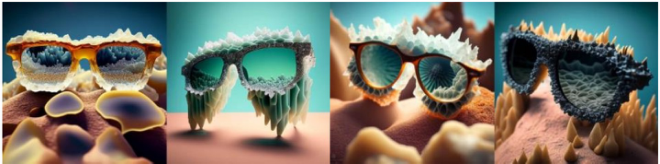
There are interesting experiments on the integration of AI and design. These include the work of Filippo Nassetti, a British architect and designer, who designed a series of sunglasses and eyeglasses by going through Mid- journey, to obtain zoomorphic-inspired products that recall the textures of biological and mineral microstructures. Once the most compelling images were selected, Nassetti set out to derive 3D models from the images pro- duced and then make actual wearable products. Nassetti sees this tool as fundamental to expanding the imagination of human beings, as it is capable of great speed in processing ideas: the surreal collection of biomorphically shaped glasses is an example of the exploration of the creative potential of Midjourney software (fig. 1). The next phase then involved transforming the images into 3D models and physical products, thus harnessing the essence of generative design in a leap from imagination to concreteness.
Figure 1: Images generated by Midjourney software (input provided by Filippo Nassetti).
Another interesting project is the one tackled by the Oio company for the Spawns spoon collection, in collaboration with Giosanpietro Jewelry. The goal of the project was to combine craftsmanship and technology in the process of conceiving and producing a product. According to Simone Rebaudengo, director and co-founder together with Matteo Loglio of the
Oio company, the products in the Spawns collection derive from an ongo- ing dialogue between different skills, which has led to the collaboration between man and algorithm, resulting in an expansion of handmade, merg- ing the ancient world of craftsmanship with that of advanced technology and outlining what they call ‘craft intelligence’.
Designers by their nature have always adapted to the socio-cultural changes with which they have had to deal: this leads them to adapt their modus operandi to the context of reference. Especially in recent decades, many issues have required a reassessment of design priorities, foremost among them, the variability of skills required as a result of technological advancement. Specifically for the AI technology revolution, companies and institutions are investing substantial resources in research and experimenta- tion on it, and the rapid rise of this technology is unlikely to slow down any time soon.
After analysing 1500 companies, Wilson & Daugherty (2018) stated that: “firms achieve the most significant performance improvements when humans and machines work together [...]. Through such collaborative intelligence, humans and AI actively enhance each other’s complementary strengths: the leadership, teamwork, creativity, and social skills of the former, and the speed, scalability, and quantitative capabilities of the latter” (Wilson & Daugherty, 2018, p. 5).
RESEARCH METHODOLOGICAL PATH The above considerations have been applied to a concrete case study developed during an integrated research and teaching experience involving collaboration between different skills and methodological approaches.
The proposed work, specifically focuses on the initial stages of the design process, from research to ideation, thus excluding engineering, prototyping and production. This is because, in the latter stages of the process, the imple- mentation of AI is already present and has occurred naturally, thanks to the predisposition of technology to solve purely analytical and technical prob- lems. In contrast, the utility of AI in the early stages of the design process, which are the most creative ones, is more unexplored and obscure, leaving room for research.
According to now-accepted thinking, changes in the early stages of the design process are the most critical compared to the later stages, where design choices are often reduced to details (Chen et al., 2002). Therefore, the impact of AI on process outcomes can increase exponentially when applied in the early stages (Figoli et al., 2002). Based on these considerations, animated by the question regarding the possible cooperation between Artificial Intel- ligence and human creativity in the ideational process of a new product, the experience followed a methodological procedure marked by the following steps.
First, a survey was conducted to outline the state of knowledge on AI, its definition and applications, with particular reference to the field of design. The reconstruction of the state of the art could not be separated from an assessment of the influence of AI technologies in general on theories of
Connection Between AI and Product Design 471
image and visual culture, not only because they disproportionately expand imaginative possibilities (Vincent, 2022), but also because they introduce a new meaning of image, which is no longer the exclusive outcome of human thought and action but is instead the result of an automatic pro- cessing process only partly controllable by humans. The degree of freedom and randomness with which AI software-generated images are endowed by their constitutive nature makes them “other” objects than human creative capacities, leading to the interpretation of AIs as interlocutors rather than mere tools, attributing to them, albeit improperly, a decision-making and ideational autonomy.
The second phase consisted of an analysis of currently available tools, con- ducted with a specific focus on those applications that show real usability as support for product design. This phase explored both software that can be used in the ideational process through the generation of images or models and those that can support prototyping and fabrication through 3D printing. Concerning this second aspect, it emerged how AI has become part of addi- tive manufacturing methods by involving multiple aspects, which include: optimization of materials and processes aimed at reducing waste and costs; integration into three-dimensional modelling and processing software aimed at minimizing time and trial and error; and automation of design processes aimed at containing production time and improving production efficiency.
Regarding the generation of images to support the ideation phase, software employing different workflows based on the inputs and outputs provided has been explored: among them, text-to-image algorithms use a three-step process (text encoding, prior, image decoding; see Condorelli et al., 2023) to generate raster images based on a user-entered prompt, usually equipped with an encoded syntax; similarly, text to 3D algorithms rely on a designer- defined prompt to generate 3D models, which, however, at present, still do not appear to be specific and customizable enough, and therefore do not offer an effective contribution to advanced design.
In the experimentation presented here, it was determined that only the main text-to-image software would be tested within the process, comparing different tools (Dall-E 2, Adobe Firefly, Midjourney) with each other and their responses to the inputs provided. The first images were generated from the same attempt prompt, appropriately declined in the specific contexts of the tested software: the results allowed the Midjourney software to be rec- ognized as the most versatile tool capable of producing graphical outcomes more in line with design expectations.
Having identified the software to be used in the ideational process, a further phase was devoted to learning how to encode textual instructions to optimize the graphic output. To devise a collection of furnishing acces- sories (consisting of a vase, a tumbler and a paperweight) by repurposing the design reference to a precise designer (in the case under consideration Ettore Sottsass), progressively more precise prompts were prepared and inserted to test the generative ability and the result obtained (fig. 2). Specifically, the first generic prompt (/image a [...] designed by Ettore Sottsass) was further spec- ified with constraints: on material; on material and form; on material, form and colour; on material, form, colour and function (figs. 3, 4).
Figures 2-3-4: Images generated by Midjourney, following the prompts: “/imagine a set of vases designed by Ettore Sottsass”, “/imagine a set of plastic vases composed of geometric shapes designed by Ettore Sottsass” and “/imagine a set of red, yel- low and pink plastic flower pots composed of geometric shapes designed by Ettore Sottsass”.
The outcomes of this testing phase allowed for process considerations and the pros and cons of the range of images generated, exploring and defining the scope for effective collaboration between the AI and the designer.
The numerous graphic solutions proposed by the Midjourney software provided the elements to tackle the next phase, during which the ideational suggestions were reworked to design a collection of real products. Some characteristic aspects of Sottsass’s objects, such as geometries, materials, colors and modularity, were deemed of fundamental importance in the design and consequently essential to be preserved. The AI-generated images, being derived through an automatic process of comparing textual inputs with a large database of comparison images associated with their captions, describe objects that are only partially provided with a character of real- ity, especially concerning function and the design logic of assemblage. The strong geometricity with which the objects were intended to be characterized, inspired by real furniture and collections conceived by the designer, led to the identification of an abacus of base-solids (sphere, cylinder, parallelepiped, hexagonal-based pyramid) within which the elements that will compose the objects of the collection were selected. In the composition of the objects, these shapes were considered whole or cut according to defined proportions (1/2, 1/3, 2/3), to optimize their role about function while also obtaining a variety of different solutions.
The last phase consisted of three-dimensional modeling of the objects, developed taking into account technical-realization evaluations about mate- rials and ergonomics. The definition of materials was inspired by the products designed by Sottsass and initially considered wood, plastic and ceramic; con- cerning the desired aesthetic effect, closer to both the prefigurations generated by Midjourney and the playful concept associated with the product line, the choice fell on ceramic, proposing a glazed finish with colors from yellow to pink to red. These same colors individually identify each of the products that make up the Keramik product line: the Rose vase (fig. 5), the Gelb bowl emptier (fig. 6), the Rot paperweight (fig. 7).
Connection Between AI and Product Design 473
Figures 5-6-7: Keramik collection: rose vase, gelb bowl emptier and rot paperweight.
DESIGN OUTCOMES: THE KERAMIK LINE The project experience conducted allowed some initial results to be high- lighted, to be evaluated as a starting point for further study in the context of subsequent applications. First, it was tested how AI-based software, such as Midjourney, can facilitate and accelerate the ideation process unfold- ing, generating original prefigurations in a short time. This speed allows designers to quickly explore a multiplicity of ideas, enriching and expand- ing their ideational possibilities, as also evidenced by the growing number of AI-assisted design pilot experiences. In each case, these are case studies in which AI is integrated into certain delimited phases of an established design workflow, entirely driven by the designer. This leads to interpreting the con- tribution of AI to the creative phase of the design process according to a logic of collaboration between Man and Algorithm, capable of leading to a real fusion between a recognized design tradition and an advanced technolog- ical approach. AI can be configured as complementary to human expertise, enhancing its innovative scope and enabling the exploration and develop- ment of novel design ideas with greater ease. Another significant advantage is the ability of text-to-image software to visualize complex ideas that might be difficult to articulate through traditional means. The designer can enter even very elaborate prompts, which the AI is nonetheless able to translate into highly detailed images, providing a realistic preview of the design before physical prototyping. However, the high complexity of the prompt does not always correspond to equally high responsiveness and effectiveness of the generated image, which often does not align with the designer’s intentions and requires an iterative process of prompt revision and optimization. In this regard, it should be emphasized that the designer must acquire technical skills to effectively use the software, and training in the activity of “prompt design,” which is capable of summarizing the design principles and function- ality of AI. The results ultimately underscore the irreplaceable role of human intelligence in the creative process: while it is true that AI can increase the efficiency of processes and provide innovative ideas, characteristics such as depth of understanding, insight, and aesthetic sensibility, which are indispens- able for realizing culturally relevant designs, are entirely contained within the mind of the designer: the collaborative interaction between AI and design
predominantly emerges as a promising avenue addressed to expanding the scope of innovation in product design.
CONCLUSION: FUTURE HORIZONS AND CRITICAL ISSUES Through this research, it was possible to explore the relationships, poten- tials and limitations of integrating AI technologies into the creative phase of the design process, experiencing the innovative potential of text-to-image software in product conception, and reflecting on the redefinition of the designer’s role in a rapidly and continuously changing scenario. The work addressed outlines perspectives and critical issues, which deserve further investigation. On the one hand, one potential that is outlined is the possibility of visualizing even complex ideas by entrusting the software with the imagi- native component, having a multiplicity of alternatives with novel solutions from which to make more informed design choices. Text-to-image software also simulates effective “virtual prototyping,” allowing a concept to be pre- figured and visualized in a three-dimensional context before committing to physical production. On the other hand, text-to-image software has some significant limitations, for example in the poor correspondence of the gen- erated images with the design intentions and in the visual result not always performing well, also about the software used. An additional critical aspect may be the designer’s need to acquire the necessary technical skills to use text-to-image software effectively. Therefore, the presented project aims to contribute to the contemporary debate on integrating AI into the creative phase of design processes with the collaboration of text-to-image software as another avenue for innovation in product design. The results obtained allow us to observe how we need to balance the level of automation with human creativity and understand the technical challenges associated with this methodology. Further reflections are generated on the effectiveness and responsiveness of software-generated images to the expectations expressed by text descriptions, outlining the necessity of an expert figure such as the prompt designer. The scenario outlined defines an area in which the role of the designer and human creativities proves irreplaceable, hinting at how more and more a process of integration and collaboration with AI technologies is becoming necessary, and how consequently the skills required of future designers are being transformed and expanded.
REFERENCES
Beaney, M. (2005). Imagination and Creativity. Open University Worldwide. Blackwell, A. F. (2002) “What is programming?”, in: J. Kuljis, L. Baldwin & R.
Scoble (Eds). Proc. PPIG 14, pp. 204–218. Brooks, F., (1995). Mythical Man-Month, The. Essays on Software Engineering.
Pearson Education, US. Chen, L., Wang, P., Dong, H., Shi, F., Han, J., Guo, Y., Childs, P. R. N., Xiao, J., & Wu, C. (2019) “An artificial intelligence based data-driven approach for design”, in Journal of Visual Communication and Image Representation, 61(1047–3203), pp. 10–22.
Connection Between AI and Product Design 475
Condorelli, Francesca, Luigini, Alessandro, Nicastro Giuseppe and Tramelli, Barbara (2023). “Drawing and Artificial Intelligence. Theoretical Statements and Exper- imental Practice for a Shared Poiesis”, in M. Cannella, A. Garozzo, S. Morena (Eds.). Transitions. Proceedings of the 44th International Conference of Repre- sentation Disciplines Teachers. FrancoAngeli, pp. 2623–2640. Eco, U. (2004). Combinatoria della creatività. <http://www.umbertoeco.it/CV/ Combinatoria%20della%20creativita.pdf> European Parliament (2020). What is artificial intelligence and how is it used?
<https://www.europarl.europa.eu/news/en/headlines/society/20200827STO8580 4/what-is-artificial-intelligence-and-how-is-it-used> Figoli, F. A., Mattioli, F. and Rampino, L. (2002). Artificial intelligence in the design process. The Impact on Creativity and Team Collaboration. Franco Angeli. Knuth, D. E., (1974). Computer programming as an art, Communication ACM,
December 1974. Liao, J., Hansen, P., and Chai, C. (2020). A framework of artificial intelligence augmented design support. Human-Computer Interaction, 35(5–6), 511–544. <https://doi.org/10.1080/07370024.2020.1733576> Lubart, T. (2005). How can computers be partners in the creative pro- cess. Classification and commentary on the Special Issue. International Journal of Human Computer Studies, 63(4-5 SPEC. ISS.), 365–369. <https://doi.org/10.1016/j.ijhcs.2005.04.002> Magistretti, S., Dell’Era, C. and Petruzzelli, A. M. (2019) “How intelligent is Wat-
son? Enabling digital transformation through artificial intelligence” in Business Horizons, vol. 62, Issue 6, Nov–Dec 2019, pp. 819–829. Manovich, L. (2001). The Language of New Media. MIT Press. Meyer, M., Wiederkehr, I., Koldewey, C. and Dumitrescu, R. (2021) “Understanding usage data-driven product planning: a systematic literature review”, in Proceedings of the Design Society, ICED21, vol. 1, Cambridge University Press. Terenzi, B. (2023). Innovazione nell’Eyewear Design. Prospettive per il settore
produttivo dell’occhiale. Maggioli Editore. Turing, A. (1950) “Computing Machinery and Intelligence”, in Mind, New Series, vol. 59, No. 236, pp. 433–460. Ubertazzi A. (2012) “Per andare nel futuro” in M. De Andrade, G. Mager e M. Scoz
(Eds.). Fragmentos urbanos, Escola Livres de Artes, Joinville, Brasile, pp. 6–9. Vincent, J. (2022). “An engine for the imagination”: the rise of AI image generators.
An interview with Midjourney founder David Holz, The Verge, 2 August 2022 <https://www.theverge.com/2022/8/2/23287173/ai-image-generation-art- midjourney-multi-verse-interview-david-holz> Wilson, H. J., & Daugherty, P. R. (2018). Collaborative Intelligence : Humans and AI Are Joining Forces. Harvard Business Review. Zingale, S. (2012). Interpretazione e progetto. Semiotica dell’inventiva. FrancoAngeli.
LISTED IN THE AHFE DIGITAL BOOKSTORE CATALOGUE
Explore the complete digital volume
Intelligent Human Systems Integration (IHSI 2024): Integrating People and Intelligent Systems
Read this individual research paper free through the original publisher, or explore the full digital proceedings book.
ISBN 978-1-958651-95-7
Explore this ISBN in the AHFE Bookstore ↗Listed in the July 2026 bookstore catalogue; search by ISBN to confirm current availability · Digital book purchase optional