Ziqi Wang, Ze Gao (2024). Enhancing Body Ownership of Non-Human Avatars in Virtual Reality through Multimodal Haptic Feedback. In: Human Factors and Wearable Technologies. AHFE Open Access, vol. 141, pp. 81–93. https://doi.org/10.54941/ahfe1005057
With the rise of virtual reality (VR) and an increase in avatar options, there is a need to enhance users’ sense of body ownership when embodying non-human avatars. This research develops an integrated system using multimodal haptic feedback to strengthen feelings of embodiment for avian avatars in VR. A user study evaluates the approach through retractable bands guiding limb movements and inflatable cushions simulating environmental flight conditions. Results demonstrate moderately positive overall usability, with variable individual responses. Spatial haptics augmented realistic wing simulations for over half of the participants. However, limitations exist regarding personalized interactions and simulating comprehensive tactile sensations. This pioneering work contributes an innovative methodology for prototyping and assessing bodily transformations in virtual environments. It advances avatar embodiment knowledge by focusing on replicating the motor experiences of avian flight. The findings underscore the nuanced interplay between multiple sensory stimuli in immersive environments. Further refinements to this system may build empathy and connections with the natural world.
This research aims to provide an image of the recent advancements of wear- able haptic feedback devices towards non-human avatars and explore the future possibilities of haptic feedback interaction with the user. In the vir- tual world nowadays, users could have multiple choices of the character they would like to play; the avatar they chose could not only look just like themselves but also completely different from the original appearance, for instance, another gender, different body shape, or even beyond human race. Beyond human avatars are non-human avatars, mammals, avians, fishes, amphibians, or even the mysterious creatures in fairy tales. Considering this, to increase the user experience, the immersion and body ownership of users
playing non-human avatars will be crucial because of the significant differ- ences in body structure between animals and humans. This research will provide a general situation of the haptic feedback research focusing on non- human avatars, analysing the outcoming and shortage of their study with experiments and data in their paper. This study also presents how to research animal movement mechanisms for VR haptic feedback and points out the future potential of non-human avatars in VR.
Benefits of Enhancing Body Ownerships of Non-Human Avatars As non-human avatars behave significantly differently from human avatars; building up a system to bridge the bodies of users and non-human creatures is challenging but worthwhile, because improving body ownership toward non- human avatars has positive significance. Firstly, how people perceive their bodies can impact how they view the world (Wittgenstein, 2023). Higher body ownership could help users to get more involved in the virtual world. Secondly, adding a non-human avatar option will enrich the product zone, stimulating the interest of potential users and attracting more people to par- ticipate in the VR interaction project. Finally, with the higher quality of haptic feedback and body ownership, users will have opportunities to experience the body sensations of other species and get close to their world from the first perspective. This could lead to more understanding and empathy between humans and other species. Besides, it could also work when the simulated target is replaced by another social group, like the disabled people, (Calepso et al., 2020).
As a result, it is crucial to enhance users’ body ownership to non-human avatars. However, users are unfamiliar with how animals move, especially from the first perspective. To enhance immersion, haptic feedback devices and VR headsets play a crucial role in helping improve body ownership by simulating animal movement mechanisms and body sensations for the users.
Combination of Haptic Feedback and Non-Human Avatar The significant differences in bodies resulted in users’ unfamiliarity with animal movements, which typically leads to a sense of disconnection and is harmful to immersion and body ownership. Considering this, recent researchers have claimed solutions to solve the corresponding problems.
Among those research, multimodal haptic feedback devices, which means combining haptic forms like vibrations in different patterns, pressing, drag- ging, restricting, etc., together with audio and visual sense, have been proven to be effective in enhancing embodiment. For instance, Vargas combined the audio and the haptic sensory in the experiment to simulate the sensation of dogs (Vargas et al., 2023), while Hecquard tried to enhance the feeling of connection and foster empathy with a compression belt and vibration heart simulators, which provides haptic feedback, and visual image in the VR headset, which provides visual contact (Hecquard et al., 2023). There- fore, multimodal haptic feedback devices and VR headsets compensate for the shortage of each other and enrich the user experience on more dimensions, enhancing the body ownership.
Enhancing Body Ownership of Non-Human Avatars in Virtual Reality 83
Methodology and Scope This research expects to contribute to an extensive investigation of the recent study relevant to enhancing the body ownership of the non-human avatar in a virtual environment. Accordingly, this study generates a thorough review of the related work with the survey reports delivered by the scholars and the essays featured in conferences and journals. This research conducts three steps to distinguish the papers: a) Identifying the publications, b) Two-step publications evaluating, c) Integrating evaluated publications.
a) Identification: The study first produced a Boolean algebra search to integrate relevant factors for identifying papers. The algebra is as shown: (“multimodal” OR “multisensor”) AND (“haptic feedback” OR “tactile feedback”) AND “virtual reality” AND (non-human avatar OR “beyond- human avatar”) AND (“body ownership” OR “presence” OR “immersion”) AND (“wearable”) AND NOT “proceedings”. The main databases for this survey are IEEE Xplore, ACM Digital Library, and Science Direct. Because of the different publications scenarios of these, the Boolean algebra was com- mitted to slight adjustment for each database. Apart from them, this research also includes survey papers that concentrate on haptic feedback devices or beyond-real transformations in VR tracks. Furthermore, the whole search process followed 3 standards: 1) All papers should be published from 2020- 2024. 2) All papers should be written in English. 3) All papers should have been reviewed by the peer. On the whole, after cancelling the replicated papers, we got 53 publications for this research. Among them, there are 9 from IEEE Xplore (%), 14 from Science Direct (%), 30 from ACM DL (%).
b) Evaluation: To evaluate the correspondence and the quality of the papers, this paper conducts 2 steps, which are abstract assessment and full-text assessment.
Abstract assessment: This research generates 2 criteria: The publications must be related to avatar embodiment in VR technology. This excluded the haptic feedback research that was irrelevant to the body ownership. In addi- tion, this research also established selecting criteria that weren’t involved in the boolean code. 1) These publications should not only focus on enhancing the fidelity of specific haptic feedback but also focus on improving the body ownership of the avatars. 2) The publications should include non-human avatars and could interact with users in a VR environment. 3) The publica- tions should include a broad literature review. At this phase, we cancelled 16 papers that couldn’t meet the standards, with 37 papers left for the full-text assessment.
Full-text assessment: We removed the publications corresponding to the following condition. 1) The project didn’t include combining VR technology and haptic feedback devices. 2) No hardware design part enhances the user’s body ownership. 3) The technology was outdated for now. 4) Must be full papers. With those criteria, we removed 4 papers and finally kept 33 papers for this survey.
c) Synthesis: Besides these 3 mainstream databases, this research also includes projects shown in the commercial platform, like meta-research, and Google-research. The product study from the labs in the industrial field has
84 Wang and Gao
helped this research to recognise the market’s needs and make an analysis of the future advancement of this technology, adding 2 papers, in all, there are 35 papers in this survey. Above all, this research has concentrated on the recent study on wearable haptic feedback devices meeting with non-human avatars. Assessing the strength and shortage of the studies, and comparing the working mechanism of their interaction system, this study could make a thorough image of the field study.
MOTIVATION AND CONTRIBUTION This study aims to produce a comprehensive review of the advancement of wearable haptic feedback devices and deliberate what additional value haptic feedback can provide as a complement to the regular visual and auditory experiences that VR headsets can provide. To achieve this goal, this paper has made the following contributions:
1. This study analyzes the way of deconstructing the movement mecha- nism of non-human creatures, using birds as an example, establishing a systematic framework in VR haptic feedback. 2. This study generated a survey of multimodal haptic feedback devices for enhancing users’ body ownership through a literature search and catego- rized them according to the presenting forms and application scenarios. Different types of haptic feedback devices are critically analyzed based on their advantages, challenges, and possible usability. 3. This study presents prospective open questions in response to the findings of the survey study.
MECHANISM FRAMEWORK With the significant variations of biomechanics between humans and other creatures, this study will establish an analyzing methodology, with which the movement mechanism of target creatures could be learned and the way to transform human haptics will be based on it.
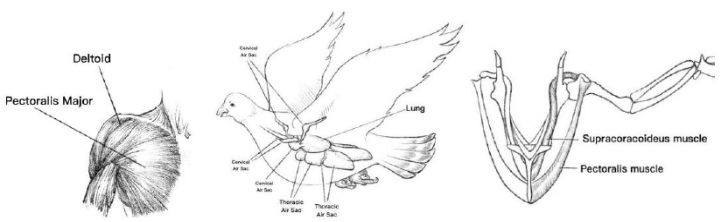
Biomechanism Framework of Avian In the first step, this research will define the scope of the creatures, as the non-human species are broad, the species that move similarly to humans are easier to simulate. In this case, considering the possible limitations of the user’s room, the research focuses on the upper body of humans as a start. According to the study (Häggström, 2014) of the upper body muscle system, shown in the Figure 2(a), this research chooses the avians which have upper limbs (wings) and pectoralis on their chest.
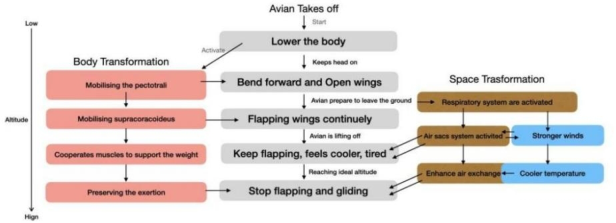
Apart from the common part of the body, there is a born gift of the avians, which is flying. To analyze the biomechanics of the bird’s flight, this study divides this topic into 2 aspects: space transformation and body transforma- tion. To begin with, this study focuses on the space changes caused by rising altitude when avian is taking off. The air pressure will be lower, accompa- nied by stronger wind and cooler temperatures. This will be a challenge for the breathing system of the birds. In the study, of biologists, the air sacs
Enhancing Body Ownership of Non-Human Avatars in Virtual Reality 85
help the bird to resist those crises. The evolution of flight in birds required the development of efficient respiratory and gas exchange systems. The lung- air sac system represents one possible solution (Maina, 2007). This study drew an image of the air sac location on a bird body, shown in Figure 2(b), referenced by (Sereno et al., 2008). Therefore, to simulate the space transfor- mations happening in the taking off, the haptic feedback devices should not only provide the strong wind, cooler temperature, and the inflation of the air sacs.
Figure 1: (a) Muscle system (b) Air sacs (c) Avian’s muscles.
On the other hand, body transformation is more about the strength exer- tion system of birds during flight. The biologists said in their study that flapping flight is the most power-demanding mode of locomotion. In con- trast, many developing birds use their forelimbs to negotiate environments (Heers et al., 2018). Biologist indicates, that two parts of muscles mobilise the wings: the pectoralis are responsible for lowering wings, and the supra- coracoideus raising them. The working biomechanics of avian wings in flight can be seen in Figure 2(c), inspired by (Ingle et al., 2019). Thus, the haptic feedback devices need to change the way humans use their muscles.
As a result, this study establishes a flow chart to clarify the movement mechanism of avians taking off, which is shown in Figure 3. This chart would be a reference for the designers and researchers who would like to enhance the body ownership of avatars with bird wings.
Figure 2: Flight movement mechanism of avian taking off.
86 Wang and Gao
User-Centred Design and Hardware Implementation After researching on movement mechanism of bird flight, this study incor- porates the User-Centred Design (UCD) theory (Gulliksen et al., 2003) in conducting the design. Gulliksen proposes three methodologies: Multidis- ciplinary Design, Iterative Design, and thorough user research and testing. These three methodologies will guide the development of the design in this study. Firstly, this study will provide a multidisciplinary perspective for this design. Above, this study investigated the movement mechanism of bird flight from the perspective of biological evolution. After integrating the mechanisms of bird flight, this study will simulate these mechanisms by com- bining the haptic feedback hardware design with the software design of the virtual reality environment, which involves the knowledge of ergonomics, programming, and so on.
Meanwhile, the focus of this study is the feedback from users as the car- rier of these simulations to this design. Therefore, in the preliminary design stage, anticipating the possible responses of users to the simulations becomes the first challenge. This study draws on the Sensorimotor system and control theory in cognitive science (Abtahi et al., 2022), in which Abtahi addresses the responses of the central nervous system of users to beyond-real transfor- mations occurring in the virtual environment and corresponding movement decisions. Abtahi proposed flows of control signals in movement-based inter- actions. This framework inspired the design and interaction approach of the software and hardware in this study; the software in the VR headset needs to provide cues that explicitly point to the movement with common sense or information known to the user and allow some tolerance for the users’ next movement and the initiation of haptic feedback, for instance, longer wait- ing time or double state judging. This conclusion integrates the sensorimotor system and psychological knowledge to anticipate movement decisions that may cause neurological errors when users are nervous and facing beyond- real transformation and to help the system optimise to be more responsive to users.
After completing the multidisciplinary research and initial design, this study is conducted to develop and iterate the hardware. The hardware con- sists of two parts: the straps system and the controlling system. The strap system is used to connect the user’s upper body, providing force feedback, and in the initial design, all straps are designed to be elastic. However, after prototyping and function testing by users, this study found that the elastic straps could not fix and support the forcing point, such as the shoulders and chest, and the stretching at the retractable straps weakened the downward pulling force, which made the force feedback not obvious enough. Therefore, this study utilises a combination of elastic and non-elasticated nylon straps. Next, the controlling system consists of an Arduino microcontroller, a vibra- tion sensor, and a servomotor, designed based on Abtahi’s sensorimotor flow. The Arduino microcontroller is like the central nervous system of the hard- ware, which receives input from the vibration sensor and makes judgements on the user’s positions; then, it makes behavioural decisions based on the judgement and commands the servo motor to act. Initially, this study used a motorised reel instead of a servo motor to control the chest strap. How- ever, after user testing, this study found that although the motorised reel can
Enhancing Body Ownership of Non-Human Avatars in Virtual Reality 87
control the length of the stretch more accurately, due to its structure, the downward pull force that the reel can generate is minimal. It is easy to dam- age and jam in the testing. Therefore, a servo motor with a metal plate is used, which produces a downward pulling force by rotating the metal plate within a range of 160 degrees in the longitudinal direction. The servo motor is more straightforward to work away from and, therefore, more stable, and its pulling force can be adjusted by voltage, which can generate a maximum of 10kg. With this pulling force, the user can feel and react with the servo motor.
From the perspective of thorough user research and testing, the initial test- ing of the hardware development has users’ participation, who provide the researcher with the experience of use and improvement opinions. At the end of hardware development, this study recruits 15 participants, designed a com- parison experimental group and cites Muender’s theory for creating a scoring questionnaire. These questionnaires are distributed to participants and calcu- lated according to the formula in Muender theory to derive the haptic fidelity of different devices and combinations.
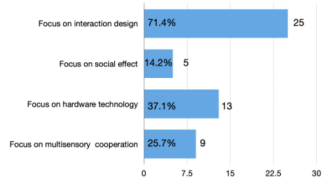
RESEARCH PERSPECTIVES FOR VR In this survey, the recent publications could be divided into four groups according to the research perspective, shown in Figure 4. To ensure accuracy, this statistic will include papers that comply with multiple groups simulta- neously. The percentage figures and the scale numbers on the bar show the promotion and the number of papers. For instance, based on the chart, 25 papers focus on the interaction design of haptic devices in a VR environment, representing 71.4% of the total.
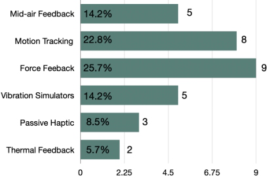
Figure 3: The research perspective.Figure 4: Hardware technology.
88 Wang and Gao
According to Figure 4, it is clear that among the perspectives on enhanc- ing body ownership through haptic feedback, most research focuses on improving the interaction system, for instance, virtual social touch interaction (Maunsbach et al., 2023) (Boucaud et al., 2023), user experience, percep- tions, and cognitions (Xi et al., 2024) (Kim & Schneider, 2020), and training assistant (Phataraphruk et al., 2020). Besides, the second most discussed perspective is hardware technology, for instance, multiple actuation (Zhu et al., 2020), texture simulations (Strohmeier et al., 2020), and pressure and thermal feedback (Zhang & Sra, 2021), followed by multiple sensory coop- eration (Siu et al., 2020), and finally, enhancing body ownership as a means to increase social empathy (Calepso et al., 2020), or improve accessibility for disabled users (Balasubramanian et al., 2023), or therapeutic usage (Min et al., 2020). Based on these findings, it claims that upgrading the interaction system is the main means to improve the users’ embodiment, and enhancing the fidelity of the haptic feedback by hardware is another effective method.
HAPTIC TECHNOLOGY FOR VR Additionally, technology advancement is also crucial for enhancing body ownership, especially for improving haptic feedback fidelity. As indicated by the survey, there are six categories of technologies, shown in Figure 5. The statistics also include the research complying with multiple groups simulta- neously. Based on the chart, the largest proportion is force feedback, which usually operates with restrictions on the human body, for instance, compres- sion force (Hecquard et al., 2023), tensioning cables (Yang et al., 2022), and soft pneumatic actuators (Zhu et al., 2020) (Zhang & Sra, 2021). Then followed motion tracking, based on the motion sensor and pressure sensor, which is crucial to the navigation of users’ bodies (Eltanbouly et al., 2022), for instance, recognizing users’ gestures (Kim & Xiong, 2022), gazing, and position (Evangelou et al., 2023). Besides, vibration feedback also supports many functional demands, for example, a sense of co-presence (Saint-Aubert et al., 2023) and gaming controller (Kim & Schneider, 2020). Moreover, mid- air haptic feedback concentrates on improving social behaviours in a virtual environment (Maunsbach et al., 2023) (Evangelou et al., 2023), which could help users who are unwilling or unable to touch others physically. Further- more, passive haptic means being touched; it works well on scoping space in a virtual environment (Daiber et al., 2020). Finally, the most minor propor- tion is thermal feedback, which handles specific haptic demands, for instance, simulating dynamic thermal sensations (Liu et al., 2021).
Based on the survey of technology advancement, it demonstrates that force feedback, corresponding with motion tracking are the main method to enhance the haptic feedback.
ANALYSIS OF RECENT HAPTIC FEEDBACK RESEARCH Through the survey, this research generates the strengths and the limita- tions of recent research and provides solutions and research plans for the enhancement of haptic feedback of non-human avatars.
Enhancing Body Ownership of Non-Human Avatars in Virtual Reality 89
Superiority and Potential of Recent Researchs The development of multimodal haptic feedback forms for different needs will provide the basis for future integration. As simulation of movement mechanism and space transformation demands multimodal haptics feedback, the reunited sensory haptic technology and reconfigurable kinetics mecha- nism system (Liu et al., 2021) can provide theoretical bases. For instance, the researcher of (Evangelou et al., 2023) explored enhancing the virtual interac- tion experience by combining motion-tracking technology and mid-air haptic feedback. With the maturity of the technology, more haptic forms could be added to the haptic feedback system.
Research Gaps and Chellanges of Recent Researchs Concerning the research gap and the challenges, the first problem that needs to be overcome is the increasing weight corresponding to the devices’ scaling up. A positive correlation exists between the equipment’s structure’s com- plexity and weight. A possible solution is to upgrade the integration level of the devices by unifying the control system, for instance, by setting the same start and end signals for the hardware and software.
Besides the second gap is the versatility of the haptic feedback devices. As the variating kinematics of different creatures, it is difficult to simulate more than one species with single devices. The challenges will be on both material and structure; the joints of the devices should be easy to shape and organize (Yang et al., 2022). Moreover, to be used in more scenarios, the sensor needs to be stable and accurate, for instance, vibration sensor, angle sensor, or horizontal sensor. At the same time, in proportion to the accuracy, the settings and coding demands for the microcontroller will be higher, and the cost will rise, too.
Finally, about the challenges of movement simulations, although recent research has developed the force feedback to change the kinematics of the users, the locating scope on the body should be expanded. Among the research, most devices are located on a specific part of the body, by which the whole balance of the body wasn’t considered. For instance, in (Calepso et al., 2020), users are expected to experience an amputated arm with haptic devices, while with the single devices on the forearm, the unbalancing body weight of losing an arm is not embodied.
Aiming at the above problems, this paper puts forward a few conclusions for improving the haptic feedback design for non-human avatars. First, it is necessary to establish a motion mechanism research system specifically for non-human avatars in VR environments, as shown in section 2 of this paper, to analyze the movement mechanism of a certain species, combined with the interaction requirements of VR software and hardware. Secondly, the haptic feedback forms correspond to non-human avatars’ movement mech- anisms. Finally, interdisciplinary working methods should be introduced, for instance, cognition, biology, interaction design, etc., to combine the biological mechanism and the human movement mechanism.
90 Wang and Gao
CONTRIBUTIONS AND OPEN QUESTIONS From the perspective of technology, this study establishes a system design and hardware framework that is based on the analysis of movement mechanisms. Inspired by the research of birds and sensorimotor theory, this study estab- lishes a hardware design framework by iterating the control system and improving the strap connection. This framework will be the basis for more force feedback designs. In the future, if this study wants to explore more body areas or forms of force feedback, we can keep the existing hardware framework and, replace the sensor and motor, change the location of the connection or material of the straps in order to complete the exploration of new force feedback.
From the perspective of doctrine, this study analyses and summarizes the main problems encountered in the current stage of haptic feedback device development by investigating the existing related studies and combining them with the practice of this study. For the recent challenges of haptic feedback devices, the movement-based interaction flow theory proposed by Abtahi can provide inspiration. The control system of the device is simplified into three parts: sensor, motor, and central neural system, which are controlled by codes. In addition, in the choice of sensor and motor, this research is based on the methodology proposed by UCD theory, which allows users to participate in the co-design at an earlier stage and demands the researcher to fully study the interaction between the user and the prototype of the device. The above theoretical guidance can provide a reference for more research on haptic feedback.
In this study, open questions emerged that could be explored further dialec- tically. The first question is: how should the versatility of applications for haptic feedback devices be balanced with fidelity? The pursuit of haptic feedback fidelity tends to increase the complexity and weight of the hard- ware, which can have a negative impact on the user’s experience. So, how should the ideal balance between versatility and fidelity of haptic feedback hardware be defined and reached? The second question is, does enhancing body ownership equate to improving haptic authenticity? In this study, the researcher speculates and simulates the body sensations of birds through bio- logical research. In contrast, the natural body sensation of birds is difficult to be directly experienced. Therefore, the way to improve the user’s body own- ership in a non-human avatar’s haptic feedback design is to make the user feel real rather than to pursue the imitation of similarity. This leads to the third question: how can researchers find commonality in individuality concerning the user’s subjective perception of “realness”? These questions can bring us to the next step of research.
LIMITATIONS AND FUTURE DEVELOPMENT When selecting publications for this paper, because this paper involves several factors, wearable devices, haptic feedback, movement mechanism, and non- human avatars, the number of publications selected is relatively small, and at the same time, each of the papers has a different research question and focus. For a more comprehensive analysis and avoidance of omission, this paper
Enhancing Body Ownership of Non-Human Avatars in Virtual Reality 91
reserved the publications that do not have all the elements but have most of them. Furthermore, due to space limitations, this paper does not analyze the movement mechanisms of other species. In the future, further analysis will be conducted for four-legged creatures and mythical creatures in conjunction with interaction design in VR environments.
In future, this study will be developed into a practical project based on simulating avian flight with haptic feedback. With the study going deep, non- human avatars will be categorized in a more detailed way. Besides the avian, tetrapods which lived on the land also have a common part with humans in movement mechanisms. The motion capture technology could help the research to study the strength exertion system and build a framework; for instance, the study of (Demuth et al., 2023) proposed a 3d digital method to investigate locomotor biomechanics.
In the process of hardware iteration, this study focuses on improving the clarity of the haptic feedback of the hardware, which is reflected in the pre- cise location, reasonable magnitude, and multiple haptic forms. These factors are referred to as foundational factors in Muender’s study and have a positive correlation with fidelity. At the same time, this study acknowledges that in the pursuit of fidelity, the hardware reduces personalised adaptation to the user’s diverse body. In the future, the study will work with more diverse users by precisely controlling the angle of the servo motor, e.g. by changing the angle of rotation from a standardized 160 degrees to range from 120 to 160 degrees. Meanwhile, the haptic feedback hardware can also be used in phys- ical world applications outside of VR, e.g. in gaming, simulation training or therapy, bridging the body sensations between the user and another person or avatar could enhance the effect of the above applications.
ACKNOWLEDGMENT
The authors would like to express their sincere gratitude to IEEE VR for the opportunity to present our work in a poster session. This platform allowed us to showcase our research and provided us with invaluable feed- back and insights from our peers in the field. We deeply appreciate the support and the engaging discussions that have contributed to the refinement and improvement of our research.
REFERENCES
Abtahi, P. et al. (2022) ‘Beyond being real: A sensorimotor control perspective on interactions in virtual reality’, CHI Conference on Human Factors in Computing Systems. doi: 10.1145/3491102.3517706. Balasubramanian, H. et al. (2023) ‘Enable blind users’ experience in 3D virtual environments: The scene weaver prototype’, Extended Abstracts of the 2023 CHI Conference on Human Factors in Computing Systems. doi: 10.1145/3544549.3583909. Boucaud, F., Pelachaud, C. and Thouvenin, I. (2023) “\it patted my arm\”: Investigat-
ing social touch from a virtual agent, International Conference on Human-Agent Interaction. doi: 10.1145/3623809.3623853.
92 Wang and Gao
Calepso, A. et al. (2020) ‘3DUI and the Phantom Limb: Multisensory experience for embodiment of amputation’, 2020 IEEE Conference on Vir- tual Reality and 3D User Interfaces Abstracts and Workshops (VRW). doi: 10.1109/vrw50115.2020.00110. Daiber, F. et al. (2020) ‘Everyday proxy objects for virtual reality’, Extended
Abstracts of the 2020 CHI Conference on Human Factors in Computing Systems. doi: 10.1145/3334480.3375165. Demuth, O. E. et al. (2023) ‘Modern three-dimensional digital methods for studying locomotor biomechanics in tetrapods’, Journal of Experimental Biology, 226(Suppl_1). doi: 10.1242/jeb.245132. Eltanbouly, S. et al. (2022) ‘Assistive telexistence system using motion blending’, 2022 International Conference on Cyberworlds (CW). doi: 10.1109/cw55638.2022.00023. Evangelou, G., Georgiou, O. and Moore, J. (2023) ‘Using virtual objects with hand-tracking: The effects of visual congruence and mid-air haptics on sense of agency’, IEEE Transactions on Haptics, 16(4), pp. 580–585. doi: 10.1109/toh.2023.3274304. Gulliksen, J. et al. (2003) ‘Key principles for user-centred systems design’, Behaviour & Information Technology, 22(6), pp. 397–409. doi: 10.1080/01449290310001624329. Häggström, M. (2014) ‘Medical gallery of Mikael Häggström 2014’, WikiJournal of
Medicine, 1(2). doi: 10.15347/wjm/2014.008. Hecquard, J. et al. (2023) ‘Fostering empathy in social virtual reality through physiologically based affective haptic feedback’, 2023 IEEE World Haptics Conference (WHC). doi: 10.1109/whc56415.2023.10224380. Heers, A. M., Rankin, J. W. and Hutchinson, J. R. (2018a) ‘Building a Bird:
Musculoskeletal Modeling and Simulation of Wing-Assisted Incline Running During Avian Ontogeny’, Frontiers in Bioengineering and Biotechnology, 6. doi: 10.3389/fbioe.2018.00140. Ingle, D. et al. (2019) ‘Science Behind the Lesson: It’s a Bird! It’s a Plane! It’s Biomechanics!’, CourseSource, 6. doi: 10.24918/cs.2019.43. Kim, E. and Schneider, O. (2020) ‘Defining haptic experience: Founda- tions for understanding, communicating, and evaluating HX’, Proceedings of the 2020 CHI Conference on Human Factors in Computing Systems. doi: 10.1145/3313831.3376280. Kim, W. and Xiong, S. (2022a) ‘Pseudo-haptics and self-haptics for free- hand mid-air text entry in VR’, Applied Ergonomics, 104, p. 103819. doi: 10.1016/j.apergo.2022.103819. Liu, Y. et al. (2021) ‘Thermocaress: A wearable haptic device with illusory moving
thermal stimulation’, Proceedings of the 2021 CHI Conference on Human Factors in Computing Systems. doi: 10.1145/3411764.3445777. Maina, J. N. (2007) ‘Development, structure, and function of a novel respiratory organ, the lung-air sac system of birds: to go where no other verte- brate has gone’, Biological Reviews, 81(4), pp. 545–579. doi: 10.1111/j.1469– 185x.2006.tb00218.x. Maunsbach, M., Hornbæk, K. and Seifi, H. (2023) ‘Mediated social touching: Haptic
feedback affects social experience of touch initiators’, 2023 IEEE World Haptics Conference (WHC). doi: 10.1109/whc56415.2023.10224506. Min, S. et al. (2020) ‘Effects of immersive virtual reality content type to mindfulness and physiological parameters’, 26th ACM Symposium on Virtual Reality Software and Technology. doi: 10.1145/3385956.3418942.
Enhancing Body Ownership of Non-Human Avatars in Virtual Reality 93
Muender, T. et al. (2022) ‘Haptic Fidelity Framework: Defining the factors of realistic haptic feedback for virtual reality’, CHI Conference on Human Factors in Computing Systems. doi: 10.1145/3491102.3501953. Phataraphruk, K., VanGilder, P. and Buneo, C. A. (2020) ‘Virtual reality platform for systematic investigation of multisensory integration and train- ing of closed-loop prosthetic control’, 2020 42nd Annual International Con- ference of the IEEE Engineering in Medicine & Biology Society (EMBC). doi: 10.1109/embc44109.2020.9175439. Saint-Aubert, J. et al. (2023) ‘Persuasive vibrations: Effects of speech-based vibra-
tions on persuasion, leadership, and co-presence during verbal communication in VR’, 2023 IEEE Conference Virtual Reality and 3D User Interfaces (VR). doi: 10.1109/vr55154.2023.00070. Sereno, P. C. et al. (2008) ‘Evidence for Avian Intrathoracic Air Sacs in a New Predatory Dinosaur from Argentina’, PLoS ONE, 3(9). doi: 10.1371/jour- nal.pone.0003303. Siu, A. F. et al. (2020) ‘Virtual reality without vision: A haptic and auditory white
cane to navigate complex virtual worlds’, Proceedings of the 2020 CHI Confer- ence on Human Factors in Computing Systems. doi: 10.1145/3313831.3376353. Strohmeier, P. et al. (2020) ‘Barefoot’, Proceedings of the 33rd Annual ACM Symposium on User Interface Software and Technology. doi: 10.1145/3379337.3415828. Vargas, M. F. et al. (2023) ‘Now I wanna be a dog: Exploring the impact of audio and tactile feedback on animal embodiment’, 2023 IEEE International Symposium on Mixed and Augmented Reality (ISMAR). doi: 10.1109/ismar59233.2023.00107. Wittgenstein, L. (2023). Tractatus logico-philosophicus. Xi, N. et al. (2024) ‘Wearable Gaming Technology: A study on the relationships
between wearable features and gameful experiences’, International Journal of Human-Computer Studies, 181, p. 103157. doi: 10.1016/j.ijhcs.2023.103157. Yang, H. et al. (2022) ‘Recompfig: Designing dynamically reconfigurable kinematic devices using compliant mechanisms and tensioning cables’, CHI Conference on Human Factors in Computing Systems. doi: 10.1145/3491102.3502065. Zhang, B. and Sra, M. (2021) ‘PneuMod: A modular haptic device with localized
pressure and thermal feedback’, Proceedings of the 27th ACM Symposium on Virtual Reality Software and Technology. doi: 10.1145/3489849.3489857. Zhu, M. et al. (2020) ‘PneuSleeve: In-fabric multimodal actuation and sensing in a soft, compact, and expressive haptic sleeve’, Proceedings of the 2020 CHI Confer- ence on Human Factors in Computing Systems. doi: 10.1145/3313831.3376333.
LISTED IN THE AHFE DIGITAL BOOKSTORE CATALOGUE
Explore the complete digital volume
Human Factors and Wearable Technologies
Read this individual research paper free through the original publisher, or explore the full digital proceedings book.
ISBN 978-1-964867-17-5
Explore this ISBN in the AHFE Bookstore ↗Listed in the July 2026 bookstore catalogue; search by ISBN to confirm current availability · Digital book purchase optional