Recently, the applications of augmented reality (AR) technology in train remote maintenance have attracted much attention from researchers. However, the train remote maintenance is a collaborative task for teams, and the transformation of collaborative methods brought about by AR has a significant impact on user’s performances in the task. In this work, an experiment was used to compare the performance differences between AR remote cooperation and traditional social software remote cooperation in train remote maintenance tasks. Social presence, collaborative availability and system availability affected by the two collaboration methods were analyzed. The results indicate that team members are more inclined to use AR device for remote collaboration in train remote maintenance tasks, and the social presence collaborative availability and system availability of the AR devices are better than traditional remote social methods. These results show that the AR technology has significant application advantages in remote train maintenance and provide a reference for the design of AR remote maintenance systems.
This paper presents the experimental results of an augmented reality remote cooperation software for high-speed train remote maintenance. We study the application of AR technology in high-speed train remote maintenance collab- orative task and compare the differences between AR remote cooperation and traditional remote cooperation through experiments. Conducted in a con- trolled laboratory with a high-speed train driving simulation platform, we focused on evaluating system availability, social presence, and collaborative availability with the support of two different technologies, with participants working remotely in roles including field maintenance, remote expert, and command center. Therefore, this paper provides suggestions for the appli- cation and system design of AR technology in remote train maintenance, focusing on the usability of collaboration in remote maintenance.
We begin by presenting an overview of related work concerning the appli- cation of AR technology in remote maintenance of high-speed trains, then we briefly describe the remote collaborative experiment method and design. We end the paper by discussing the findings based on our results.
An Augmented Reality Collaborative Experiment: Evaluation of Effectiveness 53
RELATED WORK
In industrial maintenance tasks, Augmented reality technology is used for communication and collaboration between remote users has become a trend of application and research in recent years. Remote maintenance using AR technology is mainly concentrated in aviation, industrial plant and auto- motive (Palmarini et al., 2018). Research found that augmented reality collaborative environment can reduce the operator’s eye and head move- ments, thereby increasing work efficiency (Reinhart and Patron, 2003). Through focus groups and field studies, users believe that AR systems can more effectively support information and knowledge sharing in maintenance tasks (Aromaa et al., 2017).
The research of AR technology in high-speed train remote operation and maintenance mostly focuses on system performance, algorithm, frame and other technical aspects. Based on AR technology to assist high-speed railway remote maintenance, a target tracking algorithm based on TLD is proposed to ensure the high accuracy of the algorithm and the high speed of calculation (Li, 2017). An adaptive framework is proposed for the railway industry to build maintenance process and provide tailor-made support for maintenance operators. The framework assists operators in fault analysis and provides solution strategies during maintenance activities (Scheffer et al., 2021).
The above studies lack the systematic and multi-person collaborative research of AR technology in the remote maintenance application of high- speed trains. In the process of train maintenance, it is often multi-role decision-making and multi-person cooperation, and the whole maintenance process is a complete system. Therefore, to continue the systematic and in- depth research of AR technology in train maintenance is helpful to more effectively play the convenience brought by AR technology.
EXPERIMENT PURPOSE There are two main purposes of this experiment:
1. We compared the performance difference between AR remote main- tenance system and traditional communication software in multi-person collaborative tasks, verifying usability and application value of AR system in remote train maintenance.
2. According to the user experience, we analyzed problems existing in the AR remote maintenance interaction system, provide reference for the optimization design of the AR system.
EXPERIMENT EQUIPMENT High-speed train simulation driving platform. Subjects completed the exper- iment task in the high-speed train simulation driving platform independently developed by the team.
OpenRail High-speed Rail Simulation Timely Software: OpenRail is a complete solution covering design to operation for several high-speed train models including the CR400AF.
Epson AR glasses: Epson AR glasses are an augmented reality device for enterprise-class applications, worn by subjects in the “on-site maintenance” role for AR-assisted operations.
Other equipment: A desktop computer and three 27-inch LCD monitors to run driving simulation software; Four 8-inch all-in-one computers to simulate high-speed train driving screens; A ROG tablet to run a remote operation and maintenance interactive system; An Android phone that simulates the “remote expert” mobile operation.
METRICS System availability mainly evaluates system quality from the perspective of users, including multiple dimensions such as system function, reliability and user operation experience (Liu et al., 2017). In this experiment, SUS sys- tem usability questionnaire is used to evaluate the usability of AR remote maintenance system. There are 10 questions in the questionnaire, with scores ranging from 1 to 7 indicating strongly disagree to strongly agree.
Collaboration availability is used to assess the quality of collaboration between partners, we revised and supplemented Mark’s collaboration ques- tionnaire (Billinghurst et al., 2003) There are 5 questions in the questionnaire, with scores ranging from 1 to 7 indicating strongly disagree to strongly agree.
Social presence is the feeling of being with others (Kreijins et al., 2022). In this experiment, social presence can reflect the degree and quality of col- laboration in the use of online communication tools. Six measures of social presence proposed by Harm were used in experiment, with a total of six ques- tions and scores ranging from 1 to 7 indicating strongly disagree to strongly agree (Harm and Biocca, 2004).
PARTICIPANTS We recruited 12 participants, all the participants were post-graduate students majoring in transportation and had knowledge of high-speed train driving and maintenance. Participants were divided into three groups: on-site main- tenance, remote specialists, and command centre, three types of people were randomly matched to form 4 groups, and each group of subjects conducted two experimental tasks.
TASKS DESIGN The experiment will simulate the driving failure of CR400AF high-speed train and its operation mode. According to the purpose of the experiment, the test group needs to use AR remote system and WeChat(a free application that provides instant messaging service for intelligent terminals) to jointly complete two tasks during the simulation operation of the train:
1. Task 1 (Battery contactor power off and reset), when the alarm message “Battery contactor power off” appears on the interface during normal opera- tion of high-speed train, the on-site maintenance personnel shall first contact the operation and maintenance command center to report the error, and the command center shall provide assistance according to its own knowledge of
An Augmented Reality Collaborative Experiment: Evaluation of Effectiveness 55
the fault. If the problem is not solved correctly, a remote expert is established and a team of three people work together to complete the task in a specified time.
2. Task 2 (emergency reset of EMU), when the alarm message “emergency reset of EMU” appears on the interface during normal operation of high- speed trains, the on-site maintenance personnel shall first establish contact with the operation and maintenance command center to report the error, and the command center shall provide assistance according to its own knowledge of the fault. If the problem is not solved correctly, a remote expert is estab- lished and a team of three people work together to complete the task in a specified time.
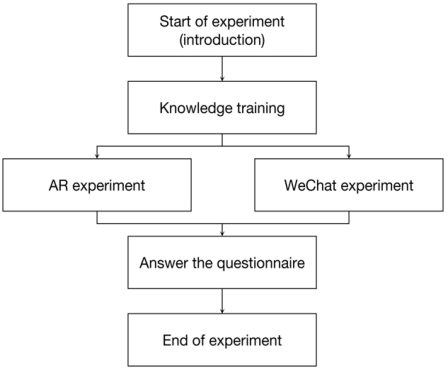
PROCEDURE The experiment consists of five steps and is expected to take 50 minutes (see Figure 1):
1. Start of experiment and introduction: It takes 2 mins to introduce the content of this experiment to the subjects and fill in the informed consent.
2. Knowledge training: Training participants, “on-site maintenance” mainly involved simulated bridge operation, AR remote maintenance inter- active system and basic fault handling knowledge; “command centre”mainly provides training on system operation and basic fault handling knowl- edge; “remote expert” is mainly for system operation and troubleshooting knowledge training, which is estimated to take 15 mins.
3. AR and WeChat experiment: The team carried out practical AR devices or WeChat for collaborative maintenance tasks, and the devices were used in a random order, which took a total of 20 minutes.
4. Answer the questionnaire: Participants need to fill out all the assessment questionnaires, which is expected to take 10 mins.
5. End of experiment.
Figure 1: Experiment flow chart.
RESULTS AND DISCUSSION
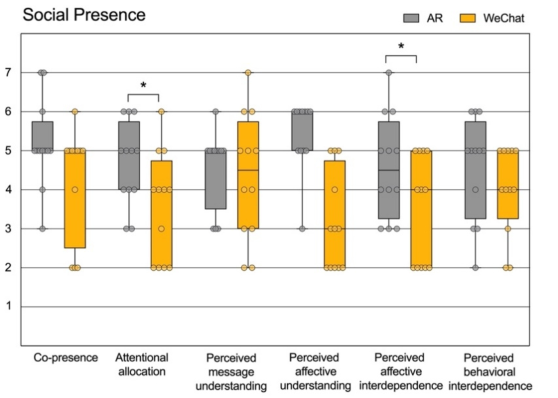
1. Social presence: Aggregate social presence was computed for each par- ticipant as the median of their Likert responses over all the questions. A Post-hoc Wilcoxon signed-rank tests of this data showed a significant dif- ference between AR group and WeChat group (Z = −4.561, p < .01), median (ICQ) levels showed the score of AR group (5.0) were higher than WeChat group (4.0).
We also computed the per-participant median scores for each of the Social Presence sub-scales: co-presence, attentional allocation, perceived message understanding, perceived affective understanding, perceived affective interde- pendence, perceived behavioral interdependence. Significant differences were found for attentional allocation (Z = −2.365, p = .018) and perceived affec- tive interdependence (Z = −2.844, p = .004). Median levels for the AR group and WeChat group. In terms of attentional allocation, AR group and WeChat group had median of 5 and 4, while in terms of perceived affective interdependence, they had median of 4.5 and 4 (see Figure 2).
Figure 2: The individuals and aggregated scores of social presence.
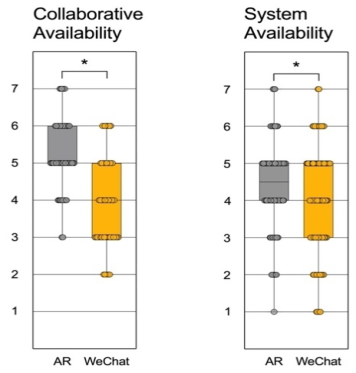
2. Collaborative availability and System availability: Post-hoc Wilcoxon signed-rank tests were used to compare all of groups. The test indicated that there were significant differences between AR group and WeChat group in collaborative availability (Z = −5.449, p < .01) and system availabil- ity (Z = −2.107, p = .035). Also, median (ICQ) levels showed AR group (5.0, 4.5) had higher collaborative availability and system availability score than WeChat group (4.5, 4.0).
Based on collaborative availability and system availability results, we found that in the AR collaboration environment, users have better collab- oration experience, which makes it easier to collaborate, understand the ideas of peers, and grasp the real-time changes of maintenance task status.
An Augmented Reality Collaborative Experiment: Evaluation of Effectiveness 57
Users generally believe that the usability of AR collaboration system is better than that of traditional social software, and the operating tools and social ways provided by the AR system are more in line with maintenance tasks (see Figure 3).
Figure 3: The individuals and aggregated scores of collaborative availability and system availability.
However, in the experiment, users took a long time to learn the remote train maintenance task using AR system, which also indicates that users are less familiar with the collaborative task using AR. At the same time, some participants also said that the AR system is more complex, the network link is not stable enough, and the wearing time is easy to cause fatigue, which will also become the research trend of the application of AR technology in train maintenance tasks in the future. A a summary of all the p-value results and the post-hoc tests that have been conducted in the experiment for all the study metrics (see Table 1).
Table 1. A summary of all the p-value results and the post-hoc tests that have been conducted in the experiment for all the study metrics.
Table available in the original PDF paper.
Metric Factor P-value Post-hoc System availability .035 AR>WeChat Collaborative availability .000 AR>WeChat Social presence Co-presence .088 ns*
In the context of rapid technological development, the application of AR technology in the remote maintenance task of high-speed trains is the future trend. The current AR remote cooperation method is still in the exploration stage, and there are still many limitations in the usability and human fac- tors. In this paper, we compare the performance differences between AR remote collaboration and traditional remote collaboration in train mainte- nance tasks. We found that users can obtain a higher sense of social presence and collaboration effectiveness in AR remote collaboration environment and believe that the usability of AR remote collaboration system is better than that of traditional collaboration software, but at the same time, users also raised some shortcomings of using AR devices for remote collaboration. The above results can provide reference for the application of AR technology in remote maintenance in the future.
ACKNOWLEDGMENT
This work was supported by the National Key R&D Program of China- 2022YFB4301202 and the National Natural Science Foundation of China 52175253.
REFERENCES
Aromaa, S., Väätänen, A., Hakkarainen, M. and Kaasinen, E.(2017). User experience and user acceptance of an Augmented Reality based knowledge-sharing solution in industrial maintenance work. Springer, Cham. Billinghurst, M., Belcher, D., Gupta, A. and Kiyokawa, K. (2003). Communica-
tion behaviors in colocated collaborative AR interfaces. International journal of human-computer interaction, Volume 16, No. 3, pp. 395–423. Harms, C. and Biocca, F. (2004). Internal Consistency and Reliability of the Networked Minds Measure of Social Presence. Seventh Annual International Workshop: Presence, Valencia: Universidad Politecnica de Valencia. Hualin, Li. (2017). Research on target-tracking algorithm based on the AR auxiliary
maintenance system of EMU. Beijing Jiaotong Univerity. Kreijns, K., Xu, K. and Weidlich, J. (2022). Social Presence: Conceptualization and Measurement. Educ Psychol Rev, Volume 34, No. 1, pp. 215–228. Palmarini, R., Erkoyuncu, J. A., Roy, R. and Torabmostaedi, H. (2018). A systematic
review of augmented reality applications in maintenance. Robotics and Computer- Integrated Manufacturing, Volume 49, pp. 215–228. Peng, Liu., Guohua, Jiang. and Yuqing Liu. (2017). Review of usability evaluation in virtual reality systems. Manned Spaceflight, Volume 23, No. 3, pp. 391–397. Reinhart, G. and Patron, C. (2003). Integrating augmented reality in the assembly
domain - fundamentals, benefits and applications. Cirp Annals Manufacturing Technology, Volume 52, No. 1, pp. 5–8. Scheffer, S., Martinetti, A., Damgrave, R., Thiede, S. and Dongen, L. V. (2021). How to make augmented reality a tool for railway maintenance operations: operator 4.0 perspective. Applied Sciences, Volume 11, No. 2656.
LISTED IN THE AHFE DIGITAL BOOKSTORE CATALOGUE
Explore the complete digital volume
Augmented, Virtual and Mixed Reality Simulation
Read this individual research paper free through the original publisher, or explore the full digital proceedings book.
ISBN 978-1-958651-94-0
Explore this ISBN in the AHFE Bookstore ↗Listed in the July 2026 bookstore catalogue; search by ISBN to confirm current availability · Digital book purchase optional