Martin Robb, Rune Vandli (2023). Best practices in using Virtual Reality for Design Review. In: Augmented, Virtual and Mixed Reality Simulation. AHFE Open Access, vol. 118, pp. 1–8. https://doi.org/10.54941/ahfe1004435
Immersive three-dimensional (3D) model review is a key use case for Virtual Reality (VR) in engineering endeavours. The stereoscopic image provided by VR headsets enables users to naturally perceive the 3D model; this bypasses the mental effort needed when viewing 3D on a regular display and viewers can easily grasp the complexities. This technology is particularly beneficial for team members who aren't design experts, such as construction staff, the Health, Safety, and Environment (HSE) team, and Subject Matter Experts (SMEs). VR allows these users to actively engage, understand, and contribute valuable insights to the design team in real-time. Now that remote working and online meetings are standard practices, VR meetings are the next step and a natural progression for collaborative design reviews. VR headsets with internet connectivity empower teams to collectively scrutinize 3D models and LIDAR (Light Detection And Ranging) point cloud scans. This user-centric, immersive review approach:-Engages a broader set of stakeholders in the design process,-Swiftly highlights design and layout flaws, and-Facilitates a safer construction sequence, especially when Building Information Modelling (BIM) is used.VR in engineering is therefore a triple-win, with the potential to reduce travel costs and CO2 emissions (significant since the construction sector is responsible for around 39% of global carbon emissions), engage specialized skillsets that may be scarce or geographically dispersed, and identify design issues at earlier project stages. For the latter, there is an outsize cost reduction gain since it is well established that project cost escalation has a significantly non-linear upward trajectory (North American Space Institute (NASA), 2004). Since the construction industry amasses a staggering $2500 billion in rework costs annually (representing 13% of the industry's total budget), early detection of issues is highly important to the success of any project.This paper delves into the workflows of VR design review, exploring how they have been successfully applied in large-scale capital projects, encompassing: -VR hardware and software solutions (current at the time of writing),-Details of a staged roll-out model that reduces barriers to adoption, and-Examples from real-world case studies.
GLOBAL CONTEXT Engineering and Construction is a sector that presents real opportunities for improvements in digitization. More than half of all contractors today still use manual processes — including pens, paper, and spreadsheets — to man- age projects, and many of those projects run up to 80% over-budget, and 20 months behind schedule (Forbes, 2023). A worthwhile improvement is the avoidance of rework, i.e., the correction of work previously done improperly. This is estimated to account for 13% of the industry’s total budget.
Another area is environmental impact: the sector is responsible for around 39% of global carbon dioxide emissions (International Energy Agency (IEA), 2019). Improvements to extended construction activity and material expen- diture attributed to on-site rework can be reduced by an estimated 10–15%. Specifically targeting the 13% of the total budget and the environmental impact directly caused by rework on site presents a sizeable opportunity.
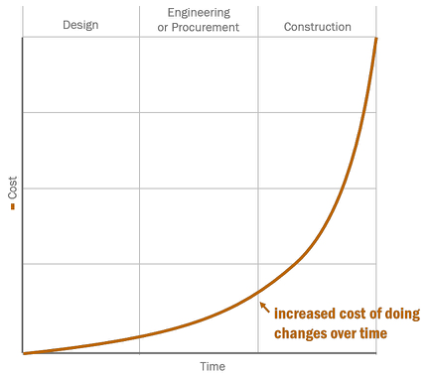
VALUE OF A SHARED UNDERSTANDING OF THE 3D MODEL Engineering and Construction change management costs skyrocket as time progresses. Studies such as that of NASA (North American Space Institute (NASA), 2004) show that changes during early design come at a low finan- cial burden, but during the later stages of Engineering, Procurement and Construction, the cost trajectory rises exponentially (Figure 1).
Figure 1: Typical project cost escalation curve.
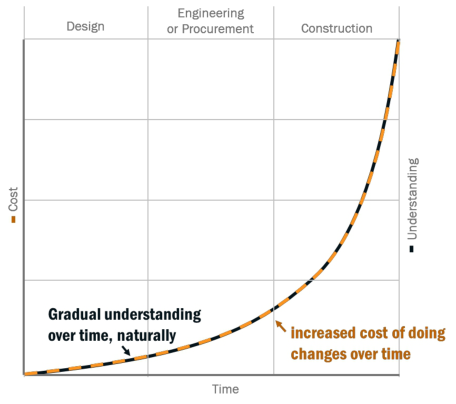
At the same time, the ‘understanding’ of the project among different project stakeholders mirrors this cost curve (Figure 2).
Early on, the ramifications of decisions and the specifics of chosen solu- tions are unclear to most parties involved in or able to influence the design process. Deep understanding often materializes too late—during construction—when the financial implications of changes are at their peak. It naturally follows that this is the most expensive time to make changes.
Best Practices in Using Virtual Reality for Design Review 3
Figure 2: Typical project cost escalation AND project team 3D model comprehension curve.
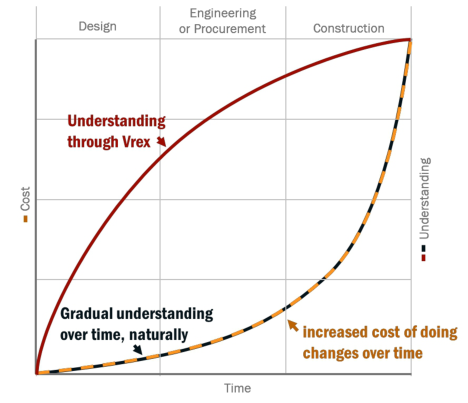
To counteract this consistent phenomenon, a Virtual Reality insight into the 3D model can increase comprehension by the various stakeholders (Figure 3). The design team can become immersed in the VR environment in real-time, harnessing a 3D experience of the BIM or CAD model, and 3D scans to attain a unified vision of the project design and its interfaces with the environment.
This approach is consistent irrespective of users’ project role and the project stage, and delivers a unified understanding for effective collaboration, accurate feedback, and confident decision-making as project complexities mount.
VR is an effective measure against cost overruns.
Figure 3: Typical project cost escalation AND enhanced 3D model comprehension curve.
4 Robb and Vandli
SYSTEM DESCRIPTION Vrex (www.vrex.no) is a VR software solution that facilitates this improved understanding and decision-making process for engineering teams. The soft- ware includes a straightforward online interface that is used for setting up projects, inviting and assigning team members’ access, uploading, and managing 3D models and point clouds to the software servers. Models are processed online and are then downloaded to an app. The files may be visu- alized using various VR runtime environments (such as Windows Mixed Reality and Meta’s Oculus), and meetings organized to review the model from within. It may be likened to a Microsoft Teams meeting held inside the 3D model. The downloaded models can also be viewed in “laptop mode”, which involves viewing and navigating on the 2D screen. This mode is comparable with regular 3D model reviews.
Vrex includes systems to coordinate and manage actions and observa- tions, which may be made inside the shared 3D model review. These can be resolved by the engineering team, remodelled, and a review of the updates held, contributing to effective design iteration.
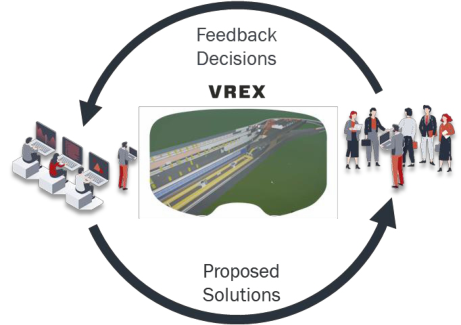
A conceptual workflow is shown in Figure 4.
Figure 4: Conceptual workflow for using VR in design review.
This software approach that includes the laptop mode provides a straight- forward option to transition from regular in-person 3D model reviews (with all using a 2D screen) into a collaborative immersive session. The approach ensures that users who are unfamiliar with VR, are unwilling to use it or do not have VR hardware available are not excluded from the meeting.
USE CASES This general model can be applied to several use cases that apply at differ- ent project stages. In the initial project phases, VR assists with determining facility layout and spatial relationships, planning pathways and circulation routes, and optimizing services. As the project advances, VR provides a platform for different disciplines like engineering and architecture to har- monize their efforts, proactively resolving conflicts and challenges. During
Best Practices in Using Virtual Reality for Design Review 5
construction, a combination of the 3D model and updated LIDAR scans can quickly indicate where construction is going off-target.
These are outlined below, ordered from the earliest to the most mature project stage.
Option selection: VR allows clients and stakeholders to effectively com- pare, evaluate, and choose the solution that best fits their needs and preferences. The VR design review enables the best possible insight and understanding of the 3D model. This may be termed an “A/B testing” approach.
Customer approvals of mechanical engineering deliverables: This use case is related to the visual component of a facility’s Digital Twin (PreVue3D, 2023), (Kongsberg, 2023). Utilizing visualization of point cloud scans, the intricate details of an existing building, its associated framework, surroundings, and building services can be captured. A new mechanical solution can be modelled into this scanned environment. The combined model may then be presented to clients for approval through VR, which provides the best possible understanding of the constraints and the engi- neered solution. Once approved, the solution can be precisely fabricated offsite, ensuring a seamless onsite installation with minimal welding and refitting.
Maintenance planning using digital scans: If there is already a digital scan of the building or structure, the intricate details of an existing building can be visualized, facilitating a dive into granular details of the existing build- ing structure and all its assets. The scan enables remote walkthroughs, simplifying the planning of maintenance tasks and the selection of req- uisite parts and equipment. Stakeholders can move to on-site execution swiftly and adeptly, drastically minimizing operational disruptions.
Precision re-fabrication: Leveraging point cloud scans, the engineering team captures the intricate details of an existing mechanical setting. CAD models representing the proposed solutions are then integrated into the point-cloud environment via CAD Authoring tools. Utilizing the Vrex abil- ity to overlay 3D point cloud scans and CAD models, both data sets are added to Vrex. Subject matter experts and consultants are brought into the platform for real-time deliberation, culminating in a final, meticulously accurate model for pre-fabrication, and installation on site, at significantly reduced production costs.
These use cases have been identified and their value realized in practice. There may be other use cases to be explored as the technology and application of VR on engineering projects continues to develop.
A STAGED ROLL-OUT MODEL FOR ENGINEERING TEAMS Since VR represents a new way of working, it cannot be assumed that all project staff will have any experience with VR. A staged roll-out model is therefore suggested as current good practice for those firms wishing to adopt the technology and apply it on projects.
6 Robb and Vandli
The advantage of a staged roll-out is that it provides a stepwise approach for new users, while those with experience (and willingness to use VR) do not need to be held back from exploring the technology. This inclusive approach should deliver the greatest value to projects.
Stage 0 – The Starting Line Stage 0 provides easy access to the VR software, allowing users to partic- ipate in VR sessions through traditional display screens. Since specialized equipment is not needed, it is an easy start for all users.
Stage 1 – Taking the First Solo Flight Stage 1 serves as your first deep dive into the full VR capabilities of Vrex. You can now explore 3D models and point clouds at a 1:1 scale, but you’ll be doing this on your own. It’s the first step towards complete immersion in the model.
Stage 2 – Harness the Power of Collaboration In Stage 2, things get interactive. Multiple users can now join the VR envi- ronment for collective model reviews – perhaps joined by newcomers at Stage 0. This shared experience fosters better communication and enables problem-solving and efficient issue capture among participants.
At this collaborative stage, teams can be separated geographically and still join the shared review experience. This represents the key stage to deliver value for VR and enables collaboration between geographically diverse and perhaps specialized resources.
Stage 3 – Unshackled Interaction By the time users reach Stage 3, they are freed from the limitations of hard- ware. Now, you can engage in untethered, multi-user sessions, diving deeper into the full potential of VR for design review.
TRAINING AND ONBOARDING The Vrex Academy (Vixel, 2023) is a useful repository of information that covers the essentials of VR, including hardware requirements, navigation, software setup, and licensing.
Once VR is set up, project team members without any experience will benefit from some basic initial familiarization training. This should cover the essentials of VR interaction, such as:
Fitting the VR headset for comfort and enabling a clear view of the VR content. Covering adaptations for glasses for those who wear them,
Setting barriers for the physical environment to ensure a safe interaction,
Learning the control system buttons and interaction styles,
Understanding the point-and-click navigation within the virtual world (e.g., Vrex uses a grip-to-move interaction style, a float navigation, and a point-to-point navigation style,
Voice interactions with people within the virtual world.
Best Practices in Using Virtual Reality for Design Review 7
Off-the-shelf VR software has been developed by companies such as Ocu- lus (First Steps in VR, (Meta, 2023)), and Learn Virtual Reality (Microsoft, 2023). These are ready-made resources to help project teams onboard first-time VR users.
For these users, the headset should be set up in a ‘kiosk’ mode, with the selected program the only option. Alternatively, the VR headset display can be cast to a separate display screen, which gives the facilitator a shared view of the VR headset screen and helps with working through the basics of navigation with the tutorials.
MANAGING BARRIERS TO ADOPTION The stepwise roll-out model is intended to show participants that VR presents a natural evolution from viewing 3D models in two dimensions. The value of VR may be seen straight away once participants put on the VR headset – and completely missed if the headset is not put on.
It is therefore recommended that the training and onboarding be made a fun introduction and is the first step on a serious and valuable journey of interacting with the 3D model / point cloud and with other users in the virtual environment.
CONCLUSION
VR design review is a solution to some key challenges in engineering, and cer- tainly has the potential to address the well-established cost-escalation curve for project teams. By some estimates, the lack of access to global exper- tise is the root cause of a significant amount (10–15%) of project rework errors (which, using the figures above, is a global cost of approximately $250-375 billion annually).
VR in design provides a mechanism that enables key staff to participate in the engineering design process remotely and in close collaboration with other team members.
Based on the experience gained introducing VR, the authors have found that the following factors contribute to successful deployment of VR on engineering projects:
Crafting straightforward workflows integrated into the engineering timeline,
Creating robust Terms of Reference (ToRs) for formal design evaluations,
Offering training sessions to acclimatize users to VR navigation and tools,
Ensuring sanitary conditions for shared VR equipment, and
Utilizing effective facilitation techniques to maximize engagement and maintain structured discussions.
Integrating VR into the existing design process necessitates thoughtful planning, starting with managerial endorsement. The financial outlay is rel- atively modest; a robust computer plus a VR headset can cost as little as $1500 and numerous affordable software solutions integrate seamlessly with
8 Robb and Vandli
existing 3D models and tracking systems. Moreover, the user experience— from initial setup to ongoing engagement—is steadily improving, making the investment in VR highly justifiable when weighed against the benefits of increased predictability in design and construction.
REFERENCES
Forbes. (2023, 08 29). Procore Powers Ahead In Digitizing The Construction Industry. Retrieved from https://www.forbes.com/sites/robertdefrancesco/ 2023/08/29/procore-powers-ahead-in-digitizing-the-construction-industry/?sh=2 420f86b3cef. International Energy Agency (IEA). (2019). 2019 Global Status Report for Buildings and Construction. Retrieved from https://iea.blob.core.windows. net/assets/3da9daf9-ef75-4a37-b3da-a09224e299dc/2019_Global_Status_Report _for_Buildings_and_Constru ction.pdf. Kongsberg. (2023, 09 08). Maximise business performance with Kognitwin.
Retrieved from https://www.kongsbergdigital.com/industrial-work- surface/kog- nitwin. Meta. (2023, 09 08). First Steps in Oculus 2. Retrieved from https://www.meta.
com/experiences/1863547050392688/?utm_source=www.google.com&utm_medi um=oculusredirect. Microsoft. (2023, 09 08). Learn Mixed Reality. Retrieved from https://learn.micros oft.com/en-us/windows/mixed-reality/enthusiast- guide/learn-mixed-reality North American Space Institute (NASA). (2004). Error Cost Escalation Through the
Project Life Cycle. Houston: NASA Johnson Space Center. PreVue3D. (2023, 09 08). Meet your digital twin. Retrieved from https://www.prevu3d.com/ Vixel. (2023, 09 08). VREX ACADEMY. Retrieved from https://academy.vrex.no/
LISTED IN THE AHFE DIGITAL BOOKSTORE CATALOGUE
Explore the complete digital volume
Augmented, Virtual and Mixed Reality Simulation
Read this individual research paper free through the original publisher, or explore the full digital proceedings book.
ISBN 978-1-958651-94-0
Explore this ISBN in the AHFE Bookstore ↗Listed in the July 2026 bookstore catalogue; search by ISBN to confirm current availability · Digital book purchase optional