Vadym Bilous, Kirill Sarachuk (2023). Development of the model-based planning system for augmented reality in industrial plant maintenance. In: Augmented, Virtual and Mixed Reality Simulation. AHFE Open Access, vol. 118, pp. 135–147. https://doi.org/10.54941/ahfe1004449
1 Chair of Automation Technology, Brandenburg Technical University of Cottbus-Senftenberg, Siemens-Halske-Ring 14, 03046 Cottbus, Germany ↗
2 Chair of Business Administration, Planning and Innovation, Brandenburg Technical, University of Cottbus-Senftenberg, Erich-Weinert-Str. 1, 03046 Cottbus, Germany ↗
Augmented reality (AR) is extensively used in modern industrial automation, especially in industrial plant maintenance (lPM). The growing amount of both research and practical projects explore, develop and integrate the AR applications for a variety of tasks in lPM. With the introduction of AR, the accomplishment of tasks like training of maintenance staff, the visualization of instructions during maintenance and error correction, the visualization of plant control processes, and many others become more visual, interactive and are, therefore, considerably simplified. Significant time efficiency with respect to commissioning of industrial equipment may also be achieved. Thus, the incorporation of AR technologies leads to comprehensive benefits in solving the automation tasks during the lPM.At the same time, the expansion of AR in IPM does not match the high potential it has demonstrated. The reasons for this comprise the implementation and adaptation issues (high risks and cost of the specific AR implementation), the technical problems (hardware. and software-related), special developer requirements, etc. Therefore, a model for planning the implementation of AR in IPM and for the benefit prediction in terms of AR efficiency is required. However, the majority of the projects and studies in the IPM area focus on the practical side of the AR implementation. The AR introduction benefits (usually in terms of development speedup or process time reduction) tend to be considered on a case-by-case basis. There is seemingly a lack of scientific papers that review the general planning of AR for the IPM in automation: there are no models to identify the feasibility of solving a particular task using the AR in general or the prediction of AR implementation results. The respective research gap consists primarily of a comprehensive analysis of the factors determining the necessity of implementing AR for a project or a process with the defined characteristics, their relation to the resulting benefits, and the main emphases to be considered when planning and deploying the AR technologies in the IPM area in particular and in the automation in general.To fill this research gap, we propose a model-based planning system (MBPS) for AR in the area of the industrial plant maintenance. This system should provide a deep scientific analysis of the feasibility and necessity of using AR to solve particular tasks in the automation field. Additionally, this MBPS should enable predictable planning and forecasting of the results of AR integration, like efficiency, applicability, quality and other criteria, and therefor support the decision making about AR implementation. This requires a broad study and analysis of criteria for evaluating the results of AR integration and usage in automation in general and in the IPM in particular.
The Augmented Reality (AR) technologies emerged in the third quarter of the twentieth century and significantly accelerated over the last couple of decades along with the increasing hardware computing power. Reaching its peak of interest in the previous decade (Palomäki, et al., 2010), they attracted a lot of investments and contributed to many of the projects (Grand Review Research, 2021). Since 2018, AR technologies have approached the plateau of productivity and have become ready for broader commercial use (Tech- navio, 2021; Markets and Markets, 2020) which was documented well in the recent scientific literature (Berger, et al., 2016; Bilous, et al., 2021; Bilous, et al., 2022; Bilous & Sarachuk, 2023; Kim, et al., 2019; Prinsloo & Van
Deventer, 2017; Tejedor-Calvo, et al., 2020). Alas, a rapidly increasing inter- est towards AR from a wide commercial perspective does not correlate with the theoretical efficiency.
While successful adoption of AR in the past was largely determined by the price and quality of hardware components (which are more widespread and more accessible to the public today), nowadays the software engineering and the development of the information and communication technologies1 (ICT) play a crucial role. With respect to the latter, the modern AR technology level is represented by an established ecosystem of applications and frame- works available for developers (Glover & Linowes, 2019) – for instance, the introduction of ARCore and ARKit made the technology available on more than 700 million devices (without considering third-party apps), mostly ben- eficial to the end-users (Technavio, 2021). What is, however, missing is the comprehensive system based on theoretical knowledge and scientific analysis for selecting tools and resources to solve a particular industrial task. This is important for the planning and forecasting tasks in science, industry, and the market.
This paper proposes the model of such planning system for AR solutions which may be used primarily by managers and project personnel planning to solve problems in the industry, but also by programmers and automation engineers. Our paper unfolds as follows: we first describe the motivation and background literature for the study. After that, we briefly describe the model- based planning system for AR and its tasks. Then, we discuss the MBPS conceptual scheme for AR and draw the overall conclusion.
BACKGROUND INFORMATION AR technologies have recently faced wide adoption in a variety of applica- tion areas of science, technology, and industry, as well as in entertainment, recreation, and sports. The ongoing research on industrial application of AR focuses more on specific tasks, benefits, current challenges and problems dur- ing implementation, for instance, in manufacturing industry (Devagiri, et al., 2022), automotive domain (Bottani & Vignali, 2019; Boboc, et al., 2020), aerospace programs (Safi, et al., 2019; Rajkumar, et al., 2020), automation (Ahmed, 2019; Mishra, et al., 2020), and several other areas.
Most of those studies focus on benefits and efficiency: mainly, the advan- tages comprising reduced maintenance or repair times for plants, simplified assembly of technical products, and increased interactivity during mechan- ical environment operation. Even early studies (Wiedenmaier, et al., 2001) recorded numerical benefit values, like assembly time reductions, in a series of practical experiments by using Methods-Time Measurement (MTM) to optimize processes. Along with that, some papers documented scientific out- comes, like a research on the factors that have a general influence on the development and implementation of AR applications or on the usage of
1Existing disparities in broadband technology support in this area, which were observed even for technologically advanced countries, may hamper the successful adoption of AR solutions.
Development of the Model-Based Planning System for Augmented Reality 137
AR technologies in general (Bottani & Vignali, 2019; Safi, et al., 2019; Gómez-Puerta, et al., 2019).
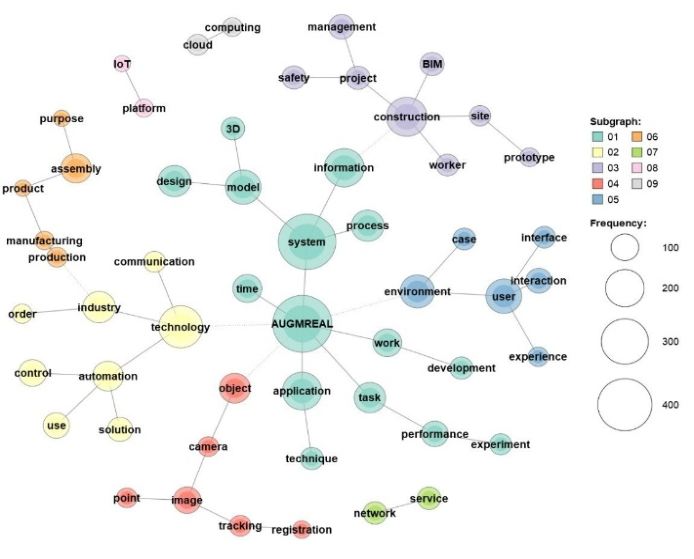
The AR domain may boast a large number of publications, which however complicates the state-of-the-art description in every particular case, espe- cially while identification of knowledge gaps. We overcame this problem by using the automatic bibliometric analysis2, focusing on papers with industrial application of AR technologies and omitting other irrelevant fields of knowl- edge. We also narrowed our search to research and development (R&D) trends, technologies, and solutions. Approximately 300 entries (90% of those published after 2015) were extracted from several search engines (mainly Scopus and Web of Science) and consequently were analyzed by KH Coder software. For the whole domain3 (see Figure 1) we observed a link between augmented reality and 3D model design, automation solutions, construction projects, image tracking, and user interaction environment. Manufactur- ing and product assembly are detached from the core node, thus indicating weaker connection and lack of scientific research and publications in this common area, despite a large number of projects (e.g., at Fraunhofer Society or Rolls-Royce). Topics such as network service, IoT, and cloud computing are located in the peripheral area and may indicate some possible research gaps.
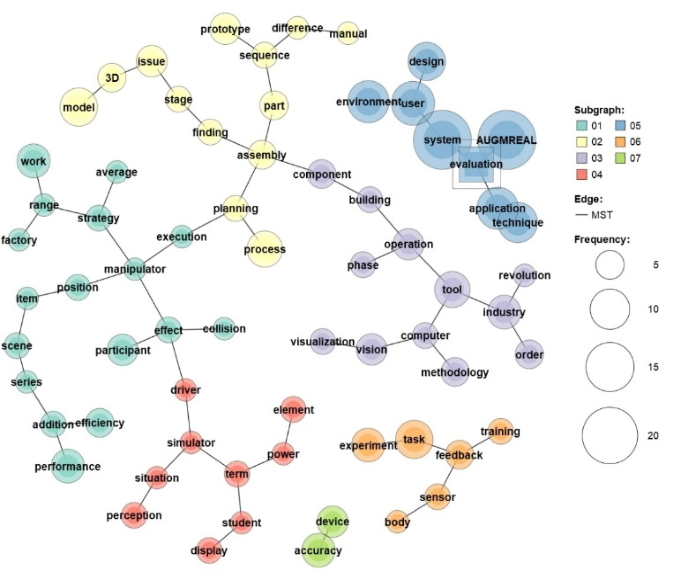
By looking closely at more detailed topics such as AR planning, AR eval- uation and prediction of AR results we may point out a poor connection in the scientific literature (see Figure 2); in fact, forecasting techniques were mentioned in just 15 articles, but rather in general discussion considering possible ways to roughly predict the technical trends and further tasks to be solved by AR (Dalim, et al., 2017; Ahmed, 2019; Bottani & Vignali, 2019; Boboc, et al., 2020). Furthermore, bibliographic analysis did not find any link to the particular methods (like KPI-based predicting of assembly or mainte- nance time); a manual screening revealed only few papers discussing the way to match the costs and benefits of AR solutions’ implementation (Palmarini, et al., 2018; Jetter, et al., 2018; Schumacher & Sihn, 2020; Alam, et al., 2021), neglecting regretfully the profitability aspect. Hence, the ability to implement the AR is low supported by the rele- vant forecasting and planning methods in the up-to-date scientific literature. This important theoretical background, however, may be an obstacle to the further adoption of AR solutions in the industrial sector, as long as firms would like to pre-estimate the output value of potential investments. Such model-based planning and AR forecasting systems will also allow, accord- ing to the required task, to determine the number of resources required for R&D and ensure the ability to reproduce the experimental results by external researchers of AR with similar input parameters.
2Bibliometric analysis is a graph theory analysis showing, in particular, keyword relationships between fields of study. 3Different research fields and related nodes (definitions) are grouped within several subgraphs displayed by different colours in the co-occurrence network. AUGMERAL stands for core node augmented reality and substitutes all similar definitions in the analysed text corpus.
Figure 1: AR in the industry - most popular research areas.Figure 2: Co-occurrence between publications in the topics methods of planning, evaluation, prediction of results and the domain of AR technology.
Development of the Model-Based Planning System for Augmented Reality 139
MOTIVATION The area of automation appears to be relatively broad, so this research focuses on industrial plant maintenance (IPM). The motivation for this choice is based on articles and existing reviews (Illanes, et al., 2018; Bichia, 2020; Isac, et al., 2020) mentioning an existing problem of both obtaining new knowledge and re-training of employees in automation and in mod- ern industry in general. This is especially actual for the maintenance and error correction for the industrial plants. Modern industry requires highly skilled professionals (Saniuk, et al., 2021; Shafeek, 2018), while the person- nel already involved in the process often needs qualification improvement to begin operating the new equipment types and tools quickly. Consequently, it seems to be desirable to implement the AR assistant staff training inside the production processes to achieve a profitable combination (Bottani & Vignali, 2019; Lehmann, et al., 2021). Therefore, the necessity to plan this process becomes obvious.
Another reason to select this research area is the amount of the previ- ous project-related studies and articles (Berger, et al., 2016; Bilous, et al., 2021; Bilous, et al., 2022; Bilous & Sarachuk, 2023) in the department of automation at the BTU university, during which six new AR applica- tions were developed. These mainly acted as interactive assistant system for the plant maintenance. These projects provided a sufficiently broad amount of scientific information about the factors influencing the develop- ment of AR in IPM and will provide the necessary background for the MBPS development.
MBPS DEVELOPMENT OUTLINE AND ITS TASKS A model-based planning system for AR in IPM should be able to analyze the factors influencing the development, implementation, and further usage of augmented solutions, as well as the efficiency of this process (the ratio of resources spent with respect to the benefits obtained). In this way, it should not only be possible to identify the main factors of such influence, but also to find their scientific validity and define their theoretical background. The model should also be able to determine the weight of each main input parameter for the final output.
Figure 3: A simple scheme of inputs and outputs for AR development.
The basic process of AR development and implementation is depicted on the Fig. 3. A full collection of the factors influencing the AR development as well as the required investments and resources will be defined in this project’s
scope as inputs; the benefits of solving particular task with AR compared to other conventional solutions will be denoted as outputs or results, similar to other studies that review and analyze the factors influencing AR in education (Dalim, et al., 2017), retail (Bonetti, et al., 2018; Perannagari & Chakrabarti, 2019), industry (Pentenrieder, et al., 2007; Alam, et al., 2021; Harikrishnan, et al., 2021), medicine (Eckert, et al., 2019), etc.
Based on the own experience in development and implementation of the AR systems and similar experiences for industrial software in general and for the IPM cases (Kerzner, 2022; Schumacher & Sihn, 2020), we define the following main tasks of the proposed MBPS.
Direct task (DT): With a certain pre-defined task is to be solved with the help of AR and applying the given resources (time, financial means, and other inputs), it is required to determine the feasibility of using the AR technology and – if the decision is positive – to calculate the related profits. For exam- ple, suppose that an industrial plant or a laboratory unit requires certain staff actions to start, stop or perform a particular production task (such as switch- ing from automatic to manual mode and back). Time, machinery, financial resources, personnel, competences that can be used to develop an AR appli- cation visualizing the instructions and guidelines for this task are known. Then, the usage of MBPS should provide an indication of the feasibility of the implementation of AR there and the possible benefits, e.g., reduction of staff training time for the tasks described above.
Inverse Task (InT): Here, the type and values (exact or within certain lim- its) of the required outputs are initially given, while corresponding AR inputs need to be determined. This includes not only the calculation of necessary costs, time, and personnel, but also the selection of the development methods, the estimation of necessary competences, and the identification of influenc- ing factors that may critically affect the project. An example of the InT could be the requirement to reduce the downtime of a particular unit when chang- ing certain components. Then, a formal planning of the development and implementation of an AR application for this task is required, defining the above AR inputs. A comparison of the theoretically calculated values with the actually available ones will allow to identify the missing resources and to take relevant actions.
Mixed Task (MT): Considering this option, the AR inputs and AR out- puts are partially known. As a result, the MBPS task implies the estimation and optimization of the values and ranges of the unknown variables for the subsequent successful development and implementation of the particular AR solution.
We suppose that exactly the MT will be demanded the most in practice, while DT and InT would be of more theoretical interest and will provide more basic knowledge. However, the Department of the Automation at BTU with a number of laboratory facilities has already developed several AR mainte- nance applications for the majority of its units, documenting both AR inputs and outputs during the development and test phases (see previous project documented in (Bilous, et al., 2021). Thus, MBPS will be primarily tested and adjusted with the DT and the InT.
Development of the Model-Based Planning System for Augmented Reality 141
CONCEPTUAL SCHEME OF THE MBPS FOR AR There are several schemes for developing a model-based planning system for solving particular problems in industry and in business. The most com- prehensive concept was proposed by (Kosiol, 1962), further developed in (Pfohl, 1998; Bleicher, 1992; Bleicher, 2013) and continuously transformed and applied in (Schierenbeck & Wöhle, 2016; Thommen, et al., 2017). The scheme was originally used for business process organization, but it has also been applied to industry (see for example (Lasisz, 2016).
The proposed approach divides the model into a structural organization level and a process structure level, namely system structure describing the project’s units (SyS) and process structure (PrS). The most important starting point is the partition of the main task into local subtasks (task clustering), and the selection of the resources for their solution (Kosiol, 1962). The process structure describes the course of operational events; the realization, implementation, or execution of the functions for which the supply has been created (Gaitanides, 2013). Thus, the focus is on the process of exploiting the capacity, resources, and elements that have been created in the SyS.
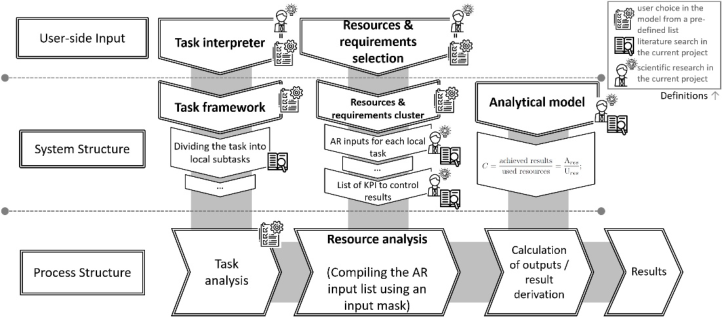
Based on the above-mentioned fundamental studies of planning systems development and considering their further extension in the respective articles, we propose the following general concept of the MBPS for AR in automation (Fig. 4). In addition to the structural and process organization, a new level has been added, marked as the user-side input (USI). The application of the developed MBPS implies the introduction of a wide number of parameters (the whole scope of AR inputs – resources, factors, etc.). Thus, it is reasonable to allocate a separate structure where the user or the researcher can select, for example, the standard sub-tasks for AR or the resources for them using decision trees or clustered tables. Therefore, the basic structure of the MBPS developed in the current project consists of three main blocks.
Task Framework (TF): After the definition of the task for the future AR development, it is divided into subtasks. For example, some common steps of the AR project development like the preparation of the AR elements, shaders, textures, the development of the interaction logic between the AR elements, the selection, or the development of a data transfer system between PLC and AR application, etc. could be regarded as the standard subtasks for the AR system development. The USI for this SyS block includes a list of pre-defined subtasks and a user defined sub-task entry form. The TF and its USI can be developed primarily based on the analysis of the scientific literature and existing projects.
Resources & requirements cluster (R&R): This block contains the list of the necessary resources and requirements that are essential for solving the subtasks of the overall AR task. The R&R cluster also includes the list of key performance indicators (KPIs) to monitor the results of the task solution using the AR. The selection of elements and KPIs in the USI for R&R can be organised using morphological tables and decision trees. The research and development of R&R and its USI starts with a comprehensive analysis of the research papers which use or/and determine the KPI for AR in IA, like (Schu- macher & Sihn, 2020; Kerzner, 2022). Then, it will be essential to assemble
Figure 4: Model-based planning system for AR (MBPS) - conceptual scheme of the model.
the full scope of the AR resources and requirements to enable the usage of such KPIs. This will be based, in particular, on the projects of the department of the current studies authors, like (Le, et al., 2016; Zou, 2018; Kilimis, et al., 2019; Bilous, et al., 2021). Finally, the latter will be compiled into a R&R system.
Analytical model (AM): This block implements a mathematical tool to pro- cess and analyse the numerical values of the elements selected or generated in the R&R, considering the subtasks from the TF. The main objective is the derivation of the model result, namely the conclusion of the feasibility (or necessity) of applying the AR to the original problem. A local task could be, for example, the evaluation of the overall efficiency as a ratio of the resources spent to the results obtained.
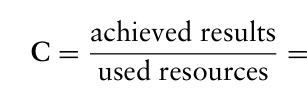
The analytical model is the most important and comprehensive part of MBPS. In a generalized way, the efficiency (C) of the AR solution can be defined as:
res + AE
= AT
; (1)
Equation reproduced from the original PDF.
used resources =
P Ares P Ures
res UIres + UD res where achieved results (Ares) is the cumulative numerical representation of the entire benefit from the implementation of AR4 (outputs) and used resources (Ures) is the cumulative numerical representation of the resources spent on developing and implementing the AR technology5.
However, this is a very basic mathematical representation considering only two AR inputs, and two AR outputs, while a more detailed description will be possible after a holistic analysis of all contributing factors, and must be refined in our further studies. This will include, first, a detailed analysis of the 4For instance, time and cost reduction; in this example this value can presented as the sum of reduced training time ATres, and reduced equipment downtime AEres. 5For instance, costs, developing time, the knowledge and skills required from the developers etc. (or AR inputs). In our example, it is calculated as the sum of implementation UIres and development costs UD res.
Development of the Model-Based Planning System for Augmented Reality 143
existing components of each value presented in this relationship to expand the number of variables. Research and tests on the developed AR applications will allow the selection of appropriate dimensions (man-hours, percentages, cost per hour, etc.) and determine the relevance (weight) of each element of this equation.
The usage of the MBPS for AR planning should start with the user util- ising the appropriate USI to select the type of task in TF and split it into subtasks (task analysis). Then, the R&R cluster, the resources for subtasks from TF and KPIs to control the results will be chosen (resource analysis). After that, the values of the known parameters will be specified, and the unknowns to be found or estimated will be marked. Then, the calculation will start. The AM will show if the unknown parameters can be calculated using the information entered and, if so, derive these. Thus, the TF and R&R cluster represent the AR inputs, and MBPS results are the AR outputs from the Fig. 3.
CONCLUSION
The concept of the model-based planning system presented in this paper is a framework for planning the development and implementation of an AR solu- tion for a particularistic task in automation. It should be able to analyze the factors that influence the development, implementation, and further usage of AR, as well as the efficiency of this process (the ratio of resources spent with respect to the benefits obtained). In this way, it should not only be possible to identify the main factors of such influence, but also to find their scientific validity and define their theoretical background. The model should also be able to determine the “weight” of each main input parameter for the final output.
As mentioned above, the model-based planning system for AR showed in the current article is presented, first, in the form of a conceptual scheme. The main blocks of the model require furthermore in-depth processing. It relates, first of all, to further expanding and developing the analytical model block. This will be provided with the further assembly of the information on the resources and results of already implemented AR projects, includ- ing the authors of the current article and his colleagues (Le, et al., 2016; Zou, 2018; Kilimis, et al., 2019; Bilous, et al., 2021; Sarachuk, et al., 2020). The compiling of the collected AR inputs and outputs will be based primarily on the mathematical methods like nonlinear PCA and manifold learning. This can be a simple mathematical framework which does not include every selected variable initially. Later, during developing of new AR applications, the AM will be tested, refined, and become more complex. An important aspect here will be the estimating which AR inputs and AR outputs and which of their coefficients are applicable locally (for example, only for IPM or for VAP), and which are relevant to the automation in gen- eral. This information will be systematised in the form of tables. Further, this data can be used for scientific analysis of AR application in particular tasks.
REFERENCES
Ahmed, S., 2019. A review on using opportunities of augmented reality and virtual reality in construction project management. Organization, Technology and Man- agement in Construction: An International Journal, Volume 11, pp. 1839–1852. Alam, S. S. et al., 2021. Factors affecting augmented reality adoption in the retail
industry. Journal of Open Innovation: Technology, Market, and Complexity, Volume 7, p. 142. Berger, U., Bilous, V. & Andulkar, M., 2016. Anwendung von der Augmented Reality für die Mensch-Roboter Interaktion bei der Fehlerbeseitigung und bei der Maschi- nenbedienung. 3D SENSATION-transdisziplinäre Perspektiven, pp. 37–38. Bichia, Q., 2020. Accelerated Automation and the Ecosystem of Adaptation to the
Changes. Globalization & Business. Bilous, V., Kudelina, L. & Staedter, P., 2021. Modular-Designed AR Application for Improved Human-Machine Interaction and Real-Time Error Correction in Laboratory Units. Available at SSRN 4084049. Bilous, V., Porsch, R. & Spanoudakis, K., 2022. Augmented Reality: Increasing
Availability and Its Implication for SMEs. s.l., Springer, pp. 349–356. Bilous, V. & Sarachuk, K., 2023. Can small and medium enterprises benefit from AR technology? Current challenges and trends. s.l., s.n. Bilous, V., Städter, J. P., Gebauer, M. & Berger, U., 2022. Usage of Augmented Real-
ity for Improved Human-Machine Interaction and Real-Time Error Correction of Laboratory Units. Annals of Scientific Society for Assembly, Handling and Industrial Robotics 2021, p. 263. Bitforge, 2019. Augmented Reality offiziell kein Hype mehr, s.l.: s.n. Bleicher, K., 1992. Der Strategie-, Struktur-und Kulturfit Strategischer Allianzen als Erfolgsfaktor. In: Wegweiser für strategische Allianzen. s.l.: Springer, pp. 266–292. Bleicher, K., 2013. Organisation: Strategien—Strukturen—Kulturen. s.l.: Springer-
Verlag. Boboc, R. G., Gırbacia, F. & Butil˘a, E. V., 2020. The application of augmented reality in the automotive industry: A systematic literature review. Applied Sciences, Volume 10, p. 4259. Bonetti, F., Warnaby, G. & Quinn, L., 2018. Augmented reality and virtual reality in
physical and online retailing: A review, synthesis and research agenda. Augmented reality and virtual reality, pp. 119–132. Bottani, E. & Vignali, G., 2019. Augmented reality technology in the manufacturing industry: A review of the last decade. Iise Transactions, Volume 51, pp. 284–310. Dalim, C. S. C. et al., 2017. Factors influencing the acceptance of augmented reality
in education: A review of the literature. Journal of computer science, Volume 13, pp. 581–589. Devagiri, J. S. et al., 2022. Augmented Reality and Artificial Intelligence in industry: Trends, tools, and future challenges. Expert Systems with Applications, p. 118002. Eckert, M., Volmerg, J. S., Friedrich, C. M. & others, 2019. Augmented reality
in medicine: systematic and bibliographic review. JMIR mHealth and uHealth, Volume 7, p. e10967. Gaitanides, M., 2013. Prozessorganisation: Entwicklung, Ansätze und Programme des Managements von Geschäftsprozessen. s.l.: Vahlen. Glover, J. & Linowes, J., 2019. Complete Virtual Reality and Augmented Real-
ity Development with Unity: Leverage the power of Unity and become a pro at creating mixed reality applications. s.l.: Packt Publishing.
Development of the Model-Based Planning System for Augmented Reality 145
Gómez-Puerta, M. et al., 2019. Research review on augmented reality as an educational resource for people with intellectual disabilities. International Journal of Developmental and Educational Psychology, pp. 473–485. Grand_Review_Research, 2021. Augmented Reality Market Size, Share & Trends
Analysis Report By Component, By Display (HMD & Smart Glass, HUD, Handheld Devices), By Application, By Region, And Segment Forecasts, 2022–2030. [Online] Available at: https://www.grandviewresearch.com/industry- analysis/augmented-reality-market Harikrishnan, A. et al., 2021. Feasibility of augmented reality technology for communication in the construction industry. Advanced Engineering Informatics, Volume 50, p. 101363. Herdina, M., 2020. Augmented Reality Disappeared From Gartner’s Hype Cycle –
What’s Next?, s.l.: s.n. Illanes, P. et al., 2018. Retraining and reskilling workers in the age of automation.
McKinsey Global Institute. Isac, N., Dobrin, C. & Badshah, W., 2020. The Impact of Sustainable Transition of Automation on Employees in the Automotive Sector and the Influ- ence of Corona Pandemic. Review of International Comparative Management, Volume 21, pp. 429–436. Jalo, H., Pirkkalainen, H. & Torro, O., 2021. The State of Augmented Reality, Mixed
Reality and Virtual Reality adoption and use in European small and medium- sized manufacturing companies in 2020: VAM Realities Survey Report. s.l.: VAM Realities Erasmu project. Jetter, J., Eimecke, J. & Rese, A., 2018. Augmented reality tools for industrial applications: What are potential key performance indicators and who benefits?. Computers in Human Behavior, Volume 87, pp. 18–33. Kerzner, H., 2022. Project management metrics, KPIs, and dashboards: a guide to
measuring and monitoring project performance. s.l.: John Wiley & Sons. Kilimis, P., Zou, W., Lehmann, M. & Berger, U., 2019. A survey on digitalization for SMEs in Brandenburg, Germany. IFAC-PapersOnLine, Volume 52, pp. 2140–2145. Kim, J. et al., 2019. A study on the application of packaging and augmented reality as
a marketing tool. Korean Journal of Packaging Science & Technology, Volume 25, pp. 37–45. Kosiol, E., 1962. Strukturierung und Organisation. In: Organisation der Unternehmung. s.l.: Springer, pp. 19–20. Lasisz, A., 2016. Optimization of Quality Assurance-and Control Activities within the Supply Process in Plant Engineering and Construction, s.l.: s.n. Le, D. T. et al., 2016. Self adaptive system for flexible robot assembly operation. s.l.,
s.n., pp. 1–5. Lehmann, M. A., Porsch, R. & Mai, C., 2021. Assembly Process Digitization Through Self-learning Assistance Systems in Production. In: Towards Sustain- able Customization: Bridging Smart Products and Manufacturing Systems. s.l.: Springer, pp. 216–223. Madsen, O. et al., 2022. The future of smart production for SMEs: A methodological
and practical approach towards digitalization in SMEs. s.l.: Springer. Markets_and_Markets, 2020. Augmented Reality and Virtual Reality Market with COVID-19 Impact Analysis by Offering (Hardware & Software), Device Type (HMD, HUD, Gesture Tracking), Application (Enterprise, Consumer, Com- mercial, Healthcare), and Geography - Global Forecast to 2025. [Online]. Available at: https://www.marketsandmarkets.com/Market-Reports/augmented- reality-virtual-reality-market-1185.html
Mishra, A., Karmakar, S., Bose, A. & Dutta, A., 2020. Design and development of IoT-based latency-optimized augmented reality framework in home automation and telemetry for smart lifestyle. Journal of Reliable Intelligent Environments, Volume 6, pp. 169–187. Palmarini, R., Erkoyuncu, J. A., Roy, R. & Torabmostaedi, H., 2018. A systematic
review of augmented reality applications in maintenance. Robotics and Computer- Integrated Manufacturing, Volume 49, pp. 215–228. Palomäki, E., Stigzelius, E. & Vartiainen, M., 2010. State of the art – Overview of new applications, practices and concepts in utilizing technology in education, their use in work contexts, global/local aspects for multichannel online services Contents. BIT Research Centre. Pentenrieder, K., Bade, C., Doil, F. & Meier, P., 2007. Augmented Reality-based
factory planning-an application tailored to industrial needs. s.l., s.n., pp. 31–42. Perannagari, K. T. & Chakrabarti, S., 2019. Factors influencing acceptance of augmented reality in retail: insights from thematic analysis. International Journal of Retail & Distribution Management. Pfohl, H. C., 1998. Logistics systems. The faculty of ILiM, Pozna´n. Prinsloo, T. & Van Deventer, J. P., 2017. Using the Gartner Hype Cycle to evaluate
the adoption of emerging technology trends in higher education–2013 to 2016. s.l., s.n., pp. 49–57. Rajkumar, A., Ebenezer, H., Snegdha, A. & Goyal, C., 2020. Augmented reality in aerospace engineering real-time application of AR iOS applications. Materials Today: Proceedings. Safi, M., Chung, J. & Pradhan, P., 2019. Review of augmented reality in aerospace
industry. Aircraft Engineering and Aerospace Technology. Saniuk, S., Caganova, D. & Saniuk, A., 2021. Knowledge and skills of industrial employees and managerial staff for the industry 4.0 implementation. Mobile Networks and Applications, pp. 1–11. Sarachuk, K. & Mißler-Behr, M., 2020. Is ultra-broadband enough? The relationship
between high-speed internet and entrepreneurship in Brandenburg. Int. J. Tech., Volume 11, pp. 1103–1114. Sarachuk, K., Missler-Behr, M. & Hellebrand, A., 2020. Ultra-High-Speed Broadband Internet and Firm Creation in Germany. s.l., s.n., pp. 40–56. Schierenbeck, H. & Wöhle, C. B., 2016. Grundzüge der Betriebswirtschaftslehre. In:
Grundzüge der Betriebswirtschaftslehre. s.l.: De Gruyter Oldenbourg. Schumacher, A. & Sihn, W., 2020. Development of a monitoring system for implementation of industrial digitalization and automation using 143 key performance indicators. Procedia CIRP, Volume 93, pp. 1310–1315. Shafeek, H., 2018. The role of staff skills in lean maintenance. Journal of Computa-
tional and Theoretical Nanoscience, Volume 15, pp. 1332–1339. Statista, 2022. Size of the global industrial automation market from 2020 to 2025 (in billion U. S. dollars). [Online] Available at: https://www.statista.com/statistics /1219772/industrial-automation-market-size-worldwide/ Technavio, 2021. Augmented Reality and Virtual Reality Market by Tech- nology and Geography - Forecast and Analysis 2021–2025. [Online] Avail- able at: https://www.technavio.com/report/augmented-reality-and-virtual-reality -market-industry-analysis Tejedor-Calvo, S., Romero-Rodríguez, L.-M., Moncada-Moncada, A.-J. & Alencar-
Dornelles, M., 2020. Journalism that tells the future: possibilities and journalistic scenarios for augmented reality. Profesional de la información, Volume 29.
Development of the Model-Based Planning System for Augmented Reality 147
Thommen, J.-P. et al., 2017. Grundlagen der Organisation. In: Allgemeine Betriebswirtschaftslehre: Umfassende Einführung aus managementorientierter Sicht. Wiesbaden: Springer Fachmedien Wiesbaden, pp. 433–445. Wiedenmaier, S., Oehme, O., Schmidt, L. & Luczak, H., 2001. Augmented reality
(AR) for assembly processes-an experimental evaluation. s.l., s.n., pp. 185–186. Zou, W., 2018. Entwicklung eines Systems für das Programmieren durch Vormachen unter Nutzung der Augmented Reality für roboterbasierte Montagesysteme. s.l.: Shaker Verlag. Zou, W., Andulkar, M. & Berger, U., 2018. Development of Robot Programming
System through the use of Augmented Reality for Assembly Tasks. s.l., s.n., pp. 1–7.
LISTED IN THE AHFE DIGITAL BOOKSTORE CATALOGUE
Explore the complete digital volume
Augmented, Virtual and Mixed Reality Simulation
Read this individual research paper free through the original publisher, or explore the full digital proceedings book.
ISBN 978-1-958651-94-0
Explore this ISBN in the AHFE Bookstore ↗Listed in the July 2026 bookstore catalogue; search by ISBN to confirm current availability · Digital book purchase optional