Judith Josupeit (2023). Does Pinocchio Get Cybersickness? – The Mitigating Effect of a Virtual Nose on Cybersickness. In: Augmented, Virtual and Mixed Reality Simulation. AHFE Open Access, vol. 118. https://doi.org/10.54941/ahfe1004445
Virtual reality (VR) has many applications. However, not all users can enjoy them equally due to cybersickness, a form of visually induced motion sickness in VR. To increase the accessibility of VR, countermeasures against cybersickness are needed. The requirements for a good countermeasure are a reasonable effect size, especially since susceptibility varies between individuals, while reducing immersion as little as possible. One idea that seems to meet these requirements, the virtual nose, has been tested with small samples – from which large effect sizes can be derived – and allows universal applicability. The mode of action of the virtual nose derives from the rest frame hypothesis: Certain objects that are perceived as stationary serve as a rest frame, facilitating the self-calibration of the body. In addition, the rest frame may not only act as a postural corrector, which should be observable by a reduction of postural sway, but also as a fixation cross, which should be observable by longer and more frequent fixations. This study tested whether a virtual nose (treatment group) significantly reduced cybersickness compared to a group without a virtual nose (control group) and whether physiological process indicators, namely head and eye tracking, differed between the groups with a larger sample size than previous studies. Participants were matched into the treatment and control group according to their gender and previous VR experience, as these aspects are discussed to influence cybersickness susceptibility. Experience groups were divided into three: none, less than 30 min of VR experience, and more than 30 min. A total of 124 participants were recruited, of which 110 were eligible for the analyses (multivariate repeated measures analysis and Holm-corrected univariate post-hoc tests). During the VR exposure, the participants’ task was to explore a virtual city and collect checkpoints. The questionnaires used were the Virtual Reality Sickness Questionnaire (VRSQ) for a pre-post-comparison and the Misery Scale (MISC) applied every 2 min during the VR exposure. The continuously sampled process indicators were cut into these fixed 2-minute intervals for the analyses. The results show no mitigating effect of the treatment. Nevertheless, the reported cybersickness was significantly lower in the more experienced group and significantly higher in the inexperienced group compared to the low-experienced group. The process indicators head and eye tracking mostly confirm the mitigating effect of previous VR experience on cybersickness susceptibility but do not differ between the treatment and control group. It can be argued that the artificiality of a virtual nose that is added to a scene nullifies the mitigating effect by reducing immersion. It may also be that the stimulus needs to be more salient to be effective. In summary, prior experience with VR was the mitigating factor. As the process indicators and the controller input differ, one explanation could be a behavioral adaptation with increasing VR experience. Alternative explanations, such as a gender- or experience-specific pre-selection effect for VR studies, are discussed.
INTRODUCTIONImmersive technologies alter the perception of reality, thus a variety of fields profit from them (e.g. training, prototyping, or leisure). One of these immersive technologies is virtual reality (VR) in which a computer-generated, three-dimensional, head-based rendering is applied. As rendering becomes more realistic and head-mounted displays (HMD) are getting affordable and light, VR is becoming widely accessible. Nevertheless, for some individuals VR has an accessibility problem: Some individuals experience discomfort, headache, or nausea; symptoms that can be subsumed under the term cyber- sickness (LaViola Jr, 2000), a shorter term for visually induced motion sickness (VIMS) in VR.
To improve upon the user experience and accessibility of the technol- ogy countermeasures against cybersickness are necessary, not only from a commercial point of view, but also for reasons of user safety. Current ideas suggest a seated VR experience, which reduces the perception of embodiment (Zielasko and Riecke, 2021), or using the more artificial locomotion of tele- portation instead of a constant acceleration (Clifton and Palmisano, 2020). In addition, a congruent internal and external field of view can reduce symptoms (Bos et al., 2010). However, this may be complicated to achieve in visually complex scenes. Another countermeasure concept deploys a virtual nose. A virtual nose can be assessed as beneficial, because it is applicable to all kinds of VR environments (Whittinghill et al., 2015, Wienrich et al., 2018), without constraining the degrees of freedom in the VR setup for the user or the com- plexity of the scene. Although the preliminary results show decreased abort rates for the group with a virtual nose, up until now large-scale laboratory studies are still lacking.
Even though the virtual nose adds artificiality to VR - unless we are volun- tarily squint-eyed we do not perceive our own nose - it might serve as a rest frame. According to the rest frame hypothesis, certain objects are perceived as stationary, e.g. walls in a room. These objects are used as reference frames - or from the perspective of the observer rest frames – to reduce the computa- tional costs of spatial calibration (Prothero and Parker, 2003). A laboratory study found a significant reduction in cybersickness when allocentric refer- ence frames were displayed (Nguyen-Vo et al., 2018). If the virtual nose is used as a reference frame for spatial calibration, postural stability should be enhanced. To sample the postural stability without any additional equipment the HMD’s built-in sensors for position tracking are used. Moreover, the vir- tual nose might not only serve as an egocentric reference frame, but also as a fixation cross. A stabilized gaze has efficiently reduced VIMS in previous studies (Nooij et al., 2017). Thus, fixation metrics might also differ between the treatment and the control group.
METHODSampleA total of 122 participants volunteered for this study. As the pre-specified criterion for discontinuation was reached (see next section), five participants had to be excluded from the final analysis. In addition, one participant had to be excluded due to inconsistent adherence to the experimenter's protocol. Furthermore, three did not reach the predefined logMAR values (0 <). Moreover, due to experimenters’ errors, two datasets were missing and another dataset was missing because of technical malfunctions of the hardware.
Of the remaining 110 participants, were 51 male and 59 female. With regard to their previous experience with VR, 51 had none, another 39 had less than 30 min and 20 subjects had at least 30 min. Age ranged from 18 to 64 years (M = 23.8 years, SD = 5.7). Participants were recruited via notices and available flyers on campus and via the participants’ database of the central experimental server of the Technical University of Dresden (ORSEE3). For safety reasons, participants were excluded if they were underage ( ≤ 17 years), had epilepsy, or a history of migraine (Martins da Silva and Leal, 2017), were pregnant, and/or had visual impairments. Participants should refrain from eating 2 hr before their session.
The participants’ demographic and experimental data were analyzed in an anonymized and aggregated form. The study adhered to the ethical guidelines of the Declaration of Helsinki and was approved by the local ethics committee (SR-EK-315072020). MaterialsAs VR hardware the HTC Vive (HTC, Taiwan, China, and Valve, Belle- vue, WA, USA) was used. For eye tracking, the Pupil Labs add-on (Pupil Labs, Berlin) was attached to the HMD. The HTC Vive infrared lighthouses, which track the position of the HMD and trackpad, were securely installed diagonally across the room, allowing for a virtual room of 3.42 × 5.42 m, sufficient for room-scale VR. A custom-built computer with an NVIDIA GeForce RTX 2070 GPU, Intel Core i7-9700K CPU and 32GB (2x16GB) RAM was used to render the VR environment. The game engine used was Unity Professional (v 2019.1.1.1f1) with the Steam VR plugin. Additionally, the Winridge City asset and the Pupil Labs plugin hmd.eyes 1.3 were used. The open-source software that enabled eye tracking was Pupil Labs software Pupil Capture (v 2.4). Some simple custom objects were created using Blender (v 2.92.0).
Visual acuity was assessed using the Freiburg Acuity Test (FrACT, v 3.10.5) with an exclusion criterion of logMar < 0 (Bach, 2007, Bach, 2021). The FrACT was displayed on a second laptop (Lenovo Thinkpad E580) with a 15.6-inch screen diagonal with an observer distance of 1.6 m.
The Virtual Reality Sickness Questionnaire (VRSQ, Kim et al., 2018), an adaptation of the well-established Simulator Sickness Questionnaire (Kennedy et al., 1993) that focuses on the symptoms of cybersick- ness was applied for the Baseline/Post-VR comparison. Although cyber- sickness is multidimensional, multidimensional questionnaires are too intrusive to administer repeatedly during VR exposure. Therefore, as a single-item scale, the Misery Scale (MISC, Bos et al., 2006) was deployed with a predefined abort criterion of MISC > 6 (Kuiper et al., 2019).
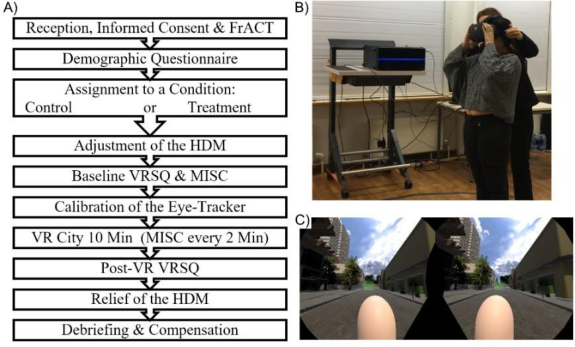
ProcedureFor a quick overview, the reader is referred to the procedure flowchart (Figure 1 A); general information regarding the eye tracking setup is described in Josupeit (2023). After reception and informed consent, the par- ticipants’ visual acuity was tested. If they showed at least standard vision, participants were asked a demographic questionnaire. Since gender and pre- vious experience are two factors that are discussed to influence cybersickness susceptibility (Rebenitsch and Owen, 2014), any countermeasure should take these into account. Therefore, participants were matched to the treat- ment or the control group according to their responses in the demographic questionnaire in order to counterbalance potential moderating effects. Pre- vious experience had 3 levels: none, less than 30 min, and at least 30 min in VR, while gender had 2 levels: male or female, non-binary participants would have been matched to a third group, but this procedure was not necessary.
Because the USB connector cable of the eye tracker was quite short, the computer was mounted on a wheeled lectern for a greater range of motion (see Figure 1 B). After the experimenter fitted the HMD, the calibration rou- tine adapted from the Pupil Labs plugin was presented in a gray room. After a successful calibration, a VR city was displayed (see Figure 1 C). The participant’s task in the city was to move around virtually using “magic carpet locomotion”. This means that rotational motion was derived from head rotation, while translational motion was generated by controller input. For forward locomotion the participant held the upper part of the trackpad pressed; for backward locomotion the lower part. To gamify the VR appli- cation the participant’s task was to collect checkpoints along the way. As a cover story, visual-spatial orientation was told to be tested. Every 2 min par- ticipants were asked the MISC to ensure that the participant was capable to continue. After 10 min the gray room was displayed once again to measure potential aftereffects on postural stability and capability of visual fixation. Moreover, the VRSQ was asked a second time. Then the participants were relieved from the HMD. Thereafter, the experimenter debriefed and compen- sated them with either course credit or 5€. In total, the experiment lasted approximately 30 min. DesignBecause the countermeasure (virtual nose) was easily perceived, a between- subjects design was necessary to reduce the expectancy effect that could lead to false positives. The 2x2x3 repeated measures (2 times VRSQ or 5 times MISC) design contained the randomized between-subjects factor virtual nose (treatment or control group) and the matched factors gender (male or female) and previous experience with VR (none, less than 30 min or at least 30 min of experience).
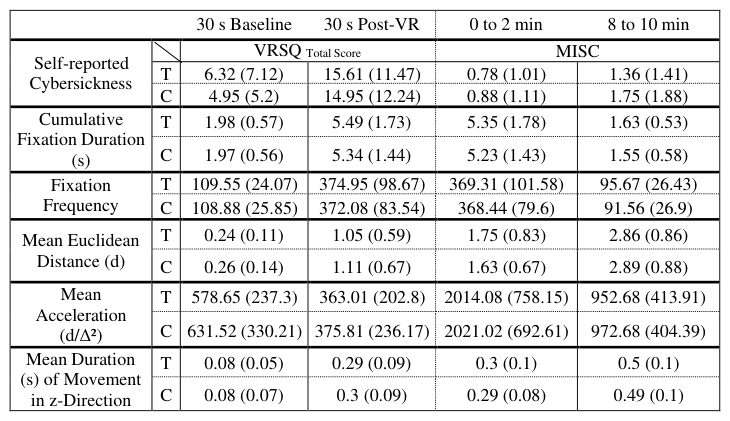
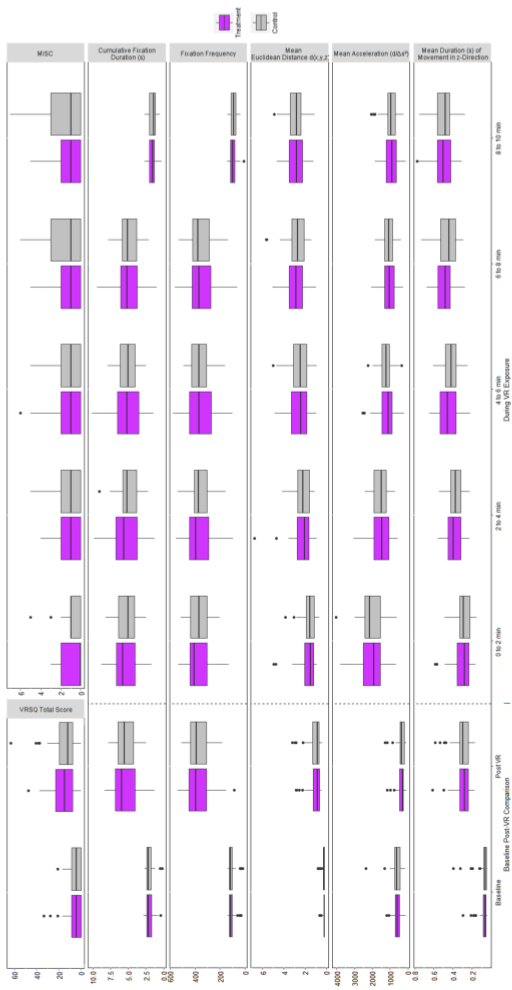
Figure1: A) Experimental procedures.B) Staged experimentalsetupwiththe computer ona wheeled lectern.C)In- game screenshotmimickingtheVR googles of the HTCVive withthevirtualnose(treatmentgroup)anda virtual checkpointfar ahead represented by the green glowing circularplane.RESULTSDataPreprocessingA VRSQ total score was calculated according to the manual (Kim et al., 2018). The fixation duration and fixation frequency were derived from the dispersion-duration-based fixation detector implemented in the Pupil Labs software Pupil Player (v 2.4) with the default settings. The confidence level was set to .6. The continuously sampled head and eye tracking data were cut into 7 intervals for the analysis. For the Baseline/ Post-VR comparison, the first 30 s in the gray room were used. During VR, the process indicators were cut into 5 intervals of 2 min each, according to the experimenter’s MISC queries, beginning with the participant’s first controller input registered. DescriptiveStatisticsFor a detailed illustration of the descriptive statistics, the reader is referred to Figure 2. Additionally, Table 1 shows a comparison of several descriptive statistics for the Baseline/Post-VR comparison and the first and the last inter- val during VR exposure. Self-reported cybersickness was right-skewed and gradually increased over time in both groups, regardless of the questionnaire used (VRSQ Total Score; MISC).
As for the cybersickness ratings, the cumulative fixation duration (s) and the fixation frequency were decreasing during the VR exposure in both groups. This trend is in contrast to the Baseline/Post-VR comparison, which might be due to the lack of visual input in Post-VR.
Of the postural stability measures, mean Euclidean distance and derived acceleration both used all three linear degrees of freedom. In line with the formula, the linear trend of the Baseline/Post-VR and the changes during VR exposure suggest a reciprocal pattern for these metrics: An increase in the mean Euclidean distance; along with a decrease in the mean acceleration. Although the last indicator of postural stability, the mean duration of the movement in z-direction (s) i.e., forward and backward movement, uses only one degree of freedom, the increasing trend for this metric is in parallel to the first two metrics on postural stability. InferenceStatisticsIn line with the descriptive statistics, tests for multivariate non-normality revealed that non-parametric tests should be applied for the statistical anal- yses. The global model for the Baseline/Post-VR comparison with the VRSQ contained the following process indicators: the cumulative fixation duration, the fixation frequency, the mean Euclidian distance and mean acceleration in all degrees of freedom, and the mean duration of movement in z-direction. To account for the heteroscedasticity of the data, the semiparametric repeated measures MANOVA was applied (Friedrich et al., 2019, Friedrich and Pauly, 2018). The results show no significant main effect of the treatment on the VRSQ or the process indicators (MATS(6,107) = 0.22, pBS = .91, n.s.). More- over, no significant main effect of gender was detected (MATS(6,107) = 10.53, pBS = .14, n.s.). Nevertheless, a significant main effect of previous experience with VR (MATS(12,107)= 25.83, pBS = .05), as well as a significant effect of time (MATS(6,107)= 875.36, pBS < .001) was found. Of the potential inter- actions the gender x time interaction got significant (MATS(6,107)= 875.36, pBS = .02). For the significant main effects (previous experience and time) univariate post-hoc comparisons were calculated. For the experience, only the VRSQTotal Score differed significantly (ATS(2,107)= 8.78, pBS = .01). The post-hoc pairwise contrast indicated that the group with no experience dif- fered from the group with the most experience (p = .04), but other contrasts did not reach significance. The post-hoc comparisons for the factor time all gained significance (all pBS < .001).
Table1. Assorted descriptivestatisticsforthe baseline/post - VR comparison andduring VR differentiating between the treatment and the controlgroup.Figure2: Boxplots visualizethe differences betweenthe treatment andcontrolgroupin the baseline/post-VR comparison and during VR exposure for the self -reported cyber-sickness (row 1), the eye events (rows 2 and 3), and the postural stability metrics(lastthreerows).Especiallyforthe comparison of the cumulative andtime-dependent metrics,keepthe different measurementintervals(30s vs. 2 min) in mind.
Additionally during VR, the global model contained 5 levels of the repeated measures factor time and the MISC, as the operationalization of cybersickness. As noted above the main effect of treatment on the MISC or the process indicators did not reach significance (MATS(6,107) = 0.33, pBS = .87, n.s.). In addition, the main effect of gender was also not sig- nificant (MATS(6,107) = 17.56, pBS = .06, n.s.). Again a significant main effect of VR experience (MATS(12,107)= 48.02, pBS = .05), and a significant effect of time (MATS(6,107) = 3408.43, pBS < .001) were found. None of the potential interactions gained significance. For the significant main effects of time and VR experience, univariate post-hoc comparisons were run with a Holm-corrected adjustment for multiple testing. When significant, post-hoc contrasts were applied. For the time effect, sequential contrasts were used, while for the experience effect pair-wise contrasts were used. Focusing on the factor time, the 4th and 5th measurement intervals were significantly differ- ent for the cumulative fixation and the fixation frequency. Moreover, the 2nd and 3rd intervals differed significantly for the mean Euclidean distance, the mean acceleration, and the mean duration of movement in z-direction. Addi- tionally, for the last two the 1st and 2nd also differed significantly. Focusing on the factor of previous experience with VR, more than 30 min and none differed significantly in the fixation duration, the mean Euclidean distance, the mean acceleration, and the MISC. Furthermore, the difference between less and more than 30 min of previous experience with VR was significant for the mean Euclidean distance and the MISC. DISCUSSION
The current study aimed to mitigate cybersickness by using a virtual nose. In contrast to previous studies, no significant effect of the treatment (virtual nose) was found, although the VR environment did induce cybersickness for the Baseline/Post-VR comparison and during VR. In addition, there was no main effect of gender for any of the continuously sampled process indica- tors or the cybersickness questionnaires. Consistent with previous studies, VR experience was found to be a moderating factor. This was true for the Baseline/Post-VR comparison, but only for the VRSQTotal Score. In contrast, repeated measures testing during VR revealed a main effect of time spent in VR and previous VR experience as significant factors for the MISC and almost all process indicators. Only the cumulative fixation duration and the mean duration of movement in z-direction did not differ between the three experience groups as would have been expected during VR.
As already mentioned in the introduction, perceiving one’s own nose is an artificial situation, which could reduce immersion; especially when the nose is perceived by the participant, which seems to be a necessary prerequisite (Wienrich et al., 2018). Alternatively, the virtual nose used could have been too subtle to serve as a reference frame. Consistent with this argument, no dif-
ferences in cumulative fixation durations or fixation frequencies during VR exposure for the treatment compared with the control group were detectable.
To obtain an ecologically valid setting the environment allowed for room- scale VR. Nevertheless, physical movement was kept at a minimum to reduce motion artifacts. Moreover, physical constraints of the eye-tracking USB connector may have counteracted immersion. It is debatable whether the Baseline/Post-VR comparison has a methodological problem, as the condi- tions were visually different. Therefore, process indicators were affected to different degrees.
Furthermore, the eye tracking data for the last interval during VR do not seem to be plausible. One explanation is that the slippage of the HMD may have led to increasingly low confidence and data loss throughout the study. As the confidence level was quite liberal and motion artifacts are possible, future studies should consider a validation after the VR exposure in the gray room to calculate a metric for the data loss. This would have ensured comparable conditions for the Baseline/Post-VR comparison in the current study as well.
The categorization into three subgroups for the moderating effect of previ- ous experience is far from optimal, but pragmatic to allow a matching into the treatment and the control group. It might be reasonable to have participants estimate their time spent in VR in future studies instead. An even better, but hardly feasible, approach would be to recruit naive participants for a repeated measures design. In any case, future studies should take the mechanisms that enable the effect of previous experience into account, whether it is a habit- uation or adaptation effect. In favor, of the latter argument are the process
indicators sampled with significant differences for almost all of them. Addi- tionally, the participants’ input for stopping the linear acceleration (i.e., not pressing the trackpad) differed in frequency for the groups [none M = 46.27 (SD = 36.79); less than 30 min M = 35.56 (SD = 28.64); more than 30 min M = 33.75 (SD = 25.14)]–not further analyzed. Thus, self-paced locomotion and perceived controllability may have additionally influenced the experience effect.
As mentioned above, it is still debatable whether susceptibility is gender- specific (Grassini and Laumann, 2020, Stanney et al., 2020). Reasons for a gender effect range from biological differences to gender stereotypes. Gender effects for other effectors of VIMS appear to be operationalization-dependent (Saredakis et al., 2020). Although the current study argues against gender- specific susceptibility, a pre-selection effect of participants cannot be ruled out (Peck et al., 2020). The current descriptive data fit this argument: While the previous experience with VR for males is almost equally distributed between the three categories (> 30 min and none each 31.37%), the female partici- pants (> 30 min 6.78% and none 59.32%) were mostly new to VR. In more detail, sensitive individuals who have had uncomfortable previous experi- ences with VR may be unwilling to participate in a VR study and therefore bias the results. Alternatively, males may simply have the advantage of more experience with virtual games in general (e.g. professional players Rogstad, 2022). The more common VR experience among males could be another alternative explanation for the ambiguous gender effect. CONCLUSION In summary, contrary to previous studies neither the treatment mitigated nor gender moderated the susceptibility to cybersickness. However, previ- ous experience with VR did have an effect on cybersickness. Future studies should focus on the causes of this effect, as in addition to habituation and behavioral adaptation, there is a chance of pre-selection effects that could bias study results. ACKNOWLEDGMENT
I would like to acknowledge I. M. Bundil, K. Holzmeyer, and J. Schöppe for collecting the experimental data. REFERENCES Bach, M. (2007). The freiburg visual acuity test-variability unchanged by post-hoc re-analysis. Graefe’s Archive for Clinical and Experimental Ophthalmology, 245, 965–971. Bach, M. (2021). Freiburg vision test (‘fract’) [Online]. Available: https://michaelbac
h.de/fract/ [Accessed, 2022 October 10]. Bos, J., Mackinnon, S. & Patterson, A. (2006). Motion sickness symptoms in a ship motion simulator: Effects of inside, outside and no view. Aviation, space, and environmental medicine, 76, 1111–8. Bos, J. E., De Vries, S. C., Emmerik, M. L. V. & Groen, E. L. (2010). The effect of
internal and external fields of view on visually induced motion sickness. Applied Ergonomics, 41, 516–521. Clifton, J. & Palmisano, S. (2020). Effects of steering locomotion and teleporting on cybersickness and presence in hmd-based virtual reality. Virtual Reality, 24, 453–468. Friedrich, S., Konietschke, F. & Pauly, M. (2019). Resampling-based analysis of mul-
tivariate data and repeated measures designs with the r package manova. Rm. R J., 11, 380. Friedrich, S. & Pauly, M. (2018). Mats: Inference for potentially singular and heteroscedastic manova. Journal of Multivariate Analysis, 165, 166–179. Grassini, S. & Laumann, K. (2020). Are modern head-mounted displays sexist? A
systematic review on gender differences in hmd-mediated virtual reality. Frontiers in Psychology, 11. Josupeit, J. (2023). Let’s get it started: Eye tracking in vr with the pupil labs eye tracking add-on for the htc vive Journal of Eye Movement Research, 15 (3). Kennedy, R. S., Lane, N. E., Berbaum, K. S. & Lilienthal, M. G. (1993). Simulator
sickness questionnaire: An enhanced method for quantifying simulator sickness. The International Journal of Aviation Psychology, 3, 203–220. Kim, H. K., Park, J., Choi, Y. & Choe, M. (2018). Virtual reality sickness questionnaire (vrsq): Motion sickness measurement index in a virtual reality environment. Applied Ergonomics, 69, 66–73. Kuiper, O., Bos, J., Schmidt, E., Diels, C. & Wolter, S. (2019). Knowing what’s com-
ing: Unpredictable motion causes more motion sickness. Human Factors: The Journal of the Human Factors and Ergonomics Society, 001872081987613. Laviola Jr, J. J. (2000). A discussion of cybersickness in virtual environments. ACM Sigchi Bulletin, 32, 47–56. Martins Da Silva, A. & Leal, B. (2017). Photosensitivity and epilepsy: Current
concepts and perspectives—a narrative review. Seizure, 50, 209–218. Nguyen-Vo, T., Riecke, B. E. & Stuerzlinger, W. Simulated reference frame: A costeffective solution to improve spatial orientation in vr. 2018 IEEE Conference on Virtual Reality and 3D User Interfaces (VR), 2018. IEEE, 415–422.
Nooij, S. A. E., Pretto, P., Oberfeld, D., Hecht, H. & Bülthoff, H. H. (2017). Vection is the main contributor to motion sickness induced by visual yaw rotation: Implications for conflict and eye movement theories. PLoS ONE, 12, 1–19. Peck, T. C., Sockol, L. E. & Hancock, S. M. (2020). Mind the gap: The underrep-
resentation of female participants and authors in virtual reality research. IEEE Trans Vis Comput Graph, 26, 1945–1954. Prothero, J. D. & Parker, D. E. (2003). A unified approach to presence and motion sickness. Virtual and adaptive environments: Applications, implications, and human performance issues, 47. Rebenitsch, L. & Owen, C. Individual variation in susceptibility to cybersickness.
Proceedings of the 27th annual ACM symposium on User interface software and technology, 2014. 309–317. Rogstad, E. T. (2022). Gender in esports research: A literature review. European Journal for Sport and Society, 19, 195–213. Saredakis, D., Szpak, A., Birckhead, B., Keage, H. a. D., Rizzo, A. & Loetscher, T.
(2020). Factors associated with virtual reality sickness in head-mounted displays: A systematic review and meta-analysis. Frontiers in Human Neuroscience, 14. Stanney, K., Fidopiastis, C. & Foster, L. (2020). Virtual reality is sexist: But it does not have to be. Frontiers in Robotics and AI, 7. Whittinghill, D. M., Ziegler, B., Case, T. & Moore, B. (2015). Nasum virtualis: A
simple technique for reducing simulator sickness. Games developers conference (GDC), 2015. Wienrich, C., Weidner, C. K., Schatto, C., Obremski, D. & Israel, J. H. (2018). A virtual nose as a rest-frame - the impact on simulator sickness and game expe- rience. 10th International Conference on Virtual Worlds and Games for Serious Applications (VS-Games), 5–7 Sept. 2018. 1-8. Zielasko, D. & Riecke, B. E. (2021). To sit or not to sit in vr: Analyzing influences
and (dis) advantages of posture and embodied interaction. Computers, 10, 73.
LISTED IN THE AHFE DIGITAL BOOKSTORE CATALOGUE
Explore the complete digital volume
Augmented, Virtual and Mixed Reality Simulation
Read this individual research paper free through the original publisher, or explore the full digital proceedings book.
ISBN 978-1-958651-94-0
Explore this ISBN in the AHFE Bookstore ↗Listed in the July 2026 bookstore catalogue; search by ISBN to confirm current availability · Digital book purchase optional