Kirill Sarachuk, Magdalena Missler (2022). Broadband development and firm creation: Dif-in-dif estimates for Germany. In: Creativity, Innovation and Entrepreneurship. AHFE Open Access, vol. 31, pp. 250–258. https://doi.org/10.54941/ahfe1001527
Although some of the outcomes of the digital transformation are reflected in the scientific literature, the connection between high-speed internet transmission rates and firm entries is still poorly studied. While some positive impact of basic broadband availability in Germany was found in our previous studies, in this paper we decided to examine the effects of better broadband coverage between 2014 and 2019 (second implementation phase of EU Digital Agenda) by applying dif-in-dif method. Except for ICT firms in district areas and a whole sample of firms in production sector, our dif-in-dif estimates seem to be statistically insignificant. That supports a view that just a certain speed of internet is necessary for the entrepreneurial milieu, while higher transmission rates are beneficial only in some particular cases.
It has been more than a decade since the Digital Agenda for Europe, a policy to promote the development of EU broadband infrastructure, was succes- sfully adopted. The basic tenet of Digital Agenda was that both households and enterprises will benefit from next-generation access networks (NGAN) – thanks to increased living standards due to ongoing digitalization proces- ses for the former, and augmented business opportunities within a better entrepreneurial milieu for the latter.
Although the need for digitalization was obviously dictated by the times, some of the goals reflected in the digital policy were quite ambitious. On the one hand, uneven and insufficient digital literacy across Europe (European Commission (2020) reported nearly sixty percent of the EU population had at least basic digital skills) was an obvious impediment to benefiting from up-to- date ICT infrastructure. On the other hand, the unpreparedness of a number of governments for digital era changes has resulted in an uncoordinated policy implementation when certain countries were severely lagging behind the proposed milestones (IHS Markit, 2018). Furthermore, the progress in digital development was fueled by a misconception that better broadband quality necessarily leads to positive transformations – higher economic out- put, productivity rates, innovation activities or start-up boom, – albeit there
Broadband Development and Firm Creation: Dif-in-Dif Estimates for Germany 251
is no guarantee that significant advantages in ICT will necessarily generate benefits for economic agents (Kandilov and Renkow, 2010).
While some of the effects of better digital infrastructure are well docu- mented in the scientific literature, a question still remains whether high- speed connections necessarily provoke higher firm entry rates (Sarachuk and Missler-Behr, 2020a). Our previous research tried to cover the menti- oned research gap for Germany: we found significant and positive impact of basic broadband availability and a weak and negative relationship of ultra- high-speed connections on new business formations (Sarachuk, Missler-Behr and Hellebrand, 2020). Earlier research for municipalities in peripheral area Brandenburg confirmed the latter finding (Sarachuk and Missler-Behr, 2020b). Considering the existing results, we decided to prove additionally the degree of relationship of advanced broadband connections on birth of new firms in Germany. Our paper is organized as follows: Section 2 presents the literature background and Section 3 delivers the overview over broadband in Germany. Section 4 outlines the empirical method (difference in differences) and explains how we compared the impact between 2014 and 2018 for Ger- man districts and independent cities with and without substantial changes in broadband avaliability. Results are discussed in Section 5 and Section 6 summarizes the findings of our research.
LITERATURE BACKGROUND Among the studies that examine the economic effects of broadband seve- ral core areas of research may be pointed out: prior to all, the existing literature has enough evidence better ICT connections contribute to ove- rall economic performance (Gruber, Hätönen and Koutroumpis, 2014; Koutroumpis, 2019; Mayer, Madden and Wu, 2020). Then, many papers mentioned better digital infrastructure to be an important condition for firm productivity, however most commonly in cases of satisfactory digi- tal literacy of employees or computer intensity (Canzian, Poy and Schüller, 2019; Fabling and Grimes, 2021 etc.). Further portion of studies exa- mine complementarities between organizational capital (Aral, Brynjolfsson and Wu, 2012; Bloom et al., 2014 etc.), innovation activities (Xu, Watts and Reed, 2019) or technological improvements (Koutroumpis, 2009) and ICT. Still, some scholars failed to observe any enabling effects of adva- nced digital infrastructure or highlight the importance of basic broad- band but not gigabit network on society (Briglauer and Gugler, 2019; Haller and Lyons, 2015). What is yet heavily understudied is the role of high-speed internet on entrepreneurship, or firm birth rates (Hasbi, 2020; McCoy et al., 2018). Furthermore, there is no consensus on spatial heterogeneity of new firm formations with respect to broadband availability (Kim and Orazem, 2017; Mack and Grubesic, 2009; Para- juli and Haynes, 2017). Respectively the case of Germany, there are just few - mostly outdates - studies examining the effects of broadband (Duso, Nardotto and Schiersch, 2021; Fabritz, 2013; Heger, Veith and Rinawi, 2011).
252 Sarachuk and Missler-Behr
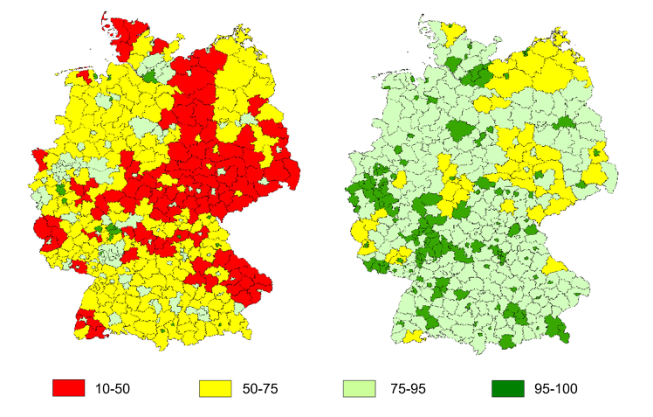
Figure 1: Coverage at 50 Mbit transmission rate in 2014 (left) and 2019 (right).
BROADBAND IN GERMANY Among the European countries, Germany was one of the first to integrate targets in its national broadband infrastructure plan from Digital Agenda for Europe: in the first stage, a basic broadband had to be granted to all citizens by 2013, and in the second phase a full coverage with fast broadband (at least at 30 Mbps transmission speed) and 50% coverage for ultra-fast broad- band (100 Mbps or more). However, eventually just one of twenty German Internet users now utilizes a fiber-optic connection: due to a historical high dominance of Deutsche Telekom, a major German operator, the overwhel- ming majority of households were traditionally benefiting from DSL/VDSL technology (Gries, 2004) at a common for the market speed of 16 Mbps – and, which was even sadder, at an inflated price.
Albeit the baseline targets of German national broadband development plan were accomplished, the ultra-broadband coverage is still distributed unevenly across the country. Cities and highly urbanized city-areas (so called independent cities) usually have better digital infrastructure, while regions of former East Germany are obviously lagging behind by the coverage with ultra-high-speed transmission rates (see Figure 1). Nevertheless, it is fair to say that the broadband provision gap was narrowing rapidly in recent years due to the Federal Funding Programs for Broadband Development (BMVI, 2021), and it is very likely that in the near future the quality of digital infrastructure will vary little from region to region.
DATA AND METHODOLOGY While in our previous studies for Germany we were looking on relationship between (ultra-)broadband provision and firm birth rates with the help of
Broadband Development and Firm Creation: Dif-in-Dif Estimates for Germany 253
OLS regression analysis, in this study we use a difference in differences (dif- in-dif) method in order to estimate the impact of improvements in high-speed internet coverage on firm creation between 2014 and 2019. Dif-in-dif method evolved from study by Card (1992) on employment changes in California and more famous research of Card and Krueger (1994) on changes on minimum wage in New Jersey, US. The essence of the method is to calculate the effect on an outcome (eg. employment as in a paper by Card and Krueger) caused by treatment (eg. minimum wage increase); hereby the average change in the outcome variable is compared for the treatment group (with changes over time) to the control group (no changes). The linear OLS model for observed outcome Yit may be written as: Yit = β0 + β1Tit + β2Git + β3 (Tit×Git) + ϵit, (1)
where Tit is a dummy variable equal to zero in the initial period and 1 in the following, Git is a dummy variable equal to 1 for treatment group and zero for control group, so β1 represents the impact for control group and the treatment’s counterfactual (1Yi = Yi1 – Yi0), β2 the same differential for both groups in T=1 and β3 the unbiased treatment effect. Much easier dif-in-dif method may be formulated as in Table 1, where a dif-in-dif esti- mator may be found in the lower right cell and is equal to β3 from the model described above. In our sample, the treatment group is represented by those German regions (both independent cities and districts) where signifi- cant changes in broadband provision at 50 Mbit1 could be observed between 2014 and 2019. For some entities, we were able to gather exact coverage data for both periods; in that case we considered the change significant if coverage ratio increased by ten percentage points. Unfortunately, for most regions such a precise data was available just for 2019, while data for 2014 was presented in four coverage ratio groups (10–50%, 50–75%, 75–95%, and 95–100%). In this case, we included the region in the treatment group only if a significant change in broadband coverage was evident (for example, the figure was at 50–75% in 2014 and 85% in 2019). The data on broadband coverage ratios for 2019 was collected from the Broadband Atlas for Germany (Breitbanda- tlas), and for the previous period – from publicly available reports for earlier periods of German Federal Ministry for Digital and Transport (BMDV).
The general data on firm birth was retrieved from the Firms’ Registry, a part of German Regional Database (Regionaldatenbank). Additionally, we 1As German Federal Ministry for Digital and Transport (BMDV) did not collect data for broadband ava- liability at transmission rates exceeding 50 Mbps before 2018, we used this transmission rate for our estimates in both time periods.
254 Sarachuk and Missler-Behr
Table 2. Number of regions with and without broadband improvements, 2014–2019.
Table available in the original PDF paper.
No (Control) With (Treatment) Total Independent cities (Kreisfreie Städte) 85 22 107 Districts (Kreise) 47 247 294
took the firm statistics for isolated economics sectors, however in this case the available data are not on the number of new business formation, but on the change in firm population (net entries). The figures were retrieved for two time periods same as with the statistics on broadband coverage.
RESULTS
Table 2 describes our sample with more details. Obviously, in recent years, significant improvements in the digital infrastructure were observed mainly in more rural district areas (Kreise), while more urbanized regions (Kreisfreie Städte) already had better internet coverage by 2014, and therefore signifi- cant changes were observed only in just a small number of independent cities. We first discuss the dif-in-dif estimates for the whole sample and afterwards for independent cities and districts separately, but also accompany the results with extra comments on outcome for economic sectors.
Whole Sample
Table 3 delivers the dif-in-dif estimates of the broadband infrastructure deve- lopment in Germany (measure by coverage ratio) over firm birth. A positive estimate indicates a higher increase in firm entries in the treatment group over the control group. For the entire country, the dif-in-dif value 152.034 indica- tes more firms were created in regions with substantial changes in broadband provision over the observed period.
Across the sectors, none of them have negative estimates, while knowledge- intensive businesses and production benefit more from better transmission rates. Surprisingly, the result for services and ICT-firms was very small, alth- ough these sectors have been developing most actively in the recent decade; however, we should keep in mind that sectoral estimates are not for pure firm entries but net entries. Still, with an exception for production sector, the dif-in-dif values appear to be statistically insignificant.
Independent Cities and Districts Given the severe differences in broadband development between independent cities (with better digital infrastructure) and districts (with lower internet transmission rates), we decided to analyze them separately. Positive dif-in- dif estimates in firm creation in a treatment group over a control group are observed for both cases, but the outcome also seems to be statistically insignificant.
With respect to the statistics on economic sectors, we also observe some varieties for dif-in-dif estimates: for service sector, the outcome in both cases is negative and almost twice larger for districts. For the independent cities, we
Broadband Development and Firm Creation: Dif-in-Dif Estimates for Germany 255
Table 3. Effect of broadband improvements over 2014–2019.
0.0077 (0.55) Effect of broadband improvements by economic sectors, whole sample
Production 27.3864 (5.4871)
12.197 (3.7262)
16.2416 (1.9555)
13.249 (1.9956)
12.1968** (6.120)
0.0156 (4.21) Services 162.8636 (30.6595)
205.75 (29.467)
76.8699 (5.6659)
120.532 (6.408)
0.7757 (32.161)
0.0438 (12.20) ICT 15.5227 (4.6931)
12.9849 (4.438)
5.6543 (.6215)
4.3048 (.6085)
1.1883 (4.6867)
0.0201 (5.45) KIBS 45.6364 (10.0614)
42.8864 (10.4659)
18.3792 (1.58456)
26.7063 (1.8017)
11.0771 (10.7193)
0.0225 (6.12) Effect of broadband improvements by economic sectors, districts
Production 33.3617 (7.2757)
24.0426 (4.5738)
16.8421 (2.10035)
14.7368 (2.1225)
7.2138 (7.7999)
0.022 (4.37) Services 153.8085 (21.1949)
217.383 (28.2399)
76.8907 (5.96525)
122.4696 (6.8209)
-17.9956 (25.8163)
0.1084 (23.67) ICT 14.6383 (3.11637)
5.6170 (2.0359)
5.6194 (.60046)
3.8543 (.6111)
7.2562*** (2.5430)
0.058 (11.99) KIBS 33.7872 (5.7723)
36.2553 (4.5840)
17.2874 (1.5553)
27.2105 (1.8012)
7.455 (6.3271)
0.0517 (10.62) Effect of broadband improvements by economic sectors, independent cities
Production 24.0824 (7.51825)
5.6471 (5.0851)
9.500 (3.75998)
- 3.4545 (3.7983)
5.4808 (18.1034)
0.034 (2.47) Services 167.8706 (46.2568)
199.3176 (43.1278)
76.6364 (18.1481)
98.7727 (16.2703)
-9.3107 (125.348)
0.013 (0.90) ICT 16.0118 (7.0988)
17.0588 (6.7749)
6.0455 (3.5842)
9.3636 (2.7076)
2.2711 (19.4869)
0.004 (0.29) KIBS 52.1882 (15.2855)
46.5529 (16.0769)
30.6364 (8.11645)
21.0455 (8.8419)
-3.9556 (44.1705)
0.006 (0.42)
Notes: Firm birth rates or change in firm population are in absolute values. Standard errors in parenthesis. * p<0.1; ** p<0.05; *** p<0.01.
also observe a below zero dif-in-dif value for knowledge-intensive busines- ses; this may be interpreted in a way that better broadband may provoke an influx of new entrepreneurs and increase competition, resulting in an inevita- ble decrease in the number of firms in subsequent periods which is consistent with finding by Kandilov and Renkow (2010). Estimates for other sectors
256 Sarachuk and Missler-Behr
rather than KIBS seem to be higher for districts, but the only one which seems to be statistically strong significant is for ICT firms in districts: these firms usually operate remotely and are not so location but rather price sensitive and possibly tend to locate themselves in areas with lower costs on rent and workforce.
CONCLUDING REMARKS Unlike in our previous studies, in this paper we tried to prove the impact of better broadband coverage at high transmission rates on firm establish- ments in Germany between 2014 and 2019, namely the end of first and second implementation stages of Digital Agenda strategy. Despite the obse- rved positive estimates for firm entries in the treatment group over the control group, these results seem to be statistically insignificant. The same holds true for dif-in-dif values in case of net entries across different economic sectors with two exceptions: we confirmed a very strong and positive significance for ICT firms located in more rural districts where significant changes in high-speed internet coverage were made in 2014-2019, but also strong and positive significance for production sector (for the whole sample). Although the total inconsequential importance of dif-and-dif values was observed in other studies as well (Wang and Gunderson, 2012), our results rather support an existing view that just a certain broadband quality threshold is impor- tant for the economic development. The only sector where such a need for speed seems to be extremely vital, as we believe, is the sector of communi- cation technologies while modern IT solutions usually require better internet transmission rates and, surely, coverage.
Couple of data limitations apply to our analysis: first, it was impossible to retrieve precise broadband coverage ratios for 2014 as the responsible organization could not provide the information and we had to rely on pre- viously published reports with more aggregated data. Secondly, the regional firm birth rates statistics was not available for separate economic sectors, but only in form of changes in firm population (entries minus exits). Howe- ver, these data imperfection does not have the undue impact on our analysis; our further research will focus more on problem whether regions could be attractive for potential firm founders, to which extend and under which con- ditions, while internet coverage, as seems from our experience, is not the main decisive factor.
REFERENCES
Aral, S., Brynjolfsson, E. and Wu, L. (2012) ‘Three-way complementarities: Performance pay, human resource analytics, and information technology’, Management Science, 58(5), pp. 913–931. Bloom, N. et al. (2014) ‘The distinct effects of information technology and com-
munication technology on firm organization’, Management Science, 60(12), pp. 2859–2885. BMVI (2021) Aktuelle Breitbandverfügbarkeit in Deutschland (Stand Mitte 2021).
Berlin.
Broadband Development and Firm Creation: Dif-in-Dif Estimates for Germany 257
Briglauer, W. and Gugler, K. (2019) ‘Go for Gigabit? First Evidence on Economic Benefits of High-speed Broadband Technologies in Europe’, JCMS: Journal of Common Market Studies, 57(5), pp. 1071–1090. Canzian, G., Poy, S. and Schüller, S. (2019) ‘Broadband upgrade and firm perfor-
mance in rural areas: Quasi-experimental evidence’, Regional Science and Urban Economics, 77, pp. 87–103. Card, D. (1992) ‘Do minimum wages reduce employment? A case study of California, 1987–89’, ILR Review, 46(1), pp. 38–54. Card, D. and Krueger, A.B. (1994) ‘Minimum Wages and Employment: A Case
Study of the Fast-Food Industry in New Jersey and Pennsylvania’, The American Economic Review, 84(4), pp. 772–793. Duso, T., Nardotto, M. and Schiersch, A. (2021) ‘Broadband and Productivity: Structural Estimates for Germany’. European Commission (2020) Digital Economy and Society Index 2020: Human
capital. Fabling, R. and Grimes, A. (2021) ‘Picking up speed: Does ultrafast broadband increase firm productivity?’ Information Economics and Policy, p. 100937. Fabritz, N. (2013) The impact of broadband on economic activity in rural areas:
evidence from German municipalities. Gries, C.-I. (2004) Entwicklung der DSL-Märkte im internationalen Vergleich. Gruber, H., Hätönen, J. and Koutroumpis, P. (2014) ‘Broadband access in the EU: An assessment of future economic benefits’, Telecommunications Policy, 38(11), pp. 1046–1058. Haller, S.A. and Lyons, S. (2015) ‘Broadband adoption and firm productivity:
evidence from Irish manufacturing firms’, Telecommunications Policy, 39(1), pp. 1–13. Hasbi, M. (2020) ‘Impact of very high-speed broadband on company creation and entrepreneurship: Empirical Evidence’, Telecommunications Policy, 44(3), p. 101873. Heger, D., Veith, T. and Rinawi, M. (2011) ‘The effect of broadband infrastructure
on entrepreneurial activities: The case of Germany’, ZEW-Centre for European Economic Research Discussion Paper (11-081). IHS Markit (2018) Broadband Coverage in Europe 2018: Mapping progress towards the coverage objectives of the Digital Agenda. Kandilov, I.T. and Renkow, M. (2010) ‘Infrastructure investment and rural economic
development: An evaluation of USDA’s broadband loan program’, Growth and Change, 41(2), pp. 165–191. Kim, Y. and Orazem, P.F. (2017) ‘Broadband internet and new firm location decisions in rural areas’, American Journal of Agricultural Economics, 99(1), pp. 1–18. Koutroumpis, P. (2009) ‘The economic impact of broadband on growth: A simulta-
neous approach’, Telecommunications Policy, 33(9), pp. 471–485. Koutroumpis, P. (2019) ‘The economic impact of broadband: Evidence from OECD countries’, Technological Forecasting and Social Change, 148, p. 119719. Mack, E.A. and Grubesic, T.H. (2009) ‘Broadband provision and firm location in
Ohio: An exploratory spatial analysis’, Tijdschrift voor economische en sociale geografie, 100(3), pp. 298–315. Mayer, W., Madden, G. and Wu, C. (2020) ‘Broadband and economic growth: a reassessment’, Information Technology for Development, 26(1), pp. 128–145. McCoy, D. et al. (2018) ‘The impact of broadband and other infrastructure on
the location of new business establishments’, Journal of regional science, 58(3), pp. 509–534.
258 Sarachuk and Missler-Behr
Parajuli, J. and Haynes, K. (2017) ‘Spatial Heterogeneity, Broadband, and New Firm Formation’, Quality Innovation Prosperity, 21(1), pp. 165–185. Sarachuk, K. and Missler-Behr, M. (2020a) ‘ICT, economic effects and business
patterns: A text-mining of existing literature’, Proceedings of the 2020 the 3rd International Conference on Computers in Management and Business, pp. 40–45. Sarachuk, K. and Missler-Behr, M. (2020b) ‘Is Ultra-Broadband Enough? The Relationship between High-Speed Internet and Entrepreneurship in Brandenburg’, International Journal of Technology, 11(6), pp. 1103–1114. Sarachuk, K., Missler-Behr, M. and Hellebrand, A. (2020) ‘Ultra High Speed Broad-
band Internet and Firm Creation in Germany’, International Scientific Conference on Innovations in Digital Economy. Springer, pp. 40–56. Wang, J. and Gunderson, M. (2012) ‘Minimum wage effects on employment and wages: dif-in-dif estimates from eastern China’, International Journal of Manpower. Xu, X., Watts, A. and Reed, M. (2019) ‘Does access to internet promote inno-
vation? A look at the US broadband industry’, Growth and Change, 50(4), pp. 1423–1440.
LISTED IN THE AHFE DIGITAL BOOKSTORE CATALOGUE
Explore the complete digital volume
Creativity, Innovation and Entrepreneurship
Read this individual research paper free through the original publisher, or explore the full digital proceedings book.
ISBN 978-1-958651-07-0
Explore this ISBN in the AHFE Bookstore ↗Listed in the July 2026 bookstore catalogue; search by ISBN to confirm current availability · Digital book purchase optional