Haina Wang, Fangfei Liu, Yun Chen (2023). The Characteristics and Influencing Factors of the Colour of the Cizhou Kiln Porcelain. In: Human-Centered Design and User Experience. AHFE Open Access, vol. 114, pp. 60–69. https://doi.org/10.54941/ahfe1004222
Chinese ceramic art boasts a rich and diverse history, and the colours of porcelain produced by different kilns reflect the aesthetic preferences, socio-cultural developments, and historical contexts of various periods and regions. Among the folk kilns in China, the Cizhou kiln stands out for its unique black-and-white colour scheme. While existing studies have extensively analyzed the history, decorative patterns, and shapes of Cizhou porcelain, few have explored the colour characteristics of the kiln and the factors that influence them. Therefore, this study aims to conduct a comprehensive investigation into the colour characteristics of Cizhou porcelain and shed light on the underlying factors that shape them. Methods: In this study, a dataset comprising 50 images of ancient Chinese porcelain and 50 images of Cizhou kiln porcelain was sourced from the internet. The main colours of each porcelain were extracted to construct the Ancient Chinese Porcelain Palette and the Cizhou Kiln Porcelain Palette, respectively, to analyze the colour characteristics of Cizhou kiln porcelain by comparing them to those of Ancient Chinese Porcelain. It was found that the porcelain from the Cizhou kiln is mainly black and white, with sharp contrast and simplicity, reflecting a unique aesthetic style. In addition, semi-structured interviews were conducted with a docent of the Cizhou Kiln Historical Museum, local potters, and the owner of a porcelain shop to verify the results of the image analysis and explore the factors that influence the colour of the porcelain. The interview results were coded at three levels to extract keywords regarding the characteristics and influencing factors of the colour of the porcelain of the Cizhou kiln.Results: The study revealed that the colours of the Cizhou kiln porcelain are mainly black and white, and they are mainly influenced by the period, region, and social culture. Firstly, the unique colour style of the Cizhou kiln porcelain developed during the Song Dynasty, but it changed over time with changes in the social environment, aesthetic concepts, and production process. Secondly, the rugged and bold character of the local inhabitants and the mineral raw materials unique to the region also influenced the choice of colour. Lastly, the Cizhou kiln is a civil kiln with more artistic freedom compared to official kilns, reflecting folk aesthetic interests and presenting bold, natural, and simple colours.Research Significance: This study of the Cizhou kilns from the perspective of colour is of great significance for a deeper understanding of the porcelain of the Cizhou kiln and provides helpful insights for exploring the trajectory of the development of traditional Chinese ceramic art and aesthetic changes. The results of the study can contribute to the innovation and promotion of the development and dissemination of ceramic art in contemporary society. Furthermore, the study results in a model of the colour-influencing factors of the porcelain of the Cizhou kiln, which is of extensive reference significance for the investigation of the reasons for the formation of the colours of other porcelain.
Chinese ceramic art has a long history and is popular all over the world. Existing research literature on porcelain colour points out that porcelain colour is influenced by a variety of factors, which can reflect the aesthetic concepts, social development and cultural connotations of different peri- ods and regions. For example, the pursuit of neo-Confucianism in the Song Dynasty and the reverence for natural Laozhuang thought led to the Song Dynasty’s celadon colour tending to be plain and elegant (An, 2008). The colour of black glazed porcelain from Yaozhou kilns in the Tang Dynasty was influenced by geographical factors, Buddhist thought and social culture (Zhang Jie, 2007). In contrast, the colour of the imperial kiln porcelain of the Ming and Qing dynasties was restricted by the feudal hierarchy (Cai et al., 2011). In addition, the colour of porcelain also largely depends on the heating technology and raw material composition (Santos et al., 2022).
This study has been approved for the 2023 Hebei Province Social Science Development Research Topic, Topic No. 20230304053.
The Characteristics and Influencing Factors of the Colour 61
Cizhou kiln is the largest civil kiln in northern China in ancient times. Cizhou kiln porcelain has high artistic value and influence and is famous in northern China. It is known as “Jingde in the south and Pengcheng in the north”. Its kiln site is located in Pengcheng Town, Fengfeng Mining area, Handan City, Hebei Province, and Guantai Town, Ci County. Ci County was called Cizhou in Song Dynasty, hence the name Cizhou Kiln. Existing studies have made a detailed analysis of the history, decorative patterns and porcelain modelling of Cizhou kiln (Zhang et al., 2022), but there are few studies on the colour characteristics of Cizhou kiln and its influencing factors.
In this study, through the collection and analysis of porcelain pictures, the horizontal comparison between Cizhou kiln porcelain and other porcelain in ancient China was made, and it was found that the unique colour of Cizhou kiln porcelain was mainly black and white. Then through the tabletop survey method and field survey method to explore the influencing factors of the colour of Cizhou kiln porcelain.
IMAGE ANALYSIS A collection of 50 images of ancient Chinese porcelain and 50 images of Cizhou kiln porcelain were collected using Baidu. The main colours of each porcelain were extracted using Adobe Color to form the Ancient Chinese Porcelain Palette and the Cizhou kiln Porcelain Palette to analyze the charac- teristics of the colours of Cizhou kiln porcelain by comparing them with the Ancient Chinese Porcelain colours.
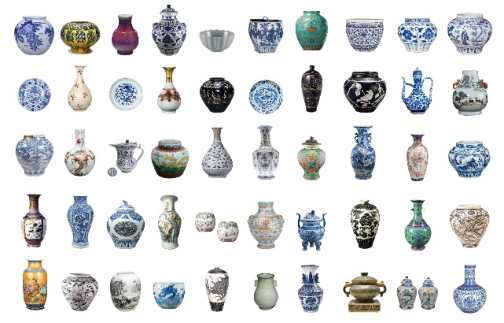
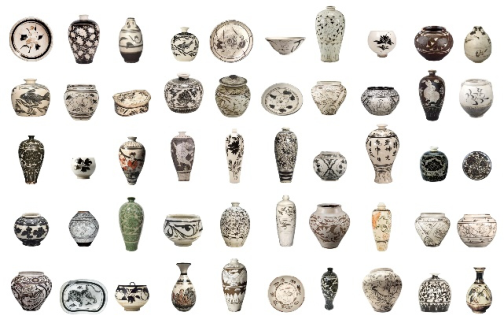
Sample Collection Using Baidu’s image search function, type ‘ancient Chinese porcelain’ and ‘Cizhou kiln’ into the search box and select the first 50 images with suitable angles and high pixels, respectively, and the backgrounds were removed for subsequent colour extraction (see Figure 1, Figure 2).
Figure 1: Images of ancient Chinese porcelain.Figure 2: Images of Cizhou kiln porcelain.
Main Colour of Sample The five main colours of each porcelain in the two sets of images were extracted one by one using Adobe Color. These colours were used to con- struct the Ancient Chinese Porcelain Palette and the Cizhou kiln Porcelain Palette.
Building Colour Palette The main colours of the two groups of porcelain were brought together to form the Ancient Chinese Porcelain Palette (see Figure 3) and the Cizhou kiln Porcelain Palette (see Figure 4), and the two palettes were compared. The results showed that: Ancient Chinese porcelain is rich in colour and colour scheme, with cyan and white predominating, as well as bright, flamboyant colours such as yellow, green and red. In contrast, the colours of porcelain from Cizhou kiln are predominantly black, white and brown with low sat- uration, and only a few porcelains are coloured with red and green, giving them an overall plain and understated appearance that is distinctly different from other porcelains from ancient China.
Figure 3: The ancient Chinese porcelain palette.
The Characteristics and Influencing Factors of the Colour 63
Figure 4: The Cizhou kiln porcelain palette.
INTERVIEW RESEARCH On the 1st of April 2023, a field research trip was conducted in the Fengfeng Mining District of Handan City, Hebei Province. The purpose of the trip was to visit the Cizhou Kiln History Museum and the China Cizhou Kiln Site Museum, as well as to conduct semi-structured interviews with a docent at Cizhou Kiln History Museum, the owner of a porcelain shop in Pengcheng Street, and a craftsman of the art studio in Cizhou kiln Site Museum. These interviews aimed to gain a deeper understanding of the colour characteristics and influencing factors of Cizhou kiln porcelain.
Coding of Interview Results The results of the interviews were coded at three levels to extract keywords regarding the visual characteristics and influencing factors of the colour of the Cizhou kiln porcelain (see Table 1, Table 2, Table 3).
Analysis of Results The interviews verified the conclusion from the image analysis that the porce- lain of the Cizhou kiln was characterized by a predominantly black and white colour palette. In addition, when asked questions about the causes of colour formation at Cizhou Kiln, the keywords period, region and social cul- ture appear several times, suggesting that these three factors were the main influences on the colour of Cizhou Kiln porcelain.
RESULT DISCUSSION AND INFLUENCING FACTORS ANALYSIS Period
Cizhou Kiln has a long history of porcelain production, with a distinctive decorative style beginning to emerge with the creation of “black painting on a white ground” in the mid to late Northern Song dynasty, and moving towards a prosperous heyday in the Jin and Yuan dynasties, with continuous firing through the Ming and Qing dynasties and the Republic of China to the present day.
Table 1. Coding of the interview with a docent of Cizhou kiln history museum.
Table available in the original PDF paper.
2. Are all the porcelains from Cizhou kiln black and white?
3. Why are the porcelains of the Cizhou kiln in the Jin dynasty different from the previous ones?
Questions 1. Do the Cizhou kiln porcelain has any characteristics in terms of colour?
Level 1 Code The most distinctive colour of Cizhou kiln porcelain is black and white, which is called “black painting on a white ground “.
No, the feature of black and white was formed in the Song dynasty, after which the colour of the porcelain changed somewhat. You can go to the exhibition over here to see how much richer the colours of the porcelains from the Jin dynasty Cizhou kiln would have been.
The multi-colour painting of the Cizhou kiln in the Jin Dynasty was made based on the decoration of black painting on a white ground, drawing lessons from the low-temperature three-colour painting techniques and the red and green painting techniques, using some unique mineral pigments. This was also because of social and political stability, economic and cultural prosperity and people’s pursuit of luxury in the Jin Dynasty. And the aesthetic culture of the scholars was also strongly impacted, no longer purely pursuing the beauty of plain colours.
Level 2 Code Cizhou kiln porcelain is black and white.
The colour of Cizhou kiln porcelain varied across different periods.
The firing techniques of the Cizhou kiln changed in the Jin Dynasty. Jin Dynasty’s social environment and national culture impacted porcelain colour preferences.
Level 3 Code black and white period period, social culture
Table 2. Coding of the interview with the owner of a porcelain shop on Pengcheng street.
Table available in the original PDF paper.
Questions 1. Which porcelains in your shop have the characteristics of the Cizhou kiln?
3. Do you know why this black and white colour characteristic was developed at that time?
2. The patterns on these porcelains are very interesting. Could you tell me something about them?
Level 1 Code Here, the Cizhou kiln porcelain is mainly black and white. These porcelain pillows, teapots and teacups are all fired in the style of a Cizhou kiln.
Most of the patterns on Cizhou kiln porcelain depict people, flowers and other things that people often saw in their daily lives. For example, the picture on this porcelain pillow is a sleeping child full of life atmosphere.
The literati ink painting influenced this in the Song Dynasty. when the artisans of the Cizhou kilns found this style of painting so beautiful that they applied the ink painting form to porcelain, creating the black and white colours of Cizhou kiln porcelain. Level 2 Code The porcelain of the Cizhou kiln is mainly black and white.
The patterns of Cizhou kiln porcelain reflect the lives of common people.
The literati ink painting of the Song Dynasty influenced the black and white colour of Cizhou kiln porcelain. Level 3 Code black and white social culture period, social culture
The Characteristics and Influencing Factors of the Colour 65
Table 3. Coding of the interview with a craftsman at the art studio in Cizhou kiln site museum.
Table available in the original PDF paper.
Questions 1. Can you tell me about your work?
3. Do you know why the porcelain of the Cizhou kiln forms the colour characteristics mainly in black and white?
2. Most of the Cizhou kiln porcelains are black and white, but I have observed that you possess some coloured porcelain. Do they also belong to the Cizhou kiln?
Because the raw materials of the Cizhou kiln, such as makeup soil, Daqing soil and Erqing soil, will turn black and white when fired.
Level 1 Code Yes, these are all made by our studio. They have a typical black-and-white colour scheme of Cizhou kiln, which is made just of the raw soil left over from the Cizhou kiln in the yard.
Yes, a small part of the porcelain in the Cizhou kiln is coloured. They need to be fired twice. This style emerged in the Jin Dynasty. But the porcelain of the Cizhou kiln is still mainly black and white.
Cizhou kiln porcelain is made of raw materials unique to the region.
The process of making coloured porcelain is more complicated than that of black and white porcelain.
Level 2 Code Cizhou kiln porcelain has a typical black-and-white colour scheme. Cizhou kiln porcelain was made from raw materials unique to the region.
Level 3 Code black and white, region black and white, period region
The porcelain of the Cizhou kiln in the Song Dynasty is mostly black and white. This is related to the political and historical background of the time. The Song Dynasty was under constant threat from the nomads in the north, and political instability led to a long history of repression of national character and a tendency towards feminine beauty in artistic aesthetics. The literati of the Song dynasty were increasingly introspective and quiet under the dual stimulus of this mentality and Neo-Confucianism, with restrained and repressed emotions and a preference for light beauty in aesthetic taste (Zhang, 2022). The rise of literati painting in the Song Dynasty, and in par- ticular the growing dominance of the expressive style of ink and wash, saw the use of this colour idiom transfer to the folk, with successful examples in folk clay toys and woodblock prints (Wei, 2005). The craftsmen of Cizhou Kiln were also influenced by literati ink painting and applied the colour style and painting techniques of ink painting to the production of porcelain, result- ing in the unique decorative style of “black painting on a white ground” of Cizhou kiln.
In the Jin Dynasty, based on “black painting on a white ground”, the Cizhou kiln produced some richly coloured porcelain, drawing on the tech- niques of the Liao Dynasty and low-temperature tri-colour of the Song Dynasty and folk red and green colour painting. These include red and green colour, red and yellow colour, red, green and yellow “three-colour”, red, green, yellow and black “five-colour” and painted sculpture and other deco- rative varieties. The process has realized the evolution from “monochrome” to “multi-colour”, “underglaze painting” to “underglaze and overglaze com- bination” and “painted sculpture integration”. This is because of the social and political stability, economic and cultural prosperity, and people’s pursuit of luxury in the middle Jin Dynasty, and after the Jin Dynasty people entered
the Central Plains. And the aesthetic culture of the Song literati was strongly influenced by the Jin dynasty’s domination of the Central Plains, and they no longer simply pursued simplicity as a beauty (Lu, 2015).
During the Yuan and Ming dynasties, black and white continued to be the main colour of the kilns (Zhou, 2021). In the late Qing Dynasty and the Republic of China, Cizhou kiln gradually lost the typical artistic style of the Song and Yuan Dynasties, with black painting on a white ground being replaced by blue and white, and began to produce blue and white and colourful porcelain, which were popular in society at the time. It is precisely because of its unique characteristics of inclusiveness and adaptability to the market that Cizhou Kiln continues to this day, becoming one of the kilns with the longest continuous firing time. This is also the secret of the kiln fire that has lasted for a thousand years in Cizhou kiln.
Region The site of the Cizhou kiln is located in Pengcheng Town, Fengfeng Min- ing area of present-day Handan City, Hebei Province, and Guantai Town, Ci County. Ci County was called Cizhou in the Song Dynasty, hence the name of the kiln. The production of ceramics in the Cizhou area can be traced back to the Cishan culture in the Neolithic Age. At that time, exquisite Cishan black pottery was produced in this area. By the time of the Northern Dynasty, the porcelain-making techniques, represented by Jia Bi celadon, had been per- fected, completing the transformation from pottery to porcelain. In the Song Dynasty, China’s culture and art were highly prosperous. Cizhou, with its superior geographical location and long history of cultural and economic development, became one of the highly developed cultural regions of the Cen- tral Plains, centred on the capital of the Song Dynasty Mu Liang. From the folk point of view, the location of Cizhou kiln in northern China has tra- ditionally been characterized by the simplicity of the people and their bold temperament. All these provide fertile soil for the formation of the rough, bold and majestic colour style of Cizhou kiln. As a result of these advan- tages, the people of Cizhou at that time had high cultural accomplishments and were good at accepting fresh artistic thoughts, which led to many of the court arts of the pre-Tang dynasty period going to the people and becoming popular (Liu, 1984).
In addition, from the perspective of geological conditions, the clay rocks of the stratum where the Cizhou kiln is located were rich in iron and produced a great deal of blue clay (Xiao, 2023). The porcelains fired with this kind of clay were mostly greyish-white or greyish-yellow, with coarse pores, mak- ing it difficult to present a delicate texture like other porcelains. However, the ancestors of the Cizhou kiln cleverly covered the surface of the porcelain with a layer of white make-up clay processed from locally mined alkali stone, firing the make-up white porcelain, changing the appearance of the porcelain of Cizhou kiln, which was coarse in quality and ugly in colour. The use of make-up white clay has resulted in the formation of a porcelain body with multiple layers and different colours, creating the conditions for the unique processing techniques of the Cizhou kiln (Ren, 2010). There is also a local
The Characteristics and Influencing Factors of the Colour 67
mineral containing iron oxide, called Piebald stone, which takes on the colour of rust after firing and is used as the painting material for Cizhou kiln porce- lain. Therefore, Cizhou kiln brushed white make-up clay on the surface of the porcelain body, took the contrast of black and white glaze as the main decoration style, and added the picking, carving, scratching and other tech- niques, so that a strong contrast between black and white picture could be presented after the kiln.
Social Culture Porcelain kilns in ancient China were divided into official kilns and civil kilns, both of which had very different styles.
The feudal society practised a centralized system, and the government directly intervened in and managed the handicraft industry. The craft attributes of porcelain intensified the differentiation and hierarchical pro- duction of the ceramic industry. The “official kilns” gathered the highest quality human and material resources and fired the most exquisite and luxu- rious imperial porcelain of wonderful shape, gorgeous decoration, excellent glaze colour and exquisite luxury regardless of cost, which embodied the will of the royal family and reflected the psychological needs of the ruling class (Cai et al., 2011).
Before the Song Dynasty, “cyan”and “jade-like”were used as benchmarks, which established the aesthetic standard and ethical sequence of porcelain as “cyan is the best”. During the Ming and Qing dynasties, emperors attached greater importance to the production of porcelain, which promoted the for- mation of the exclusive production pattern of imperial porcelain. As an important instrument for royal sacrifice, the colour and form of porcelain gradually went beyond the aesthetic scale and solidified into a sequence of class identity markers, and formed a colour system that had to be strictly observed from the royal family down to the common people. With the increasingly common use of porcelain for royal daily use and furnishings, the colour of porcelain was customized. It was incorporated into the Palace rules and regulations of the Qing Dynasty, and the colour application of the concubines had been normalized.
The “Five famous kilns”, the most famous official kilns in the Song Dynasty, specialized in the production of porcelain for the imperial nobles at that time, using extremely elaborate raw materials, shapes and decorative motifs. But this also to a certain extent limited the producer’s intelligence, for example, some verses reflecting feudal superstition and negative, pes- simistic and world-weary thoughts were unlikely to appear in the official kilns. Cizhou kiln, as a civil kiln, was different. The porcelains produced in the Cizhou kiln were used by the common people in their daily lives. Com- pared with the official kilns, on the one hand, the colours it can use are limited. But on the other hand, the artistic creation of the Cizhou kiln was freer and full of folk aesthetic taste. Most of the porcelains abandoned the ornate and cumbersome decoration, and the overall colour presented bold, natural and simple visual characteristics.
CONCLUSION
This study discusses the visual characteristics and influencing factors of the colour of Cizhou kiln porcelain. The colour extraction of Internet images shows that the colour of the Cizhou kiln is mainly black and white. This view is verified through field investigation and interview, and it is concluded that the colour of Cizhou kiln is mainly affected by three factors:
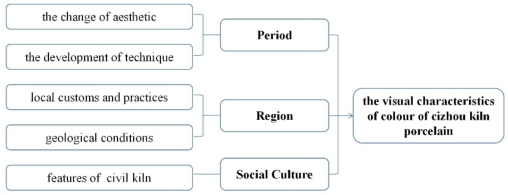
1. Period: The distinctive colour style of Cizhou kiln porcelain was devel- oped in the Song dynasty, but thereafter, with changes in the social environment, aesthetic concepts and production techniques, the colours of porcelain from the kiln varied somewhat from period to period. 2. Region: The region where Cizhou Kiln is located has a long history of ceramic firing, The bold and heroic character of residents and special mineral raw materials influenced the colour selection of Cizhou Kiln. 3. Social culture: Cizhou kiln is a civil kiln. Compared with official kilns, although the choice of colours was somewhat more restricted than at the official kilns, the artistic creation was more freedom and versatility, and the colour palette reflected the aesthetic pursuits of the folk.
Based on these findings, a model of the factors influencing the character- istics of the colour of Cizhou kiln porcelain was developed (see Figure 5), which demonstrates the reasons for the formation of the colour of Cizhou kilns. The model is not only applicable to the porcelain of the Cizhou kiln but also to the study of the colour of other porcelains.
Figure 5: Influencing factor model of the characteristics of the colour of Cizhou kiln porcelain.
ACKNOWLEDGMENT
The successful completion of this study would not have been possible without all the people who helped me with the interviews during the research process. Their patient and sincere answers gave me much inspiration and allowed me to learn a lot about the Cizhou kiln, which laid the foundation for me to complete this research. I would like to express my sincere gratitude to them for their support of this research.
REFERENCES
An Lingzhong. (2008). Analysis of Song Dynasty Celadon Colour Culture (Master’s thesis, Beijing Institute of Fashion Technology). https://kns.cnki.net/KCMS/detail/ detail.aspx?dbname=CMFD2009&filename=2009057793.nh
The Characteristics and Influencing Factors of the Colour 69
Cai, Huafei & Xu, Yanfang. 2011 A new species of the genus Cai, Huafei & Xu.
(2021). Forbidden and unforbidden: the ethics of porcelain colour under the “five elements theory” from the official kiln system of the Ming and Qing dynasties. Art. 100 (02), 194–201. Liu, C. K.. (1984). An overview of the study of the Magzhou kiln. Hebei Ceramics (02), 16–18. Lu, Jun & Li, Sha. (2015). Experimental discussion on the spirituality and creativ-
ity of red and green colours in the context of Song and Jin culture. Jingdezhen Ceramics (04), 26–27. Ren Shuanghe. (2010). A brief discussion of the unique production process of ancient magnetism kilns... (eds.) Proceedings of the Ninth National Ceramic Art and Design Innovation Competition and the First Chinese Ceramic Art Conference (pp. 398–403). Santos, T., Hennetier, L., Costa, V. A. F., & Costa, L. C. (2022). Microwave versus
conventional porcelain firing: Colour analysis. Materials Chemistry and Physics, 275, 125265. Wei, Shujun. (2005). Research on the folk decorative art of the Magzhou kiln (Master’s thesis, Hebei Normal University). https://kns.cnki.net/KCMS/detail/detail. aspx?dbname=CMFD0506&filename=2005103979.nh Xiao Jiancong. (2023). A brief discussion on the artistic style and causes of
Song dynasty magnetism kilns. Ceramic Science and Art (03), 110–111. doi: 10.13212/j.cnki.csa.2023.03.103. Zhang Jie. (2007). The black-and-white meaning of the Tang Dynasty Yaozhou kilns: Interpreting the culture of black-glazed porcelain decoration. Art Wizard (06), 73–76. Zhang Xiaomin. (2012). Exploring the colour evolution of Ming and Qing porcelain
(Master’s thesis, Jingdezhen Institute of Ceramics). https://kns.cnki.net/KCMS/ detail/detail.aspx?dbname=CMFD2012&filename=1012392966.nh Zhang, Ben & Yin, Chaoyang. (2015). Art forms and their cultural connotations of porcelain from the Yuan dynasty’s Magzhou kilns. Lantai World (12), 159–160. doi: 10.16565/j.cnki.1006–7744.2015.12.075. Zhou Chen. (2021). An analysis of the artistic characteristics and cultural con-
notations of a white ground black-flower porcelain pillow from the Yuan dynasty’s Magzhou kiln. Ceramic Studies (01), 58–60. doi: 10.16649/j.cnki.36– 1136/tq.2021.01.016.
LISTED IN THE AHFE DIGITAL BOOKSTORE CATALOGUE
Explore the complete digital volume
Human-Centered Design and User Experience
Read this individual research paper free through the original publisher, or explore the full digital proceedings book.
ISBN 978-1-958651-90-2
Explore this ISBN in the AHFE Bookstore ↗Listed in the July 2026 bookstore catalogue; search by ISBN to confirm current availability · Digital book purchase optional