Shuhan Zhang, Chen Xu, Yun Chen (2023). Human-centered Design Investigation and Development of Chinese Young women's Daily mobility Safety. In: Human-Centered Design and User Experience. AHFE Open Access, vol. 114, pp. 144–157. https://doi.org/10.54941/ahfe1004231
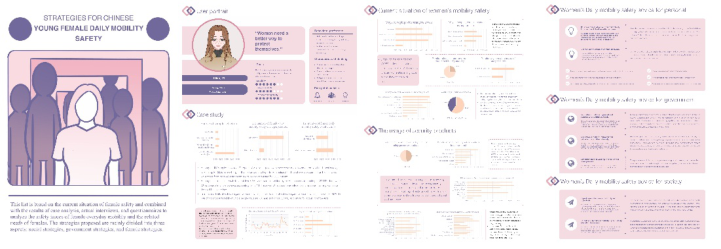
Starting from the human-centered design concept, this paper investigates the current situation of daily mobility safety for young women aged 20-30 in China, and finds that their perceptions of possible dangers in daily mobility do not match with the actual situation, and that there is a lack of standardized, systematic, and scientific daily mobility safety strategies and service guarantee systems for women. (2) Methods: Through the collection and analysis of news cases, we initially understand the safety hazards of women's daily mobility; through interviews and research, we further clarify the problems to mobility safety needs; based on the conclusions drawn from the first two types of research, we conducted a questionnaire survey to gain a more in-depth understanding. Finally, on the basis of the above human-centered design research, we clarify the design direction, summarize the user needs and complete the design practice. (3) Results: Under the guidance of the human-centered design concept, we designed an early warning product combining software and hardware including AI recognition technology, developed a set of information visualization strategies and formed a service system based on the current situation of young women's daily mobility safety. (4) Conclusions: According to the safety issues in women's daily mobility, young women need a human-centered mobility safety product from a female perspective. By combining social and government countermeasures, the product can be further improved and provide a more humane safety guarantee for young women.
Due to the complex factors that women need to consider in choosing their daily mobility paths and means of transportation, women’s lack of self- protection ability (Viswanath K. and Basu A., 2015) and the existence of prejudice against women in social thought (Hancock C., et al., 2008), the issue of women’s mobility safety has existed at the theoretical level and has not been given sufficient attention and solutions (Zhang B., 2019). Violence (del Mar Rodas-Zuleta M. et al., 2022), sexual assault (Dheeraj K. N. and RJ, G., 2015), and other threats to women’s safety during go out to reduce the scope of public space available to women. Fear of crime affects where and when women go out (Stark J. and Meschik M., 2018), hinders women’s mobility activities (Chowdhury S. and Van Wee B., 2020), and
Human-Centered Design Investigating and Developing 145
causes indelible physical and psychological harm and shadows to women (Zhang M., and Li Z., 2019). Failure to effectively address safety issues in women’s mobility can keep women in environments that make them uneasy and uncomfortable and further violate women’s rights to participate in public spaces and to do productive work, education, and improved living environments (Tandogan O. and Ilhan B. S., 2016).
Through the analysis of existing literature, it can be seen that researchers have analyzed and researched women’s safety issues in today’s society from the aspects of women’s living environment (Heng H., 2021), women’s pre- vention awareness (Li N., 2017), dangers encountered by women (Wan C. and He N., 2018), and women’s safety product design (Zhu R., et al., 2021). However, on the whole, the development of theoretical research related to women’s mobility safety in China started late, and the relevant research has undergone a development process from a single to a systematic one. With the improvement of women’s safety theory, China gradually began to conduct theoretical research and design research on women’s safety protection prod- ucts. However, relevant research is centered on women’s needs, and part of it is still in the stage of theoretical research.
In many countries, theoretical research on women’s safety and women’s safety products has been conducted and is relatively well developed. In the United States, experimental research was conducted as early as 1997 on the important factors of perpetrators’ aggressive behavior in mobility safety incidents (Herz R. S., Cahill E. D., 1997). Since then, Bangladesh has also conducted in-depth research on the status of women’s safety (Uzzaman M. A. et al., 2021); the United States has conducted experiments to verify the effec- tiveness of interventions for women with safety problems (McFarlane J. et al., 2002); India has conducted research on the design of safety products for women (Aggarwal D. et al., 2022); and Mexican researchers have chosen to collaborate with women victims to propose ways to create safety con- trols for women (Frohmann L., 2005). European research, on the other hand, provides solutions to mobility safety issues from a human-centered perspective through inclusive innovation strategies and personalized tech- nologies (Schwittay A., 2019). At the same time, the concept of mobility safety products used from a social perspective has been proposed internation- ally (Grosh M., et al., 2008). Although these studies do not stop at theoretical principles, there is still room for development in the practice of women’s safety and protection solutions.
Based on the human-centered design concept and the current situation of young women’s mobility in China, we have designed an early warning product that contains a combination of hardware and software with AI recognition technology, and provided society, the government, and young women individually with a systematic visualization of women’s mobility haz- ard response strategies and prevention strategies, forming a service system to guarantee the safety of young women’s daily mobility. It is hoped that the design of this system will raise the awareness of women’s mobility safety in society as a whole, so that the issue of women’s safety will move from the theoretical level to the practical level. During the research process, we ana- lyzed the dangerous cases of women’s mobility reported by the media to get
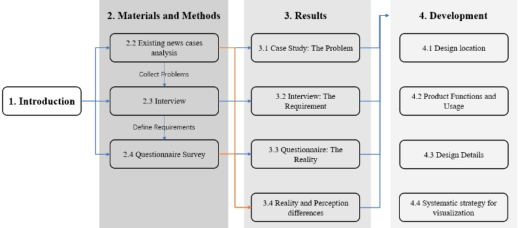
a preliminary understanding of the safety problems encountered by women’s mobility; conducted interviews with eight young women to understand the current views of young women on women’s mobility safety and the demand for mobility safety; and finally, through the questionnaire survey to under- stand the needs of women’s safe mobility and to design a series of products as well as a systematic strategy to deal with the dangers of women’s mobility. The framework of this paper is shown in Figure 1.
Figure 1: The framework of this paper (adapted from the author).
MATERIALS AND METHODS
General Description This study is divided into three steps: 1. Existing news events analysis: through case studies to gain a preliminary understanding of the safety prob- lems encountered by women going out. 2. Preliminary research on women’s mobility safety requirements: Through interviews, we initially understand women’s requirements for safe mobility, and further develop a more sci- entific outline of the questionnaire by combining the case study and inter- view results. 3. In-depth research on women’s mobility safety requirements: Through the questionnaire distributed to young women, we gain a deeper understanding of the current situation and requirements of young women’s mobility safety, designed products to protect women’s daily mobility safety in line with the actual situation, and put forward systematic coping strategies and preventive strategies.
Existing News Events Analysis A scientific interview and questionnaire outline was developed by collecting and analyzing incidents of crime and delinquency encountered by women while mobility as reported by major online platforms and the media.
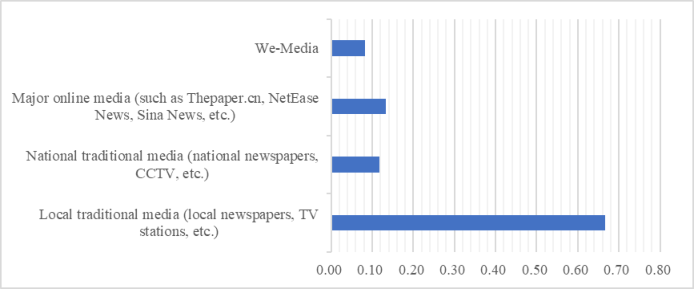
Sample Selection A sample of 120 cases of women’s mobility safety cases reported and pub- lished by Chinese self-media, mainstream online media, national traditional media, and local traditional media was selected for analysis, and the number of cases selected by each media was summarized through a table, as shown in Figure 2.
Human-Centered Design Investigating and Developing 147
Figure 2: Source of sample selection (adapted from the author).
Conclusion and the Next Step Based on the statistical analysis of cases reported by major media, we devel- oped an outline for the interviews. In the analysis of the cases, most of the female victims of safety incidents were in the age range of 20 to 30 years old, so we conducted interviews with women at this age and asked them more in detail.
Preliminary Research on Women’s Mobility Safety Requirements: Interview Main Question Setting Based on the previous case study, we designed the interview questions around the obtained findings, as shown in Table 1. We then interviewed users using this interview outline.
Table 1. Questions for the interview (adapted from the author).
Table available in the original PDF paper.
Questions Content Question 1 What is your everyday mobility frequency?
everyday mobility habits Question 2 What kind of transportation do you usually use? Question 3 What time do you usually go out and come home? Experience Question 4 Have you ever encountered any incidents affecting personal safety when you go out? Question 5 Have you ever used any female safety products such as pepper spray, shock sticks, alarms, etc.? Question 6 Have you ever used a female safety app? Question 7 Expect a new safety product for women? Requirement Question 8 What are your color expectations for the new security products? Question 9 What are your styling expectations for the new security products? Question 10 What are your expectations for the new security product app?
Participant Recruitment We selected eight young female respondents from the age range of 20 to 30 years old from different families, ages, and regions in China, and deter- mined the initial direction of our questionnaire design by integrating their interview responses.
(1) Setting: Each interviewee received an introduction email that included the interview questions list and an information sheet (the description of the interview aim, method, and the use of data). The email also linked to a self-booking system where the participant could easily select their interview time. (2) Introduction: Each interview consisted of two personnel who are the interviewee and the interviewer (the researcher). The interviewer showed the information sheet and briefly summarized the interviewee’s study before the primary interview started. (3) Agreement signature: A consent form was provided, which presented eight relevant clauses about the agreement of participating in this study. Each interviewee was required to read and sign. Otherwise, the interview would not be continued. (4) The main body of the interview: The interview followed 10 questions (Table 1). Each interview was audio-recorded with each interviewee’s permission.
Data Collection and Analysis After collecting and integrating the interview results, we initially developed a questionnaire by analyzing the mobility safety habits, experiences, and opinions on mobility safety solutions for women with different incomes, occupations, and ages, and hoped to obtain more scientific conclusions through the questionnaire.
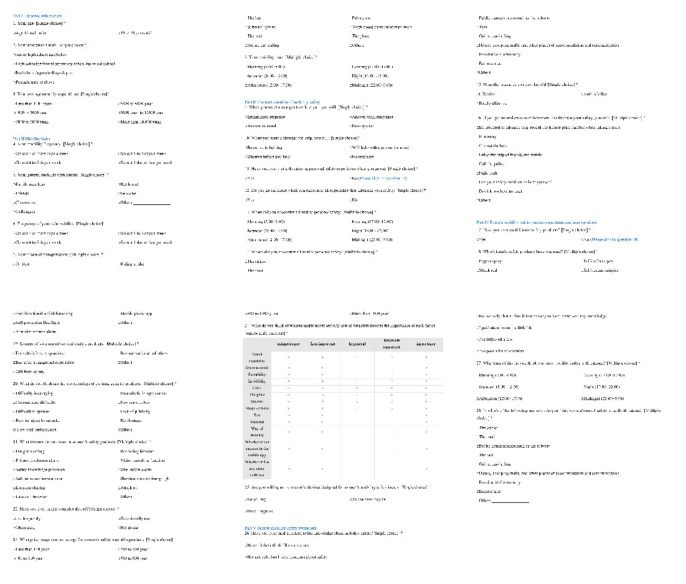
In-Depth Research on Women’s Travel Safety Requirements: Questionnaire Survey Questionnaire Design The questionnaire consists of 28 questions and is distributed in the form of an online questionnaire, details of which are shown in Figures 3. The questions are mainly related to women’s daily mobility habits, the basic situation of women’s mobility safety, and the shortcomings and impor- tance of the products we listed in the category of women’s mobility safety.
Participant Recruitment In this study, 200 questionnaires were distributed, 190 questionnaires were returned, and 190 were valid.
Human-Centered Design Investigating and Developing 149
Figure 3: Questions for the questionnaire (adapted from the author).
Data Collection and Analysis Based on the collected data, we first processed the data from the 190 ques- tionnaires collected. Similar contents in case analysis, interviews, and ques- tionnaires were compared. And the results were sorted into tables. Then we designed a series of products to protect women’s daily mobility safety based on the current situation, and summarized the related data and information visualization into a set of information visualization strategies.
RESULT
Case Study: The Problem By analyzing the cases reported in different media, we have summarized the information about women’s daily mobility safety into tables.
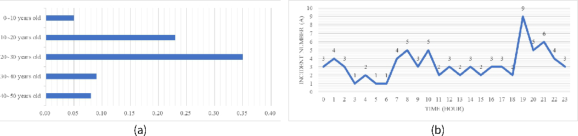
The age of the victims in the women’s daily mobility safety events reported in the media was counted, as shown in Figure 4(a). We found that most vic- tims were aged 20–30 years old, so we chose to target young women aged 20–30 years old in the next interview and questionnaire study. The number of participants reported in the media was counted, and we found that mul- tiple perpetrators accounted for 59.09% of the cases, while single victims accounted for 67.50% of the cases. The time of occurrence of women’s daily mobility safety events reported in the media is shown in Figure 4(b), with 7 p.m. being the highest incidence time.
Figure 4: (a) Age of women’s safety event victims. (b) The time of women’s daily mobility safety events (adapted from the author).
Interview: The Requirement We found that many women have certain opinions and dissatisfaction with the solution strategies and related products for women’s daily mobility safety problems today, and have certain expectations for future security products. Based on the content of the interviews, we summarized a table as shown in Table 2.
Table 2. Content of the interview (adapted from the author).
Table available in the original PDF paper.
Questions Answers Analysis everyday mobil- ity habits Q1 What is your everyday mobility frequency?
The everyday mobility frequency of respondents is generally relatively high.
The majority (5/8) of respondents go out almost every two days. Some respondents (2/8) go out every day. Very few (1/8) respondents go out infrequently.
Q2 What kind of transportation do you usually use?
Respondents tended to choose lower-cost modes of transportation.
Most of the respondents (6/8) would choose to walk or take public transport to go out. More than half (5/8) of the respondents would ride. A small percentage (2/8) of respondents would choose to take a private car or taxi.
All respondents planned their outings during the day.
Q3 What time do you usually go out and come home?
The vast majority (6/8) of respondents leave home in the morning and return in the afternoon or evening. Some (3/8) of the respondents go out at noon.
Some (3/8) have experienced this. These illegal activities give them the psychological damage.
Experience Q4 Have you ever encountered any incidents affecting personal safety when you go out?
Half (4/8) of respondents have used it. Half (4/8) of respondents have not used it.
The promotion degree of female safety protection products is relatively general.
The probability of events affecting personal safety in daily mobility is not very large. But it will bring an indelible psychological shadow to women. Q5 Have you ever used any female safety products such as pepper spray, shock sticks, alarms, etc.?
Q6 Have you ever used a female safety app?
Female safety apps are poorly promoted.
Some (3/8) of respondents have used it. More than half (5/8) of respondents had not used one.
Q7 Expect a new safety product for women?
All (8/8) respondents expect to launch a new product in this area.
Respondents preferred low saturation colors.
Respondents are eager to see more of these products on the market. Requirement Q8 What are your color expectations for the new security products?
Respondents expected products to be yellow, orange, pink, blue, and purple.
Q9 What are your styling expectations for the new security products?
Respondents expect the product to be simple, aesthetics, cute and compact in shape.
Respondents expected the app to be simple, functional and practical.
Respondents prefer more feminine looks. They hope the modelling of products softer and more rounded. Q10 What are your expectations for the new security product app?
Human-Centered Design Investigating and Developing 151
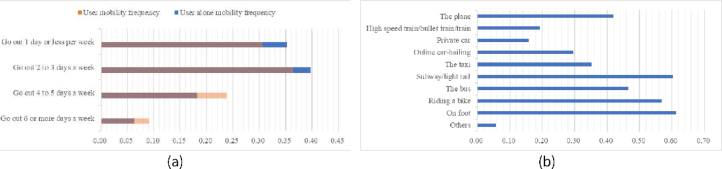
Questionnaire: The Reality Daily Mobility Habits The daily mobility frequency, solo daily mobility frequency, and daily mobility mode in the questionnaire are summarized as shown in Figure 5. From Figure 5(a), it can be seen that young women prefer the daily mobil- ity frequency of 2∼3 days a week; from Figure 5(b), it can be seen that young women’s preferred modes of transportation are walking, subway, and cycling.
Figure 5: (a) Comparison of daily mobility frequency and solo daily mobility frequency. (b) Which mode of transportation was preferred by the participants (adapted from the author).
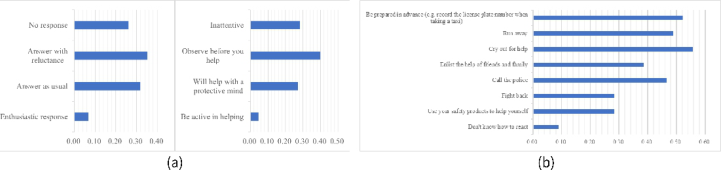
Daily Mobility Experiences In the questionnaire, the respondents’ reactions and coping methods when they met strangers were statistically analyzed, as shown in Figure 6. 25% of the respondents encountered security problems in their daily mobil- ity, of which 67.5% were alone when facing danger, and the over- all success rate of taking countermeasures to solve security incidents was 59.09%.
Figure 6: (a) Ways of coping with strangers accosting and strangers asking for help. (b) The way to deal with daily mobility safety problems (adapted from the author).
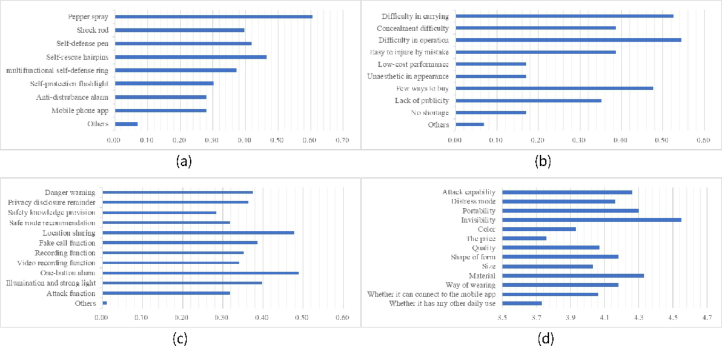
Usage and Recommendations of Women’s Daily Mobility Safety Products Among the respondents, 48.86% of women have used relevant products. The products they used are shown in Figure 7(a), and the difficulties they encoun- tered in using them are shown in Figure 7(b). In addition, 70.45% of them are very willing to try new women’s travel safety products. And they suggested areas where they wanted the product to improve, as shown in Figure 7(c).
The ranking of the focus on the product’s core requirements is shown in Figure 7(d).
Figure 7: (a) Which daily mobility safety products have been used. (b) Deficiency in women’s daily mobility safety protection products is considered. (c) The func- tion of women’s daily mobility safety protection products is expected by participants. (d) Importance score of each element of wearable products (adapted from the author).
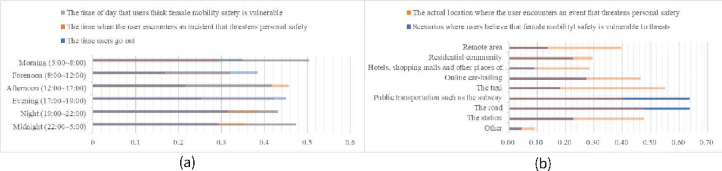
Female Daily Mobility Safety Awareness 50% of the respondents are actively concerned about women’s daily mobil- ity safety issues, of which 3.41% attach great importance to such issues. And 22.73% of women who are not actively concerned about such issues think that learning relevant knowledge is necessary. The comparison between respondents’ evaluation of women’s mobility environment and the actual situation is shown in Figure 8.
Figure 8: (a) Time comparison of daily mobility environment assessment and reality of participants. (b) Location comparison of daily mobility environment assessment and reality of participants (adapted from the author).
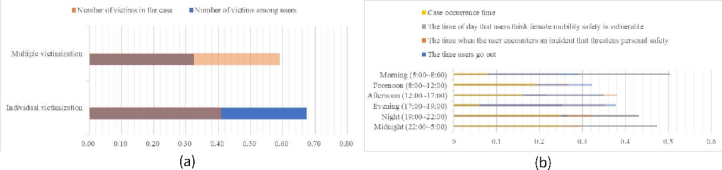
Reality and Perception Differences We compared the number of victims in the news events with the number of victims counted in the questionnaire as shown in Figure 9(a). We found
Human-Centered Design Investigating and Developing 153
that the proportion of multiple victims was higher in the news events and the number of female victims was higher among the women studied in the questionnaire so that neither multiple nor single persons should relax their vigilance about their surroundings in daily mobility. We compared the time of the news case, the time when women’s daily mobility safety was threat- ened in the questionnaire, the time when women thought the events should happen, and the time when women actually do daily mobility, as shown in Figure 9(b).
It can be found that the surveyed users encountered mobility safety prob- lems mostly in the afternoon to night time, which coincides with the time period of the surveyed users’ choice of mobility time, indicating that the time when women encountered mobility safety problems is more closely related to the mobility time chosen by the majority of women. There is a large dis- crepancy between the time when women’s mobility safety problems are likely to occur and the actual situation, which indicates that the time period when women’s mobility safety problems are likely to occur as perceived by the respondents does not correspond to the facts and requires a certain amount of safety knowledge popularization.
Figure 9: (a) Comparison of the number of victims. (b) Comparison of time information (adapted from the author).
DEVELOPMENT Design Location
After analyzing and researching the content of the previous work, this paper, starting from the human-centered design concept and design method- ology, determines to design a product combining software and hardware for the mobility safety problems of young women aged 20∼30, and plans a service system to guarantee the daily mobility safety of young women.
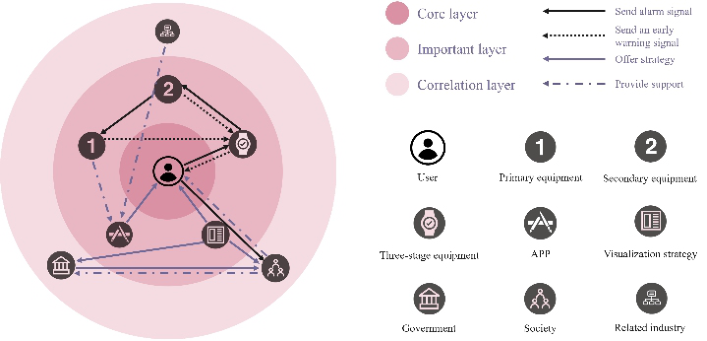
Product Functions and Usage The design results are composed of women’s mobility safety early warning interactive products - Primary equipment, Secondary equipment, and Three- stage equipment. Mobility safety apps and visual strategies are also included. It mainly includes an early warning function and an alarm function. All parts cooperate with each other to realize the service system to ensure the safety of women’s mobility, as shown in Figure 10.
Figure 10: Two phases of work: early warning phase and alarm phase (adapted from the author).
Design Details Hardware Products Primary equipment provides early warning of hazards through expression- motion recognition cameras, signal strength through signal strength indicator lights, and enhanced signal reception and transmission through the addition of parabolic antennas. The main role of Secondary equipment is to carry out hazard warning work for women’s safety on the road, collecting alarm signals and sending them to Primary equipment. The main role of the Three-stage equipment is to receive the warning signal sent by the Primary and Sec- ondary equipment, and send the signal to the nearest Secondary equipment when the target user sends an alarm signal. It realizes the danger warning to the target user through the body vibration function, and helps women to alarm through the interactive function, and the overall details are shown in Figure 11.
Figure 11: (a) Detail of primary equipment. (b) Detail of secondary equipment. (c) Detail of three-stage equipment (adapted from the author).
Figure available in the original PDF paper.
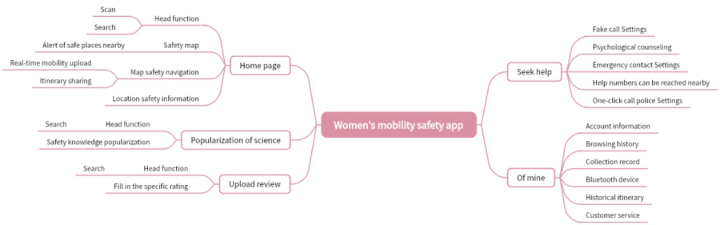
Software Product In order to better provide services and protection for young women and to implement the human-centered design concept, we designed an APP, whose main functions are shown in Figure 12.
Human-Centered Design Investigating and Developing 155
Figure 12: Application information architecture (adapted from the author).
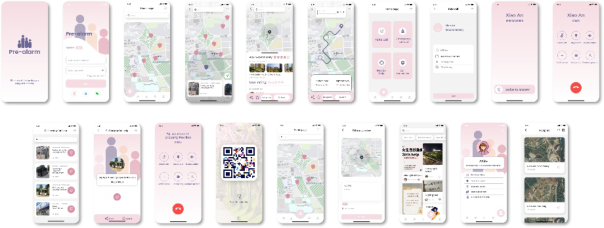
A high-fidelity model of the APP is shown in Figure 13. It realizes the con- nection with Three-stage equipment through Bluetooth, plans mobility routes for young women, and further improves the personalized service guarantee according to their feedback. In addition, it also has the function of popular- izing safety knowledge, which enables the target users to improve their safety awareness and master more mobility safety-related skills.
Figure 13: The high fidelity model (adapted from the author).
Systematic Strategy for Visualization According to the above research data, conclusions and design, we propose a set of information visualization strategy systems based on the current situation of young women’s mobility safety, as shown in Figure 14.
Figure 14: Information visualization strategy system (adapted from the author).
CONCLUSION
Based on the human-centered design concept and design methodology, this paper summarizes the user needs and determines the product design scheme centered on the early warning function and the expression action recogni- tion analysis technology, with a view to improving the awareness of women’s mobility safety in the whole society, reducing the potential safety hazards of women’s mobility, and moving the women’s safety issue from the theoretical level to the practical level. From the analysis of the news cases, it was found that both single and multiple participants are susceptible to dangerous events, and the same is true for daytime mobility, and this was verified in both the interview results and the questionnaire results. From the analysis of the inter- view results, the product expectations of the respondents were derived. From the analysis of the questionnaire results, it is found that there is a discrepancy between the perception of young women and the actual situation of danger- ous cases, and they may make wrong judgments and lay a safety risk as a result.
The innovation of this research result lies in the collection and integration of data from both case study and questionnaire survey directions, and the problem of inconsistency between young women’s cognition of daily mobil- ity dangers and the actual occurrence of dangers is found. At the same time, the concept of prior warning is introduced into the design of women’s mobil- ity safety protection products, so that women can not only use software products to anticipate the safety conditions of their own mobility environ- ment, but also get warning signals from the products to remind them to take appropriate countermeasures. Based on these issues, a set of strategies is pro- posed from the social level, individual level, and government level to study the related problems, with the intention of improving the awareness of mobility safety in the whole society and reducing the safety hazards of women.
Limitations The solutions proposed in this paper are only applicable to the current social situation in China, we hope to be able to collect more women’s difficulties in the process of daily mobility, and the product design concepts proposed in this paper can be realized theoretically as well as based on the existing science and technology in the modeling, but it still needs more tests to be further improved.
REFERENCES
Aggarwal, D., et al. (2022, February). An insight into android applications for safety of women: techniques and applications. In 2022 IEEE Delhi section conference (DELCON) (pp. 1–6). IEEE. CAI, Y. (2010). Reflections on the Human-centered Design. Packaging Engineering,
31(10), pp. 78–80. Chowdhury, S. and Van Wee, B. (2020). Examining women’s perception of safety during waiting times at public transport terminals. Transport policy, 94, pp. 102–108.
Human-Centered Design Investigating and Developing 157
del Mar Rodas-Zuleta, M., Cardona, S. and Escobar, D. (2022). Gender-based violence and Women’s mobility, findings from a medium-sized Colombian city: A quantitative approach. Journal of Transport & Health, 25, 101376. Dheeraj, K. and RJ, G. (2021). Women’s Safety Mobile App. International Journal
on Cybernetics & Informatics (IJCI), 10(1), p. 2. Frohmann, L. (2005). The framing safety project: Photographs and narratives by battered women. Violence against women, 11(11), pp. 1396–1419. Grosh, M., et al. (2008). For protection and promotion: The design and implemen-
tation of effective safety nets. World Bank Publications. Hancock, C., Blanchard, S. and Chapuis, A. (2018). Banlieusard. es claiming a right to the City of Light: Gendered violence and spatial politics in Paris. Cities, 76, pp. 23–28. Heng, H. (2021). Safe Cities for and by Women: Development of the Topic in Spatial
Research and Practice. New Building, 39(1), pp. 22–26. Herz, R. and Cahill, E. (1997). Differential use of sensory information in sexual behavior as a function of gender. Human Nature, 8, pp. 275–286. Li, N. (2017). Investigation on the Current Situation and Countermeasures of Female
College Students’ Safety Awareness. Intelligence, (4), pp. 94–95. McFarlane, J., et al. (2002). An intervention to increase safety behaviors of abused women: results of a randomized clinical trial. Nursing research, 51(6), pp. 347–354. Schwittay, A. (2019). Designing Urban Women’s Safety: An Empirical Study of Inclu-
sive Innovation Through a Gender Transformation Lens. The European Journal of Development Research, 31(4), pp. 836–854. Stark, J. and Meschik, M. (2018). Women’s everyday mobility: Frightening situations and their impacts on travel behaviour. Transportation research part F: Traffic psychology and behaviour, 54, pp. 311–323. Tandogan, O. and Ilhan, B. (2016). Fear of crime in public spaces: From the view of
women living in cities. Procedia engineering, 161, pp. 2011–2018. Uzzaman, M., Xulu-Kasaba, Z. and Haque, M. (2021). Personal safety and fear of sexual harassment among female garment workers in Bangladesh. International journal of environmental research and public health, 18(24), pp. 13406. Viswanath, K. and Basu, A. (2015). SafetiPin: an innovative mobile app to collect
data on women’s safety in Indian cities. Gender & Development, 23(1), pp. 45–60. Wan, C. and He, N. (2018). Summer Safety Guide for Women -- How to cope with Harassment. Collection, 6, pp. 80–81. Zhang, M. and Li, Z. (2019). Characteristics and Coping Strategies of Female College
Students’ Unsafe Travel Events. Journal of Guangxi Youth Leadership Academy, 3. Zhang, X. (2022). Research on female safety product design from the perspective of service design (a master’s degree thesis, the northern industrial university). Zhu, R., et al. (2021). Research on Intelligent Female Defense Products Based on
Modern Technology. Science and Technology Communication (16), 119-122. Doi: 10.16607/j.cnki.1674–6708.2021.16.043.
LISTED IN THE AHFE DIGITAL BOOKSTORE CATALOGUE
Explore the complete digital volume
Human-Centered Design and User Experience
Read this individual research paper free through the original publisher, or explore the full digital proceedings book.
ISBN 978-1-958651-90-2
Explore this ISBN in the AHFE Bookstore ↗Listed in the July 2026 bookstore catalogue; search by ISBN to confirm current availability · Digital book purchase optional