Paulo Jorge Martins Parra, André Gouveia, João Rocha (2026). EcoCar: A Human-Centered Design Approach to Sustainable Urban Micro-Mobility. In: Human Factors and Ergonomics In Design. AHFE Open Access, vol. 210, pp. 220–227. https://doi.org/10.54941/ahfe1007443
The EcoCar project emerges as a response to the urgent need for decarbonization and for a new paradigm in personalised urban mobility. Rather than extending existing solutions, EcoCar proposes a structural transformation in a sector that has consistently failed to meet environmental targets. The project aims to establish the foundations of a simplified and efficient mobility ecosystem, breaking away from the complexity and material intensity typically associated with conventional electric vehicles. Positioned within the L-category, EcoCar aligns with requirements for low energy consumption, accessibility, and the principles of Sustainable Urban Mobility Plans. Its design challenges the traditional automotive model by retaining only essential elements and prioritising modularity, customisation, additive manufacturing, and circular-economy values such as repair, reuse, and recycling. Compact and intelligent, it draws on lessons from existing micro-vehicles while defining clear objectives for safety and commercial viability. Integrated into a smart-city context, EcoCar supports communication between vehicles and users, facilitating access to traffic, pollution, and charging information, and promoting a connected urban mobility ecosystem. Its reduced dimensions contribute to more efficient traffic flow, with the potential to significantly increase circulation capacity compared to conventional cars. Developed from a blank-slate approach, EcoCar was conceived strictly around real user needs. Human-factors research, anthropometric data, and iterative physical experimentation guided the development of a full-scale prototype, enabling the evaluation of ergonomics, visibility, usability, and interior layout. The construction and public presentation of the prototype validated the concept and established a solid foundation for future development towards a functional electric vehicle.
Contemporary urban mobility faces profound structural challenges associated with the accelerated growth of cities, the concentration of populations in metropolitan areas, and the historical dependence on individually motorised transport. These factors result in a significant increase in road traffic, the saturation of existing infrastructure, and growing environmental impacts, expressed through greenhouse gas emissions, local air pollution, and the degradation of the quality of urban public space.
Conventional automobiles, designed for multiple contexts of use and often oversized in relation to users’ actual needs, display reduced efficiency Received February 6, 2026; Revised April 7, 2026; Accepted April 21, 2026; Available online July 20, 2026
EcoCar: A Human-Centered Design Approach to Sustainable Urban Micro-Mobility 221 when assessed against current sustainability standards. The low average occupancy rate, combined with high levels of energy consumption and technical complexity, contributes to a mobility model that lacks resilience and is difficult to reconcile with the decarbonisation and efficiency goals defined at European and international levels.
Within this context, it becomes essential to rethink the concept of the individual urban vehicle, questioning not only propulsion technologies but, above all, the project logic underlying automotive design. The EcoCar project emerges precisely from this critical need, proposing an alternative approach based on radical scale reduction, functional simplification, and user centrality, positioning design as a strategic tool for systemic transformation (Parra, 2007). This perspective aligns with human-centred design principles and systemic approaches to sustainability, in which the vehicle is understood not as an isolated artefact but as part of a broader urban mobility ecosystem.
Initially developed as academic research within the field of industrial design, EcoCar evolved over several years through successive phases of experimentation and prototyping, articulating theoretical knowledge, design practice, and empirical validation. In this sense, the project can be framed within a research-through-design approach, where iterative prototyping operates as a means of exploring, testing, and refining design hypotheses. This article aims to present this trajectory in an integrated manner, situating EcoCar within the contemporary debate on sustainable urban mobility, human factors, and innovation oriented towards environmental responsibility.
Design Approach and Methodology The design approach adopted in the EcoCar project is grounded in a critical view of traditional automotive design and in the application of principles of human-centred design, systemic sustainability, and innovation oriented towards complexity reduction (Parra & Mestre, 2002). Rather than starting from the incremental optimisation of existing solutions (Sparke, 2002), the project adopts an exploratory and prospective stance, questioning from the outset the functional, formal, and cultural assumptions associated with the individual urban vehicle. This approach positions design not only as a problem-solving activity, but as a mode of inquiry through which alternative mobility scenarios can be critically explored.
From a methodological perspective, EcoCar was developed through an iterative and non-linear process, structured into successive cycles of conception, materialisation, evaluation, and reformulation. This methodology enabled the continuous integration of theoretical and empirical knowledge, fostering progressive learning throughout the project. Prototyping played a central role in this process, being used as a tool for applied research capable of revealing technical, ergonomic, and production-related constraints that are difficult to identify solely through digital models. Within this framework, each iteration functioned as a test of specific design assumptions, allowing the identification of constraints and opportunities that informed subsequent design decisions.
The project began with a phase of contextual and conceptual research, involving a critical analysis of existing urban mobility systems, their associated environmental impacts, and emerging typologies of electric micro-vehicles (Wood, 1997). This phase made it possible to establish the
guiding principles of EcoCar, namely dimensional reduction, modularity, component minimisation, and the simplification of the product life cycle, from production through to recycling. These principles were not treated as fixed requirements, but as working hypotheses to be progressively evaluated and refined throughout the design process.
Subsequently, conceptual drawings and preliminary CAD models were developed and used as instruments for formal and structural exploration. These digital models enabled the assessment of overall proportions, volumetric relationships, and initial construction solutions, serving as a basis for the production of physical models. The transition from the digital environment to physical materialisation proved to be a key moment in the methodological process, allowing hypotheses to be validated and adjustments to be introduced based on experimentation. In particular, discrepancies between digital assumptions and physical behaviour provided critical feedback for refining both structural and ergonomic aspects of the design.
The adopted methodology also integrated the use of digital manufacturing technologies, such as 3D printing and CNC milling, not only as means of production but as tools for design thinking. These technologies enabled a high speed of iteration, which was essential for testing different solutions with a controlled investment of time and resources. In this way, EcoCar consolidates a hybrid methodology in which design, engineering, and material experimentation are articulated in a continuous manner. This hybrid approach reinforces the role of prototyping as a mechanism for knowledge generation, bridging conceptual intentions and material realisation within a research-oriented design process.
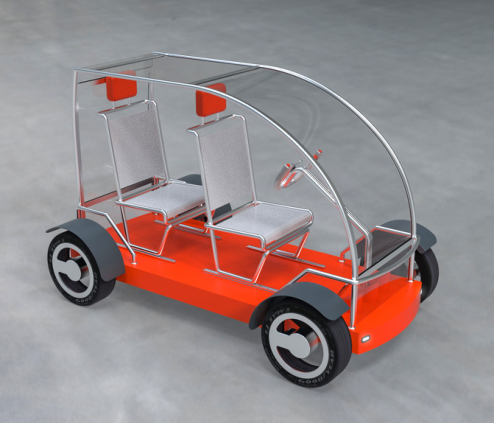
Figure 1: Full-scale EcoCar prototype highlighting the simplified structural concept and user-centred ergonomic configuration.
EcoCar: A Human-Centered Design Approach to Sustainable Urban Micro-Mobility 223 Human Factors and Ergonomics
The consideration of human factors and ergonomics constituted one of the structural pillars of the EcoCar project, decisively influencing the formal, dimensional, and functional choices of the vehicle. Based on the principle that urban mobility should be designed according to real users rather than idealised use scenarios, the project incorporated, from its earliest stages, anthropometric data, principles of physical and cognitive ergonomics, and established references in the field of human factors (Stanton et al., 2005). Within this framework, human factors were treated not as constraints to be accommodated, but as active drivers of design decisions.
In an initial phase, the definition of the overall dimensions of the chassis and passenger compartment was based on anthropometric tables representative of the adult population, ensuring comfortable accommodation for a wide range of users (Dreyfuss Associates, 1993). Parameters such as seated height, functional reach of the upper and lower limbs, visual fields, and joint angles associated with the driving posture were considered. These data informed decisions regarding seat height, pedal positioning, steering column inclination, and the location of primary controls. This translation of anthropometric data into spatial configuration allowed the alignment of dimensional reduction objectives with ergonomic viability.
Beyond theoretical analysis, the project made extensive use of physical experimentation through the construction of simplified ergonomic models. These models made it possible to simulate the driving experience and to empirically evaluate postural comfort, control accessibility, and users’ spatial perception (Del Zanna, 1995). The use of rapid models proved particularly effective in identifying ergonomic conflicts at an early stage, reducing the need for costly corrections in later phases of the project. These physical simulations provided feedback that could not be fully anticipated in digital environments, particularly in relation to posture, reach, and perceived spatial constraints.
Visual and cognitive ergonomics were also taken into account, particularly with regard to the driver’s field of vision, the layout of informational elements, and the simplification of the human–machine interface. The reduction in the number of controls and the clarity of the information presented align with the objective of minimising cognitive load while driving in a complex urban environment. This approach contributes to increased safety, ease of learning, and user acceptance of the vehicle. In this sense, interface simplification was not only a functional decision, but also a strategy to enhance usability under cognitively demanding urban conditions.
By integrating human factors as a transversal component of the design process, EcoCar demonstrates that ergonomics should not be understood as a final adjustment, but as a structuring element of sustainable mobility design, ensuring functional efficiency, comfort, and user well-being simultaneously. This integration reinforces the role of ergonomics as a core component of design reasoning, directly informing both form development and system performance.
Prototype Development The development of the EcoCar prototype embodies the convergence of conceptual research, ergonomic validation, and constructive feasibility. This phase represented a decisive moment in the project, in which the decisions made at the levels of design and methodology were tested under real materialisation conditions, allowing the overall coherence of the system to be assessed. In this sense, prototyping functioned as a critical stage for evaluating the viability of previously established design assumptions.
The first stage of materialisation consisted of the production of a 1:10 scale model, conceived as an intermediate model for formal and structural validation. For this purpose, the existing CAD drawings were adapted to the available manufacturing technologies, requiring the refinement of geometries, the definition of minimum thicknesses, and the reorganisation of components. The model was produced using a combination of filament- based 3D printing, CNC milling, and thermal forming processes of plastic materials, enabling a clear reading of the concept and its constructive logic. This translation from digital models to physical artefacts made it possible to assess the coherence between formal intent and constructive feasibility.
Reduced-scale models made it possible to identify structural weaknesses, adjust proportions, and anticipate challenges associated with the production of the full-scale model. This iterative process reinforced the importance of prototyping as a tool for learning and decision-making, contributing to a significant improvement in the quality of the final project. In particular, the identification of structural limitations at this stage informed subsequent design refinements and prevented the transfer of unresolved issues to later phases.
Based on the results obtained, the CAD drawings were further developed for the production of the full-scale (1:1) prototype. At this stage, the three- dimensional model was refined with a view to technical feasibility, taking into account manufacturing processes, structural materials, and assembly methods (Page, 1966). Detailed technical drawings, visualisations, and three- dimensional models were produced, serving as the basis for the construction of the structural platform, chassis, and vehicle enclosure. This phase required the reconciliation of design intentions with material and production constraints, resulting in a more robust and feasible system configuration.
The production of the main platform took place in an academic context, using advanced prototyping equipment. This platform functions as the structural backbone of the vehicle, supporting all functional components, such as axles, seats, the steering column, and auxiliary systems. For the production of the tubular structure and final finishing, a collaboration was established with an industrial unit, allowing the prototype to approach a technically realistic solution. The collaboration between academic and industrial contexts contributed to bridging experimental design exploration with practical production conditions.
The final phase involved the complete assembly of the prototype, integrating all previously developed structural and functional elements. The result was a fully operational physical demonstrator, presented in public and museological contexts, which made it possible to validate the EcoCar concept
EcoCar: A Human-Centered Design Approach to Sustainable Urban Micro-Mobility 225 at formal, ergonomic, and constructive levels. This full-scale materialisation confirmed the project’s potential as a basis for future industrial developments and for its integration into sustainable urban mobility systems. At this stage, the prototype operated as a comprehensive validation tool, enabling the assessment of the interaction between structural, ergonomic, and functional components within a single integrated system.
Discussion The analysis of the results obtained throughout the development of the EcoCar project makes it possible to identify a set of relevant contributions to the field of sustainable urban mobility and product design oriented towards responsible innovation. The progressive materialisation of the concept, from exploratory models to a functional full-scale prototype, demonstrated the feasibility of a design approach based on the deliberate reduction of complexity and the optimisation of material and energy resources. However, this feasibility should be understood within the scope of a prototype-based validation, and further development would be required to assess performance under real operating conditions.
When compared with conventional automobiles, EcoCar shows clear advantages in terms of spatial efficiency, energy consumption, and suitability for the urban context. Its reduced dimensions allow for a significantly smaller occupation of public road space, enabling a reorganisation of traffic flows and a more rational use of urban space. This characteristic is particularly relevant within the framework of Sustainable Urban Mobility Plans (SUMPs), which advocate integrated, multimodal solutions aimed at reducing environmental impact (European Commission, 2019). These potential advantages, while conceptually grounded, remain to be quantitatively assessed in future stages of development.
From a design perspective, the project reinforces the importance of iterative methodologies and prototyping as instruments of applied research. The ability to test, evaluate, and reformulate solutions throughout the process contributed to a more effective integration of human factors, avoiding frequent inconsistencies between formal concept and usability. The articulation between the academic context and industrial collaboration also demonstrated the potential of higher education institutions as active agents in the production of applied knowledge and socially relevant innovation. In this context, the project highlights how design processes can operate as structured forms of inquiry, where material experimentation and iterative testing contribute directly to knowledge generation.
Finally, EcoCar shows that sustainability in mobility design is not limited to the adoption of electric propulsion systems, but requires a profound reconfiguration of the cultural, technical, and functional assumptions associated with the automobile. The proposal of a minimal, modular, and communicative urban vehicle points towards new scenarios of personalised, shared mobility integrated into intelligent urban ecosystems. At the same time, the project raises questions regarding scalability, regulatory integration, and user adoption, which remain open for future investigation.
CONCLUSION
The EcoCar project represents a relevant contribution to the debate and practice of sustainable urban mobility, demonstrating the feasibility of a simplified electric urban vehicle that is user-centred and aligned with principles of environmental and social sustainability. Full-scale prototyping enabled the validation of the concept, usability, and ergonomics, establishing a solid foundation for subsequent development phases. Within this context, the project also demonstrates how iterative prototyping can operate as a method for integrating design intentions with empirical validation.
Beyond its formal and technical outcomes, the EcoCar project illustrates the relevance of Human Systems Integration (HSI) as a structuring approach to the design of complex mobility systems. By placing the human as an integral element of the system from the earliest design stages, the project demonstrates how user needs, behaviours, constraints, and ergonomic requirements can be systematically incorporated throughout the development process. This perspective reinforces the role of design as a mediator between technological feasibility and human-centred performance.
In this context, the growing body of knowledge surrounding HSI, supported by emerging modelling tools and frameworks, offers significant potential for enhancing interdisciplinary collaboration. The development of HSI frameworks supported by Systems Modeling Language (SysML) enables the use of a shared language and structured processes for distributing models and sharing information across design, engineering, and validation stages. Such approaches contribute to greater coherence across the system lifecycle and support the development of more robust, usable, and sustainable solutions.
As future work, the evolution of EcoCar towards a phase of detailed engineering and functional testing is envisaged, with a view to series production and integration into shared mobility ecosystems. Further research may deepen the incorporation of digital communication and traffic management systems, reinforcing EcoCar’s role within smart-city contexts. In this sense, EcoCar can be understood not only as a vehicle concept, but as a practical demonstration of how Human Systems Integration can inform the development of sustainable, human-centred urban mobility systems. At the same time, the transition from prototype to implementation will require further validation in real-world conditions, particularly in relation to user adoption, regulatory frameworks, and system integration.
ACKNOWLEDGMENT
CIEBA – Centre for Research and Studies in Fine Arts, Faculty of Fine Arts, University of Lisbon.
REFERENCES
Del Zanna, G. (1995) Humans, Disabilities, and the Environment: Research into Criteria for Accessible Design. Bollate: Editrice Abitare Segesta Spa. Dreyfuss Associates, H. (1993) The Measure of Man and Women: Human Factors in
Design. New York: Whitney Library of Design. European Commission (2019) Sustainable Urban Mobility Plans: Guidelines.
Brussels: European Commission. Page, S.F. (1966) Body Engineering: Design and Construction of Motor Vehicle Bodywork. London: Chapman & Hall. Parra, P.J.M. (2007) EcoCar: Sustainable Urban Mobility and Human-Centered
Vehicle Design. Tese de doutoramento, Universidade de Lisboa, Lisboa, Portugal. Parra, P.J.M. e Mestre, A. (2002) MUSA Project – Applied Sustainable Urban Mobility. In: Proceedings of the International Conference on Eco Design. New Delhi, India. Sparke, P. (2002) A Century of Car Design. London: Mitchell Beazley. Stanton, N.A., Hedge, A., Brookhuis, K., Salas, E. e Hendrick, H.W. (2005) Handbook
of Human Factors and Ergonomics Methods. Boca Raton: CRC Press. Wood, J. (1997) Concept Cars. Bristol: Parragon Books.
LISTED IN THE AHFE DIGITAL BOOKSTORE CATALOGUE
Explore the complete digital volume
Human Factors and Ergonomics In Design
Read this individual research paper free through the original publisher, or explore the full digital proceedings book.
ISBN 978-1-964867-86-1
Explore this ISBN in the AHFE Bookstore ↗Listed in the July 2026 bookstore catalogue; search by ISBN to confirm current availability · Digital book purchase optional