Said Youssouf Kadafi, Hui Lyu, Tebello Pusetso, Zhang Xusheng (2023). Design Application of Solar Backpack for African Rural Area Students. In: Human-Centered Design and User Experience. AHFE Open Access, vol. 114, pp. 289–295. https://doi.org/10.54941/ahfe1004246
Access to electricity is a significant challenge in Africa, the impact of which is even greater in schools in isolated rural areas. According to the World Bank, approximately 600 million people (nearly two-thirds of the population) in Sub-Saharan Africa lack access to electricity, leading to difficulties in people’s livelihood, including limited educational opportunities. It has been observed that students living in rural areas take long-distance walks (1h to 2hrs) to school early in the morning and return home after dark with no street lights. Moreover, many students study at night without access of light and electricity. Therefore, this study aims to explore the potential applications and benefits of solar-powered backpacks for African students living in rural areas. The study was conducted in Comoros, at the Mohammadia Community School in the village of Irohe Oichili and the village of Chomoni Oichili where students walk more than 6.5km to get to school. Three hundred and one students were interviewed. The questionnaire was employed to capture necessary data for the solar-powered backpack design and a vivid picture of the importance of this design in Comorian rural communities for students. The parameters within the questionnaire includes families’ financial status, whether electrical power shortage affects the students’ educational performance, whether the solar-powered backpack will benefit the students and so on. The results of the survey showed that 82% of the students came from families with low financial status. 80% of the students reported that electrical power shortage affects their educational performance. 90% of the students reported that they would benefit from using a solar-powered backpack. Therefore, a solar-powered backpack was designed with a solar panel attached to the front of the backpack, and a LED light was attached directly inside the backpack. For the charging facility, the backpack is occupied by a USB port, located on the bag’s exterior, connected to the charge center and the battery, while the battery inside the pack is stored neatly away. The battery provides power to the port through an extension system connected inside the backpack. The prototype was tested, and we found that the average time spent on the school way to charge is 1h48min. The capacity of the battery charged on the way is 36%. The period of usage for studying is 1h30min, and the battery life after usage is 16%. As a result, a solar-powered backpack could provide a convenient, portable and sustainable source of electricity for student living in remote areas who are unable to access the electrical grid. Future work is to update the prototype with an attached solar panel that can be disconnected for better charging when the student enters the classroom or at home.
Access to electricity is a significant challenge in Africa.The impact is even greater in sub-Saharan Africa (hereafter Africa or SSA), where electrification is substantially lower than what it could be, which severely limits economic activities, the provision of public services and quality of life, and the adop- tion of new technologies in various sectors such as education, agriculture, and finance (Blimpo and Cosgrove-Davies, 2019). Not only is the 43 per- cent access rate far below that in comparable regions (and also below the global access rate of 87 percent), but also the total number of people without electricity has increased in recent decades as population growth has outpaced electrification growth. Moreover, the access rate in rural Africa is much lower (25 percent) (Blimpo and Cosgrove-Davies, 2019). Thus, schools in rural areas of Africa are greatly impacted, and because of this, students’ academics are jeopardized.
Despite the obvious connection between electricity and educational achievement, however, there had been troubling scenes reported in Guinea, South Africa, and Uganda (UNDSA, 2014). It has been reported that children gather in publicly illuminated areas (like parking lot street lights) to study and complete their homework because they have electricity neither at home nor at their school in Guinea (Goodwin, 2013). In South Africa, each year almost
80,000 young children unintentionally ingest kerosene (spilled from lamps) to the point where they need to be admitted to the hospital and, even with treatment, more than half (60 percent) develop chemically induced pneumo- nia (Furukawa, 2012). In Uganda, it is common for children to study in bed with a candle on the edge of their headboards, inducing fires and thousands of burn-related accidents, some of which lead to death or lifelong disfigurement (Kanagawa and Nakata, 2008).
Past technical innovations resulted in the existence of renewable energy technologies such as photovoltaic, micro hydro power, biomass gasification and wind power. These technologies are mature and often possess lower levelized costs of electricity than fossil fuel-based system such as diesel gener- ators. Hence the challenge today is not to find ways of generating electricity in an environmentally acceptable manner but how to disseminate and operate these technologies in a financially sustainable way in rural areas in develop- ing countries (Agbemabiese et al., 2012). Thus Agbemabiese et al. (2012) point out that not only new energy technologies but deployment approaches are required to reach the goal of universal energy access. Small stand-alone systems such as PicoPV and Solar Home Systems (SHS) are successfully distributed in a financially sustainable way (IEA, 2011).
In defiance of the technical innovations made, some families are impov- erished and struggle to obtain or install electricity alternatives. Therefore, this study aims to explore the potential applications and benefits of solar- powered backpacks to provide convenient, portable and sustainable source of electricity for African students living in rural areas while studying at home or school at night.
METHODOLOGY
The present study was conducted in the rural areas of Comoros, specifically at the Mohammadia Community School situated in the village of Irohe Oichili and several schools in Chomoni Oichili village. It was observed that the stu- dents residing in these areas are compelled to commute a distance of over 6. 5 km, often taking more than an hour each way, to attend school since the schools are very isolated to the villages. Neither the villages nor the schools have access to electricity. The questionnaire was employed to interview 301 students from primary and high school. The primary rationale behind the questionnaire interview was to have a vivid picture of the importance of the solar-powered backpack design in Comorian rural communities for students; considering factors such as their family’s financial status, power shortage impact on the students’ educational performance and understanding these students’ wishful solution to the problem.
DESIGN OF A SOLAR-POWERED BACKPACK The objective of the solar-powered backpack is to offer illumination to stu- dents during their evening study sessions, whether it be at their home or schools, as well as to supply power for other gadgets like cellular phones. A backpack that operates on solar power has been constructed, featuring
Design Application on Solar Backpack for African Rural Area Students 291
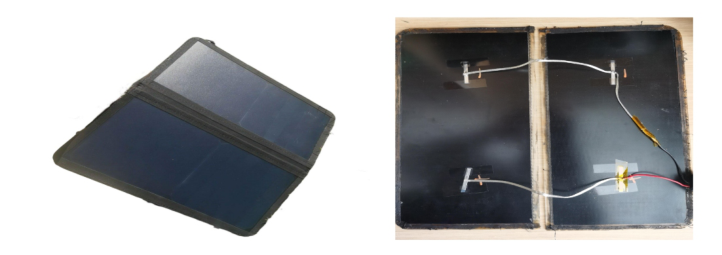
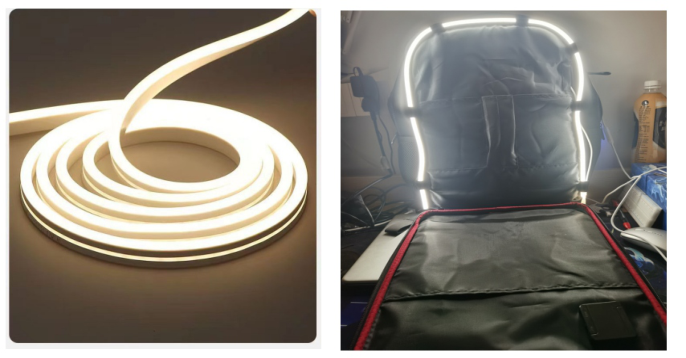
two photovoltaic panels as shown in Figure 1 attached to its frontal surface. The proposed strategy involves capitalizing on the considerable distance cov- ered by students during their daily commutes to and from school as a means of harnessing solar energy through the absorption of sunlight by the panel, which in turn charges the solar controller or micro-inverter that converts the direct current into alternating current to charge the battery. The LED lamb cable (see Figure 2) is attached within the backpack, receiving power from the battery to provide illumination. The backpack is also equipped with a charg- ing feature that incorporates a USB port located on the exterior of the bag, which is connected to the charge centre and battery. The battery is securely stored within the pack and supplies power to the port via a cord system that is internally integrated into the backpack.
Figure 1: Photovoltaic panels used in solar-powered backpack design.Figure 2: LED light system.
Usability Testing of a Solar-Powered Backpack The objective of conducting a user testing is to obtain input from the student demographic pertaining to the design and functionality of the solar-powered
292 Kadafiet al.
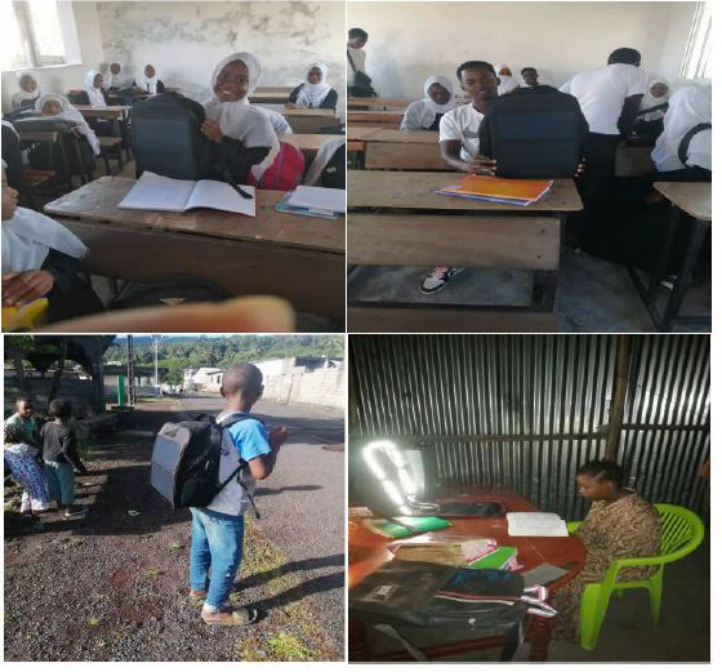
backpack. The provision of feedback facilitates the identification of areas with potential for improvement and serves as a means of determining the suit- ability of backpacks for meeting the needs of students residing in rural regions of Africa. As part of the study, a total of 32 participants (see Figure 3) were selected for the purpose of conducting usability testing of the solar-powered backpack. The study utilized a questionnaire to obtain data regarding the duration of recharging the battery on the way to school, the quantity of bat- tery capacity charged during this process, the time covered while utilizing the backpack light for studying, and the residual life of the battery subsequent to the use of the backpack light.
Figure 3: Usability testing of the solar-powered backpack.
RESULTS AND DISCUSSIONS
Table 1 indicates that rural areas of Comoros, specifically Mohammadia Community School in the village of Irohe Oichili and various schools in Chomoni Oichili village are not electrified. These communities are consid- ered impoverished with no sustainable income as the highest number of the students for unemployment of both parents captured 82%. The survey also
Design Application on Solar Backpack for African Rural Area Students 293
Table 1. Survey of the importance of electricity on education.
Table available in the original PDF paper.
Questions Answers No of students What is the occupation status of your parents?
(a) 22 (b) 19 (c) 248 (d) 12 (e) 0
(a) Both employed (b) One employed (c) Both unemployed (d) Self employed (e) other Is your home electrified? (a) Yes (b) No
(a) 0 (b) 301
If no, any electricity supply alternatives used at your home?
(a) Yes (b) No
(a) 97 (b) 204
If yes, what alternative are there in terms of electricity supply at your home?
(a) 95 (b) 2 (c) 0 (d) 0 (e) 0
(a) Stand-alone solar panels (b) Solar home system (c) Generator (d) Wind power (e) other
What light source do you use at your home? (those with no electricity and alternative power)
(a) 72 (b) 132 (c) 0
(a) Candle (b) Lamp (c) Other Is your school electrified (a) Yes (b) No
(a) 0 (b) 301
If no, any electricity supply alternatives used at your school?
(a) Yes (b) No
(a) 121 (b) 180
If yes, what alternatives are there in terms of electricity supply at your school?
(a) 5 (b) 81 (c) 35 (d) 0 (e) 0
(a) Stand-alone solar panels (b) School solar systems (c) Generator (d) Wind power (e) Others
Does unavailability of electricity affect your education?
(a) Yes (b) No
(a) 243 (b) 58
If yes, how does it affect your education?
(a) 165 (b) 22 (c) 55 (d) 1
(a) Insufficient light to do homework at night (b) Unable to charge gargets (phones and laptops) for research (c) Lack of access to electric instruments for learning at school (d) Others (a) Yes (b) No (a) 271 (b) 30
Do you think a solar-powered backpack that provides light and charging facility will be helpful to you?
If yes, which function is more important to you?
(a) 224 (b) 47
(a) Light (b) Charging gargets
294 Kadafiet al.
shows that 68% of the students have no electricity supply alternative, while the remaining 32% have alternative electricity supply at home. The percent- age of students who reported to have alternative electricity supply, 98% use the stand-alone solar panels and 2% have installed the solar home system. It can be inferred that many households use stand-alone solar panels primarily to charge small devices such as phones and electric lamps, rather than larger appliances such as stoves and heaters that require adequate power supply. Additionally, the survey shows that 64% of students who do not have access to electricity use kerosene lamps and 38% use candles to light their homes. Thus, from this we can conclude that such students do not have sufficient light to study at home at night. Similarly, the schools in these villages are not electrified, 40% of the students indicated that their schools have alterna- tive electricity supply, while 60 % have none. Students whose schools have alternative electricity supply; 4% use stand-alone solar panels, 67% use solar school systems and 29% use generators. 80% of the students reported that electrical power shortage affects their educational performance. It is there- fore observed that electricity shortage affects education negatively as 55% of students indicated that insufficient light prohibits them to study at night, 7% of the students complain that they are unable to charge their gargets for research and 18% of students struggle because of lack of electrical instru- ments for learning at school. To finalize the survey, we asked the students if they think a solar backpack that provides light and charging facility will be helpful to them, 90% said it will be helpful. From this, 74% of the students mentioned that the light is the most important function of the backpack, whereas 26% say the charging facility is important.
USABILITY TESTING OF A SOLAR-POWERED BACKPACK The data indicates that on average, the duration of charging the battery on the way to school is 1h48min, the quantity of battery capacity charged on the way is 36%, the time covered while utilizing the backpack light for studying is 1h30min, and the residual life of the battery subsequent to the use of the backpack light is 16%. From this, the inference is to update the prototype with a solar panel that can be connected and disconnected for better charging when the student enters the classroom or when at home.
CONCLUSION
Electricity shortage negatively impacts the educational prospects of students in rural areas of Africa. On the other hand, the rural communities of Africa are impoverished to install convenient electricity supply alternative systems in schools and their homes. As a result, a financially affordable innovation such as the solar-powered backpack that will provide convenient, portable and sustainable electricity for illumination and charging is suggested.
REFERENCES
Agbemabiese, L., Nkomo, J., & Sokona, Y. (2012). Enabling innovations in energy access: An African perspective. Energy Policy, pp. 38–47.
Design Application on Solar Backpack for African Rural Area Students 295
Blimpo and Cosgrove-Davies. (2019). Electricity Access in Sub-Saharan Africa International Bank for Reconstruction and Development / The World Bank. Chishio Furukawa. (2012). Health and Safety Benefits of Replacing Kerosene Can-
dles by Solar Lamps: Evidence from Uganda (Brown University. Economics and Environmental Studies Department. Evan Mills. (2012). Health Impacts of Fuel-based Lighting. Lumina Project Technical Report. Lawrence Berkeley National Laboratory: 10. IEA. (2011). World Energy Outlook 2011 - Energy for All. IEA. Phil Goodwin. (2013). The dark side of education. available at https://www.one.or
g/us/2013/10/08/the-dark-side-of-education/. UNDESA. (2014). Electricity and education: The benefits, barriers, and recommendations for achieving the electrification of primary and secondary schools. Energy and Education 1.
LISTED IN THE AHFE DIGITAL BOOKSTORE CATALOGUE
Explore the complete digital volume
Human-Centered Design and User Experience
Read this individual research paper free through the original publisher, or explore the full digital proceedings book.
ISBN 978-1-958651-90-2
Explore this ISBN in the AHFE Bookstore ↗Listed in the July 2026 bookstore catalogue; search by ISBN to confirm current availability · Digital book purchase optional