Robert Bąk, Anna Wicher, Patryk Wicher (2025). Survival in the real and digital world – an example of innovative support for preventive medicine using INNOAGON methods. In: Human Factors in Sports, Preventive Medicine and Innovative Agonology. AHFE Open Access, vol. 188, pp. 69–76. https://doi.org/10.54941/ahfe1006484
The cognitive goal of this article is to present knowledge about the yet unknown proportions of convergence and divergence between the subjective sense of one's own motor and mental competences to survive in various circumstances of the natural environment and social interactions with the results of applied motor, non-motor and mixed-motor simulations, among young women and men preparing for a profession related to the universal human values hypothesis. The study enrolled 32 students from the University of Rzeszów studying sports and military. No distinction has been made based on sex, as it was assumed that that awareness of threats and competence to survive are essential characteristics of every human being, regardless of sex. The level of perception and survival skills has been studied in two areas, i.e. in the real world (RW) and digital world (DW). Respondents correctly identify the main areas of survival competence in the real and digital worlds. There are large discrepancies between imagined and empirically verified survival skills, in both areas studied. There are empirically proven grounds for implementing and objectively assessing the competencies of survival in the real and digital world as specific components of somatic, mental and social health. It is necessary to objectively verify these competences with simple and easily accessible research tools.
In this article, the phenomenon of survival is identified with a new applied science, INNOAGON (innovative agonology), the mission of which coincides with the hypothesis about the primary of the universal human values: ‘survival of humans and nature in a non-degenerate form and responsibility for coming generations’ (Piepiora and Kalina, 2023, p. 285). Therefore, this is a very broad understanding of the term “survival”, which, in our view, connects a micro scale with a macro scale in a distinct manner. This is also how we perceive INNOAGON’s methodological and application offerings aimed at strengthening all health dimensions together with survival ability from a micro (personal safety) to a macro scale (Kalina, 2020, p. 171, 2024a, Kalina and Kruszewski, 2023).
We have been studying elementary phenomena from the perspective of knowledge acquired so far, not only about extreme threats to health and life of a human acting in a natural and artificial (created by a human) environment (Tomczak and B¸ak, 2019; B¸ak, 2020; 2021). We also strive to expose as many elements from the complementary perspective and from the view of the cited literature discussing INNOAGON and preventive medicine (Kalina, 2023, 2024; Wicher et al., 2025). This perspective is very broad and individual scientific papers may as well be devoted to, e.g., the notion of combining conventional treatment methods based on pharmaceuticals with recommendations that do not cause any negative side effects. On the contrary, they will at least reinforce the therapeutic effects (that are associated with a given disease) but they will also have preventive effects that go beyond a given treatment profile. Such example is the idea of incorporating programmes that reduce the risk of injury from unintentional falls into treatment procedures at sanatoria (Wicher et al., 2025).
The cognitive goal of this article is to present knowledge about the yet unknown proportions of convergence and divergence between the subjective sense of one’s own motor and mental competences to survive in various circumstances of the natural environment and social interactions with the results of applied motor, non-motor and mixed-motor simulations, among young women and men preparing for a profession related to the universal human values hypothesis.
MATERIAL AND METHODS The study enrolled 32 students from the University of Rzeszów studying sports and military. No distinction has been made based on sex, as it was assumed that that awareness of threats and competence to survive are essential characteristics of every human being, regardless of sex. The level of perception and survival skills has been studied in two areas, i.e. in the real world (RW) and digital world (DW). In the first stage, students declared the types of needs and threats and their own competences in given area. In the RW area, these were declarations of skills (RWD), which involved the so- called Five Basic Survival Skills (shelter, fire, food and water, first aid, rescue signalling). Correspondingly, the following main threats (DWD) have been identified in the DW area: ‘disinformation and manipulation’, ‘identity theft and fraud’, ‘cyberbullying’, ‘health threats’, and ‘dehumanization’.
Table 1: Methods of verifying declared skills in the RW area.
Table available in the original PDF paper.
Verified Element
First Aid Rescue Signalling
Shelter Fire Food and Water Starting a fire Preparing a
Demonstrating Preparing
Practical task Constructing a shelter from scratch in a forest using survival methods
elements for quick alarm signalling
various improvised methods of dressing wounds and fractures
meal from fish and available plants + water extraction and treatment
Survival in the Real and Digital World – An Example of Innovative Support 71
Declarations of students have afterwards been empirically verified through practical performance tasks. In the RWV area (real world verification), these were verified during a survival camp (Table 1).
In the DWV (digital world verification) area these were verified using computer tests and situation assessment (Table 2).
Table 2: Methods of verifying declared skills in the DW area.
Table available in the original PDF paper.
Cyberbullying Health
Dehumanization
Verified Element
Identity Theft and Fraud
Threats
Disinformation and Manipulation Identification
Identification Identification
Identification
Practical task Disinformation and manipulation resistance test
of physical, mental and social health risks
of threats related to identity loss and ICT fraud
of threats related to isolation from people, denial of humanity
of cyberbullying (hate, humiliation, harassment, intimidation, exclusion)
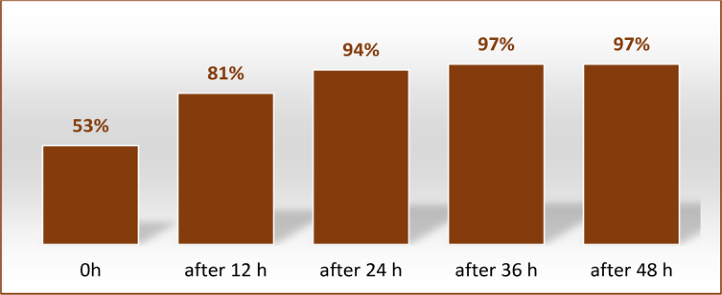
The first author of this article has taken part in the study as an observing participant. The students have also declared being motivated for survival activities in both areas. Creativity, teamwork and level of information deprivation (students were not able to use their phones for 48 hours) have been additionally assessed in the RWV area. Declarations of the need to use a phone and associated depressed wellbeing have been collected at 12-hour intervals.
RESULTS
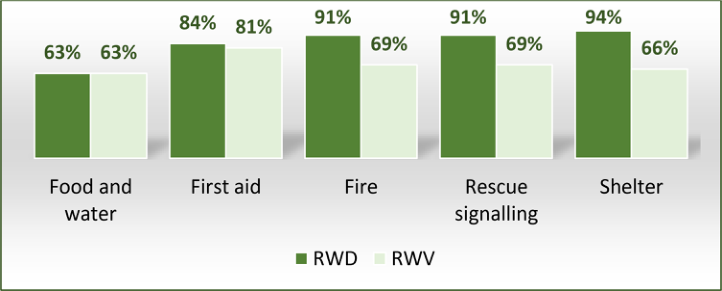
Real World (RW) Area Students’ declarations revealed a high awareness of the needs and threats in the real world (RW). As far as the identification of the Five Basic Survival Skills is concerned, the vast majority of students were able to identify the main survival needs, while declaring competence in this area, with the most significant being ‘shelter’ (94%), ‘fire’ (91%), ‘rescue signalling’ (91%) (Figure 1).
Empirical verification in the RW area revealed differences in declarations made and competences demonstrated.
Many of the respondents did not fully confirm the skills they had previously declared (Figure 3). The highest level of convergence was noted for competences associated with ‘food and water’ (63%→63%) and ‘first aid’ (84%→81%) and the lowest level was observed for ‘shelter’ (94%→66%).
The students surveyed had high motivation to undertake survival activities, particularly in the RW area (average motivation 9.1 on a scale of 1–10), and were slightly less motivated in the DW area (8.2). When performing survival tasks during field activities (RW area), the students revealed high creativity (4.1 on a scale of 1–5). In addition, 67% of the participants actively engaged in activities that required cooperation with other participants.
72 B¸ak et al.
Figure 1: Average results of declared (RWD) and verified (RWV) real world (RW) survival skills, ordinal variable – level of differences (source: own research).
The average level of revealed differences between declarations and skills was 18% in the RW area.
The research revealed psychological deficits in the study group (Figure 3). Students most often defined feelings related to having no access to their phones as “anxiety” caused by no access to information. Only one person consistently declared no need in this regard.
Figure 2: Student declarations regarding the need for access to a smartphone, ordering variable: deprivation time (source: own research).
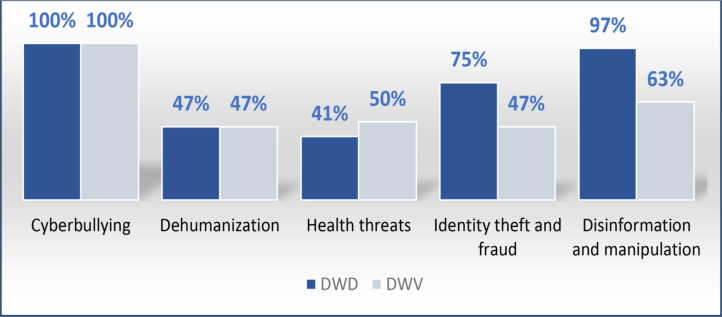
Digital World (DW) Area As far as declarations regarding functioning in the digital world (DW) are concerned, a high awareness of the main threat factors and declared competences was revealed (Figure 2). Respondents perceived a high level of threat from ‘cyberbullying’ (100%), ‘disinformation and manipulation’ (97%), ‘identity theft and fraud’ (75%). In contrast, awareness of social
Survival in the Real and Digital World – An Example of Innovative Support 73
(‘dehumanisation’ 47%) and health-related (‘health threats’ 41%) threats was surprisingly low (Figure 2).
A greater convergence of declarations and skills was revealed than in the DW area. Respondents were able to accurately identify the main threats they identified in their declarations: ‘cyberbullying’ (100%→100%)) and ‘dehumanization’ (47%→47%); the greatest difficulty was encountered while identifying ‘disinformation and manipulation’ (97%→63%).
The average level of revealed differences between declarations and skills was 15% in the DW area.
Figure 3: Average results of declared (DWD) and verified (DWV) real world (RW) survival skills, ordinal variable – level of differences (source: own research).
As a source of their competence, 69% cited their own activity and 94% the use of other people’s experience (Internet, YouTube, personal relationships).
Those with the highest competences (RW+DW) were highly motivated and creative but often did not cooperate in a group. On the other hand, those with the lowest competences were less motivated but were eager to cooperate with other participants.
DISCUSSION
As far as methodology is concerned, these study results are closest to the concept of ‘innovative agonology’, an applied science dealing with promotion, prevention and therapy related to all dimensions of health and concerning the optimisation of activities increasing the ability to survive (from a micro to a macro scale) (Kalina and Kruszewski, 2023, p. 193). If the acquisition of survival competencies is considered, whether in the real or digital world, as a preventive measure for individual health, this fact generates far more far-reaching implications. On a macro scale, we can even assume that we are discussing broadly understood social and mental health. It is true that high levels of willingness to cooperate and motivation or dependence on smartphones revealed by the study are something else. On the other hand, differences in the subjective assessment of one’s own competences versus possessed (proven) competences for survival reveal
74 B¸ak et al.
dilemmas related to the objective measurement (or self-awareness) of these competences. From the point of view of innovative agonology, these are fundamental dilemmas, related mainly to the difficulties in measuring mental and social health (Dobosz, 2024, p. 130). Even if based on the simplest indicators, measurement is a fundamental prerequisite for confronting one’s own subjective sense (Kalina, 2012; B¸ak et al., 2019).
It is easier to measure elements of somatic health, and the results of pilot studies in young men and women (Dobosz, 2018, 2019) demonstrate their cognitive and applied value. Only to a certain extent it is easy to confront one’s own sense of survivability with objective indicators. There is an infinite number of situations in which a person can lose their life, health or freedom. However, the methods recommended for military use (Tomczak, 2022), the results of unique experiments (Tomczak, 2013, 2021, 2022), together with imagination, creative disposition of researchers, methodological competence and their sense of responsibility are the main prerequisites for constructing original empirical systems that meet the criteria for scientific measurement of phenomena.
Therefore, appropriate task categories were constructed to measure survivability (both in the real and digital world) in order to make this measurement objective, for the purpose of results of own studies presented here. This methodological procedure, which meets the criteria for accurate scientific measurement, brought the expected results. Students’ ideas were confronted with reality that was deliberately created experimentally, but therefore based on direct evidence. Revealed deficits provide an empirical basis for educational measures in these areas. The effectiveness of such measures has been acknowledged in various studies using easy- to-use research (and educational) tools (Klimczak and Kalina, 2020; G¸asienica-Walczak and Kalina, 2021; Kalina et al., 2024). The greatest divergence has been revealed in the digital world (DW) area, which is of particular significance given the age of participants. The entire group is the so-called ‘Generation Z’, i.e. the generation for whom digital reality is naturally intertwined with or often even preferred to the real world. According to their declarations, they derive their knowledge (the most reliable one in their opinion), not only in the field of ‘digital survival’, mainly from the media (Internet, YouTube). This is a generation raised in a fully digitalised society, but often unaware of digital risks. Furthermore, they have been hit hard by the COVID-19 pandemic (B¸ak, 2020). This justifies the need for education, tailored to this generation’s specific perception of the surrounding reality.
CONCLUSION
1. There are empirically proven grounds for implementing and objectively assessing the competencies of survival in the real and digital world as specific components of somatic, mental and social health. 2. It is necessary to objectively verify these competences with simple and easily accessible research tools.
Survival in the Real and Digital World – An Example of Innovative Support 75
REFERENCES
B¸ak R, Barczy´nski BJ, Krzemieniecki LA. Reliability of the Mental and Social Health (M&SH) Questionnaire – test-retest adult men and women. Arch Budo 2019; 15: 321–327. B¸ak, R., (2020). Students’ attitudes towards survival competencies before and after
Covid-19 lockdown. Arch Budo Sci Martial Arts Extreme Sports, 16, pp. 85–90. B¸ak, R., (2021). The ability to use firearms in stressful conditions as an important criterion for survival. Arch Budo Sci Martial Arts Extreme Sports; 17: … Dobosz, D. (2019) Empirical verification of self-rated positive health (somatic
dimension) in women with professional competence in the field of health education. Pedagog Psychol Med-Biol Probl Phys Train Sport 2019; 23(2): 66–75. Dobosz, D. (2018) Empirical verification of self-rated positive health (somatic dimension) in men with professional competence in the field of health education. Arch Budo Sci Martial Art Extreme Sport; 14: 93–100. Dobosz, D. (2024). Methodological dilemmas concerning measuring of mental and
social health: a narrative review. ARCH BUDO, 20. G¸asienica Walczak, B., and Kalina, R. M. (2021). Validation of the new version of “the susceptibility test to the body injuries during the fall” (STBIDF-M). ARCH BUDO, 17, pp. 371–400. Kalina, A., Kruszewski, A., & G¸asienica-Walczak, B., 2024. Motor modifications
versus movement habits in measuring the SFI phenomenon. Archives of Budo Journal of Innovative Agonology, 20. Kalina, R. M. (2012) The profile of Sense of Positive Health and Survival Abilities indices (subjective assessment) as a diagnostic tool used in health-related training. Arch Budo; 8(3): 179–190. Kalina, R. M. (2024a) BUDO & INNOAGON – historical complexity but similar
missions. Arch Budo J Inn Agon; 20: 1–15. Kalina, R. M. (2024b) Preventive Medicine – the Most Prestigious Profession of the Near Future. Human Factors in Design, Engineering, and Computing, 2024; 159: 1453–1459. Kalina, R. M. (2023) Complementary Medicine – An Example of the Application
of the Basic Research Method of Innovative Agonology. Proceedings of the 14th International Conference on Applied Human Factors and Ergonomics and the Affiliated Conferences (AHFE 2023); 2023 Jul 20–24; San Francisco, USA. Healthcare and Medical Devices 2023; 79: 316–324. Kalina, R. M., (2020). Language and methods of innovative agonology as a guide in interdisciplinary research on interpersonal relationships and people with the environment – from micro to macro scale. ARCH BUDO, 16, pp. 271–280. Kalina, R. M., and Kruszewski, A. (2023). INNOAGON is an acronym for
‘innovative agonology’, but is not synonymous with ‘science of martial arts’. ARCH BUDO, 19. Klimczak, J., and Kalina, A. (2020). Projection of a specific class of human activity on a micro to macro scale as a presumption for a simple approach to measurements of mental and social health. ARCH BUDO, 16, pp. 325–332. Piepiora PA, Kalina RM. Hypothesis on the supreme value criteria of the global
civilization. In: J. Kalra, N. Lightner (eds.) Healthcare and Medical Devices. AHFE (2023) International Conference. USA: AHFE International, 2023; 79: 280–289. Tomczak, A. (2013) Effects of a 3–day survival training on selected coordination motor skills of special unit soldiers. Arch Budo; 3: 168–172. Tomczak, A. (2021) Changes in coordination motor abilities of young men during
survival school simulation training. Warszawa: Akademia Sztuki Wojennej. Polish.
76 B¸ak et al.
Tomczak, A. (2022) The “survival multidisciplinary competition” psychomotor competence test as a synthetic tool for modern defence education. Arch Budo Sci Martial Art Extreme Sport; 18: 51–59. Tomczak, A., and B¸ak, R. (2019). Chances of survival in isolation in the case of Polish
military pilots – a comparative analysis of the research from 1998 and 2018. Arch Budo Sci Martial Arts Extreme Sports, 15, pp. 69–76. Wicher PT, ´Sliwczy´nski A, Wierzba W et al. (2024) Preventive medicine in clinical practice: Rationale based on the diversity of implemented interventions with spa patients in Poland 2018–2023. Health Prob Civil; 18(4).
LISTED IN THE AHFE DIGITAL BOOKSTORE CATALOGUE
Explore the complete digital volume
Human Factors in Sports, Preventive Medicine and Innovative Agonology
Read this individual research paper free through the original publisher, or explore the full digital proceedings book.
ISBN 978-1-964867-64-9
Explore this ISBN in the AHFE Bookstore ↗Listed in the July 2026 bookstore catalogue; search by ISBN to confirm current availability · Digital book purchase optional