Samuel Mekonnen, Tebello Pusetso, Ugwueke Emmanuel, Hui Lyu (2023). Anthropometric-based school furniture design for Ethiopian secondary school students. In: Ergonomics In Design. AHFE Open Access, vol. 77, pp. 466–472. https://doi.org/10.54941/ahfe1003405
Students take part in one of the most sedentary occupations. They spend an average of 5-8 hours in school daily. About 80% of this time, they sit in the classroom doing activities such as reading, writing, and communicating. It has been suggested that schools are places where students develop their permanent sitting habits (M. S. Parvez, et al, 2018). The mismatch between students and school furniture dimensions has been associated with adolescent low back pain (Milanese & Grimmer, 2004). Therefore, suitable and comfortable school furniture for students is necessary. Although many developed countries have proposed school furniture dimension guidance, developing countries and most least-developed countries still lack the support of an anthropometric database for school furniture design. Therefore, this study aims to fill this gap by establishing an anthropometric database of secondary school students in Addis Ababa, Ethiopia, investigating the mismatch between students' anthropometric dimensions and current school furniture dimensions, and providing recommendations for secondary school furniture dimensions.MethodSample selection Two hundred secondary school students (85 (42.5%) male and 115 (57.5%) female) from two secondary schools in Addis Ababa, Ethiopia, were recruited in this study. Every 25 subjects were randomly selected from each grade in each secondary school using the cluster sampling method. The mean ± SD age and body height were 17 ± 1.4 years and 5.4 ft ± 0.3 ft respectively. The sample size was set according to suggestions from World Health Organization that 200 is the minimum sample size used for building reference standards (WHO, 1995). Before testing, all subjects were instructed about the contents of the experiment and provided their consent.Data treatment and Analysis Body dimensions, including stature, sitting height, knee height, popliteal height, and thigh clearance, were measured using metallic tape. Data were presented with mean, standard deviation, and percentile base for the 5th, 50th, and 95th percentile values. Based on the percentile values of anthropometric dimensions of subjects and furniture dimensions, combinational formulas of furniture dimensions were set. The mismatch is determined if the calculated value of the critical dimensions is outside the interval quantity (Gouvali et al., 2006).ResultThe results of this study show that the chairs and tables of secondary schools in Addis Ababa were poorly designed without considering the anthropometric features of students. Most students sit in chairs with a seat that is too tight and without a backrest, which may cause health problems such as back pain in the long term. Therefore, we proposed three sets of acceptable furniture dimension range for the secondary school students in Addis Ababa, which may be helpful as a reference for school furniture design, and subsequently improve students’ comfort and health in school.
Ergonomics is the scientific discipline concerned with understanding inte- ractions among humans and other elements to optimize human health and overall system performance (Bridger, 2021). By creating products, furni- ture, and other gadgets that are suited to the specifications of the human body, we can improve human comfort, physical health, well-being, and performance.
Students take part in one of the most sedentary occupations. They spend an average of 5–8 hours in school daily. About 80% of this time, they sit in the classroom doing activities such as reading, writing, and communicating (Dhara et al., 2009). It has been suggested that schools are places where stu- dents develop their permanent sitting habits (Parvez et al., 2018). However, poor sitting posture during the school day causes school-aged children to have musculoskeletal pain, including back, neck, leg, and shoulder pain (Kaya
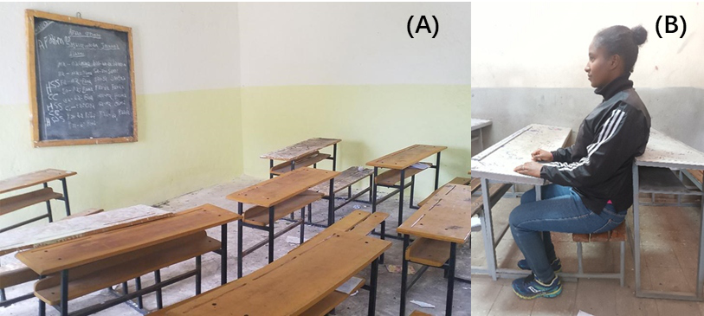
Figure 1: (A) Existing furniture in Ewket Le Hibret secondary school, addis ababa, ethiopia. (B) A subject’s sitting condition in the classroom.
and Erkarslan, 2019, Milanese and Grimmer, 2004). The mismatch betw- een the students’ body and school furniture dimensions was considered a crucial ergonomic factor contributing to poor sitting posture (Saarni et al., 2009). For instance, when a chair is excessively high, the underside of the thigh becomes compressed, and there is improper foot contact with the floor, which causes discomfort and blood flow restrictions. The student is compel- led to advance his buttocks on the chair seat as a result of this circumstance. When there is a lack of back support, students may sit with a slouched, kyphotic posture. When the chair is too low, the knee flexion angle decre- ases, the students’ weight is distributed unevenly across the posterior thighs and is transferred to a limited area of the ischial tuberosities (Chung and Wong, 2007), with the pelvis tilts backward. Therefore, suitable and com- fortable school furniture for students is necessary. Although many countries have proposed school furniture dimension guidance, least-developed coun- tries (LDCs) such as Ethiopia still lack the support of an anthropometric database for school furniture design (see Figure 1).
This study aims to fill this gap by establishing an anthropometric data- base of secondary school students in Addis Ababa, Ethiopia, investigating the mismatch between students’ anthropometric dimensions and current school furniture dimensions, and providing recommendations for future secondary school furniture design in Ethiopia.
METHODOLOGY
Sample Selection For this study, regular secondary school students were considered as the user population. Two hundred students (85 (42.5%) male and 115 (57.5%) female) from four grades (9-12) and two secondary schools in Addis Ababa, Ethiopia, were recruited using the cluster sampling method (mean age 17 ± 1.4 years, mean height 5.4 ± 0.3ft). Every 25 subjects were randomly selected from each grade in each secondary school.
The sample size was set according to suggestions from World Health Organization that 200 is the minimum sample size used for building refe- rence standards (Sellen, 1998). Before testing, all subjects were instructed about the contents of the experiment and provided their consent.
Data Collection Dimensions of students and school furniture were measured manually by an experienced researcher. Length measurements were done with metallic tape. A plastic ruler was used to set the maximum reference point for measuring stature, sitting height, knee height, popliteal height, and thigh clearance. Nine anthropometric dimensions (see Table 1) and six school furniture dimensions (see Table 2) measurements were taken.
Table 1. Anthropometric measures (Castellucci et al., 2014).
Table available in the original PDF paper.
Body dimensions Descriptions Stature (S) The vertical distance between the floor and the top of the head, and measured with the subject standing erect and looking straight ahead Shoulder Height Sitting (SHS) The vertical distance from the subject’s seated surface to the acromion Elbow Height Sitting (EHS) Taken with a 90
elbow flexion, as the vertical distance from the olecranon to the seated surface Subscapular Height (SUH) The vertical distance from the inferior angle of the scapula to the seated surface Popliteal Height (PH) Taken with 90
knee flexion, as the vertical distance from the floor to the popliteal surface Thigh Thickness (TT) The vertical distance from the highest uncompressed point of the thigh to the seated surface Hip Width (HW) The horizontal distance measured at the widest point of the hip in the sitting position Buttock-popliteal Length (BPL) Taken with a 90
knee flexion, as the horizontal distance from the posterior surface of the buttock to the popliteal surface Buttock-knee Length (BKL) Taken with a 90
knee flexion, as the horizontal distance from the posterior surface of the buttock to the front of the kneecap
Table 2. School furniture dimensions (Castellucci et al., 2014).
Table available in the original PDF paper.
Furniture Dimensions Descriptions Seat Height (SH) The vertical distance from the floor to the middle point of the front edge of the seat Seat Depth (SD) Distance from the back to the front of the sitting surface Seat Width (SW) The horizontal distance between the lateral edges of the seat Upper Edge of Backrest (UEB)
The vertical distance between the middle points of the upper edge of the backrest and the top of the seat Desk Height (DH) The vertical distance from the floor to the top of the front edge of the desk Seat to desk Clearance (SDC)
The vertical distance from the middle point of the front edge of the seat to the lowest structure point below the desk
Anthropometric-Based School Furniture Design 469
Data Treatment and Analysis Anthropometric measures were calculated and displayed using mean, stan- dard deviation, and the 5th, 50th, and 95th percentile values. Based on the percentile values of anthropometric measures and furniture dimensions, combinational formulas of furniture dimensions were set (see Table 3). The
Table 3. Dimension combination formulas (Castellucci et al., 2014, Osquei-Zadeh et al., 2012).
Table available in the original PDF paper.
Measures Formulas Seat Height (SH) and Popliteal Height (PH) (PH + 2) cos 30
mismatch percentages between body and furniture dimensions were subse- quently calculated. According to Gouvali and Boudolos (2006), a mismatch is determined if the calculated value of the critical dimensions is outside the interval quantity (i.e., lower or shorter than the minimum, or higher or taller than the maximum values).
With the formulas and percentile values of anthropometric dimensions (see Table 4), three recommended chair-desk combinations were proposed for the 5th, 50th, and 95th % of secondary school students in Addis Ababa, Ethiopia.
RESULT
The match and the mismatch percentages were calculated for both males and females (See Table 6). Table 4 shows the anthropometric measures of students. Table 5 shows the dimensions of the existing school furniture. We found that the seat depth and upper edge of the backrest displayed a misma- tch percentage of 100%. The desk height was 100% matched with the student’s body dimensions. Seat height showed a 17.3% and 15% misma- tch percentage for males and females, respectively, when 49.3% and 40% of seat width did not match males and females. Seat-to-desk clearance mani- fested a mismatch of 13.3% and 20% for males and females, respectively.
Tables 7 and 8 proposed the acceptable furniture dimension range and the recommended furniture dimensions based on the students’ anthropometric measures, respectively.
CONCLUSION
In this study, we provided an anthropometric database of secondary school students in Addis Ababa, Ethiopia, and proposed recommendations for sch- ool furniture design, which may subsequently improve students’ comfort and health in school. The results of this study showed that the chairs and desks of secondary schools in Addis Ababa were designed without considering most of the anthropometric features of students. Most students sit in chairs with seat depths too narrow and without a backrest, which may cause health pro- blems such as back pain in the long term. Except for the desk height, all the rest parameters did not match the measured students’ anthropometry.
ACKNOWLEDGMENT
The authors would like to acknowledge Ewket Le Hibret and Higher 23 secondary school directors and students who take part in this study, for their willingness and support for this study.
REFERENCES
Bridger, R. S. (2021) Introduction to Human Factors in Accident Investigation. RS Bridger. Castellucci, I., Arezes, P. and Molenbroek, J. ‘Applied anthropometrics in school
furniture design: which criteria should be used for standardization’. Proceedings of the 5th international conference on applied human factors and ergonomics AHFE, 23. Chung, J. W. and Wong, T. K. (2007) ‘Anthropometric evaluation for primary school furniture design’, Ergonomics, 50(3), pp. 323–334.
Dhara, P. C., Khaspuri, G. and Sau, S. K. (2009) ‘Complaints arising from a mismatch between school furniture and anthropometric measurements of rural secondary school children during classwork’, Environmental health and preventive medicine, 14(1), pp. 36–45. Gouvali, M. K. and Boudolos, K. (2006) ‘Match between school furniture dimensions
and children’s anthropometry’, Applied ergonomics, 37(6), pp. 765–773. Kaya, N. A. and Erkarslan, Ö. (2019) ‘Mismatch between classroom furniture and student body dimensions: Case of Izmir’, Ergonomi, 2(3), pp. 167–177. Milanese, S. and Grimmer, K. (2004) ‘School furniture and the user population: an
anthropometric perspective’, Ergonomics, 47(4), pp. 416–426. Osquei-Zadeh, R., Ghamari, J., Abedi, Z. and Shiri, H. (2012) ‘Ergonomic and anthropometric consideration for library furniture in an Iranian public univer- sity’, International Journal of Occupational and Environmental Medicine, 3(1), pp. 19–26. Parvez, M., Parvin, F., Shahriar, M. and Kibria, G. (2018) ‘Design of ergonomically
fit classroom furniture for primary schools of Bangladesh’, Journal of Engineering, 2018, pp. 1–9. Saarni, L. A., Rimpelä, A. H., Nummi, T. H., Kaukiainen, A., Salminen, J. J., and Nygård, C.-H. (2009) ‘Do ergonomically designed school workstations decrease musculoskeletal symptoms in children? A 26-month prospective follow-up study’, Applied ergonomics, 40(3), pp. 491–499. Sellen, D. (1998) ‘Physical Status: The Use and Interpretation of Anthropometry.
Report of a WHO Expert Committee. WHO Technical Report Series No. 854. Pp. 452. (WHO, Geneva, 1995.) Swiss Fr 71.00’, Journal of Biosocial Science, 30(1), pp. 135–144.
LISTED IN THE AHFE DIGITAL BOOKSTORE CATALOGUE
Explore the complete digital volume
Ergonomics In Design
Read this individual research paper free through the original publisher, or explore the full digital proceedings book.
ISBN 978-1-958651-53-7
Explore this ISBN in the AHFE Bookstore ↗Listed in the July 2026 bookstore catalogue; search by ISBN to confirm current availability · Digital book purchase optional