Samia Rafique, Jecha Suleiman Jecha, Hui Lyu (2023). Evaluation of ergonomic needs among female sewing machine operators in garments industry of Bangladesh: a pilot study. In: Physical Ergonomics and Human Factors. AHFE Open Access, vol. 103, pp. 78–82. https://doi.org/10.54941/ahfe1003037
The enrichment of the garments industry in Bangladesh has given employment to millions of people, especially women. With cellular manufacturing, enhanced productivity accompanies increased musculoskeletal disorders risk (Shaheen A., Mohammad Z.R, 2014). Sewing operators working posture is a vital factor related to musculoskeletal symptoms (Dianat et al., 2015). However, there is limited research on the ergonomic needs evaluation among Bangladesh female sewing machine operators.Seven female sewing machine operators in a garment manufacturing unit in Dhaka, Bangladesh, were recruited for this pilot study. A combined survey sheet was developed to record demographic information and CMDQ questionnaires. The demographics included age, weight, height, marital status, and education level. CMDQ is a survey sheet to evaluate the rating of symptoms in specific body parts (neck, shoulder, arm, upper back, lower back, leg) by multiplying the frequency, severity, and interference scores. Anthropometric measurement and sewing facilities (table and chair) dimension measurement were conducted. Subjects were interviewed about their subjective opinions on the ergonomic functions of sewing machine facilities.Participants were 31.6±8.8 years old, 56.4±8.4 kg, and 5.27±0.35ft. They are married, and their educational levels range from class 5 to 8. A typical daily work process of a female sewing machine operator in a garment manufacturing unit in Bangladesh is constantly sitting for more than 10 hours with a 1-hour lunch break. They hardly move around, only to pick up their work in the morning and submit their production to their supervisor at the end of the day. After a whole day of work, four people reported lower back pain, while three reported neck pain, 2 with leg pain, and 1 with arm pain. Lower back got the highest discomfort score (26.5), followed by neck (10), arm (7), and leg (3). The mismatch computations between body and facility dimensions showed that the current design of sewing facilities is unsuitable for female workers. The seat height is too low, and the hip width is too narrow for them. According to interviews, subjects complained about their current working chair without elbow rest which was quite uncomfortable for them to work. It could be one of the reasons that a worker is facing severe arm pain. Consistent with anthropometric measurement results, several subjects mentioned that the seat and desk height was inappropriate for them. They had to use a cushion on the seat to make them more comfortable.In conclusion, female sewing operators in Bangladesh's garment industry face a high risk of musculoskeletal disorders with mismatched facility dimensions and little consideration of their ergonomic design. A better understanding of their ergonomic needs involving sewing operations can potentially impact workers' quality of life and national productivity.
Bangladesh has enriched in garments industry in recent past years. It is a promising step in industrialization, which has given employment to millions of unemployed people, especially women (Kabir et al., 2019, Sikdar et al., 2014). However, with cellular manufacturing, enhanced productivity accom- panies increased musculoskeletal disorders. It may be due to the given focus on production rather than workers’ health condition (Kabir and Ahmed, 2003). A study revealed that most female workers in the garment sector suf- fer from musculoskeletal diseases such as neck and back pain (Ahmed and Raihan, 2014). Among them, sewing operators who work with sustained awkward posture are the population with a high risk of musculoskeletal sym- ptoms (Dianat et al., 2015, Sealetsa and Thatcher, 2011). However, there is
Evaluation of Ergonomic Needs Among Female Sewing Machine Operators 79
limited research to uncover their working conditions and ergonomic needs (Ali et al., 2014).
Therefore, this study aims to investigate the ergonomic needs of female sewing machine operators in the garments industry of Bangladesh and pro- pose a design concept of a ‘relaxing chair’ based on interviews, questionnai- res, and arthrometric measurements.
METHODS
Seven female sewing machine operators, mean age 31.6 ± 8.8 years old, mean weight 56.4 ± 8.4 kg, and mean height 5.27 ± 0.35 ft, in a garment manu- facturing unit in Dhaka, Bangladesh, were recruited for this pilot study. A combined survey sheet was developed, including demographic questions and Cornell Musculoskeletal Discomfort Questionnaires (CMDQ). Because most of the subjects were illiterate, surveys were conducted by questioning. The demographics included age, weight, height, marital status, and education level. CMDQ is a survey sheet used to evaluate the rating of symptoms in specific body parts (neck, shoulder, arm, upper back, lower back, and leg) 1 hour after work and after a whole day of work by multiplying the frequency, severity, and interference scores. Table 1 shows the details of CMDQ.
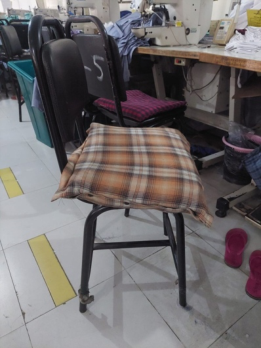
Anthropometric measurements and sewing chair dimension measurements were conducted manually using a metallic tape. Figure 1 shows the wor- king chair and its measurements. Subjects were also interviewed about their opinions on the ergonomic functions of sewing facilities.
Table 1. Cornell musculoskeletal discomfort questionnaires for specific body part.
Table available in the original PDF paper.
Frequency Severity Interference 0 = Never 1 = slightly uncomfortable 1 = not at all 1.5 = 1-2 times/week 2 = moderately uncomfortable 2 = slightly interfered 3.5 = 3-4 times/week 3 = very uncomfortable 3 = substantially interfered 5 = once in every day 10 = several times every day
Figure 1: (A) current working chair and (B) working chair dimensions.
RESULTS
The subjects’ demographic information and anthropometric data are shown in Tables 2 and 3, respectively. Subjects were all married, and their educatio- nal levels ranged from class 5 to 8.
Based on observations and interviews, a typical daily work process of a female sewing machine operator in a garment manufacturing unit in Bangla- desh is constantly sitting for more than 10 hours with a 1-hour lunch break. They hardly move around, only to pick up their work in the morning and submit their production to their supervisor at the end of the day.
Among seven subjects, no one reported shoulder and upper back pain. After 1 hour of work, the lower back got the highest average discomfort score (3.57 ± 5.62), followed by the neck (1.43 ± 2.56), arm (1.00 ± 2.65), and leg (0.43 ± 0.73). After a whole day of work, the average discomfort score of the lower back increased to 6.21 ± 8.42, followed by the arm (3.00 ± 7.94), neck (1.86 ± 2.53) and leg (1.86 ± 3.18) (see Tables 4 and 5).
The mismatched computations between body measurements and chair dimensions showed that the current sewing facilities were unsuitable for them ergonomically (see Table 3). The mismatched computations showed that the backrest was lower mismatched with 42.9% of subjects, the seat width was lower mismatched with 100% of them, and the seat height was higher mismatched with 100% of them. According to interviews, the subject complained about their current sewing chairs without an elbow rest which was quite uncomfortable for them to work. It could be one of the reasons that workers are facing severe arm pain. Consistent with anthropometric measure- ment results, several subjects mentioned that the seat and desk heights were
Table 2. Subjects’ demographic information.
Table available in the original PDF paper.
Subject Age (years) Weight (kg) Height (ft) Marital Status Education 1 40 69 6 Married Class 5 2 45 45 5 Married Class 8 3 21 50 5 Married Class 5 4 24 52 5.3 Married Class 8 5 25 64 5.3 Married Class 7 6 33 55 5.3 Married Class 8 7 33 60 5 Married Class 8
Table 3. Subjects’ anthropometric measurements.
Table available in the original PDF paper.
Measurements Mean ± SD (cm) Mismatch percentage Sitting Height 83.1 ± 2.3 Shoulder Height 55.6 ± 2.4 42.9% LM with UEB Elbow Rest Height 31.2 ± 1.5 Popliteal Height 40.0 ± 1.2 100% HM with SH Hip Breadth 36.1 ± 0.9 100% LM with SW Knee to Knee breadth 15.5 ± 0.3
inappropriate. They had to use a cushion on the seat to make them more comfortable (see Figure 1 left).
DISCUSSIONS The results gave an insight into the working conditions of female sewing machine operators. They sat for more than 10 hours a day with a 1-hour lunch break and barely moved around. The CMDQ analysis showed that, after a whole day of work, their localized discomfort scored highest in the lower back, followed by the arm, neck, and leg, but not in the shoulder and upper back. Meanwhile, the mismatched calculations found that the upper edge of the backrest and the seat width was too low, while the seat height was too high for them. However, at the same time, we found that female operators liked having a soft cushion on their seats to make themselves com- fortable, which may indicate unsuitable desk-chair dimensions in the sewing workplace.
It has been reported that sewing operations require the coordination of feet, hands, and eyes with the body statically inclined forward (Dianat et al., 2015). Prolonged forward inclination, with lower back muscles contracting continuously, is a high-risk factor for musculoskeletal disorders. And the design of the backrest may become useless under this condition.
Currently, research on improving sewing operators’ workplaces is limi- ted. This study has limitations in terms of sample size and needs further exploration.
CONCLUSION
With this pilot study, we found that female sewing operators in Bangladesh’s garments industry faced a high risk of musculoskeletal disorders due to the following factors: 1) prolonged working hours without rest; 2) mismatched facility dimensions; 3) non-adjustable chairs without armrests. Therefore, we developed a design concept of a ‘relaxing chair’, which will be produced based on anthropometric data of a larger sample size. It would have a soft cushion and an armrest that would be height-adjustable. Moreover, it will be equip- ped with neck and lumbar support to reduce disc pressure during sustained work. Which hopefully will improve the health conditions of female sewing operators in Bangladesh. Future work would evaluate the comfort level and discomfort scores of sewing operators after a whole day sitting in the current and the modified chair.
ACKNOWLEDGMENT
The authors would like to thank all the subjects who participated in this study and gave their valuable opinions. Moreover, we would like to ackno- wledge International Design Education (IDE) program for providing this opportunity.
REFERENCES
Ahmed, S. and Raihan, M. Z. (2014) ‘Health status of the female workers in the garment sector of Bangladesh’, J Faculty Econom Administr Sci, 4(1), pp. 43–58. Ali, M., Rahman, M., Parvez, M. and Hoque, A. ‘Ergonomic design of gar-
ments furniture for Bangladeshi workers based on anthropometric measurement’. International Conference on Mechanical, Industrial and Energy Engineering, Khulna. Dianat, I., Kord, M., Yahyazade, P., Karimi, M. A. and Stedmon, A. W. (2015) ‘Association of individual and work-related risk factors with musculoskeletal symptoms among Iranian sewing machine operators’, Applied ergonomics, 51, pp. 180–188. Kabir, H., Maple, M., Usher, K. and Islam, M. S. (2019) ‘Health vulnerabilities of
readymade garment (RMG) workers: a systematic review’, BMC Public Health, 19, pp. 1–20. Kabir, M. and Ahmed, M. ‘Design of working chair and table for Bangladeshi garments workers to reduce fatigue and discomfort’. Procee of the International Conference on Mechanical Engineering (ICME2003): Citeseer, 26–28. Sealetsa, O. and Thatcher, A. (2011) ‘Ergonomics issues among sewing mach-
ine operators in the textile manufacturing industry in Botswana’, Work, 38(3), pp. 279–289. Sikdar, M. M. H., Sarkar, M. S. K. and Sadeka, S. (2014) ‘Socio-economic conditions of the female garment workers in the capital city of Bangladesh’, International Journal of Humanities and Social Science, 4(3), pp. 173–179.
LISTED IN THE AHFE DIGITAL BOOKSTORE CATALOGUE
Explore the complete digital volume
Physical Ergonomics and Human Factors
Read this individual research paper free through the original publisher, or explore the full digital proceedings book.
ISBN 978-1-958651-79-7
Explore this ISBN in the AHFE Bookstore ↗Listed in the July 2026 bookstore catalogue; search by ISBN to confirm current availability · Digital book purchase optional