Saandi Youssouf, Zhang Xusheng, Amir Ubed, Peter Walusimbi, Daphne Isatou Timbo, Mekontchou Tsane Steve (2025). Design of a Digital Library Kiosk for public area in Comoros. In: Human Factors in Design, Engineering, and Computing. AHFE Open Access, vol. 199, pp. 563–574. https://doi.org/10.54941/ahfe1006868
Access to information and education is crucial for personal growth and community development; however, many regions worldwide face significant barriers in providing these opportunities (World Bank, 2018). The Union of the Comoros is an island nation located at the northern end of the Mozambique Channel in the Indian Ocean. Comoros faces persistent challenges in providing access to educational resources due to financial constraints, prolonged library construction timelines, and centralization of existing facilities in urban areas such as Moroni. Limited access to library resources in schools and public spaces restricts information dissemination and delays educational developments, particularly in rural communities. Due to high costs and logistical barriers, traditional library models remain unattainable for many areas, often leaving incomplete projects in urban centers without benefiting rural communities. This study aims to design a solar-powered digital library kiosk that decentralizes and expands access of educational materials across the country. A user study involving 102 participants from urban, semi-urban, and rural areas, combined with anthropometric and ergonomic analysis, was conducted to identify user needs, literacy levels, and environmental conditions. The resulting design integrates a solar power system for off-grid operation, a multilingual interface to support diverse literacy levels, and multiple content access options, including USB, Bluetooth, email, and printing. Durable, weather-resistant materials and an RFID-based login system enhance users’ usability and security. Findings indicate that the Komo Library kiosk provides a culturally relevant, cost-effective, and scalable solution to improve literacy and educational accessibility in Comoros, offering a sustainable model for bridging the educational gap between urban and rural areas.
In the present era, access to information and educational resources is a foundation of society’s progress and individual empowerment (World Bank, 2018). The rapid development of technology continues to transform how people create, share, and consume knowledge. Digital libraries, as
repositories of organized digital content, enable users to access academic materials, reference texts, multimedia resources, and research content through digital platforms, regardless of location. They serve as essential tools for improving educational quality, fostering innovation, and promoting lifelong learning in both developed and developing nations.
In Sub-Saharan Africa, the establishment of digital libraries has been identified as a key strategy to overcome the critical information shortfalls that delay development efforts in the region (UNESCO, 2021). The design of such systems is guided by principles of usability, interoperability, scalability, and sustainability (IFLA, 2019). Several initiatives, such as the Mzansi Digital Libraries in South Africa, have shown the potential of digital platforms to provide educational materials, health information, and government services. However, these initiatives focus on digital platforms alone, lacking physical access points a challenge in Comoros, where many rural areas have limited internet access and few digital devices to use remote library platforms.
In Comoros, access to educational resources remains restricted by structural and infrastructural barriers. Public libraries are infrequent, often limited to the capital city, Moroni, while many schools and universities across the islands operate without functional libraries. Approximately 85% of schools lack library facilities, limiting students’ access to up-to-date learning materials. The adult literacy rate (ages 15 and above) was 61.71% in 2022, well below the world average of 77.72%, with persistent disparities between urban and rural regions (UNESCO, 2022).
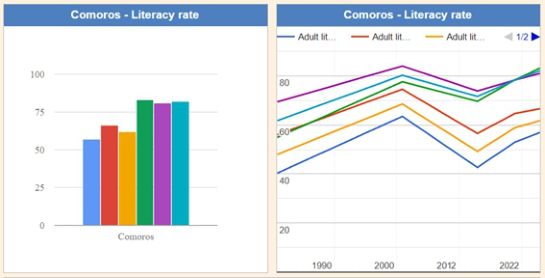
Figure 1: Literacy rate in comoros (Countryeconomy.com, 2024).
Figure 1 illustrates literacy rate trends in Comoros. The left bar chart compares different literacy categories: blue represents overall adult literacy, red shows male literacy, orange indicates female literacy, green represents youth literacy (ages 15–24), and purple corresponds to other related metrics. The right line graph traces the evolution of these categories from 1980 to 2022, highlighting general improvements and gender gaps over time.
Design of a Digital Library Kiosk for Public Area in Comoros 565
Table 1: Literacy rate in comoros from 1980 to 2022 (Countryeconomy.com, 2024).
Table 1 above, illustrates Literacy rate in Comoros from 1980 to 2022. This rate highlights disparities between genders and between urban and rural areas, indicating that a significant portion of the population still lacks basic literacy skills, which are essential for personal and professional development.
To address these challenges, the Komo Library project proposes the design of a solar-powered digital library kiosk tailored to the Comorian context. The digital library kiosks (Komo Library) offer an innovative approach to delivering resources in a compact, accessible form. These mini libraries combine a tangible space with digital content, providing both a physical access point and a digital platform to bridge the gap for communities without reliable internet or personal devices. Powered by solar panels, the kiosks overcome challenges related to unreliable electricity, ensuring continuous access to information. The Komo Library aims to make information accessible and foster a sustainable reading culture across Comoros.
This research project is grounded in the recognition that many students, educators, educational institutions and the general public in Comoros lack access to adequate library facilities. Traditional libraries require substantial financial investment in physical infrastructure, not only to build a dedicated facility but also to stock it with up-to-date materials, ensure ongoing maintenance, and manage operational costs. These economic constraints have resulted in the concentration of the few existing libraries in urban centers like Moroni, leaving rural areas underserved and disconnected from educational resources. The main purpose of this project is to provide a user- friendly and secure space for accessing digital content, accommodating users who may not have personal digital devices such as smartphones, tablets, laptops or Desktop computer to access content remotely. The kiosk will offer multiple methods of downloading information, including USB, Bluetooth, email, and printing options, ensuring inclusivity and convenience for all users. Additionally, the kiosk will feature a web-based system that allows individual users to log in and access information, while institutions, such as schools and universities, can log in to manage content and provide customized access to resources based on their specific needs. The introduction of these komo library kiosks into public areas, schools, universities, government offices,
hospitals, and rural areas will provide widespread access to a diverse range of digital content, from educational materials to health information.
METHODOLOGY
The current study was directed in both urban and rural areas of the Union of the Comoros to understand user needs and environmental factors that influence the design of a digital library kiosk. A total of 102 participants took part in the research, including students, teachers, and community members from urban, semi-urban, and rural regions. Data were collected through surveys to examine digital literacy levels, access to educational materials, and user expectations regarding digital library services. In addition to the user study, anthropometric measurements were taken to determine the appropriate dimensions of the kiosk interface, screen height, and working area, ensuring ergonomic comfort for users of different ages and body sizes. The environmental conditions of potential installation sites, such as lighting, heat, and space availability, were also analyzed to ensure durability and usability in outdoor public areas. The results from the survey and anthropometric study were integrated into the human-centered design process, guiding the system’s physical structure, interface design, and user experience features. The design incorporated a solar power system for off- grid operation, an RFID login mechanism, and a multilingual interface to accommodate diverse literacy levels. These methods ensured that the final design of the Komo Library kiosk was both technically feasible and socially relevant to the context of Comoros.
However, this approach has certain limitations. Due to logistical and financial constraints, it was not feasible to conduct in-person interviews or face-to-face distribution of the survey within Comoros. Challenges such as limited travel funding, distance from the study location, and lack of on-site research personnel made direct field data collection impractical. As a result, the reliance on online channels may introduce sampling bias, particularly underrepresenting populations without consistent internet access or those unfamiliar with digital platforms. These limitations are acknowledged and taken into account when interpreting the results and defining the scope of applicability for the proposed design solution. Despite these constraints, the survey provided essential insights that directly informed the interface design, and feature prioritization of the proposed digital library kiosk.
Table 2: Anthropometric measured data.
Table available in the original PDF paper.
Body Dimension Measured Illumination Conditions Mean (cm) 5th % ile (cm) 50th % ile (cm) 95th % ile (cm)
As shown in Table 2, anthropometric measurements were collected from 15 participants to support the ergonomic configuration of the Komo Library kiosk. Key body dimensions including sitting and standing eye height, elbow height, and seat height were analyzed using mean, 5th, 50th, and 95th percentile values in accordance with ISO 7250 standards. The data informed the positioning of the screen, desk, and interface height to ensure comfortable reach and visibility for users of different statures. Recommended screen distance (50–75 cm) and tilt angle (10
–20
) were applied to enhance visual comfort and reduce fatigue. These measurements ensured that the kiosk accommodates a wide range of users and promotes an ergonomically sound and inclusive interaction experience.
DESIGN OF THE KOMO LIBRARY KIOSK The Komo Library is a digital library kiosk developed to address the educational and infrastructural challenges in Comoros by providing accessible and sustainable information resources across public areas. The design focus on creating a compact, booth-like structure, it offers digital access points that overcome Information access limitations, operate independently of the national power grid and be deployed in both urban and rural public areas. The kiosk accommodates two people at a time and includes a digital terminal, solar-powered lighting, and a ventilation system. Through sustainable energy and user-friendly features such as USB, Bluetooth, and print capabilities, the Komo Library aims to improve literacy rates and foster a culture of reading in Comoros. The interior layout was informed by anthropometric and ergonomic measurements, ensuring comfortable viewing angles, adequate reach distance, and accessible interface height for users of different ages and body sizes.
A solar power system is mounted on the roof to collect and store energy for operation. The system includes photovoltaic panels connected to a battery unit that supplies continuous power to the digital screen, lighting, and peripheral devices. The kiosk’s user interface (UI) was developed following human-centered design principles to ensure clarity, simplicity, and accessibility for users with limited digital experience. The interface provides multilingual support in Comorian, French, and Arabic, enabling inclusive use by diverse groups. To enhance user experience and security, the kiosk integrates an RFID-based login system that allows registered users to access personalized accounts. The system architecture supports multiple content access modes, including USB drives, Bluetooth, email, and printing, enabling users to retrieve, share, or store materials according to their needs. The
content management system (CMS) allows administrators and educational institutions to upload and update resources remotely, ensuring that the library remains dynamic and relevant.
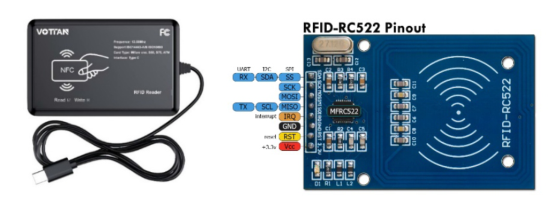
Figure 2: RFID card reader.
The RFID card reader is central to the Komo Library’s secure access and payment system. Operating at 13.56 MHz with Mifare and ISO14443- A/B protocol support, this tool allows users to authenticate their identity, access the kiosk, and manage payments for services. Users will receive membership cards that contain unique identifiers, which they can scan on the RFID reader to log in or access the kiosk’s services. This system not only enhances security and convenience but also ensures that each user or institution has customized access, meeting the diverse needs of individual users and organizational clients (Tech-Logic, 2024), (Andrew, 2024). The system has two types of RFID readers: one for reading information to handle login and payment authentication, and another RFID door reader with a keypad that enables users to access the kiosk and allows manual typing of their ID if they forget their card. Together, these two readers support a seamless and secure user experience for both access control and service transactions.
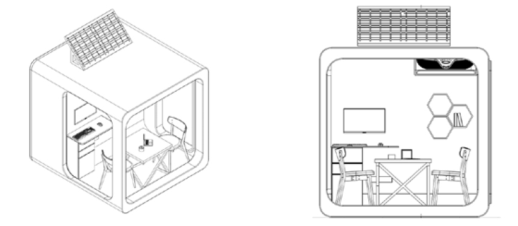
CONCEPTUAL SKETCHES AND 3D MODELING The Komo Library was first developed in conceptual sketches and later improved into 3D modelling. The conceptual design process typically follows a path from ideation to digital realization, involving multiple stages. This 3D models allow the examination of the design from various angles and the assessment of its feasibility. After modelling, the design went through a rendering phase to create lifelike images that showcase what the final product will look like.
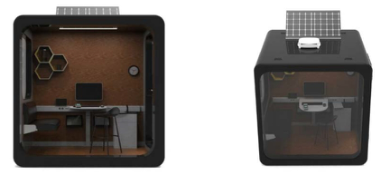
Figures 4 and 5 illustrate the final 3D model of the Komo Library kiosk and the digital interface layout, which together represent the practical and visual aspects of the system. The design provides a cost- effective, environmentally sustainable, and culturally relevant solution for improving access to information and promoting literacy development in Comoros.
Design of a Digital Library Kiosk for Public Area in Comoros 569
Figure 3: Conceptual sketches.Figure 4: 3D Front perspective view of the Komo library kiosk.Figure 5: 3D front and perspective view of the Komo library kiosk.Figure 6: User login page.
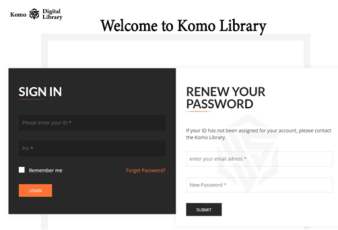
The login page (Figure 3456783456786) is designed with a focus on simplicity and usability, enabling users to securely access their accounts through either an RFID card or manual login using an ID and password. The “Sign In” section provides fields for ID and PIN input, with a “Remember me” option to streamline future logins for frequent users.
For users who may have forgotten their login credentials, the “Renew Your Password” section offers an easy-to-follow password recovery process. Users are prompted to enter their email address to receive a reset link, ensuring security while facilitating smooth account recovery. This design balances accessibility and security, catering to users with varied digital literacy levels.
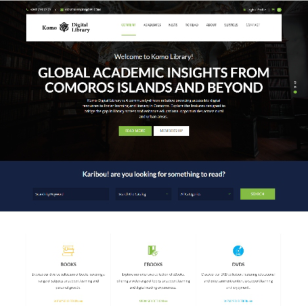
This central dashboard (Figure 7), accessible after login, serves as the main navigation hub for users exploring the Komo Library’s digital resources. Organized with clear icons and well-defined categories, the interface is designed to facilitate easy access to educational content across various subjects. Multilingual support allows users to switch languages, enhancing inclusivity for the Comorian audience. The dashboard’s layout emphasizes efficient browsing, combining user-friendly organization with a visually appealing design to simplify content discovery and make the experience accessible to users of all backgrounds.
Figure 7: User dashboard and navigation.Figure 8: Content access.
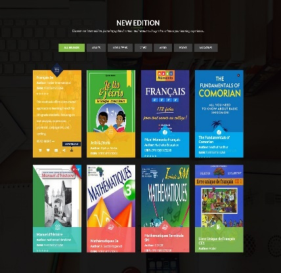
The content access screen (Figure 9) offers multiple options for downloading and retrieving resources, catering to users’ needs for both online and offline access. Users can choose to download files via USB, Bluetooth, email, or select a print option for physical copies, depending on
Design of a Digital Library Kiosk for Public Area in Comoros 571
Figure 9: Co9tent access and download options.
their preferences and access to connectivity. This flexibility ensures that users in areas with limited internet availability can still retrieve their educational materials.
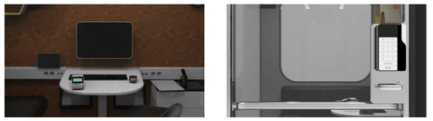
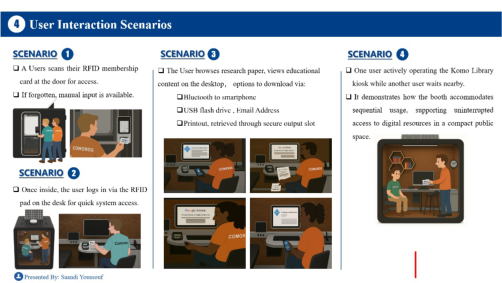
USER INTERACTION To enhance the clarity of the Komo Library kiosk concept, this section presents a series of visual illustrations that simulate real-world usage scenarios. These visuals depict how users would interact with the kiosk, including access through the RFID system, interior engagement with digital content, and the overall environment within the booth. The illustrations help demonstrate the practicality, accessibility, and user-centered intent of the design. While these visuals are not used for formal usability testing, they serve to convey the functional vision and narrative of the final design outcome.
Figure 10: Visual demonstration of the design concept.
RESULTS AND DISCUSSION
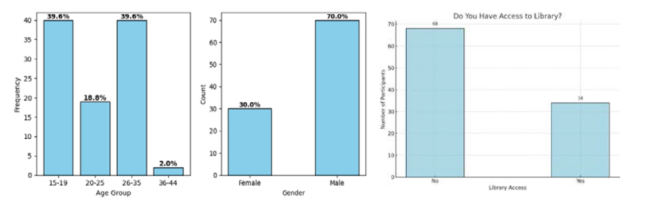
Figure 11 reveals that the majority of participants are between two main age groups: 15–19 years old and 26–35 years old, both comprising 39.6% of
the sample. The age group 20–25 years old represent 18.8% of respondents, while the group 36–44 years old represent 2% of participants, and the gender given is male and female.
Figure 11: Age, gender and library access among participant.
Additionally, Figure 11 illustrate gender distribution which revealed that 70% of the participants were male, while the female represents 30%. The literacy rate in Comoros, which stands at 61.71% for adults aged 15 and above as of 2022, provides further context for the significance of this study. This rate is an improvement from previous decades, highlighting ongoing challenges, particularly in rural areas where access to educational materials is limited. The 68 % indicates that, over half of participants reported not having access to a library, while 34% confirmed that they do have access to library. This highlighted a gap in library access that our Komo library could address.
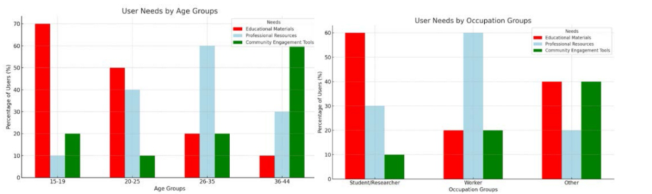
Figure 12 shows the need of participants grouped by age and Occupation. The largest group, 15–19 years, has a significant focus on Educational Materials (70%), reflecting the priority for foundational learning resources. The 20–25 years group shows a more balanced distribution, with 50% requiring Educational Materials and 40% focused on Professional Resources, indicating a transition towards career-related needs. The 26–35 years group demonstrates a dominant requirement for Professional Resources (60%), with less emphasis on Educational Materials (20%) and Community Engagement Tools (20%). Lastly, 36–44 years prioritizes Community Engagement Tools (60%), reflecting an interest in tools benefiting the wider community, with minimal focus on Educational Materials (10%). The largest group, Student/Researcher, shows a predominant demand for Educational Materials (60%), with a moderate need for Professional Resources (30%) and minimal focus on Community Engagement Tools (10%).
For the Worker group, the dominant requirement is Professional Resources (60%), highlighting their career-driven focus. This group shows relatively balanced but lower needs for Educational Materials (20%) and Community Engagement Tools (20%). The Other category indicates an equal demand for Educational Materials (40%) and Community Engagement Tools (40%), reflecting diverse needs, with a reduced emphasis on Professional Resources (20%).
Design of a Digital Library Kiosk for Public Area in Comoros 573
Figure 12: User needs by age and occupation groups.
CONCLUSION
Access to education and information in Comoros remains a critical challenge, particularly in rural and underserved regions where infrastructure is limited and literacy rates remain low. The Komo Library kiosk was designed to address these challenges by offering a decentralized and sustainable approach to educational resources, eliminating the need for large-scale infrastructure projects. Integrating a solar-powered system, the kiosk ensures continuous operation in areas with unreliable electricity, making educational materials more accessible to students in both urban and remote communities. Its user-centered design, multilingual interface, and multiple content access options (USB, Bluetooth, email, and print) cater to diverse user needs, offering an inclusive, ergonomic, and scalable solution for digital learning.
The results of this study confirm that the kiosk provides a cost- effective, culturally relevant alternative to traditional libraries, with the potential to bridge the educational gap between urban and rural areas of Comoros. Leveraging renewable energy, ergonomic principles, and modular construction, the kiosk offers a flexible and sustainable model that can be replicated in similar contexts worldwide. As the project progresses, future developments may focus on improving system scalability, additional content customization, and greater integration with local educational systems, ensuring the kiosk continues to meet the evolving needs of communities. Through this innovation, the project contributes to broader goals of educational equity and environmental sustainability, promoting literacy and learning in underserved regions.
ACKNOWLEDGMENT
The authors would like to express their sincere gratitude to their supervisor, Professor Zhang Xusheng for his invaluable guidance and support throughout the course of this research. We also extend our thanks to the participants from Comoros and the research team for their significant contributions. This work was supported by Zhejiang University, Ningbo Innovation Center, through a scholarship provided under the United Nations- sponsored project.
REFERENCES
Comoros Literacy Rate 1980–2024. (2024). Macrotrends. Retrieved from https:// www.macrotrends.net/global-metrics/countries/COM/comoros/literacy-rate. Correa, T., & Pavez, I. (2016). Digital inclusion in rural areas: A qualitative
exploration of challenges faced by people from isolated communities. Journal of Computer-Mediated Communication, 21(3), 247–263. https://doi.org/10.1111/ jcc4.12154. Fox, E. A., & Chen, Y. (2021). Introduction to digital libraries. In 2021 ACM/ IEEE Joint Conference on Digital Libraries (JCDL), 354–355. IEEE. https:// ieeexplore.ieee.org/document/9651898. Kavulya, J. M. (2007). Digital libraries and development in Sub-Saharan Africa:
A review of challenges and strategies. The Electronic Library, 25(3), 299–315. https://doi.org/10.1108/02640470710754814. Muzaffar, C. B., & Iqbal, M. T. (2020). Design and analysis of off-grid solar system for DC load of a house in Pakistan. In 2020 11th IEEE Annual Information Technology, Electronics and Mobile Communication Conference (IEMCON), 0804–0807. IEEE. https://ieeexplore.ieee.org/document/9284863. Pearce, M. S. A. (2020). The digital gap still exists, generationally, rurally, and
academically. In 2020 12th International Conference on Education Technology and Computers, 215–222. ACM. https://doi.org/10.1145/3436756.3437048. Pereira, D. I., Njuguna, P. M., & Njogu, M. (n.d.). Rural electrification using off-grid solar PV powered energy kiosks. Suleman, H. (n.d.). Design and architecture of digital libraries. Tripathi, D. P. K., Basu, N., & Abraham, D. G. (2024). Impact of digital
literacy programs on the empowerment of rural communities: Case studies from developing regions. Library Progress International, 44(3), 22834–22841. https:// doi.org/10.48165/bapas.2024.44.2.1. Xie, H. (2006). Evaluation of digital libraries: Criteria and problems from users’ perspectives. Library & Information Science Research, 28(3), 433–452.
LISTED IN THE AHFE DIGITAL BOOKSTORE CATALOGUE
Explore the complete digital volume
Human Factors in Design, Engineering, and Computing
Read this individual research paper free through the original publisher, or explore the full digital proceedings book.
ISBN 978-1-964867-75-5
Explore this ISBN in the AHFE Bookstore ↗Listed in the July 2026 bookstore catalogue; search by ISBN to confirm current availability · Digital book purchase optional