Christopher Fleischmann, Irina Leher, David Scherb, Marius Kollerer, Jörg Miehling, Sandro Wartzack, Stefan Sesselmann (2023). Comparison of maximum hip abductor torques from patient-specific multibody simulation models with isometric and isokinetic force measurements. In: Human Interaction & Emerging Technologies (IHIET 2023): Artificial Intelligence & Future Applications. AHFE Open Access, vol. 111, pp. 812–819. https://doi.org/10.54941/ahfe1004089
Muscuolskeletal simulations have become an important tool to simulate biomechanical properties. However, adaption of the models to patients or test persons is relevant in order to obtain realistic results (e.g. hip joint moments or muscle forces). It is particularly important to correctly reproduce the patient-specific maximum isometric muscle forces of the individual musculotendinous structures. The purpose of this work is to determine the extent to which gluteal muscle adaptation has an impact on the maximum hip joint moment during hip abduction.Based on MRI images volumes of the gluteal muscles were determined. These were used to calculate the muscles' maximum isometric force via the physiological cross-sectional area and the specific muscle tension. Since the values of the specific tension differ greatly in literature, several models were created. The models were investigated regarding their maximum hip joint moment and compared, first, to a marker-based scaled generic model and, second, to isokinetic and isometric force measurements using a dynamometer.It was shown that both, the models and the muscle strength measurements, show a maximum in the lower area of hip abduction and decrease sharply with increasing abduction. The models with a lower specific tension were much closer to the measured maximum hip torques. Higher values for the specific tension and the model without patient-specific information on the musculature were above the strength measurements. However, all models are clearly above the measurements with increasing abduction.It can be concluded that the gluteal muscles should be simulated with rather lower values of the specific tension.
Total hip arthroplasty (THA) is a frequently used surgery to replace a dam- aged hip joint, often caused by osteoarthritis (Health at a Glance, 2015; J.S., 2012; Gallo et al., 2012). However, it can cause damage to the mus- cles around the hip joint, particularly the gluteal muscles, which can lead to reduced function such as hip abduction and stabilisation of the pelvis (Flack et al., 2012; Damm et al., 2018; Zaghloul, 2018). This muscle damage occurs during the surgical approach to the hip joint through inci- sion or dissection of the muscle tissue (Nogler et al., 2017; Petis et al., 2015; Hardinge, 1982). Extensive planning of these operations is essential to optimize surgery quality for patients. Musculoskeletal simulations, for example, offer a possibility for improved planning (Scherb et al., 2023) and are a useful and well-recognized research tool in the field of biomechanics (Delp et al., 2007; Seth et al., 2011; Leher et al., 2022). Simulations improve the comprehensibility of the complex dynamics of human movements.
The models usually consist of representations of passive structures (e.g., bones) and active structures (e.g., muscles). However, the available mod- els are based on generic datasets. In order to achieve realistic patient-specific results, it is necessary to adapt the models as well as possible to a patient or test person, since the anatomical (Fleischmann et al., 2020) and muscular structures can differ greatly between different people (Janssen et al., 2000).
Typical parameters for modelling the musculotendinous structure of one muscle are the optimal fiber length, fiber pennation angle or tendon slack length, the most important one is the maximum isometric force each muscle tendon can generate. Accordingly, the adjusted maximum isometric forces of mutiple muscles classified as a muscle group (e.g., hip abductors) determine the maximum occurring torque this muscle group can apply on the model.
The maximum torques of muscle groups can also be captured in real life at a patient or test person via isokinetic and isometric torque measurements. Isokinetic testings are designed to maintain a constant speed of movement regardless of the amount of resistance applied to the muscle. They provide a detailed assessment of muscle strength throughout the entire range of motion. On the other hand, isometric measurements are taken against a stationary object. This is a simpler and less expensive way to assess muscle strength. The aim of this study is the subject-based modeling of the gluteal muscles (gluteus maximus, gluteus medius and gluteus minimus) in a musculoskeletal human model and subsequent in vivo comparison of the maximum hip abductor torque using isometric and isokinetic measurements.
MATERIAL AND METHODS Musculoskeletal Model
For the patient-specific implementation of the musculoskeletal model in OpenSim a Volume Isotropic Turbo spin echo Acquisition (VISTA, slice thick- ness 3 mm, repetition time 989.9 ms, echo time 200 ms) of one subject (32 years, male, 170 cm, 60 kg) with no musculoskeletal impairments of the hip was performed. Based on these MR-datasets, the gluteal muscles were seg- mented using Mimics Research 23.0 (Materialise, Leuven, Belgium). Then,
the respective muscles were divided into three anatomical individual vol- umes according to the gluteal muscle tendons in the musculoskeletal model of Delp et al., (1990) to account for the implication of gluteal muscles to mutiple hip degree of freedoms.
First, the physiological cross-sectional area (PCSA) for each individual musculotendon unit via the segmented volumes, the pennation angle θ and the optimal fiber length was calculated as follows (Correa et al., 2011; Knarr et al., 2013) (formula 1):
cm3
h
= muscle volume
PCSA
cm2i
× cos θ [
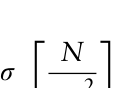
] optimal fiber length [cm] . (1) Then, the maximum isometric force of each muscle tendon was calculated with the the specific tension σ according to formula 2 (Correa et al., 2011; Knarr et al., 2013):
Equation reproduced from the original PDF.
In the literature, the specific tension differs greatly in multiple studies (Chen et al., 2023). Thus, several models with differing values for specific tension were created. The lowest applied value for the specific tension is 25 N/m2 (Friederich et al., 1990) and is based on a cadaveric study of young subjects by Spector et al. (1980). The second specific tension value applied is 30 N/m2 (Charles et al., 2020) and derived from Zajac et al. (1989) (Zajac et al., 1989). Lastly, a specific tension of 61 N/m2 was used, which is based on a study of elderly cadavers by Wickiewicz et al. (1983) (Wickiewicz et al., 1983). This value is also very close to the data reported by Rajagodal et al. (2016) (Rajagopal et al., 2016).
The resulting maximum isometric forces of each muscle tendon are shown in Table 1. The values for pennation angle and optimal fiber length (formula 1) were derived from Friederich et al. (Friederich et al., 1990).
Table 1. Calculated maximum isometric forces based on different values for the specific tensions described in the literature.
The calculated maximum isometric forces were implemented in the mus- culoskeletal models. For individual marker based scaling, a near-static kine- matic measurement (Vicon ® Motion Systems Ltd, Oxford, United Kingdom) was performed using a 39 marker full body plug-in gait model. Afterwards the maximum isometric force for each gluteal muscle unit was adjusted in the models.
Isokinetic and Isometric Muscle Strength Measurements Isokinetic and isometric force measurements were performed in order to be able to compare the results of the simulations with the actual attainable torques. Before the examination, the subject had to undergo a 10-minute warm-up period on a stationary bicycle ergometer to increase blood flow, elevate muscular temperature and lower the risk of injuries (Park et al., 2018; Powers et al., 2009).
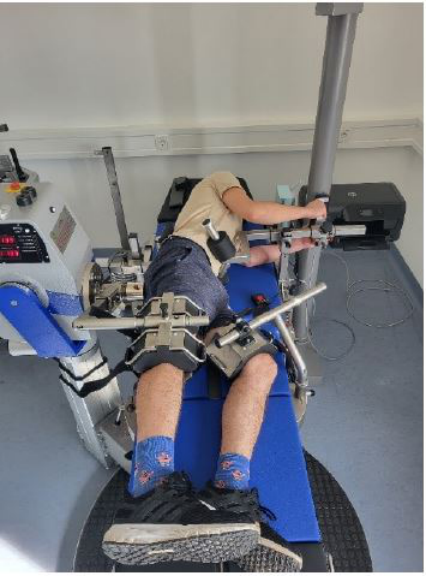
Isokinetic and isometric muscle strength measurements were performed in the lateral recumbent position using an IsoMed2000 (D. & R. Festl Gmbh, Hemau, Germany). For this purpose, the inactive leg was bent and fixed. Furthermore, the hip was firmly clamped both ventrally and dorsally. The force was applied to the examined leg medial and lateral to the knee joint using a double pad. The hip joint center was aligned with the dynamometer’s axis of rotation (Figure 1).
Figure 1: Positioning of the subject for the isokinetic and isometric force measurements.
The range-of-motion for the concentric isokinetic examination was 0-40
hip abduction. Measurements were performed at angular velocities of 10
/s, 20
/s, and 30
/s for three repetitions to ensure full force development but not to induce muscle fatigue (Danneskiold-Samsøe et al., 2009).
Isometric force measurements were performed at 15
and 30
abduction according to the literature (Danneskiold-Samsøe et al., 2009). Furthermore, one additional isometric measurement was performed at the angular position where the maximum hip joint torque occurred in the isokinetic measurement. Each isometric measurement was performed three times for a duration of five seconds.
For each measurement, gravity compensation was performed to eliminate the effect of gravity on both adapters and extremities.
For patient-specific simulations the models were manually adjusted cor- responding the muscle force measurement position (Figure 1). This initial position is used for the simulated calculation of the maximum hip joint moments generated by the corresponding hip abductors.
RESULTS
The isokinetic measurements showed a maximum torque between 99.0 Nm and 88.2 Nm (Table 2). The maximum torque for the left leg was found at 10
/s and for the left leg at 20
/s. The respective maxima were 4
on the left and 6
on the right, which means that another isometric measurement was carried out at these values.
Table 2. Simulated maximum hip joint torques of the models with the different applied specific tensions in OpenSim and the isometric and isokinetic measured torques.
The isometric measurements at these angles resulted in significantly higher maximum torques than the values given in the literature at 15
or 30
abduction.
Comparison of Maximum Hip Abductor Torques 817
The models with Friederich’s specific tension showed the lowest values for the maximum torque with 96.6 Nm for the left side and 97.1 Nm for the right side. The models based on Zajac showed maximums of 111.5 Nm for both sides. The model based on Delp showed maxima between 200.1 Nm (left) and 200.7 Nm (right). The generic scaled model was 156 Nm for each side.
DISCUSSION
The investigation shows that the values for the maximum torque in the multi- body simulation for the left and right side hardly differ. However, the isoki- netic and isometric measurements showed significantly higher differences of up to 8.7 Nm.
Overall, both the multi-body simulations and the isokinetic and isometric force measurements show a decreasing maximum force with increased hip abduction. The simulations and the force measurements showed the highest maximum force at values of 4
to 5
abduction.
At the optimal hip abduction angle, the best agreement with the simula- tion was shown with the values of the specific tension from Friederich et al. (25 N/cm2) followed by the values of Zajac et al. (30 N/cm2) (Friederich et al., 1990; Zajac et al., 1989). The simulations with the specific tension from the generic model and the values from Delp et al. (61 N/cm2) shows higher maximum torques than the measured ones (Delp et al., 1990).
The values for the measurements at 15
positions proposed in the litera- ture, the results of the models based on Friederich and Zajac also correspond significantly better than the generic and the Delp model (Delp et al., 1990; Friederich et al., 1990; Zajac et al., 1989; Danneskiold-Samsøe et al., 2009). With a hip abduction of 30
, the isometrically measured values are closest to the values of the musculoskeletal model based on Friederich et al. (1990).
In addition, it should also be considered that these were only concentric measurements which normally produce lower maximum forces and torques than eccentric measurements (Harden et al. 2019).
CONCLUSION AND OUTLOOK In this work it was shown that the patient-specific adaptation of the mus- cle volumes in connection with the specific tension shows strong differences between the musculoskeletal models. Even if the models with the lower spe- cific tension show better agreement, it becomes clear that the isokinetic and isometric measurements differ significantly from the musculoskeletal models at higher muscle abduction. This study only referred to the patient-specific adaptation of the gluteal muscles and only to pure hip abduction. Models based on lower specific tensions showed greater agreements with the torque measurements with the dynamometer at small hip abduction. For larger hip abduction values, the simulations were well above the actual maximum torques. This could possibly be due to the fact that only the maximum iso- metric force was adjusted patient-specifically, but not the muscle origins and insertion points which will be implemented in the next steps. Furthermore,
other hip movements (e.g., hip rotation or hip flexion and extension) should be examined in further studies.
REFERENCES
Charles, J. et al. Subject-specific muscle properties from diffusion tensor imaging significantly improve the accuracy of musculoskeletal models. J Anat 2020; 237 (5): 941–959. Chen, Z. et al. Musculotendon Parameters in Lower Limb Models: Simplifications,
Uncertainties, and Muscle Force Estimation Sensitivity. Ann Biomed Eng 2023. Correa, T. et al. A mass-length scaling law for modeling muscle strength in the lower limb. J Biomech 2011; 44 (16): 2782–2789. Damm, P. et al. Gluteal muscle damage leads to higher in vivo hip joint loads 3
months after total hip arthroplasty. PLoS One 2018; 13 (1): e0190626. Danneskiold-Samsøe, B. et al. Isokinetic and isometric muscle strength in a healthy population with special reference to age and gender. Acta Physiol (Oxf) 2009; 197 Suppl 673: 1–68. Delp, S. et al. An interactive graphics-based model of the lower extremity to study
orthopaedic surgical procedures. IEEE Trans Biomed Eng 1990; 37 (8): 757–767. Delp, S. et al. OpenSim: open-source software to create and analyze dynamic simulations of movement. IEEE Trans Biomed Eng 2007; 54 (11): 1940–1950. Flack, N. et al. A review of the anatomy of the hip abductor muscles, gluteus medius,
gluteus minimus, and tensor fascia lata. Clin Anat 2012; 25 (6): 697–708. Fleischmann, C. et al. Femoral Shape and Size Variability from segmented CT datasets for patient-specific THA planning. Current Directions in Biomedical Engineering 2020; 6 (3): 486–488. Friederich, J. et al. Muscle fiber architecture in the human lower limb. J Biomech
1990; 23 (1): 91–95. Gallo, J. et al. Aseptic Loosening of Total Hip Arthroplasty as a Result of Local Failure of Tissue Homeostasis. In: Fokter S (Hrsg.). Recent Advances in Arthroplasty: InTech, 2012. Hardinge, K. The direct lateral approach to the hip. J Bone Joint Surg Br 1982; 64
(1): 17–19. Health at a Glance 2015: OECD, 2015. J., S. et al. Risk Factors for Aseptic Loosening Following Total Hip Arthroplasty. In: Fokter S (Hrsg.). Recent Advances in Arthroplasty: InTech, 2012. Janssen, I. et al. Skeletal muscle mass and distribution in 468 men and women aged
18–88 yr. J Appl Physiol (1985) 2000; 89 (1): 81–88. Knarr, B. et al. Muscle volume as a predictor of maximum force generating ability in the plantar flexors post-stroke. Muscle Nerve 2013; 48 (6): 971–976. Leher, I. et al. Patient-Specific Modelling for Preoperative Estimation of Hip
Mechanics for Improved Planning of Total Hip Endoprosthesis Using Multibody Simulations. In: Ahram T, Taiar R (Hrsg.). Human Interaction, Emerging Tech- nologies and Future Systems V. Cham: Springer International Publishing, 2022, S. 1088–1096. Nogler, M. et al. Operative Zugangswege zur Hüfte beim älteren Menschen.
Orthopade 2017; 46 (1): 18–24. Park, H.-K. et al. The effect of warm-ups with stretching on the isokinetic moments of collegiate men. J Exerc Rehabil 2018; 14 (1): 78–82. Petis, S. et al. Surgical approach in primary total hip arthroplasty: anatomy, technique
and clinical outcomes. Can J Surg 2015; 58 (2): 128–139.
Comparison of Maximum Hip Abductor Torques 819
Powers, S. K. et al. Total fitness & wellness. 5. Aufl. San Francisco, Calif., London: Pearson Benjamin Cummings, 2009. Rajagopal, A. et al. Full-Body Musculoskeletal Model for Muscle-Driven Simulation
of Human Gait. IEEE Trans Biomed Eng 2016; 63 (10): 2068–2079. Scherb, D. et al. Evidence for the Applicability of Musculoskeletal Human Models to Improve Outcomes of Total Hip Arthroplasty. In: Tavares JMRS, Bourauel C, Geris L, Vander Slote J (Hrsg.). Computer Methods, Imaging and Visualiza- tion in Biomechanics and Biomedical Engineering II. Cham: Springer International Publishing, 2023, S. 194–207. Seth, A. et al. OpenSim: a musculoskeletal modeling and simulation framework for
in silico investigations and exchange. Procedia IUTAM 2011; 2: 212–232. Spector, S. et al. Muscle architecture and force-velocity characteristics of cat soleus and medial gastrocnemius: implications for motor control. J Neurophysiol 1980; 44 (5): 951–960. Wickiewicz, T. et al. Muscle architecture of the human lower limb. Clin Orthop Relat
Res 1983 (179): 275–283. Zaghloul, A. Hip Joint: Embryology, Anatomy and Biomechanics. BJSTR 2018; 12 (3). Zajac, F. Muscle and tendon: properties, models, scaling, and application to
biomechanics and motor control. Crit Rev Biomed Eng 1989; 17 (4): 359–411.
Read this individual research paper free through the original publisher, or explore the full digital proceedings book.
ISBN 978-1-958651-87-2
Explore this ISBN in the AHFE Bookstore ↗Listed in the July 2026 bookstore catalogue; search by ISBN to confirm current availability · Digital book purchase optional