Christian Goglin (2023). Proposition of an utilitarianism and fair objective function building method based on values and socio-economic consequences for data-driven decisions. In: Human Interaction & Emerging Technologies (IHIET 2023): Artificial Intelligence & Future Applications. AHFE Open Access, vol. 111, pp. 749–755. https://doi.org/10.54941/ahfe1004082
In this short article, we propose a method to setup the objective function of machine learning binary classifier used in data driven decision. The goal is to take fair decisions aligned with an ethical value system and based on the long-term consequences of prediction errors for all stakeholders.The proposed method is based on human in the loop with an ethical committee to define the appropriate setup of the objective function, depending on the context of the decision. The setup parameters are of three categories: the fairness criteria, the ethical values and the weights associated to socio-economic long-term consequences of prediction errors.
In data-driven decisions based on a binary classification machine learning model, the algorithm learns the model from the data by optimizing a function measuring the empirical error, named the objective function. Much work has been done to make these decision models fairer by optimizing group fairness. The multiple group fairness criteria proposed (independence, sepa- ration, sufficiency...) aim to implement static affirmative actions to improve group fairness (Kozodoi et al., 2022). But these mitigation actions based on fairness processor, are made at the expense of the performance of the model (for example measured by the accuracy) and therefore of its initial objective. Also, these methods do not take into account the perspective of the long-term socio-economic consequences of the predictions errors for all stakeholders, and resulting from the model being made fairer by affirmative actions (Liu et al., 2018). In the classical example Compas1, revealed in the ProPublica article2, if we reason about the consequences of prediction errors, the anta- gonism between predictive performance (accuracy) and fairness, leads to the
1COMPAS = Correctional Offender Management Profiling for Alternative Sanctions 2https://www.propublica.org/article/machine-bias-risk-assessments-in-criminal-sentencing
following question: are we willing to increase the recidivism rate of defen- dants to improve fairness between ethnic groups? This trade-off may or may not be shocking depending on one’s value system. Indeed, we are in the con- text of a moral dilemma in which two values are in competition: the integrity of individuals and the equity between groups. Then this question may arise if the social consequences of less discrimination between groups result in more errors of justice, which is a dramatic effect. Thus, not only the values come into play, but also the relative importance of the consequences of predictions impacting on both prisoners and future victims, and specifically the erroneous predictions.
To address this issue, we propose a method consisting in generalizing analysis outcomes from two cases, that of bank credit granting and that of predictive justice.
Credit Granting Case The banking credit granting process is based on a credit score, measuring the expected default risk of the borrower. Nowadays, this score is often computed using a machine learning model trained on a huge historical dataset.
Regarding the fairness, and more precisely the group fairness, scholars propose numerous criteria and processors to mitigate the fairness issue. The mitigation is performed by optimizing the chosen fairness criteria. Let’s con- sider two groups in the population, defined on a protected attribute xa, for instance the gender, with xa= 0 for female and xa= 1 for male.
As explained by Kozodoi et al. (2022), the separation criteria (SEP) suits well the specific context of the credit granting. This criterion means the clas- sifier don’t make more mistakes (prediction errors) for one group than for the other. If we consider the confusion matrix resulting of the model evaluation, for both groups, the signification of this constraint is: FPR{xa = 0}= FPR{xa = 1} and FNR{xa = 0}= FNR{xa = 1}
The separation criteria, defined as follow, must be minimized: SEP = (1/2)|(FPR{xa = 0}- FPR{xa = 1}) + (FNR{xa = 0}= FNR{xa = 1})|
With FPR = False Positive Rate = the classifier predicts no default but the borrower default
FNR = False negative rate = the classifier predicts a default, but the borrower would not default SEP is part of our first criteria, associated to the fairness ethical value, formally, we write:
Equation reproduced from the original PDF.
With V0 the fairness value subjective relative importance and α0 the sub- jective relative severity of the fairness risk, both are scalar ϵ[0, 1]. Subjective means the result of human judgement.
Also, in this use case, we have two stakeholders, the bank, and the bor- rower. Let’s then consider the whole group of borrowers (female and male)
Proposition of an Utilitarianism and Fair Objective Function Building Method 751
one hand, and the bank on the other hand, to examine the consequences of prediction errors. Stakeholder 1, Bank:
Case FPR: the consequence is economic, it’s a loss due to the default of the borrower.
Case FNR: the consequence is economic, it’s a shortfall in income due to the credit not granted (no cumulated interest income) For each harmful consequence, we identify the related ethical value, chosen in the EU guidance document “Design and Ethics of Use Approaches for Artificial Intelligence”3
Associated value to FPR and FNR is ‘social well-being’ corresponding to following danger: the financial stability of the bank.
(Verbraken et al., 2014) propose an indicator, the expected maximum pro- fit (EMP), built on FPR and FNR for this specific context that best suit bank objective than Accuracy [(TP+TN)/( TP+TN+FP+FN)] since it takes in account the real expectation: the profit and lost.
Note: consequences are asymmetric. In average, FPR consequences seve- rity > FNR consequences severity, even if this assertion closely depends on interest rates.
This note means we can weight the consequences related to FPR and FNR differently. Stakeholder 2, borrower:
Case FPR: the default has important economic consequences for the borrower and first, a risk of over indebtedness. There are also some psychologic consequences like ill-being due to over-indebted since peo- ple experience anxiety linked to material difficulties such as the seizure of furniture, electricity, or telephone cuts, or even eviction from their home. Dependence on family and institutions becomes extreme, especially if the over-indebted person is unable to have a home or a bank card. This anxiety can then lead to depression and suicidal thoughts.
Case FNR: the consequence is a risk of banking exclusion with economic and social consequences since the person is not able to realize its profes- sional projects (starting a business or financing professional training) and may ask help to his family and friends. There are also some psycholo- gic consequences like ill-being due to difficulties in obtaining a job and integrating in society (Gloukoviezoff, 2009).
Again, consequences are asymmetric with FPR consequence severity > FNR consequence severity, meaning we could weight those consequence differently.
Associated value to FPR and FNR is the same: ‘individual well-being’ corresponding to following danger: personal bankruptcy or difficulties to integrate in society and mental health.
If at the beginning of this research, our first idea was to define an economic indicator measuring the consequences of FPR and FNR for borrower, to have an equivalent to the EMP indicator and be able to mix both indicators, we dismiss this idea since for borrowers, consequences are not only economic but also psychosocial.
After this brief analysis, we can define our secund criterion, related to socioeconomic consequences of classifier prediction errors for stakeholders: SOCIO_ECO_CRITERION = (V1.α1 + V2.α2).FPR + (V3.α3 + V4.α4).FNR
Vi and αiare scalar ϵ[0, 1] with i = 1..4 V1 and V3 are the subjective severity related to social well-being value and α1, α3 the subjective severity of the social well-being risk for the bank regarding FPR and FNR.
V2 and V4 are the subjective severity related to individual well-being value and α2, α4 the subjective relative severity of the individual well-being risk for the borrower regarding FPR and FNR.
This secund indicator replaces the Accuracy, the goal is to minimize the prediction errors but, taking in account the subjective severity of values at stake (Vi) and the relative severity of socioeconomic consequences at stake for all stakeholders (αi).
The final objective function to minimize mix two criteria, the first one is related to the fairness while the secund one is related to the socioeconomic consequences: CRITERION = FAIRNESS_CRITERION + SOCIO_ECO_CRITERION
Prédictive Justice Case This second case relates to the predictive justice, when a score, based on machine learning, predicts the likelihood of committing a future crime by a defendant.
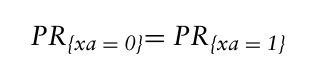
Concerning the first criterion related to the group fairness, we choose the independence (IND) criteria, meaning the model must not disadvantage one group. Here, groups are defined based on a protected ethnic attribute xa, with xa= 0 for Afro-American and xa= 1 for White defendants. IND criterion means:
Equation reproduced from the original PDF.
With PR = Positive Rate = Proportion of defendants for which the classifier predicts they will not commit a future crime
Equation reproduced from the original PDF.
IND is part of our first criteria, associated to the fairness value, formally, we write:
Equation reproduced from the original PDF.
Proposition of an Utilitarianism and Fair Objective Function Building Method 753
In this case, we have two stakeholders, the defendant, and the people, meaning anybody that can be victim of the defendant in case of reoffending. Let’s examine the socioeconomic consequences of prediction errors: Stakeholder 1, Defendant:
Case FPR: the defendant is released but commit a crime, the main consequence, for him, is a new period of imprisonment.
Case FNR: the defendant is not released while he would not commit a crime, the main consequence, for him, is deprivation of freedom.
Associated value to FPR and FNR is ‘freedom’ corresponding to following danger: the imprisonment.
Consequences are asymmetric, this time for an ethical reason (defendant free will) rather than the severity of the consequences: FNR consequences > FPR consequences because with FNR, the harmful consequences are not depending on the defendant whereas with FPR, the defendant is guilty. Stakeholder 2, The people:
Case FPR: the defendant is released but commit a crime, the consequence for the victim may be severe and even fatal with the death.
Case FNR: the defendant is not released while he would not commit a crime, the consequence for the people is null.
Associated value to FPR ‘individual well-being’ corresponding to follow- ing danger: to be victim of a crime.
We can now define our secund criterion, related to socioeconomic conse- quences of classifier prediction errors for stakeholders.
SOCIO_ECO_CRITERION = (V1.α1 + V2.α2).FPR + V3.α3.FNR (NB: α4 is null, see upper) The final objective function to minimize is again as follow:
CRITERION = FAIRNESS_CRITERION + SOCIO_ECO_CRITERION This second case is useful for two reasons:
1) This time, the socioeconomic consequences of prediction errors are more psychosocial than economic.
This point supports the idea to have dedicated weight to measure the consequences severity rather than a quantitative measure like the Expected Maximum Profit, because psychosocial consequences cannot be reduced to a monetary amount. To determine the severity weights, we propose a qualitative analysis, resulting from discussions between sta- keholders, lawyer and ethicist expert, and a deliberation, rather than a mathematical model that cannot embed the long-term consequences and the complexity of the psychosocial dimension. 2) The “Compas” case, mentioned in the introduction, is a real illustration of predictive justice. In this case, the software company solution (based
754 Goglin
on machine learning), compute a score, predicting the likelihood a rele- ased defendant would commit a future crime. First, “a disproportionate number of black defendants were ‘false positives’: they were classified by COMPAS as high risk but subsequently not charged with another crime.” as explain (Courtland, 2018) but what is more interesting for us is the illustration of a dilemma where two values are in competition: the fair- ness and the safety (Individual well-being) as explained by Müller (2020). In Table 1 below, we can see that human judges take fair justice decisions since the error rate (60%) are equal between groups (White and Afro- American) but the total accuracy (60%) of their decisions is lower than the total accuracy of decisions computed by robot judge (65%) which in turn are less fair (error rates disadvantage Afro-American).
This point supports the idea to quantify the relative importance of values at stake in the decision where values derive from the harmful consequences of the prediction errors.
Table 1. Tension between Accuracy and fairness in predictive justice (Müller, 2020).
Généralization In the previous cases, we ‘ve chosen the same analysis approach. We have defined a two-criteria objective function with group fairness as first cri- terion and prediction errors (FPR and FNR) as proxy of socio-economic consequences. We have identified a system of ethical values, specific to the decision-making context, chosen in the ethical values and principles propo- sed in the EU guidance document “Design and Ethics of Use Approaches for Artificial Intelligence”. This value-based method is in line with other appro- ach more general used to design electronic systems with ethical values, like ‘Ethics by design’ and ‘Value-sensitive design’ (Stahl et al., 2023).
We also have measured the socio-economic harmful of prediction errors (FP and FN) with scalar weights (αi with i = 1..4) because some social consequences cannot be reduced to monetary equivalent amount, like the shame sentient resulting of the banking exclusion or the freedom privation due to unfair extended imprisonment.
We think both the ethical values at stake, and the weights, could be setup by an ad hoc committee, composed by the stakeholders (banker and borro- wer representants in the first case), plus ethicist and lawyer. We recommend a decision-making process in two steps with at first, an open discussion betw- een ethical committee members, followed by a vote. The first step would allow to identify ethical values related to prediction errors for each stake- holder and to discuss the relative importance of socio-economic harmful consequences. The discussion would also focus on the appropriate group- fairness criterion to use in the case context. The vote would then consist
Proposition of an Utilitarianism and Fair Objective Function Building Method 755
of filling in a questionnaire where ethical values and weights would be asked using a numerical scale (Osgood scale for instance). Ethical values and weights would then be averaged.
The outcome of the ethical committee deliberation process would be the objective function to minimize and implement in the classifier model.
CONCLUSION
Nowadays, data driven decisions are more and more frequently used to decide resources allocation (credit granting), to accept or reject application or to assist public authorities (social benefits, justice, police…). Artificial Intel- ligence systems are often machine learning based binary classifier, fueled by empirical data. It’s now well-known that numerous bias exist in the training Dataset leading to unfair decision between groups. Criteria proposed by sch- olars help to mitigate this risk, but other dimensions are not addressed by the literature, the ethical values dilemma as well as the importance of the long-term consequences of the prediction errors at stake in the decision and depending on a specific context. The method presented here aims to answer this gap. Since this research is ongoing, this method still need to be tested with empirical data for comparison.
REFERENCES
Courtland, R. (2018) ‘As machine learning infiltrates society, scientists grapple with how to make algorithms fair.’, Nature, 558(7710), pp. 357–360. Gloukoviezoff, G. (2009) ‘L’exclusion bancaire : de quoi parle-t-on ? Une perspective
française’, Vie sciences de l’entreprise, N
182(2), pp. 9–20. Kozodoi, N., Jacob, J. and Lessmann, S. (2022) ‘Fairness in Credit Scoring: Assessment, Implementation and Profit Implications’, European Journal of Operational Research, 97(3), pp. 1083–1094. Liu, L. T. et al. (2018) ‘Delayed Impact of Fair Machine Learning’. arXiv. Available
at: https://arxiv.org/abs/1803.04383 (Accessed: 14 March 2023). Müller, V. C. (2020) ‘Ethics of Artificial Intelligence and Robotics’, in E. N. Zalta (ed.) The Stanford Encyclopedia of Philosophy. Winter 2020. Metaphysics Rese- arch Lab, Stanford University. Available at: https://plato.stanford.edu/archives/wi n2020/entries/ethics-ai/ (Accessed: 17 April 2021). Stahl, B. C., Schroeder, D. and Rodrigues, R. (2023) Ethics of Artificial Intellige-
nce: Case Studies and Options for Addressing Ethical Challenges. Cham: Springer International Publishing (SpringerBriefs in Research and Innovation Governance). Available at: https://doi.org/10.1007/978-3-031-17040-9. Verbraken, T. et al. (2014) ‘Development and application of consumer credit scoring models using profit-based classification measures’, European Journal of Opera- tional Research, 238(2), pp. 505–513. Available at: https://doi.org/10.1016/j.ejor .2014.04.001.
Read this individual research paper free through the original publisher, or explore the full digital proceedings book.
ISBN 978-1-958651-87-2
Explore this ISBN in the AHFE Bookstore ↗Listed in the July 2026 bookstore catalogue; search by ISBN to confirm current availability · Digital book purchase optional