Blockchain and generally decentralized technologies will be used quickly in all industrial fields. Fast-Moving Consumer Goods (FMCG) is one of the areas that has attracted a lot of attention from different perspectives, both in terms of marketing and in terms of contributing to environmental sustainability through the reduction of CO2 production. This study attempts to propose a suitable and near-to-optimal supply chain network for FMCG by using the critical advantages of blockchain technology, especially traceability. With the help of blockchain technology, information can be transferred to this network with greater transparency, traceability, and security. Moreover, the smart contract will provide the possibility of autonomous contract execution among the stakeholders in the supply chain. The smart contract eliminates payment delays, error risks, and the complexity of a traditional contract while maintaining the authenticity and credibility of supply chain interactions.
FMCG – Fast-Moving Consumer Goods, as the name suggests, are quickly moving with low-profit margins; these include the day-to-day products. The FMCG sector in the food industry combines in with additional challenges, including the product’s quality and lifecycle. In such a complex supply chain, traceability plays a pivotal role. In its pursuit, numerous traceability techno- logies have been implemented or are being implemented and currently utilized (Dixit et al., 2019).
The implementation of blockchain technology for traceability in the FMCG sector would play an immense role in better communicating the vari- ous possible data from sensors being used for the tracking to the Blockchain, thereby maintaining the privacy of the data being shared among the vari- ous parties involved (Aghamohammadzadeh & Fatahi Valilai, 2020; Agrawal et al., 2021).
Research Objectives Research Objective 1: Decreasing the level of uncertainty in a multi-level supply chain.
In the evaluation process, there is a questionnaire that will help to better understand the current situation, the acceptability, and so on of a company’s supply chain.
1. What are the relative advantages and disadvantages of a blockchain traceability system compared to paper-based and computerized systems? 2. What is the current state of traceability in your supply chain? 3. How willing are you to adopt a Blockchain-based traceability system, and which behavioral factors influence this willingness? 4. Are you open to interoperability (sharing data among other stakehol- ders)? If not, why not? 5. Level of knowledge of blockchain technology? 6. Are you open to adopting blockchain technology for traceability? If not, why? 7. Does the issue of data immutability concern you?
Whenever there is a technology that is to be adopted, the most challenging part is not the technical requirement. However, it is building out that network of stakeholders from various supply chains to agree on common ground and have mutual trust among each other to share data amongst themselves and to be committed to maintaining the infrastructure necessary.
Research Objective 2: Initializing smart contracts in Blockchain provides traceability solutions effectively.
Smart contracts are digital contracts stored on a blockchain automati- cally executed when predetermined terms and conditions are met. The data is automatically entered into the block by using a smart contract when the transaction occurs. This safeguard makes it more difficult for potential atta- ckers to modify a shared database. The primary goal of smart contracts is to simplify commercial transactions between parties by eliminating the inter- mediaries involved in traditional business operations. These contracts strive to eliminate payment delays, error risks, and the complexity of a traditional contract while maintaining authenticity and credibility.
Smart contracts are best seen as automated transaction administrators, as a blockchain is a register for validating transactions, and this is precisely what smart contracts retain from legal contracts. A smart contract can be thought of as the automation of the transactional part of a legal contract, with the assurance that transactions will be carried out effectively and with- out tampering, which fits in nicely with the need to deal efficiently with the requirements of trust and coordination to deploy Revenue Sharing effecti- vely. Smart contract is a software that runs on a blockchain and executes a digital agreement governed by a set of rules. Therefore, smart contracts for revolutionary supply chain management can take the role of human coordi- nators where the issues have been addressed. Furthermore, automating the coordinating process can relieve the supply chain of a significant managerial expense.
Traceability in FMCG Industries by Application 695
The supply chain plays a vital role in ensuring that every transaction is delivered to all stakeholders within the organization in a secure manner. In this circumstance, the aim is to identify the challenges in traceability appli- cations with Blockchain technology which provide visibility and information of supply chain and to analyze the solutions and methods.
Literature Review
Traceability Evolution Through Literature Traceability plays a pivotal role in providing control over the supply chain, and it also assists in the follow-up processes, which can highly be determined by the nature or field of the product we are dealing with in the supply chain. The supply chain is a complex web of networks that includes aspects such as the openness, emergence, and dynamics of it, and these aspects contribute to the interruptions and disruptions in the complex supply chain (Sirkka, 2008).
Traceability, as defined in the United Nations Global compact and Business for Social Responsibility, is “the ability to identify and trace the history, distri- bution, location and application of products, parts, and materials, to ensure the reliability of sustainability claims, in the areas of human rights, labor (including health and safety), the environment and anti-corruption”. The Blockchain has emerged as a possible solution for implementing traceability by creating information paths while ensuring security and data immutabi- lity (Mandolla et al., 2019). Blockchain-based traceability enables the secure exchange of information, facilitating product quality monitoring/control, operational monitoring/control, real-time data acquisition, and transpare- ncy and transparency throughout delivery (Azzi et al., 2019). Traceability is critical for preventing or promptly responding to food contamination, sickness, medication or pesticide residues, or attempted bioterrorism. “Blo- ckchain is fixing a social problem, not a technological problem.” Walmart’s blockchain experiment serves a bigger purpose and has a beneficial impact on the Walmart brand through prevention, readiness, and evidence (Caldarelli et al., 2020). Walmart’s blockchain solution must be “business-driven and technology-enabled,” with the ability to tackle challenges including time efficiency, cost reduction, long-term goodwill, and income-generating. This endeavor needs leadership to organize stakeholders and raise awareness of various technological options to ensure whole-chain traceability (Burkitt, 2014). Blockchain, the technology behind electronic currency, is a decentralized, distributed ledger that records digital asset transactions. Blockchain emer- ged as a technology to perform transactions in the cryptocurrency market (Ganesan et al., 2023). Decentralized blockchains provide the same job as many intermediaries in our society, establishing trust and maintaining inte- grity between transacting parties by verifying and documenting immutable transactions (Khaturia et al., 2022; Lobo et al., 2022).
Additionally, Blockchain is viewed as a solution for supply chain manage- ment (SCM) traceability problems (Lu & Xu, 2017) and for generating closer and trustworthy relationships between organizations and their suppliers and
through the entire SCM. On the one hand, a blockchain-enabled smart con- tract (a script that can trigger a transaction) has the potential of bringing high levels of efficiency with a decentralized operation to SCM (Wamba & Queiroz, 2020). On the other hand, Blockchain can be combined with other cutting-edge technologies (e.g., big data analytics, the internet of things, cyber-physical systems, among others) to bring about disruptive impacts in all specialized fields (Aste et al., 2017).
The reviewed literatures can be categorized to three research themes, which are explained in more details in this section. Table I presents the review of literatures from these three themes. Supply chain traceability is the process of tracking the provenance and journey of products and their inputs, from the very start of the supply chain through to end-use. Traceability provides opportunities to find supply chain efficiencies, meet regulatory requirements, connect with and understand the actors in the upstream supply chain, and of course, to story-tell consumers about the provenance and journey of produ- cts, often utilizing pictures or scannable QR codes on packaging (Navendan et al., 2022). Blockchains provide end-to-end traceability by introducing a uniform technology language into the supply chain and allowing customers to read the tale of goods on their labels via their phones. Each information contains vital information that might show safety concerns with the pro- duct in question. The blockchain record can also assist merchants to monitor the shelf life of items in specific stores and increase controls linked to food authenticity (Galvez et al., 2018).
Smart Contract in Supply Chain A smart contract is a software that runs on a blockchain and executes a digital agreement governed by a set of rules. Its benefits are:
Automation: Smart contracts may automate a wide range of tasks, sub- ject to the expressiveness of the programming framework in which they are created. Solidity, for example, the programming language for writing contracts on the Ethereum blockchain, is Turing-complete, meaning it can represent any issue that can be solved by a Turing computer, giving smart contracts as much flexibility as possible.
Distribution: Smart contracts, as opposed to software kept on central servers in the client-server paradigm, are duplicated and distributed among all nodes of a blockchain network.
High Securities: Another practical smart contract use cases include secu- rities. With smart contracts, capitalization table management can be simplified and improved. This means no intermediaries between the par- ties, including security custody chains. It can also be used for dividends, automatic payments, liability management, and stock splits. Also, smart contracts can help reduce operational risk and make workflows digitized (Geroni, 2021).
Cross Border Payments: Trade Finance can also be revolutionized with the help of smart contracts. There is no doubt that it can help in internatio- nal goods transfer and trade payment initiations using a Letter of Credit (Geroni, 2021).
Traceability in FMCG Industries by Application 697 (Continued)
sibility.
Data privacy related to Agri-food
industry.
Discussion of data and data
standardization and issues related to
data monitored steps
Data access of each transaction
Benefits of smart
contracts and discussion
of numerous
opportunities in the
current market.
transaction with the
help of a smart contract
Account/Balance mode
is used to record organic
cotton details.
Blockchain adoption in the
individual and organizational
levels.
policies
RFID enabled traceability,
secure removal of tracking
devices.
Traceability methods and
stages Details regarding a
A blockchain-based
traceability system
would provide all partners
with a unique opportunity,
flexibility, and authority to
trace back their supply
network by creating a
decentralized ledger.
agri-food traceability: Improvement of Traceability Essential to implementing data acces-
Blockchain and verifying the
transaction with the help of smart
contracts
traceability in the agriculture supply
chain:
food supply chain industry Traceability issues concerning
supply chain traceability: A case
example of textile and clothing
industry
Table 1. Literature review in defined research themes.
Table available in the original PDF paper.
Reference Research Studies Traceability Smart Contract Data Accessibility
(Centobelli et al.,
2021) Blockchain technology to improve
(Kamble et al.,
2020) Modelling the Blockchain-enabled
(Dabbene et al.,
2014) Traceability issues emerging in the
(Sivaganesan,
2019) Medicine transportation by using
(Agrawal et al.,
2021) Blockchain-based framework for
Provides a practical method
to guarantee the blockchain network
performance in data storage and
meets the data privacy requirements
of the drug stakeholders.
addressed.
sharing among stakeholders.
the smart
contract-enabled alert
mechanism is designed
and developed.
Smart contracts with
IoT based tracking.
Smart contracts are used
in a hybrid approach. Data handling and security are Local food quality and storage
origin assurances by
traceability.
Importance of each node in
traceability Standardized conditions for data
Importance to increase the
resilience of supply chains
with the help of traceability.
and tracing platform for drug supply
chain
traceability of food local products: A
blockchain application to a Smart
Tourism Region
Selection Approach for Sustainable
Food Supply Chains
in food supply chains using
blockchain technology
United Nations Sustainable
Development Goals: A case study of
blockchain implementation in Thai
fish industry:
Table 1. Continued.
Table available in the original PDF paper.
Reference Research Studies Traceability Smart Contract Data Accessibility
(Liu et al., 2021) Blockchain-based smart tracking
(Baralla et al.,
2020) Ensuring transparency and
(Islam et al.,
2021) A Hybrid Traceability Technology
(Behnke &
Janssen, 2020) Boundary conditions for traceability
(Tsolakis et al.,
2021) Supply network design to address
Traceability in FMCG Industries by Application 699
Transparency: Because smart contracts are built on blockchains, their sou- rce code is immutable and available to everybody on public blockchains and all authorized users on permissioned and private blockchains.
Trust: Smart contracts extend the digital trust inherent in single blockch- ain transactions to the level of complex contractual agreements. As a result, two or more parties who have never met can now communicate through contractual agreements without the need for costly administra- tion and oversight by human third parties (Sirkka, 2008). Using smart contracts will improve the liquidity of the financial assets, improving the suppliers, buyers, and institutions’ financial efficiencies. To make smart contracts work in trade finance, especially in cross-border payments and international trade, it is necessary to find an industry standard and imple- ment it accordingly. Automating the coordinating process can relieve the supply chain of a significant managerial expense (Geroni, 2021).
Data Accessibility Through the Supply Chain The three significant characteristics of blockchain technology - security, decentralization, and transparency - ensure that any application developed is secure and inaccessible to unauthorized parties. In a blockchain network, data tampering is impossible. By encryption, Blockchain enables network security. Every block in a blockchain is linked to the block before and after it. This makes it difficult for a hacker to edit any record since the hacker would also need to change the records or blocks related to the record that he wishes to manipulate or access, which is impossible to achieve in an extensive network with a high number of blocks in a blockchain. For example, for a cli- nician to get Access to a patient’s medical information, the patient’s ID must be on the list of that clinician’s patients. This system also defines the autho- rization rules. A medical record is a collection of information that includes the patient’s name, date of consultation, allergies, dangerous behaviours, and so on. Grant Access, Revoke Access and Add Participant are the three tran- sactions used to provide the above Access. Thus, this article demonstrates a blockchain-based framework Hyperledger Fabric and the Composer tool (Agrawal et al., 2021).
CONCEPTUAL MODEL Supply Chain Perspective
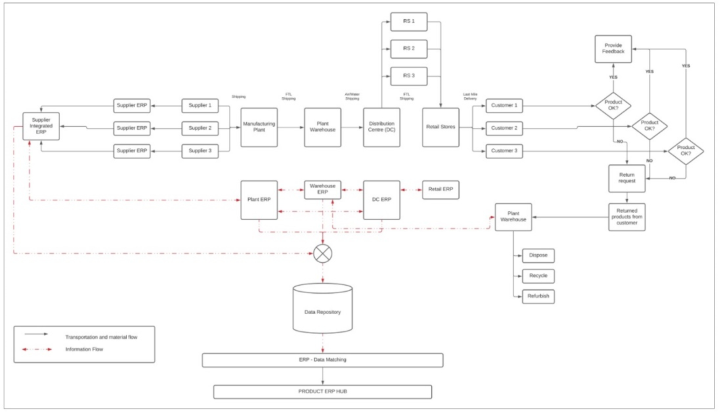
In the conceptual model, as shown in Figure 1, it has been explained the flow of transportation and material goods and information flow across the supply network of FMCG. Based on the location of the suppliers, the raw materials are shipped through various means of transport to reach the manufacturing plant. Each of these suppliers has their ERP systems, which track the infor- mation regarding the movement of the material and then are finally updated onto a supplier integrated ERP hub, from where the information is collected and connected to the data repository. After raw materials reach the manufa- cturing plant, once the product is finished and packed, they are transported to the internal plant warehouse. Both the manufacturing plant and the plant
Figure 1: The whole structure of proposed solution.
warehouse have ERP systems that feed all the data/information. This infor- mation is again shared among the other parties like the distribution center, plant warehouse to the distribution center. After the products are shipped through the preferred mode of transport, primarily by roadways in full tru- ckloads to the distribution centers, they are sent to the various retailers and the customers through the last-mile delivery from the distribution center. The information obtained from each ERP is shared with the plant warehouse to monitor the inventory levels to ensure consistent supply. All the informatio- n/data from the ERP systems are converged at a data repository which are then matched to check for the credibility of the data and with whom it can be shared. The model also gives a gist of the reverse logistics involved if the product is not as per the required standards.
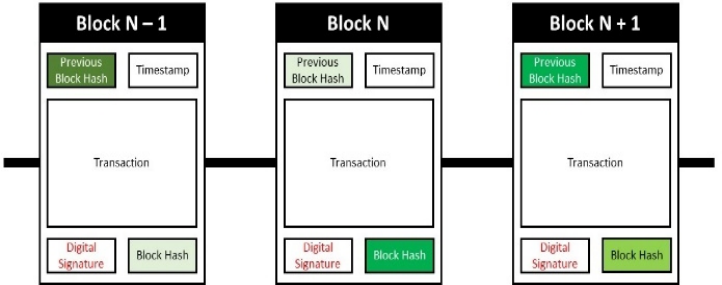
Blockchain Perspective According to Figure 1, there is an extensive flow of information between various parts of the supply chain network, which is usually managed and controlled in a centralized structure. But, by using blockchain technology, it is possible to control the network in a decentralized manner. In this method, a chain of information blocks is formed, which is called a digital ledger. Figure 2 shows different parts of the blocks in this chain. There is a time- stamp in each block, which shows the time of block registration. The other part of each block called “transaction” is the same information that is exch- anged among the blocks in Figure 1. The transaction of each block must be verified by another member of the decentralized structure, which is called a “miner”. The process of verifying the information finally leads to the digital signature on the block and assigning a hash number to that block. In each block, in addition to its hash, the previous block’s hash is also included. So, the chain of blocks is formed. The important advantage of this method is
Traceability in FMCG Industries by Application 701
Figure 2: The structure of each block in digital ledger.
that in addition to the possibility of controlling the information exchanged in different parts of the network due to the transparency of the decentralized structure, the security of the exchanged information is also very high because it is not possible to change the information of any of the blocks according to the explained chain of blocks. In this way, information is exchanged betw- een different components of the network with high transparency, traceability, and security.
Use Case Scenario The supplier sends the raw materials to the manufacturer. The manufacturer receives all the required raw materials from various suppliers. The shipment details and raw material characteristics are measured and updated in the chain block. The information about the shipping details is also mentioned in the chain. The manufacturer produces the final product, then stored in the plant warehouse through the appropriate means of travel. The produced timestamp, the quality characteristics of the product, and quantity are upda- ted to the nodes in the chain. The product through the roadways is shipped to various distribution locations (DC). Various IoT sensors within the truck used to monitor the product are utilized to the maximum, and the entire data is updated onto the block in a chain. Through these DC’s they are distributed to various retailers across the region. The timestamps, the quality of product, and information sharing between the DC and the plant warehouse play a pivotal role in ensuring the data matches and compares the inventory levels in real-time. The customers buy the product from various retailers, thereby ending the B2C cycle. In this scenario, the information flow between two nodes is bidirectional, ensuring that anyone within the blockchain network can view the status and track the product (Kaur & Al, 2021).
Once the raw materials are received from the supplier to the manufacturing plant, all the relevant data/information about the characteristics of the mate- rial, shipping time, INCO terms are fed into the smart contracts, which are used as a medium for information sharing across the supply chain network on the FMCG sector. Since it is possible to set particular rules, conditions in smart contracts at every single stage of the network, various conditions
regarding the product can be cross verified through this, thereby elimina- ting any that do not comply. Once the product is manufactured, relevant information regarding the quality, quantity, pricing, and so are fed into the smart contract, in terms of shipping information about the lead time, delivery times, are product condition are mentioned, and they are cross-referenced with the set conditions in the smart contract. If they vary, there will be fines that the shipping party will have to comply with. Once the product reaches the distribution center, it is further moved to the retail stores where most customers purchase. The last-mile delivery of the product from the retailers to the customers is a challenging task, but it plays a pivotal role in FMCG B2C. These smart contracts at each stage of the supply network are linked to their respective ERP systems, thereby cross-referencing each stage’s data and maintaining high-security standards.
CONCLUSION
The complexity of interaction in FMCG supply chain necessitates the tra- ceability of information and processes among stockholders. Moreover, the complexity of financial interaction among the stakeholders in FMCG is highly challenging due to nature of this industry. This paper has discussed how the use of Blockchain in the traceability of the FMCG industry is benefi- cial. A conceptual model has been presented that provides information about how the flow of materials and information occurs in the FMCG industry and how they can be tackled with smart contracts. Tracking and tracing the product withholds numerous challenges by focusing on why it is bet- ter to use blockchain technology and how they can eliminate human errors and optimize the overall efficiency and effectiveness of the supply network. The conceptual model has also considered the application of smart contract mechanism. The smart contract mechanism facilitates the interaction of sta- keholders autonomously and enable the traceability of finical interaction in FMCG supply chain. The paper suggests the application of token model for tracing and sharing the value added yielded in stakeholder collaborations for future studies.
REFERENCES
Aghamohammadzadeh, E., & Fatahi Valilai, O. (2020). A novel cloud manufacturing service composition platform enabled by Blockchain technology. International Journal of Production Research, 58(17), 5280–5298. https://doi.org/10.1080/ 00207543.2020.1715507 Agrawal, T. K., Kumar, V., Pal, R., Wang, L., & Chen, Y. (2021). Blockchain-based
framework for supply chain traceability: A case example of textile and clothing industry. Computers & Industrial Engineering, 154, 107130. https://doi.org/10. 1016/j.cie.2021.107130 Aste, T., Tasca, P., & Di Matteo, T. (2017). Blockchain Technologies: The Foreseeable Impact on Society and Industry. Computer, 50, 18–28. https://doi.org/10.1109/ MC.2017.3571064 Azzi, R., Kilany, R., & Sokhn, M. (2019). The power of a blockchain-based supply
Traceability in FMCG Industries by Application 703
Baralla, G., Pinna, A., Tonelli, R., Marchesi, M., & Ibba, S. (2020). Ensuring transparency and traceability of food local products. A blockchain application to a Smart Tourism Region. Concurrency and Computation Practice and Experience, 33. https://doi.org/10.1002/cpe.5857 Behnke, K., & Janssen, M. F. W. H. A. (2020). Boundary conditions for traceabi-
lity in food supply chains using blockchain technology. International Journal of Information Management, 52, 101969. https://doi.org/10.1016/j.ijinfomgt.2019. 05.025 Burkitt, L. (2014, June 17). Wal-Mart to Triple Spending on Food-Safety in China.
Wall Street Journal. https://online.wsj.com/articles/wal-mart-to-triple-spending- on-food-safety-in-china-1402991720 Caldarelli, G., Rossignoli, C., & Zardini, A. (2020). Overcoming the Blockchain Oracle Problem in the Traceability of Non-Fungible Products. Sustainability, 12(6), Article 6. https://doi.org/10.3390/su12062391 Centobelli, P., Cerchione, R., Vecchio, P. D., Oropallo, E., & Secundo, G. (2021).
Blockchain technology for bridging trust, traceability and transparency in circular supply chain. Information & Management, 103508. https://doi.org/10.1016/j.im .2021.103508 Dabbene, F., Gay, P., & Tortia, C. (2014). Traceability issues in food supply chain management: A review. Biosystems Engineering, 120, 65–80. https://doi.org/10. 1016/j.biosystemseng.2013.09.006 Dixit, S., Rawat, R., Chougule, R., Singh, S., & Kadam, A. (2019). Tracing the
original source of FMCG-SCM using Blockchain. 5. Galvez, J. F., Mejuto, J. C., & Simal-Gandara, J. (2018). Future challenges on the use of blockchain for food traceability analysis. TrAC Trends in Analytical Chemistry, 107, 222–232. https://doi.org/10.1016/j.trac.2018.08.011 Ganesan, S., Wicaksono, H., & Fatahi Valilai, O. (2023). Enhancing Vendor
Managed Inventory with the Application of Blockchain Technology. In M. Valle, D. Lehmhus, C. Gianoglio, E. Ragusa, L. Seminara, S. Bosse, A. Ibrahim, & K.-D. Thoben (Eds.), Advances in System-Integrated Intelligence (pp. 262–275). Springer International Publishing. Geroni, D. (2021, September 16). Top 12 Smart Contract Use Cases. 101 Blockchains. https://101blockchains.com/smart-contract-use-cases/ Islam, S., Manning, L., & Cullen, J. M. (2021). A Hybrid Traceability Technology
Selection Approach for Sustainable Food Supply Chains. Sustainability, 13(16). https://doi.org/10.3390/su13169385 Kamble, S. S., Gunasekaran, A., & Sharma, R. (2020). Modeling the blockchain enabled traceability in agriculture supply chain. International Journal of Information Management, 52, 101967. https://doi.org/10.1016/j.ijinfomgt.2019.05.023 Kaur, R., & Al, E. (2021). An Approach for Secure Product Traceability in Food Sup-
ply Chain Based on Blockchain. Turkish Journal of Computer and Mathematics Education (TURCOMAT), 12(10), Article 10. https://doi.org/10.17762/turcomat .v12i10.4080 Khaturia, R., Wicaksono, H., & Fatahi Valilai, O. (2022). SRP: A Sustainable Dynamic Ridesharing Platform Utilizing Blockchain Technology. In M. Freitag, A. Kinra, H. Kotzab, & N. Megow (Eds.), Dyna- mics in Logistics (pp. 301–313). Springer International Publishing. https://doi.org/10.1007/978-3-031-05359-7_24 Liu, X., Barenji, A. V., Li, Z., Montreuil, B., & Huang, G. Q. (2021). Blockchain-
based smart tracking and tracing platform for drug supply chain. Computers & Industrial Engineering, 161, 107669. https://doi.org/10.1016/j.cie.2021.107669
Lobo, C. R., Wicaksono, H., & Valilai, O. F. (2022). Implementation of Blockchain Technology to Enhance Last Mile Delivery Models with Sustainability Perspe- ctives. 10th IFAC Conference on Manufacturing Modelling, Management and Control MIM 2022, 55(10), 3304–3309. https://doi.org/10.1016/j.ifacol.2022. 10.123 Lu, Q., & Xu, X. (2017). Adaptable Blockchain-Based Systems: A Case Study for
Product Traceability. IEEE Software, 34(6), 21–27. https://doi.org/10.1109/MS .2017.4121227 Mandolla, C., Petruzzelli, A., Percoco, G., & Urbinati, A. (2019). Building a Digital Twin for Additive Manufacturing through the Exploitation of Blockchain: A case analysis of the aircraft industry. Computers in Industry, 109, 134–152. https://do i.org/10.1016/j.compind.2019.04.011 Navendan, K., Wicaksono, H., & Fatahi Valilai, O. (2022). Enhancement of Crowd
Logistics Model in an E-Commerce Scenario Using Blockchain-Based Decentra- lized Application. In M. Freitag, A. Kinra, H. Kotzab, & N. Megow (Eds.), Dynamics in Logistics (pp. 26–37). Springer International Publishing. https://do i.org/10.1007/978-3-031-05359-7_3 Sirkka, A. (2008). Modelling traceability in the forestry wood supply chain. 2008 IEEE 24th International Conference on Data Engineering Workshop, 104–105. https://doi.org/10.1109/ICDEW.2008.4498296 Sivaganesan, D. (2019). BLOCK CHAIN ENABLED INTERNET OF THINGS.
Journal of Information Technology and Digital World, 01(01), 1–8. https://doi. org/10.36548/jitdw.2019.1.001 Tsolakis, N., Niedenzu, D., Simonetto, M., Dora, M., & Kumar, M. (2021). Supply network design to address United Nations Sustainable Development Goals: A case study of blockchain implementation in Thai fish industry. Journal of Business Research, 131, 495–519. https://doi.org/10.1016/j.jbusres.2020.08.003 Wamba, S. F., & Queiroz, M. M. (2020). Blockchain in the operations and sup-
ply chain management: Benefits, challenges and future research opportunities. International Journal of Information Management, 52, 102064. https://doi.org/ 10.1016/j.ijinfomgt.2019.102064
Read this individual research paper free through the original publisher, or explore the full digital proceedings book.
ISBN 978-1-958651-87-2
Explore this ISBN in the AHFE Bookstore ↗Listed in the July 2026 bookstore catalogue; search by ISBN to confirm current availability · Digital book purchase optional