Haseena Alkatheeri, Evangelos Markopoulos, Hamdan Hamdan Al-qayed (2023). An organizational and operational capability and maturity assessment for SMEs in emerging markets towards the ESG criteria adaptation. In: Human Interaction & Emerging Technologies (IHIET 2023): Artificial Intelligence & Future Applications. AHFE Open Access, vol. 111, pp. 682–692. https://doi.org/10.54941/ahfe1004075
SMEs are considered the backbone of every economy forming nearly 95% of the private sector globally. As they are mostly family businesses, start-ups or specialized enterprises, they operate mainly locally or regionally with a direct impact to the society, the, employment and the national economy. On the other hand, due to their limited size and operations they cannot afford the cost and effort needed for long term planning and strategy development that can secure the value, volume, reputation and recognition needed to attract investments. The ESG criteria can be considered as a privilege system primarily for the large-scale organizations and the Multinational Enterprises whose financial and human resources can be easier allocated on ESG activities that return serious financial and reputational benefits. Research indicates that more than 90% of the investors invest only in companies with high social and sustainable profiles. The message from investors and consumers is that if companies cant show any sign of changing their business models, they wont be able to sell. The same applies at country level. Finland for example does not offer any business opportunities to any company that does not have a solid and proven sustainability strategy and track record. This trend, for clients and investors, to consider only Green (sustainable) or Pink (Social) products and companies for their purchases and investments, drives all types of organizations towards that adaptation of the ESG criteria. However, and since such a strategy requires investments, resources, funds and time that only Multinational organizations can provide, SMEs are left out from any opportunity to develop, grow, and compete. This paper highlights this ESG discrimination among the SMEs and MNEs and intends to bridge this gap by identifying, in a smaller scale, activities that reflect the ESG criteria and can be implemented by the SMEs at organizational and operational level. Such an approach provides SMEs the opportunity to record, report and receive credit, visibility and recognition for their sustainable, social and ethical governance efforts and actions, that can potentially enlarge their customer base and attract the investments needed to further develop themselves. The proposed approach is based on an assessment that creates an SME ESG roadmap framework for the SMEs to initially identify their ESG awareness and maturity before adopting any ESG related strategy and commitment. The assessment highlights the SMEs capability and maturity to adopt such a mid-range strategy and align their operations with the ESG criteria on a smaller scale. The results of the assessment formulate an achievable ESG related strategy for each SME, identify the key ESG activities to be implemented, indicate their order of execution, and predict a performance score upon the completion of the proposed strategy. This score can be utilized by SMES to receive social, reputational and financial recognition for their contribution to the local and regional society and economy. To secure the relevance of the SMEs ESG oriented activities with the actual ESG requirements, the proposed approach has been developed after studying several ESG reporting and scoring methodologies such as the Refinitiv, FTSE Russel, BHI, and others, and extractive the most relevant ESG requirements and metrics that can be implemented and measured with the abilities of an SME.Due to the significant variations of the SMEs operations, the proposed framework is targeted primarily to SMEs in emerging markets where the economic development and a structured business environments can help such a novel approach in SMEs strategic management and leadership.
SMEs are considered the backbone of every economy particularly in developing countries and emerging economies as they contribute up to 40% of national income (GDP). SMEs represent about 90% of businesses and more than 50% of employment worldwide, making them important contributors to job creation and global economic development (World Bank, 2023). In OECD countries, SMEs account for about 99 per cent of firms, 70 per cent of all jobs (OECD, 2017). SMEs contribute more than 50per cent of GDP in high-income countries worldwide (ILO, 2019).
As they are mostly family businesses, start-ups, or specialized enterprises, SMEs operate mainly locally or regionally, directly impacting society,
An Organizational and Operational Capability and Maturity Assessment 683
employment, and the national economy. On the other hand, due to their limited size and operations, they cannot afford the cost and effort needed for long-term planning and strategy development that can secure the value, volume, reputation, and recognition needed to attract investments.
The ESG criteria can be considered as a privilege system primarily for large-scale organizations and Multinational Enterprises (MNEs) whose financial and human resources can be easier allocated to ESG activities gaining serious financial and reputational benefits. The number of asset managers that incorporate ESG into their asset allocation process indicates a rapid increase. Research indicates that more than 90% of investors invest only in companies with high social and sustainable profiles (US/SIF, 2018).
The message from investors and consumers is that if companies can’t show any sign of changing their business models, aligned with the ESG framework they won’t be able to target future sales (CBINSIGHTS, 2019). The same applies at the country level. Finland for example does not offer many business opportunities to companies that do not have a solid and proven sustainability strategy and track record (Valtioneuvesto, 2021). This trend, for clients and investors, to consider only Green (sustainable) or Pink (social) products and companies for their purchases and investments, drives all types of organizations towards that adaptation of the ESG criteria (Markopoulos et al., 2022a). However, since such a strategy requires investments, resources, funds, and time that only Multinational Enterprises can provide, SMEs are left out of any opportunity to develop, grow, and compete.
THE CHALLENGE OF ESG SCORING The rapid recognition of the ESG index by the industry, and the financial institutions specifically that reward organizations based on their ESG score, created several scoring methodologies from different institutions based on their institutional investment strategy and policy. This is also due to the new thematic investment schemes that emerge which become appealing to investors with very specific investment objectives (Refinitiv, 2022a).
These different methodologies of defining the ESG pillars resulted in a tremendous inconsistency in the categories and themes of each pillar, making the adaptation of the ESG more of a strategic decision on which methodology to select that can result in a higher ESG score.
To demonstrate this issue three ESG methodologies have been analysed. Table 1 briefly presents the differences and similarities among the ESG themes of Refinitiv (a subsidiary of London Stock Exchange Group, formerly called Thomson Reuters Financial & Risk) (Refinitiv, 2022b), The Financial Times Stock Exchange Group (FTSE Russel, a subsidiary of London Stock Exchange Group), (FTSE Russel, 2017), and Brooks, Hughes & Jones, Inc. (BHJ, a Securities and Exchange Commission (SEC) Registered Investment Adviser) BHJ (BHJ, 2019).
Water security Sustainable natural resources / Agriculture Water use and conservation Green building / Smart growth Social Workforce Labor standards Workplace safety
Workplace benefits
Human rights Human Rights and Community Community Health and Safety Diversity and anti-bias issues
Product responsibility
Customer responsibility
Community development Avoidance of tobacco and other harmful products Human rights Governance Management Anti-corruption Anti-corruption policies
The differences in the categories of each methodology extend to the differences in the themes that compose a category. For example, the ‘Health and Safety’ which is a theme in the ‘Workforce’ category of the ‘Social’ pillar in the Refinitiv methodology, is a category (not a theme) of the ‘Social’ pillar in the FTSE Russel methodology. This inconsistency where themes in one methodology are categories in another and vice versa creates a chaotic difference in what is measured, how, why, for what, and by whom.
Further analysis of Table 1 also indicates that based on the type of operations an organization has, a different ESG methodology can be selected. If for example, an organization provides products then the Refinitiv Methodology is a better choice to go with as the ‘Social’ pillar has the category ‘Product Responsibility’, compared to the FTSE Russel Methodology that has within the same pillar the ‘Customer Responsibility’ category which is a different concept and approach on the concept of ‘responsibility’.
ESG CHALLENGES AND OPPORTUNITIES IN THE EMERGING MARKETS The lack of ESG standardization has been a serious issue in planning to adopt the ESG framework in most organizations (Markopoulos et al., 2020), especially in emerging markets whose increasing growth and power puts
An Organizational and Operational Capability and Maturity Assessment 685
them under greater pressure from investors to act on their ESG commitments (Casanova & Miroux, 2021).
Research indicates that indeed, emerging markets are making significant progress in their ESG efforts (EMI, 2021). The top 20 emerging economies are key in driving global ESG efforts that rebuild the middle class and revive growth. (Casanova & Miroux, 2016) The growth and maturity of emerging markets impact the global business landscape. Over the years the U.S. firms dominated the Global Fortune 500, up until recently where only China counts 135 companies, compared to the 122 U.S. companies. To sustain such progress, emerging markets must increase their ESG efforts for many reasons, especially for the Principles for Responsible Investment (PRI) which has been built around ESG. PRI’s six principles, supported by the UN Global Compact and the UN Environment Programme Finance Initiative were developed by investors for investors in 2006.
In 2020 PRI signatories from emerging markets indicated an increase of 50% and in 2021 they account for 12% of the total PRI signatories, and 23% of the UN Global Compact business signatories with Brazil leading the way (714 companies). Lastly, 50 of the 108 partners of the 2021 Sustainable Stock Exchanges (SSE) initiative, are in emerging and developing economies.
Despite the promising growth of the emerging markets on ESG, there are several challenges and obstacles to tackle. The biggest one today is the poor availability and quality of ESG data. This limits the ability of investment firms to identify investment opportunities, but also their willingness to take investment risks that would have been taken in other markets.
Companies in emerging markets must integrate consistent and measurable ESG practices throughout their operations and standardize their ESG data to attract initial investments that can develop a healthy business cycle.
However, this can be challenging as ESG data standardization remains a fuzzy concept not only for the emerging markets but also for the developed ones due to the lack of a common methodology in terms of what needs to be measured, how, and why.
SMEESG: AN ESG FRAMEWORK FOR SMES IN THE EMERGING MARKETS To address the ESG data standardization issue in emerging markets the development of an ESG culture is needed. What seems to differentiate the emerging markets from the developed ones is the degree of consistency and persistence organizational cultures build over the years. The common problem of ESG data standardization between emerging and developed countries exists but it is handled differently based on the organizational maturity that derives from the internal organizational culture of each organization at each geographical region.
Such ESG cultures can be adopted by all companies and particularly by Small and Medium Size Enterprises that form the backbone of any economy but also feed with human resources the larger companies. On the other hand, methods proposed to SMEs must be feasible in terms of cost, effort,
and results visibility that encourage SMEs to invest in them and gain quick results that will help them maintain and increase their ESG adaptation efforts.
The SMEESG (SMEs-ESG) framework has been developed by extracting the most relevant ESG requirements and metrics that can be implemented and measured within the abilities of SMEs.
To secure the relevance of the SMEs ESG oriented activities with the actual ESG requirements, the proposed approach has been developed with selective categories from existing ESG methodologies while taking into consideration the ESG challenges and opportunities in the emerging markets (Markopoulos, 2023). The SMEESG framework divides the ESG pillars into 9 categories and 27 themes (see Table 2).
Green revenues [E.2.1] Human intellectual capital [E.2.2] Renewable resources [E.2.3] Water security [E.2.4] Emissions [E3] Pollution [E.3.1] Clean technology [E.3.2]
An Organizational and Operational Capability and Maturity Assessment 687
New themes that do not exist in the three ESG frameworks studied in this research are ‘Human Intellectual Capital’ under the ‘Sustainable natural resources’ category and the ‘Disaster recovery’ and ‘Business continuity’ under the ‘Risk management’ category.
The SMEESG framework does not contain requirements that need large corporate structure or significant budget to achieve them such as ‘Corporate governance’, ‘CSR strategy’, ‘Corporate political contributions’, ‘Climate change, Biodiversity’, and ‘Takeover defences’, among others.
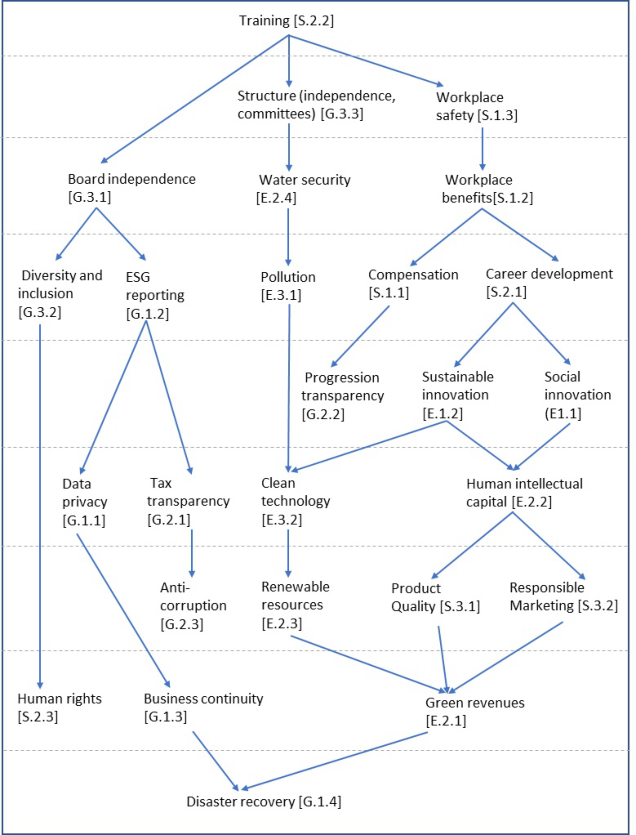
A proposed adaptation order of the SMEESG framework is given with a staged network diagram (see Figure 1). The network is divided into stages that balance the effort and complexity needed to implement the SMEESG themes.
Figure 1: SMEESG adaptation diagram.
SMEESG Organizational and Operational Capability and Maturity Assessment The adaptation of the SMEESG starts with an organizational capability and maturity assessment. Since the framework targets SMEs it must ensure that the company is aware of the commitment, effort, and investment needed to be made towards achieving an ESG score. This understanding is critical for the development of the ESG culture needed for companies to provide better and standardized ESG data, especially in emerging markets.
The assessment determines the readiness of the organization to adopt the SMEESG framework and prevents potential failures that can result in the termination of such initiatives or the creation of unreliable and incomplete ESG data. This readiness is measured by the degree of capability and maturity of the SME to adapt to the framework. The fact that an SME is willing to adopt the framework does not necessarily mean that this adaptation can be done.
Table 3. SMEESG assessment parts.
Table available in the original PDF paper.
Part Theme Description
What drives the SMEs towards this goal?
Organization Organizational motives Organizational commitment How committed is the leadership and management of the company? Organizational Structure
Have the organizations been structured to support this goal? (Teams, leaders, hierarchy, auditors, etc), Investment Budget Has the budget been arranged? and how it will be spent (time, goals, etc)? Time orientation Has time been arranged for this goal and how it will be distributed among tasks and people? Resources What human resources & non-human resources (machines, etc), have been arranged, and how they will be allocated? Human Resources
Availability How the availability of human resources has been arranged and secured? Expertise Do the human resources have the needed expertise and how they obtained it? Reliability How reliable is each person in the role given on this project? Metrics Performance indicators
How performance will be measured? (Process, people, tools) Data collection How data will be collected? (Process, people, tools) Data validation How data will be validated? (Process, people, tools) Data reporting How data will be reported? (Process, people, tools) Risk Management
Employee turnover How likely is the employee turnover and what can be done to avoid it? Pressure/Crisis management
Can the organization support this goal under periods of pressure/crisis? Employee burndown How can employees be replaced or supported in case of work overload? Infrastructure management
How access to data, IT systems, buildings, etc has been arranged, secured, and managed?
An Organizational and Operational Capability and Maturity Assessment 689
Capability can be defined and measured by the degree and the number of resources the organization is able in invests in the adaptation of the framework.
Maturity can be defined by the quality and quality of data gathered over specific periods of time during the adaptation of the framework.
Organizations might have the resources to implement ESG activities and initiatives indicate capability, but if not done properly, frequently, and correctly indicates a lack of maturity.
Balancing capability and maturity in an SME can be of high risk and complexity, but also for larger organizations with limited years in operations. This can be the case for many companies in emerging markets which might have the critical figures on available resources but not the culture to drive discipline and consistency in the execution of ESG initiatives.
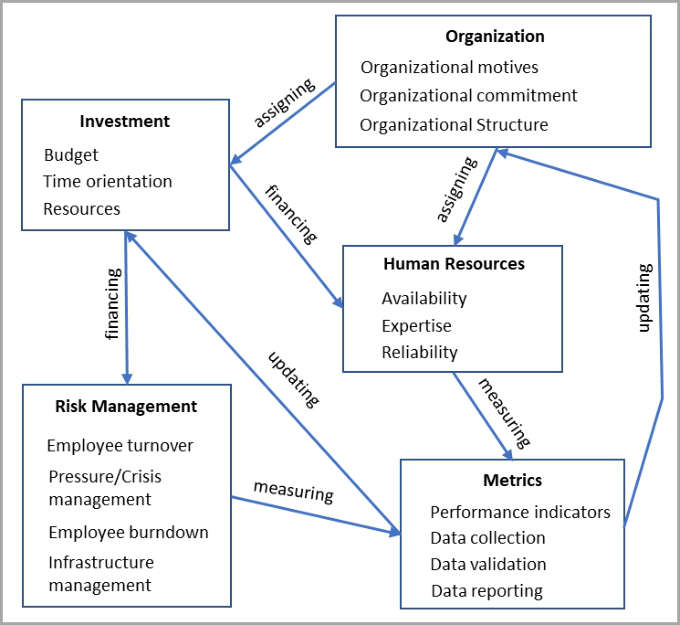
The SMEESG capability and maturity assessment is based on 17 themes grouped into 5 parts (see Table 3) named 1. Organization, 2. Investment, 3. Human Resources, 4. Metrics, 5. Risk Management. The execution order of the assessment parts is presented by a process diagram that indicates the assessment activities flow and relationship (see Figure 2).
Figure 2: SMEESG assessment execution process.
LIMITATIONS AND AREAS OF FURTHER RESEARCH The SMEESG framework has been developed as part of this research project to democratize ESG with its adaptation by Small and Medium Size Enterprises especially in emerging markets whose significant growth expects closer alignment with sustainable, social, and ethical management practices and standards. The framework has been developed by taking into consideration the industry needs, maturity, capability, and market demand for ESG democratization.
On the other hand, there is a need for further case studies to create the critical volume of data needed to allow a comparison between the SMEs and the MNEs ESG efforts which can determine similarities in commitments, achievements, and investments towards reaching adopting ESG practices and indicate ESG alignment.
What seems to be the limitation of the framework becomes the area of further research. This work will continue by engaging more SMEs from various sectors and industries for further assessment data, and implementation feedback collection that can analyze the framework’s operations, redesign its structure in terms of themes, study selected execution patterns (order of adopting the themes), and generate a scoring calculation that can be compared to the one used for larger organizations and MNEs.
To better achieve such results gamification technologies will be integrated for the development of pro-Environmental behaviour toward achieving effective ESG corporate strategies (Markopoulos et al., 2022b), in physical and virtual environments (Markopoulos et al., 2021a).
CONCLUSION
The proposed approach is based on an assessment that creates an SME ESG roadmap framework for the SMEs to initially identify their ESG awareness and maturity before adopting any ESG-related strategy and commitment. The assessment highlights the SME’s capability and maturity to adopt such a mid- range strategy and align their operations with the ESG criteria on a smaller scale. The overall approach democratizes ESG and extends SMEs’ social contributions beyond corporate social responsibility (CSR) (Markopoulos, 2021b). The result of the assessment formulates an achievable ESG-related strategy for each SME, identifies the key ESG activities to be implemented, indicates their order of execution, and predicts a performance score upon the completion of the proposed strategy. This score can be utilized by SMEs to receive social, reputational, and financial recognition for their contribution to the local and regional society and economy.
ACKNOWLEDGMENT
The authors would like to acknowledge Zayed University in the United Arab Emirates as this research leading to these results has received funding from Zayed University in the frame of the program “Research Incentive Fund” under the Grant agreement number 20133.
An Organizational and Operational Capability and Maturity Assessment 691
REFERENCES
BHJ (2019). Part 3: How are SRI/ESG strategies implemented?, BHJ Advisors, April 19, 2019. https://bhjadvisors.com/2019/04/29/part-3-how-are-sri-esg-strategies -implemented/ Casanova L, Miroux A. (2021). Emerging Market Multinationals Report 2021:
Building the Future on ESG Excellence. Emerging Markets Institute, Cornell University. DOI https://doi.org/10.7298/cvhn-dc87 Casanova L, Miroux A. (2016). Emerging Markets Multinationals Report 2016.
Emerging Markets Institute, Cornell University. DOI https://doi.org/10.7298/cv hn-dc87 CBINSIGHTS (2019). How Millennial Ethics Are Reshaping Fintech, CB Insights, March 27, 2019. https://www.cbinsights.com/research/millennial-investment-ethi cs-fintech-2019/ EMI (2021). ESG pressure takes center stage at the 2021 Emerging Markets Institute
conference. Cornell University. https://business.cornell.edu/hub/2021/12/02/esg- pressure-takes-center-stage-2021-emerging-markets-institute-conference/ FTSE Russel (2017). From niche to norm. ESG integration into stewardship responsibilities by institutional investors in Japan’, FTSE Russel, July 3, 2017. https://www.ftserussell.com/research/niche-norm ILO (2019). The power of small: Unlocking the potential of SMES. International Labour Organization, October 2019. https://ilo.org/infostories/en- GB/Stories/Employment/SMEs#power-of-small Markopoulos E., Kirane I. S., Gann E. L., Vanharanta H. (2020) A Democratic, Green
Ocean Management Framework for Environmental, Social and Governance (ESG) Compliance. In: Ahram T., Taiar R., Gremeaux-Bader V., Aminian K. (eds) Human Interaction, Emerging Technologies and Future Applications II. IHIET 2020. Advances in Intelligent Systems and Computing. pp. 21–33, vol. 1152. Springer. Markopoulos, E., Katheeri, H., Qayed, H. (2023). A decision support system architecture for the development and implementation of ESG strategies at SMEs. In: Tareq Ahram, Waldemar Karwowski, Pepetto Di Bucchianico, Redha Taiar, Luca Casarotto and Pietro Costa (eds) Intelligent Human Systems Integration (IHSI 2023): Integrating People and Intelligent Systems. AHFE (2023) International Conference. AHFE Open Access, vol. 69. AHFE International, USA.http://doi.org/10.54941/ahfe1002916 Markopoulos, E., Ramonda, M. (2022a). An ESG-SDGs alignment and execution
model based on the Ocean Strategies transition in emerging markets. In: Evangelos Markopoulos, Ravindra S. Goonetilleke and Yan Luximon (eds) Creativity, Innovation and Entrepreneurship. AHFE (2022) International Conference. AHFE Open Access, vol. 31, pp. 93–103. AHFE International, USA. https://doi.org/10. 54941/ahfe1001511 Markopoulos E., Staggl A., Gann E. L., Vanharanta H. (2021b) Beyond Corporate Social Responsibility (CSR): Democratizing CSR Towards Environmental, Social and Governance Compliance. Advances in Creativity, Innovation, Entrepreneurship and Communication of Design. AHFE 2021. Lecture Notes in Networks and Systems, vol. 276, pp. 94–103. Springer. https://doi.org/10.1007/ 978-3-030-80094-9_12 Markopoulos, E., Ramirez, A., Markopoulos, P., Vanharanta, H. (2022b). Gamification in a Democratic Pro-Environmental Behaviour Model towards achieving effective ESG corporate strategies. In: Evangelos Markopoulos, Ravindra S. Goonetilleke and Yan Luximon (eds) Creativity, Innovation and Entrepreneurship. AHFE (2022) International Conference. AHFE Open Access, vol. 31, pp. 104–114. AHFE International, USA. https://doi.org/10.54941/ahfe 1001512
Markopoulos P. Pyae A., Khakurel J. Markopoulos E., Saarnio R., Luimula M.
(2021a). Understanding How Users Engage in an Immersive Virtual Reality- Based Live Event. Conference: Conference: 12th IEEE International Conference on Cognitive Infocommunications (CogInfoCom) (pp. 447–452), 2021. ISBN 978-1-6654-2494-3 https://discovery.ucl.ac.uk/id/eprint/10153242/ OECD (2017) Enhancing the contributions of SMEs in a Global and Digitized Economy. OECD, June 2017. https://www.oecd.org/mcm/documents/C-MIN -2017-8-EN.pdf Refinitiv (2022a). Refinitiv ESG Scores. RE2607801/9-22. https://www.refinitiv.cn/c
ontent/dam/marketing/en_us/documents/fact-sheets/esg-scores-fact-sheet.pdf Refinitiv (2022b). Environmental, social and governance scores from Refinitiv. https://www.refinitiv.com/content/dam/marketing/en_us/documents/ methodology/refinitiv-esg-scores-methodology.pdf?elqCampaignId=14314 US/SIF (2018). Sustainable investing assets reach $12 trillion as reported by the US SIF Foundation’s biennial Report on US Sustainable, Responsible and Impact Investing Trends.https://www.ussif.org/files/US%20SIF%20Trends%20Report% 202018%20Release.pdf Valtioneuvesto (2021). Finland ranks first in international sustainable development comparison. Finish Government. Press release. June 14, 2021. https://valtioneuvosto.fi/en/-//10616/finland-ranks-first-in-international-sustain able-development-comparison World Bank (2023). Small and Medium Enterprises (SMEs) Finance. https://www.
Read this individual research paper free through the original publisher, or explore the full digital proceedings book.
ISBN 978-1-958651-87-2
Explore this ISBN in the AHFE Bookstore ↗Listed in the July 2026 bookstore catalogue; search by ISBN to confirm current availability · Digital book purchase optional