Maurício Randolfo Flores Da Silva, Enzo Morosini Frazzon, Guilherme Luz Tortorella, Julia Cristina Bremen, Bruna Rigon De Oliveira (2023). Human-centric decision for the Integrated Planning of Smart Port Systems. In: Human Interaction & Emerging Technologies (IHIET 2023): Artificial Intelligence & Future Applications. AHFE Open Access, vol. 111, pp. 44–53. https://doi.org/10.54941/ahfe1004008
While the context of Industry and Logistics 4.0 is mainly related to smart systems and automation, new efforts are being applied to develop human-centric super-smart system, under the name of Industry 5.0. One example of a logistics system in this context can be seen in port terminals, which are migrating from traditional modern ports to Smart Ports. In this context, a series of questions arise related to the intrinsic human factors influencing the performance of smart systems. Thus, the main objective of this research is to develop a conceptual framework of human-centric decision for the integrated logistics operation and maintenance planning in smart port systems. A systematic literature review is adopted to build the scientific pillars for the conceptual framework. Afterwhile, under the Industry 5.0 context, we developed a human-centric decision framework connected with smart technologies to acquire real-time data and integrate logistics operations. As conclusion, we identified that the interaction of humans with recommendations from smart systems are not explored properly, and, so, the constructed framework presented an approach demonstrating that human decision can be influenced by intrinsic factors and affect the interaction between humans and intelligent systems.
The rise of Industry 4.0 concept promoted advances in traditional systems and enabled the development of new technologies and digitalization in diffe- rent environments, providing intelligence to systems and processes (Tortorella et al., 2022). The adoption of smart technologies and digitalization in the logistics context received the name “Logistics 4.0” (Knapp et al., 2021).
However, while the context of Industry and Logistics 4.0 is mainly related to smart systems and automation, new efforts are being applied to develop the context of a human-centric super-smart system, under the name of Indu- stry 5.0 (Leng et al., 2022). The concept of Industry 5.0 suggests that humans are still the key players in the decision-making process, which combines the intelligence from smart systems and devices, the precision of machines, and
Human-Centric Decisions for the Integrated Planning of Smart Port Systems 45
also the human interaction with the technologies (Breque et al., 2021; Müller, 2020). The human characteristics interacting with smart systems can be con- sidered as a critical factor to improve the performance of the organizations (Kavre et al., 2022; Rieger and Manzey, 2020), despite the fact that the lack of studies including human aspects in smart systems adoption makes the analysis of human influence unfeasible in this scenario.
One example of a logistics system in the smart context can be seen in port terminals, which are migrating from traditional modern ports to Smart Ports (da Silva et al., 2023). Indeed, port terminals are struggling to maintain an elevated efficiency level with the demand increase that occurred in the last decades (Chen et al., 2019), and so, the adoption of smart technologies is an opportunity to optimize port operations. Specifically in container terminals, the coordination of truck flow is a critical issue for port managers, since the unbalanced arrival of trucks can cause congestion in port hinterland and impact the efficiency of yard operations (Yu et al., 2022).
Meanwhile, with the advent of smart systems application, a series of que- stions arise related to the intrinsic human factors influencing the performance of smart systems (Cimini et al., 2022). On one hand, humans are more fle- xible than machines and can perceive some situations and reschedule some operations more quickly (Grosse et al., 2015). On the other hand, the deci- sion that humans can make after receiving data from smart technologies can vary, and systematic errors can occur due to learning, biases, worker experi- ence and judgmental decision, or other human factors (ElMaraghaby et al., 2021; Knapp et al., 2021). Including the human factors in a simulation model is a challenge to con- struct a more realistic experiment, however, the use of simulation experiments considering the human influence in intelligent logistics systems is still not explored properly, which points to a research opportunity. Based on the sce- nario described above, the aim of this research is to design a conceptual framework of human-centric decision for the integrated logistics operation and maintenance planning in smart port systems. From the conduction of a systematic literature review, this study revised scientific papers to identify the human factors that influence intelligent logistics systems and detailed how to insert the factors into a computational modelling.
The remainder of this paper is structured as follows. The research metho- dology section presents the method used in the systematic literature review. In the results and findings section, the qualitative analysis of the content of the papers are summarized. The conceptual framework section details and discusses the design of a framework for the integration of logistics operations and maintenance planning with human-centric decisions in smart systems. Finally, the conclusion section closes the paper and present future research opportunities.
RESEARCH METHODOLOGY A systematic literature review (SLR) is adopted as the methodology in this paper to build the scientific pillars for the conceptual framework addressing the topics of the research. The selected method for the SLR is the Preferred
Reporting Items for Systematic Review and Meta-Analysis (PRISMA), which is divided into four steps: identification of papers, screening, eligibility, and inclusion (Moher et al., 2010).
To start the process of papers identification, Scopus and Web of Science were used as databases, which covers the main journals in the research area. The search string used is: ((“human factor*” OR “resource* availab*” OR “cognitive biases” OR “learning skills” OR “human decision*” OR “human influence”) AND (“smart port*” OR “port terminal”) AND (“simulation” OR “model*)). Moreover, we limited the results for articles published in journal, using English language, and published before November 24th, 2022.
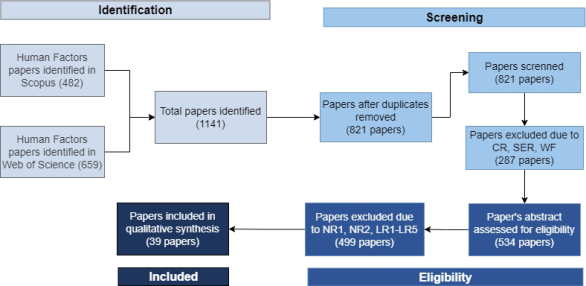
In the papers screening and eligibility phase, we start removing duplicated papers using the bibliometrix package, developed by Aria and Cuccurullo (2017), in the software R Studio. Next, in the eligibility phase, we double read the title, abstract, and keywords of the selected papers and removed the papers non-related or loosely related to the searched topic. Table 1 sum- marizes the adopted criteria for selecting or removing the papers in this phase.
Finally, the papers classified as CR in the eligibility phase were included in the final portfolio. We read the full content of the selected papers and extracted information according to some research questions that guided our review, which will be presented in detail in the results and findings section. Figure 1 demonstrates the number of papers considered in each phase of the PRISMA method application and the number of papers removed regarding each criterion.
In terms of data analysis, the review was conducted with the purpose of extracting relevant information to address the research topics that guide the study. To highlight the data from the publications, we used coding and the software Mendeley®. Furthermore, the reading sequence was organized by the year of publication, which enabled the analysis of content focusing on identifying if open gaps cited in the older publications were addressed in more recent studies.
Table 1. Eligibility criteria.
Table available in the original PDF paper.
Principle Criteria Human Factors Inclusion Closely Related (CR) The research content is explicitly dedicated to human factors in logistics environment. Exclusion Search Engine Reason (SER)
The full text of a paper is not available.
Only a part of the paper is available in English, but not the full text. Without full text (WF) Non-related (NR) NR1: Papers that are not academic article; NR2: Papers not in line with “human factors” AND “logistics systems” OR “port terminals” theme. Loosely related (LR)
LR1: Human factors are only used as example; LR2: Human factors is used only to point to future opportunities; LR3: Human factors are only a cited expression; LR4: Human factors are used only in keywords and/or references; LR5: Human factors studied outside the logistics context.
Human-Centric Decisions for the Integrated Planning of Smart Port Systems 47
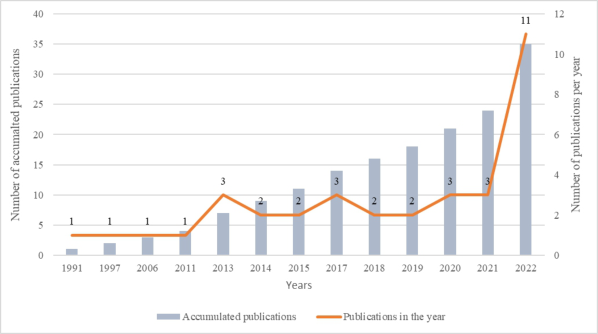
Figure 1: Review phases following the PRISMA method.Figure 2: Scientific publications related to human factors over the years.
The full-paper reading enables the identification of human factors cited by the authors, and consequently the grouping of factors in categories, as well as the analysis of the influence of each human factor in the logistics systems. The final portfolio of this research consists of 35 papers. Figure 2 presents the analysis of publications over the years.
It can be seen from Figure 2 that human factors in the context of the logi- stics environment were first studied in 1991, but only after 2011, when the Logistics 4.0 concepts started to be studied that human factors became a more frequent research topic in the literature. Indeed, we can observe that the total accumulated publications and the publications per year are growing signifi- cantly in the last few years, achieving the main peak so far in 2022. Even though, as the topic is still in the infancy stage of development and conceptu- alization, there are some open points in the literature and an opportunity to develop a consistent approach in the area.
RESULTS AND FINDINGS The qualitative analysis performed has the objective to answer two main questions:
(1) What are the main human factors that must be considered in the modelling of logistics systems? (2) How the human factors can affect the performance of smart systems?
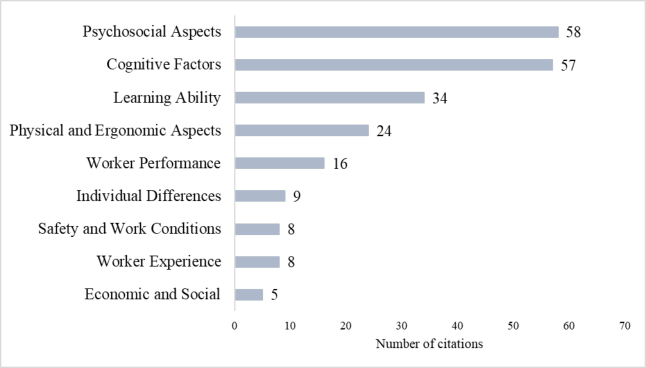
Human Factors Human factors can be defined as the aspects influencing the interaction betw- een humans and systems (Grosse et al., 2017). Nilsson (2006) defines that human factors can be either a value creator for the logistics operation, as also can be the main producer of uncertainty, due to human behaviour and interaction with technologies. Related to human management in the context of Logistics 4.0, da Silva et al. (2022) emphasize that human resource mana- gement (HRM) involves different aspects of human skills and qualifications, the training and learning, and the techniques and management strategies used to coordinate the organization. Moreover, considering the concept of Indu- stry 5.0, Nahavandi (2019) indicates that humans are the central factor to improve the efficiency of processes by the combination of data collected by intelligent systems and the human creativity and brainpower to propose fle- xible solutions. Indeed, the studies related to trends and research directions in the logistics field points out for a human-centric era, with human-technology integration and collaboration, the challenges for humans in the digital era with decisions being taken from humans based on intelligent systems and technologies, the automation impact on performance and the human auto- nomy on high performance environments (Cimini et al., 2022; O’Neill et al., 2020). Vijayakumar et al. (2022) classify human factors into four main categories, being physical aspects, mental aspects, perceptual aspects, and psychosocial aspects. The classification proposes a grouping of factors according to the influence of aspects on the human. In our case, we reviewed the final portfolio of papers related to human factors, and identified 219 aspects, which we grouped into nine categories according to the interaction of the aspect with humans and technologies. Figure 3 presents the categories we defined and the number of citations for each category.
Aiming to summarize the factors of each human factor category and the influence of each factor on logistics operations, we performed an analysis of this relationship between the components of each category, which is presented in Table 2.
Regarding the influence of human factors on logistics operation of smart systems, each category can have a different influence on the system, and according to the three most cited categories in our research, we detailed the possible influence of each factor on the system performance that needs to be considered in the modelling and simulation of logistics systems.
In this sense, the learning ability must be considered as the learning curve for new activities associated to workers, and include the possibility of long periods of absence causing forgetting of previously acquired knowledge. In parallel, to model cognitive factors, mental and perceptual aspects can be affected by work conditions; cognitive adaption plays a crucial role in an environment that the work must adapt itself according to external events; and
Human-Centric Decisions for the Integrated Planning of Smart Port Systems 49
Figure 3: Human factors classification.Table 2. Analysis of human factors included in each category.
Table available in the original PDF paper.
Classification Human Factors Psychosocial aspects Boredom, confidence biases, conformity, emotional intelligence, emotions use in problem-solving, incentives, job satisfaction, leadership, monotony, motivation, optimism, time pressure, and risk-taking attitude Cognitive factors Alertness, behavioural aspects, cognitive biases, human recognition and perception time, human sense, mental and perceptual factors Learning ability Adaptability, confusion, forgetting, human-technology interaction, information processing, memory, reaction, reading, training, and workers support Physical and ergonomic aspects Body posture, ergonomic aspects of workstation, health and safety, perceptual physical aspects, physical conditions, fatigue, stress, work force, workload, and work conditions. Worker performance Decision-making, human delay for response, operator errors, speed, and worker productivity Individual differences Culture, diversity, and inclusion, ethical, gender, genetics, and personal characteristics Safety and work Resources availability, workers safety, workers well-being, and exposure to risks Worker experience Field experience, professional qualification, work experience, and worker skills Economic and social Economical and financial aspects, social influence
cognitive biases can affect decision-making and influence how the manager deal with unforeseen events, which requires probability models to be included in the modelling according to each decision-making.
Finally, from the psychosocial aspects can inferred that worker physical and mental well-being has a direct impact on productivity; psychosocial cha- racteristics can have an impact on the relationship between workers, and create a better work environment; and emotional intelligence can be used
to achieve more assertive decisions under time pressure. Thus, to include psychosocial aspects in the modelling of logistics operation, interviews and questionaries must be applied to port managers and operators to identify beh- avioural patterns and create probability functions to estimate the possibility of different decisions.
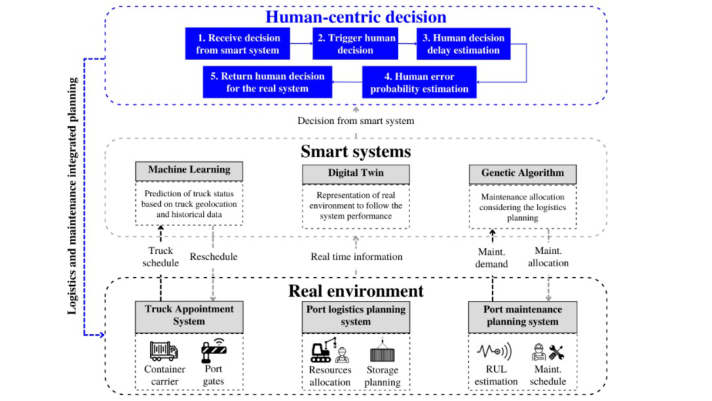
Conceptual Framework of Human-Centric Decision for the Integration of Logistics Operations and Maintenance Planning As explained in the previous section, the main objective of this paper is to design a conceptual framework of human-centric decisions for the integra- ted logistics operation and maintenance planning in smart port systems. The conceptual framework using smart systems with human-centric decisions is supported by the concepts of Industry 5.0, in which the technologies and the human directly interact to improve the operational performance of the smart port logistics system. Hence, the proposed conceptual framework is divided in three main parts: the real environment, representing the operatio- nal systems of the port terminal; the smart systems, which are responsible for data analysis and developing intelligent approaches; and the human- centric decision, enabling the analysis of interaction between humans and technologies. The conceptual framework can be seen in Figure 4.
Figure 4: Conceptual framework for integration of logistics operations and maintena- nce planning with human-centric decisions.
The operational part, represented by the real environment, is composed of the container processing operations that involve the transporting from the origin point to the port terminal, the gate operations, and the yard opera- tions. The coordination of trucks during the transport applies a Machine Learning algorithm to predict the truck status in advance and propose resch- eduling, when a disruption is identified. The yard operations are coordinated with a port logistics planning system to monitor the resources availability
Human-Centric Decisions for the Integrated Planning of Smart Port Systems 51
and allocation, as well as the slots available in the storage area according to the priority rules for moving to the berth area. The data collected from the port logistics planning system is used by a Digital Twin to represent the real environment and follow the system performance according to possible changes in the planning.
Afterwhile, when a decision is required by a change in the system (e.g., maintenance requirement, higher demand than resource available, ave- rage waiting time of trucks longer than the expected, etc.), the conceptual framework proposes a human-centric decision, which is mainly represen- ted by five following steps: (1) receive data from smart system – the smart system informs the port manager about the disruption identification and pre- sents the available data collected; (2) trigger human decision – the system requires a decision from the manager, according to the scenario informed; (3) human decision delay estimation – based on real data to be collect from port terminals, the conceptual framework proposes the use of probability to estimate the delay time to decide between the requirement and the final decision; (4) human error probability estimation – in this sense, the propo- sal considers the real environment to evaluate the impact of each possible solution in the operational system performance, and then evaluate if the chosen solution by the human manager is the most efficient, the amount of errors in human decision is used as probability to estimate the human error; (5) return human decision for the real system – the human decision is informed to the system and return as the logistics and maintenance inte- grated planning for the real environment to be applied in the operational systems.
Following the human-centric decision, the operational part also considers the port maintenance planning system, which according to the strategy defi- ned and the Remaining Useful Life (RUL) of each resource triggers a Genetic Algorithm (GA) to identify the most suitable time window to allocate main- tenance without creating a disturbance in the efficiency of yard operations. In order to maintain the availability as high as possible, corrective mainte- nance must be avoided, and condition-based maintenance (CBM) strategies should be used as a priority to monitor the life cycle of port equipment and perform the maintenance before the breakdown. To monitor the resource condition in real-time, a group of technologies that can be used to identify performance drops, which indicates that the resource is requiring maintena- nce. Between the technologies, we highlight the use of smart sensors installed on port equipment, as well as thermography, oil analyzers, and oscilloscopes.
Finally, the implementation of the defined planning integrating logistics operations and maintenance creates a loop cycle, in which the resources status and the port operators’ efficiency may undergo unexpected circum- stances, and then new updates can be necessary, triggering the human-centric decisions. Therefore, the integration of logistics operations and maintenance planning occurs by coordinating the port gates activities with yard operations and monitoring the current status of resources based on smart sensors, which allows the system to preventively identify efficiency decreases and schedule maintenance, having the human decision as a crucial role in the integration process.
CONCLUSION
Considering the main objective of this research, this study developed a conce- ptual framework to integrate logistics operations and maintenance planning with human-centric decisions. From the scientific point of view, the main contribution can be described as the identification of the human factors to be considered in the simulation and modeling of smart logistics systems. Besides, the conceptual framework is an innovative approach in the literature, consi- dering that the existing studies focus on integrating production and planning operations, and fail to include logistics activities.
On the other hand, from a practical point of view, our model represents the starting point for developing a solution to minimize congestion and long waiting time of containers at port terminals, mainly caused due to lack of synchronization between port gate operations, yard operations, and main- tenance planning. Besides, the research can be seen as an advance in the literature, since we propose a framework considering that the recommenda- tion of smart system can be ignored by the human, and a different schedule can be implemented based on the manager experience and perception of the scenario. However, a limitation of our study is that the developed framework was not computationally tested, and then, we could not compare the efficie- ncy of the developed approach. Based on this limitation, we point out that a research opportunity from the conceptual framework developed is to design simulation experiments to evaluate the performance of the model in a real use case of a smart port.
Withal, a systematic analysis of human behaviour during the execution of logistics operations can contribute to estimating quantitatively the effect of human factors on logistics operational efficiency. In this sense, the factors identified in the theoretical review performed by this paper can be visuali- zed in practice and the individual impact of each category can be estimated according to real data since the existing practical studies fail to include human factors in the simulation and modeling of logistics operations.
ACKNOWLEDGMENT
This study was financed in part by the Coordenação de Aperfeiçoamento de Pessoal de Nível Superior – Brasil (CAPES) – Finance Code 001. Funding for the research was provided by the Alexander von Humboldt Foundation (Prof. Enzo Morosini Frazzon - Georg Forster Research Fellowship for Experienced Researchers).
REFERENCES
Aria, M., Cuccurullo, C. (2017). bibliometrix: An R-tool for comprehensive science mapping analysis, Journal of Infometrics Volume 11, No. 4. Breque, M., De Null, L., Petridis, A. (2021). Industry 5.0: Towards a sustainable,
human-centric and resilient European industry, R&I Papers Series. Chen, J., Huang, T., Xie, X., Lee, P., Hua, C. (2019). Constructing Governance Framework of a Green and Smart Port, Journal of Marine Science and Engineering Volume 7, No. 4.
Human-Centric Decisions for the Integrated Planning of Smart Port Systems 53
Cimini, C., Lagorio, A., Cavalieri, S., Riedel, O., Pereira, C. E., Wang, J.
(2022). Human-technology integration in smart manufacturing and logistics: cur- rent trends and future research directions, Computers & Industrial Engineering Volume 169. da Silva, L., Soltovski, R., Pontes, J., Treinta, F., Leitão, P., Mosconi, E., Resende, L., Yoshino, R. (2022). Human resources management 4.0: literature review and trends, Computers & Industrial Engineering Volume 168. Da Silva, M. R. F., Agostino, I. R., Frazzon, E. M. (2023). Integration of Mach-
ine Learning and Simulation for dynamic rescheduling in Truck Appointment Systems, Simulation Modelling Practice and Theory Volume 125, No. May 2023. ElMaraghaby, H., Monostori, L., Schuh, G., ElMaraghaby, W. (2021). Evolution and future of manufacturing systems, CIRP Annals – Manufacturing Technology Volume 70. Grosse, E., Glock, C., Jaber, M., Neumann, P. (2015). Incorporating human
factors in order picking planning methods: framework and research opportunities, International Journal of Production Research Volume 53, No. 3. Grosse, E., Glock, C., Neumann, W. (2017). Human factors in order picking: a content analysis of the literature, International Journal of Production Research Volume 55. Kavre, M., Gardas, B., Narwane, V., Navimipour, N., Yalçin, S. (2022). Evaluating
the effect of human factors on Big Data Analytics and Cloud of Things Adoption in the Manufacturing Micro, Small, and Medium Enterprises, IEEE Computers Society Volume 24, No. 4. Knapp, F., Kessler, M., Arlinghaus, J. (2021). “The Influence of Cognitive Biasis in Production Logistics”, in: Dynamics in Logistics, Freitag, M., Kotzag, H., & Megow, N. (Eds.), Springer, pp. 183–193. Leng, J., Sha, W., Wang, B., Zheng, P., Zhuang, C., Liu„ Q., Wuest, T., Mourtzis, D.,
Wang, L. (2022). Industry 5.0: Prospect and retrospect, Journal of Manufacturing Systems Volume 65. Müller, J. (2020). Enabling technologies for Industry 5.0: Results of a workshop with Europe’s technology leaders, European Union – Independent Expert Report. Moher, D., Liberati, A., Tetzlaff, J., Altman, D. (2010). Preferred Reporting Items
for Systematic Review and Meta-Analyses: the PRISMA statement, International Journal of Surgery Volume 8. Nahavandi S. (2019). Industry 5.0—a human-centric solution, Sustainability Volume 11, No. 16. Nilsson, F. (2006). Logistics management in practice – towards theories of complex logistics, The International Journal of Logistics Management Volume 17, No. 1. O’Neill, T., McNeese, N., Barron, A., Schelble, B. (2022). Human-Autonomy
Teaming: A Review and Analysis of the Empirical Literature, Human Factors Volume 64, No. 5. Rieger, T., Manzey, D. (2022). Human Performance Consequences of Automated Decision Aids: The Impact of Time Pressure, Human Factors Volume 64, No. 4. Tortorella, G., Fogliatto, F., Gao, S., & Chan, T.-K. (2022). Contributions of Industry
4.0 to supply chain resilience, The International Journal of Logistics Management Volume 33, No. 2. Vijayakumar, V., Sgarbossa, F., Neumann, W., Sobhani, A. (2022). Framework for incorporating human factors into production and logistics systems, International Journal of Production Research Volume 60, No. 2. Yu, H., Deng, Y., Zhang, L., Xiao, X., Tan, C. (2022). Yard Operations and Mana-
gement in Automated Container Terminals: A Review, Sustainability Volume 14, No. 6.
Read this individual research paper free through the original publisher, or explore the full digital proceedings book.
ISBN 978-1-958651-87-2
Explore this ISBN in the AHFE Bookstore ↗Listed in the July 2026 bookstore catalogue; search by ISBN to confirm current availability · Digital book purchase optional