Pengyu Du, Kin Wai Michael Siu, Yi-Teng Shih (2022). Product Style Preferences: An Image-based User Study Software Concept. In: Usability and User Experience. AHFE Open Access, vol. 39, pp. 258–264. https://doi.org/10.54941/ahfe1001715
In the market, once producers of a particular product category become mature in their production technology, their products will have few functional differences. Thus, the greatest challenge for designers today lies in developing an appropriate design language that fits the tastes of target users. Designers use many user-study methods (interviews, questionnaires, focus groups) to understand their target users’ tastes. However, these methods mainly rely on language as the core medium of interaction. Because language can be subjective and one-sided, it is difficult to describe abstract concepts such as style preferences. In addition, in such design research, language-based information is transferred from target users to design researchers to designers over several rounds, and the objectivity and accuracy of such information can decrease substantially because of differences in people’s interpretations. This paper reviews product styling-related user study methods and technologies and proposes an image-based user study software concept that minimizes the above problems. This proposed software uses images as its main medium of interaction between target users and designers. It applies artificial intelligence technology to analyze target users’ common style preference patterns based on their image choices and sorting results. The software’s output is each target user’s persona in the form of a perceptual map and mood board. These personas provide objective product style preferences directly from the target users. This software can thus provide designers with intuitive and accurate references and inspire them to design products that meet users’ tastes and improve user experience.
In the market, once producers of a category’s products become mature in their production technology, it is hard for them to compete due to their pro- ducts’ similar functions and quality level (Person et al., 2008). The greatest challenge for designers thus lies in developing an appropriate design langu- age that fits target users’ tastes. (Li et al., 2018). As the efficiency of the design language depends entirely on the designer’s and product manager’s subjective understanding and experience (Ranscombe et al., 2017), theories such as product semantics and Kansei engineering (KE) have been developed
Product Style Preferences: An Image-based User Study Software Concept 259
to provide a deeper understanding of the meanings and feelings that pro- ducts elicit (Krippendorff and Butter, 1984, Nagamachi, 2002). However, traditional methods such as interviews, questionnaires, and focus groups still dominate the early stages of collecting user information (Nagamachi, 2011, Alcántara et al., 2005). Therefore, although these theories have great value, they have limitations in design practice. One limitation is the rapid deve- lopment pace of consumer products, as it is difficult to conduct integrated research with limited time and resources, especially for small design compa- nies and consultancies (Salminen et al., 2020). A second limitation is that language is the core research medium of mainstream methods such as inte- rviews and questionnaires. For example, questionnaires use language-based scales such as semantic differential scales, which feature descriptive adjecti- ves, usually in the form of pairs of antonyms of a specific product attribute, to evaluate users’ feelings about product traits(Osgood, 1964). However, people have different understandings of words and meanings, making these scales are inevitably subjective (Salminen et al., 2020). This paper presents an image-based user study software concept that addresses these limitations from a new perspective by simplifying the research process and compensating for the imperfections of language.
BACKGROUND
Design as a Communication Process Product design has shifted away from considering only physical requirements to also accounting for its consumers’ psychological needs (Krippendorff, 2005). As society develops, people’s lives become more materialistic and product design strategies move from manufacturer-dominant to consumer- dominant (Nagamachi, 1995). However, because of a lack of a practical methodology to address product functions that relate to psychological needs (Demirbilek and Sener, 2003, Crilly et al., 2004), designers must rely on their own tastes rather than their knowledge of customers’ psychological needs (Hsu et al., 2000). In such cases, it is crucial to understand target users’ product style preferences.
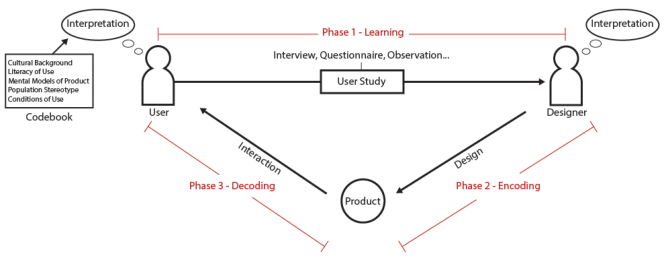
Product semantics, introduced by Krippendorff and Butter (1984) (Bucha- nan, 1995), is defined as “the study of symbolic qualities of man-made forms in the context of their use and the application of this knowledge to industrial design” (Krippendorff and Butter, 1984). Product semantics states that pro- duct style preference can be studied from the perspective of product forms’ symbolic qualities and the design process can be seen as a communication process (Krippendorff, 1989). As Figure 1 shows, “the user’s cultural back- ground, literacy of use, mental model of product, population stereotype, and conditions of use” together comprise that user’s unique “codebook” (Krip- pendorff and Butter, 1984). In the first phase of the communication process, i.e., learning, designers study the codebooks of their target users using rese- arch methods such as interviews, questionnaires, and observations. In the second phase, i.e., encoding, designers work as interpreters to transform these codebooks into the product language for the design. In the last phase, i.e.,
Figure 1: Information flow (designer-product-user). (Adapted from Krippendorff & Butter, 1984).
decoding, users interact with the product as they use it. During these interacti- ons, the target users interpret the design language based on their codebooks, thereby rendering the whole process circular (Krippendorff and Butter, 1984). This process can be simplified as an information flow (designer–product– user). It is easy to understand from this information flow that the crucial step in product design is the first phase, i.e., learning. If the designer inter- prets the wrong meaning from the target users’ codebooks, then the entire information flow fails and the target users will have trouble using the pro- duct and develop negative feelings toward it. In such cases, the quality of the codebooks determines the success of the design. However, the methods cur- rently used to obtain these codebooks have many shortcomings, which we discuss in the next section.
Decrease in Objectivity and Accuracy of Information During the Research Process During phase one of the information flow, target users’ information is inte- grated by different people in different design stages (we do not exclude the case in which the same person plays the roles of researcher and desi- gner, but we focus on a design team with an organizational division of labor). The first interpretation occurs as researchers collect users’ back- ground information. Researchers record different users’ information mainly through language-based methods such as interviews and questionnaires. The second interpretation occurs during the generation of the research report. After the target users’ information is collected, researchers compile and syn- thesize it into a research report based on their understanding and then identify commonalities. The third interpretation occurs as the information moves from researchers to designers. Designers interpret the research report to deve- lop their understanding of target users and generate the appropriate design language. Although language can greatly assist people in communicating, people have different cultural backgrounds, lifestyles, beliefs, opinions, and even methods of expression; thus, the objectivity and accuracy of the infor- mation will sharply decrease after multiple rounds of interpretation. This
Product Style Preferences: An Image-based User Study Software Concept 261
often results in huge differences in understanding between target users, rese- archers, and designers. In addition, although the research process described above is simplified and idealized, the actual process has more steps and is more complex.
COMPONENTS OF THE IMAGE-BASED USER STUDY SOFTWARE CONCEPT The Concept of Image Searching
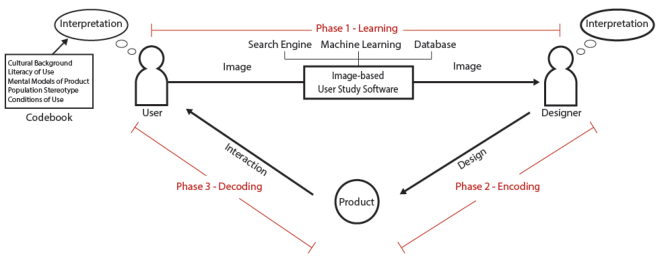
An image-based user study software concept (Figure 2) is proposed to improve the objectivity of the target user information collection methods used in phase one of the information flow. There are three reasons for using image as the foundation of the concept: (1) vision is a powerful sense that can convey the perceptions of other senses to a certain extent (Alcántara et al., 2005) (Li et al., 2018); (2) most consumer products are sold through online platforms, where users have few opportunities to use senses other than vision; and (3) the image search engine is a mature technology widely used on platforms such as Google Image Search, Image Finder, and Pinterest (Koch et al., 2020), and the machine learning mechanisms of search engines can compensate for the researchers’ subjectivity when large quantities of data are analyzed.
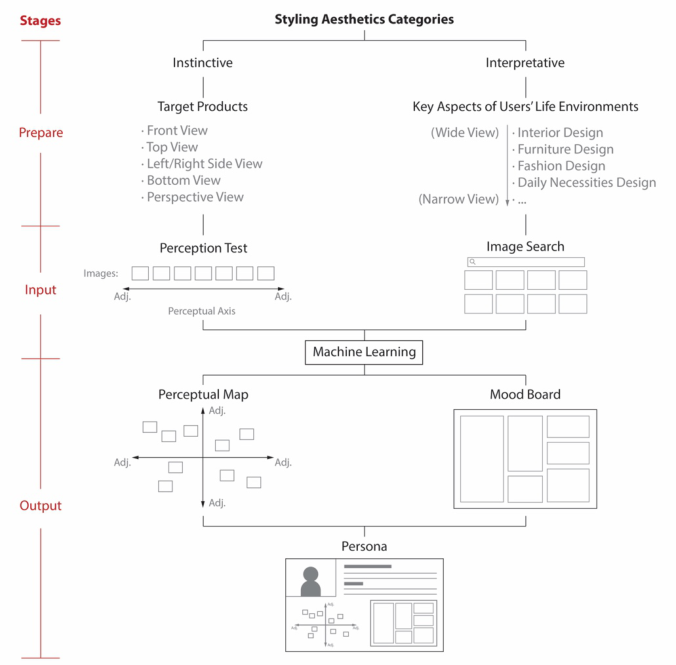
As Figure 3 shows, in the learning phase, the preparation stage of the sof- tware concept involves two categories of styling aesthetics: instinctive and interpretative. For example, if a design group is trying to design a target pro- duct related to the speaker category, then the designer should first classify different speaker styles such as vintage, progressive, and organic. Then, these images will be assigned to the instinctive category and used to test the target users’ instinctive preferences for the target product. In the input stage, the instinctive category images are placed on a perceptual axis of adjectives rela- ted to the product. Then, target users arrange the images on the axis based on their perceptions of the adjectives. The target users’ chosen images will become the standard definition of their taste regarding that adjective. This process avoids situations in which the design language does not elicit the
Figure 2: Information flow (image-based user study software). (Adapted from Krippen- dorff & Butter, 1984).Figure 3: Detailed depiction of the learning phase. (By the authors).
feelings or meanings intended by the target users because language cannot accurately express people’s abstract intuitive feelings concerning an image.
The interpretive image categories are selected from key aspects of the tar- get users’ living environments. They are used to determine the target users’ general style preferences regarding the target project-related objects such as interior design, furniture design, and fashion design to give the designer a more comprehensive understanding of the target users. Target users can search for their preferred products’ images based on the assigned product categories at the input stage. This process has two advantages over on-the- spot observations. The first is that many products in the target users’ real-life environments do not match their tastes for realistic reasons such as unaf- fordable prices or because they are gifts from others. The second is that the new method can be conducted online through a personal computer, which is more convenient than on-the-spot observations and requires less time and resources.
At the output stage, the typical style patterns of the collected images are studied and generated in the form of perceptual maps and mood boards by machine learning technology. The perceptual maps and mood boards can
Product Style Preferences: An Image-based User Study Software Concept 263
be combined to generate image-based personas that prevent the designer from engaging in one-sided decision-making. Although machine learning technology-powered perception mapping can provide objective and effici- ent evidence of target users’ style preferences regarding a target product, the testing materials used for the perception map are existing products and may affect the designers’ creativity. Therefore, the mood board offers designers complementary contextual information about the target users.
Establishing a Database The machine learning-powered database is another important feature of the image-based user study software. All of the users’ background information and associated images are stored in a database for easy analysis. The database also allows reverse image searches, whereby designers can input images of their design prototypes to identify the corresponding target users.
CONCLUSION
Many machine learning-based design applications can help non-designers with design work, especially in the field of poster and logo design. However, although machine learning can help the human brain analyze large quanti- ties of data, it still follows algorithmic rules. The creativity of designers is thus irreplaceable. This study investigates the potential of machine learning technology and combines it with the concept of image search for the precise study of product style preferences. In such cases, the software is a design assi- stant tool that can provide an objective and comprehensive understanding of target users’ product style preferences while preserving the designer’s creative freedom.
ACKNOWLEDGEMENT
We would like to thank the postgraduate research fund and Eric C. Yim Endo- wed Professorship of the Hong Kong Polytechnic University (PolyU). We also thank the support of the Public Design Lab and RISUD of PolyU.
REFERENCES
Alcántara, E., Artacho, M., González, J. & Garcia, A. C. 2005. Application of product semantics to footwear design. Part I—Identification of footwear semantic space applying diferential semantics. International Journal of Industrial Ergonomics, 35, 713–725. Buchanan, V. M. R. 1995. The idea of design, Mit Press. Crilly, N., Moultrie, J. & Clarkson, P. J. 2004. Seeing things: consumer response to
the visual domain in product design. Design studies, 25, 547–577. Demirbilek, O. & Sener, B. 2003. Product design, semantics and emotional response.
Ergonomics, 46, 1346–60. Hsu, S. H., Chuang, M. C. & Chang, C. C. 2000. A semantic differential study of designers’ and users’ product form perception. International journal of industrial ergonomics, 25, 375–391.
Koch, J., Taffin, N., Lucero, A. & Mackay, W. E. SemanticCollage: Enriching Digital Mood Board Design with Semantic Labels. Proceedings of the 2020 ACM Designing Interactive Systems Conference, 2020. 407–418. Krippendorff, K. 1989. On the essential contexts of artifacts or on the proposition
that” design is making sense (of things)”. Design issues, 5, 9–39. Krippendorff, K. 2005. The semantic turn: A new foundation for design, crc Press. Krippendorff, K. & BUTTER, R. 1984. Product Semantics-Exploring the Symbolic Qualities of Form. Departmental Papers (ASC), 40. Li, W., Wang, L., Wang, L. & Jing, J. A model based on eye movement data and
artificial neutral network for product styling evaluation. 2018 24th International Conference on Automation and Computing (ICAC), 2018. IEEE, 1–6. Nagamachi, M. 1995. Kansei engineering: a new ergonomic consumer-oriented technology for product development. International Journal of industrial ergonomics, 15, 3–11. Nagamachi, M. 2002. Kansei engineering as a powerful consumer-oriented techno-
logy for product development. Applied ergonomics, 33, 289–294. Nagamachi, M. 2011. Innovations of Kansei Engineering, United States of America, Taylor and Francis Group, LLC. Osgood, C. E. 1964. Semantic differential technique in the comparative study of
cultures. American Anthropologist, 66, 171–200. Person, O., Schoormans, J., Snelders, D. & Karjalainen, T.-M. 2008. Should new products look similar or different? The influence of the market environment on strategic product styling. Design studies, 29, 30–48. Ranscombe, C., Kinsella, P. & Blijlevens, J. 2017. Data-driven styling: augmenting
intuition in the product design process using holistic styling analysis. Journal of Mechanical Design, 139. Salminen, J., Guan, K., Jung, S.-G., Chowdhury, S. A. & Jansen, B. J. A literature review of quantitative persona creation. Proceedings of the 2020 CHI Conference on Human Factors in Computing Systems, 2020. 1–14.
LISTED IN THE AHFE DIGITAL BOOKSTORE CATALOGUE
Explore the complete digital volume
Usability and User Experience
Read this individual research paper free through the original publisher, or explore the full digital proceedings book.
ISBN 978-1-958651-15-5
Explore this ISBN in the AHFE Bookstore ↗Listed in the July 2026 bookstore catalogue; search by ISBN to confirm current availability · Digital book purchase optional