Yuqi Li, Sijia Wang, Hongyu Zhang (2023). Game-based Plant Science Popularization Mobile Application for Contemporary Young People. In: Human Factors in Virtual Environments and Game Design. AHFE Open Access, vol. 96, pp. 30–38. https://doi.org/10.54941/ahfe1003864
Nature is the basic condition for human survival and development. The nature-deficit disorder is a phenomenon put forward by American writer Richard Louv, that is, the complete separation of modern urban children from nature in the 21st century. Some experts explain that this desire and ignorance of nature is due to a lack of time to go outdoors, especially in the countryside. In real life, the population of "nature-deficit disorder" has expanded from children to adults. In order to let young people go into nature and understand the thousands of plants in nature, our team wants to design an application to popularize plants through a game-based live experience, so that users can learn more plant knowledge in fun. This design adopts the methods of the questionnaire survey, user interview, and literature retrieval to deeply discover the contemporary young people's understanding of plants, the development status of game-based science popularization apps at home and abroad, and the expected functions of users, to determine the information construction, visual image and interactive experience of the APP. Our team uses Rhino, Cinema 4D, Blender, Unity, Unreal and other software, combined with ergonomics to achieve scene modeling and rendering, to create a more realistic AR experience. The APP can guide users to enter the virtual map, take photos and punch cards through AR switching angles, and randomly obtain passes to unlock other maps. At the same time, users can click to view specific plant data, unlock the plant by completing key tasks such as roots, stems, and leaves, and bring it into the backpack for creation; the app can also game the handicraft which uses plants as raw materials, and guide users to create their own unique imprint. After the usability test, the respondents all believed that this APP could produce a better effect of plant science popularization in the game experience.
In his book “The Last Child in the Woods: Saving Children with Nature Defi- cit Disorder,” American author Richard Louv explains a phenomenon called nature-deficit disorder. Nature-deficit disorder is not a medical diagnosis, but a term used to describe the costs of alienation from nature for humans, espe- cially children, including reduced use of the senses, difficulty concentrating, and a higher incidence of physical and mental illness (Richard Louv, 2005).
Game-Based Plant Science Popularization Mobile Application 31
In reality, more and more adults are suffering from nature-deficit disorder. 21st century young people have long been accustomed to the 996 life, in this fast-paced era, most young people are too busy, travel and enjoy nature has long become a luxury. Only by touching, listening, tasting, observing and feeling every grass in nature, can we gain the sensual experience of nature and effectively say goodbye to nature-deficit disorder (Ruonan Tian and Li, Shi 2020). Through Plantopia, our team hopes to help the youth to re-enter nature and enjoy a slower life.
There are many plant science popularization APPs in the market, but many users think that these APPs on the market are not effective in popularizing plants, and the picture-plus-text science approach has failed to attract users. AR is a technology that cleverly integrates virtual information with the real world (Qianhua Wu, 2019). With the popularity of AR, more and more peo- ple can see things that are normally inaccessible through their cell phones. Therefore, our team want to build a virtual plant world for users to find and understand plants in the game, and present the plant models to users with the help of AR to help them know plants more intuitively.
This study aims to propose a feasible design solution to help address the needs of young people who want to get close to nature. The app allows users to find plants in a virtual environment, dive into them in a game, and leave a unique imprint about them in their creations, thus helping them to build their own bridge with the natural world, which is beneficial from a social point of view.
RELATIVE WORK Questionnaire Survey
We conducted a questionnaire survey among young people. The question- naire consisted of 12 questions in four aspects: basic user information (age), plant awareness (familiarity, plant testing), current situation of plant science (understanding channels, willingness to science popularization) and product function expectations (functions such as identifying plants and fun experie- nce). There were 173 participants, covering 14–40 years old, most of whom aged 18-30.
The survey results showed that most of the participants’ familiarity with plants was relatively low, with 45.09% of them having a general familiarity with plants (some plants are very common but do not know what they are called) and 30.06% of them having a less familiarity with plants (can only recognize a few plants occasionally). In the two test questions, only 52.60% (question 1: choose which one is a peach blossom among three pictures) and 12.14% (question 2: choose the correct name among five options: sorghum, barley, rice, barley, and wheat according to the picture) of the participants answered correctly.
In the survey on the current situation and willingness to learn about plant science popularization, we found that through documentaries (46.67%) and asking friends (53.94%) were the channels which most participants learned about plants, while fewer participants learned about plants through the chan- nels of books (36.36%), classes (21.82%) and APP (11.52%). If there was a
gamified experience plant science popularization app that could help young people learn about plants, 92.27% of the respondents would be willing to use it.
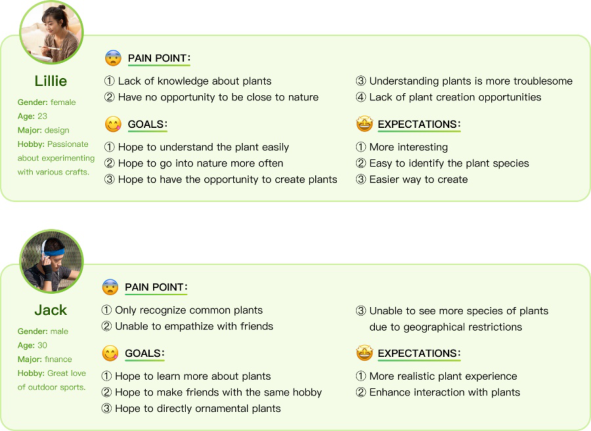
Persona In order to further explore the pain points and expectations of users, we con- ducted in-depth interviews with three young people of different professions and ages. The interview objectives were clearly defined as “deeply understand the five basic parameters of interviewees’ names, hobbies, pain points, goals and expectations”, and a detailed interview outline was created around the interview objectives. Based on Alen Cooper’s “seven-step persona method”, the interviews were organized and analyzed to produce personas (Figure 1).
Design Direction According to the preliminary questionnaire survey and persona, we condu- cted a detailed pain point analysis and compiled four design directions: plant science and identification (using the resource library to quickly identify plant species), gamification experience of plants (building a virtual environment to attract users to learn about plants in the game), plant-related creation (gui- ding users to create unique works), and sharing function (satisfying young people’s desire to share through the community).
At the same time, in order to sort out the information architecture of the APP, we determined six functions: (1) Science popularization, to make more people know plants by means of daily plant and sweeping. (2) Virtual map, which takes the form of a map to classify plants and interestingly show plants in different ecological environments. (3) AR, which shows the real form of
Figure 1: Persona.
Game-Based Plant Science Popularization Mobile Application 33
plants through AR technology. (4) Game, through the game to explore dif- ferent plants, complete the task to add them to the “backpack” as creation materials. (5) Creation, users can use the intangible culture heritage techni- ques, such as embossing, top-dyeing and tie-dye to DIY. (6) Share, share the creation in the community, the technical staff will make the excellent works into physical and send to the corresponding users.
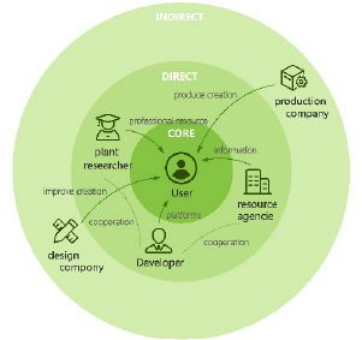
Figure 2: Stakeholder map.
Stakeholder Map To further confirm the landing of the APP, we sorted out the related instituti- ons and processes involved in the APP, drew a user-centered stakeholder map, and analyzed the behaviors and needs of each part (Figure 2). Developers can work together with plant researchers and resource agencies to provide users with platforms and professional resources, design and production companies can work together to help users improve and produce creations, all of this is to make the user experience better.
DESIGN PRACTICE ABOUT PLANTOPIA Product Positioning
In order to solve the nature-deficit disorder of young people, our Plantopia is a plant science popularization app for all young people, which can make young people get closer to nature through science popularization, AR expe- rience, game, DIY creation, community sharing and other functions, unlike traditional plant science popularization app with single function, weak vision and poor interactivity. Our product can let contemporary young people slow down and get close to plants in the virtual world and gamification experience, and feel the natural world of wind blowing trees, chickens crowing insects, and rain beating bananas.
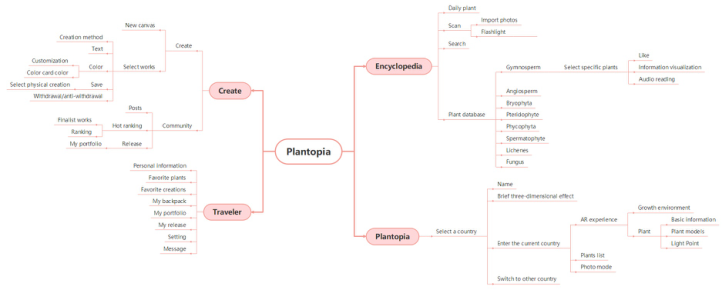
Information Architecture The main functions of APP are encyclopedia, plantopia, create, and traveler. Among them, plantopia and create are the featured sections of Plantopia, highlighting the uniqueness and fun of the APP (Figure 3).
Design Specifications To help the brand maintain the extension and unity of the subsequent design (Lixing Qi, 2020), we developed design specifications (including fonts, colors, buttons, icons, etc.). In terms of font, we used the Apple Square font of IOS; in terms of color, we used green, which symbolizes nature, as the main color, and its contrasting color, red, as the secondary color; in terms of icon, we drew 44 icons such as navigation bar, plant category, and map category in a unified manner.
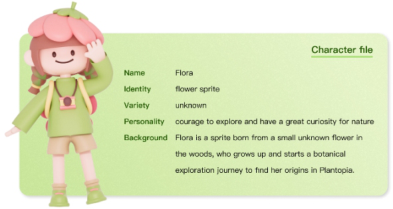
IP Design To enhance the visual appeal, we designed an IP for Plantopia named Flora (Figure 4), which is a flower sprite with a great curiosity about nature and courage to explore. Flora is a sprite born from a small unknown flower in the woods, who grows up and starts a botanical exploration journey to find her origins in Plantopia. In Plantopia, users will follow Flora’s steps in the virtual world to immerse themselves in the game and get closer to nature.
Figure 3: Information architecture.Figure 4: IP design.
Game-Based Plant Science Popularization Mobile Application 35
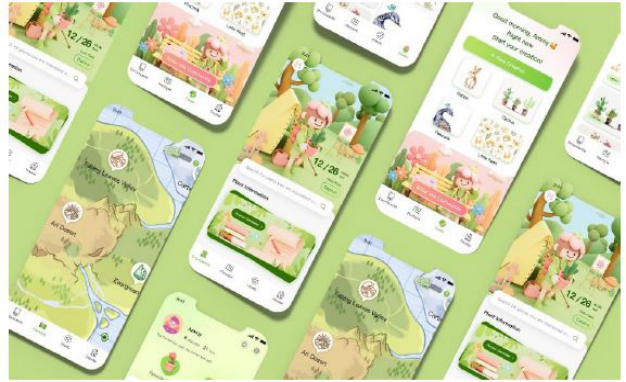
Interface Presentation Based on the drawn emotional version, the style of the app was determined as three-dimensional, diffuse and fresh, while we drew the high-fidelity interface of Plantopia according to the four main functions: encyclopedia, plantopia, create and traveler (Figure 5).
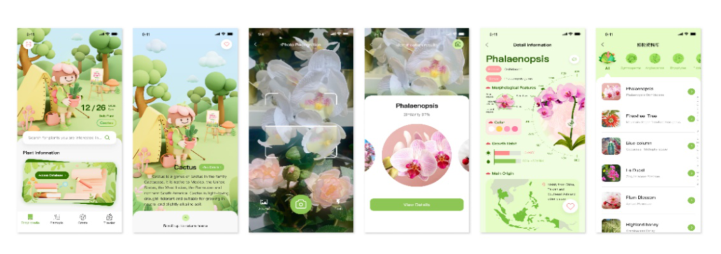
USE PROCESS Encyclopedia
There are six main interfaces in the encyclopedia (Figure 6). Scroll down the “Daily Plant” section to view the information of today’s recommended plants; click on the “Scan” icon to identify plants and view their details, and after entering the plant details, you can turn the model and view its morph- ology, origin, habit, culture, value and other information visualization; click on “Access Database” to view all the plants in the database, and you can also quickly understand the plant-related information according to the group.
Figure 5: Interface presentation.Figure 6: The six main interfaces of the encyclopedia.
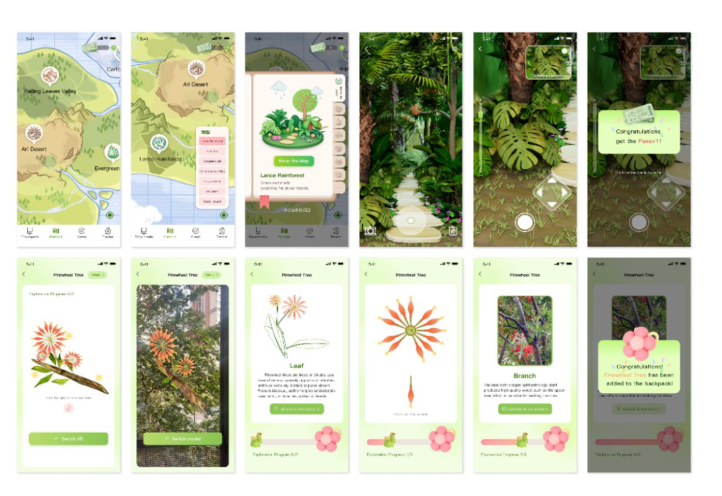
Plantopia The Plantopia function mainly has twelve interfaces as shown in the figure (Figure 7). Users can freely slide to view the complete map; click the “Locate” icon to view all maps, users can quickly reach the map they want to go accor- ding to their needs; after clicking on the photo mode, users need to tour the map and take photos according to the tasks in the upper right corner, there will be passes dropped to complete the task, passes can be used to unlock new maps for new exploration, after entering the map, click on each plant to view its model and AR effect, and click on the light dot to complete the small tasks to add the plant to your backpack.
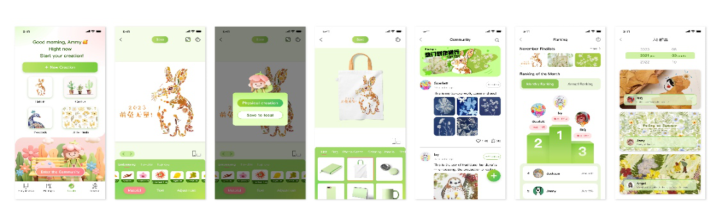
Create The creation function mainly has seven interfaces as shown in Figure 8 (Figure 8). In the creation mode, users can create DIY about plants accor- ding to the materials in the backpack; click “Save”, users can choose physical creation or directly save to local, users will choose suitable physical objects according to their preferences for in-depth creation; after the creation is com- pleted, the work can be released to the community to share with more people; the community will rank the works monthly according to their popularity, and the technicians will send the top three works to the corresponding users.
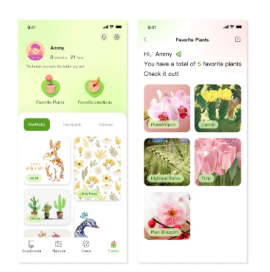
Traveler The traveler function has two main interfaces as shown in the figure (Figure 9). Users can view their favourite plants and creations here, as well as view their portfolio, backpack contents and published contents.
Figure 7: The twelve main interfaces of the plantopia.
Game-Based Plant Science Popularization Mobile Application 37
Figure 8: The seven main interfaces of the create.Figure 9: The two main interfaces of the traveler.
CONCLUSION
After the completion of the design scheme, we communicated with many young people, and the feedback showed that many respondents apprecia- ted our design solution, and they said that the function of the APP could not only satisfy plant science, but also create a very interesting virtual world with games that could cleverly help users get close to plants and nature in person. This design has not been further validated and optimized because this study has not been fully landed. We tend to propose design directions, and the spe- cific technical implementation needs further review and development, such as how to land the AR technology, how to ensure the fluency of users when exploring in the virtual world, etc.
The project aims to help contemporary young people take time out of their busy lives and immerse themselves into the world of plants, slowing down young people’s lives with the novelty of the game and allowing them to fre- ely enjoy the pleasures of nature. We designed this app and will continue to work on future improvements to provide more interesting plant science popularization for today’s youth and help more people enter nature.
ACKNOWLEDGMENT
We would like to extend our most sincere gratitude to all those who have helped with this study.
REFERENCES
Lixing Qin. Mobile APP icon design specification discussion [J], Neijiang Technology, 2020, 41(07):48+51. Qianhua Wu. Augmented reality (AR) technology application and development trend
[J]. Communication World, 2019(01). Richard Louv. Last Child in the Woods: Saving Our Children from Nature-Deficit Disorde [M]. Chapel Hill: Algonquin Books, 2005. Ruonan Tian, Li Shi, Effective strategies to help young children say goodbye to
“nature-deficit disorder” [J]. Teaching in forest areas, 2008(08): 118–120.
LISTED IN THE AHFE DIGITAL BOOKSTORE CATALOGUE
Explore the complete digital volume
Human Factors in Virtual Environments and Game Design
Read this individual research paper free through the original publisher, or explore the full digital proceedings book.
ISBN 978-1-958651-72-8
Explore this ISBN in the AHFE Bookstore ↗Listed in the July 2026 bookstore catalogue; search by ISBN to confirm current availability · Digital book purchase optional