Mingyan Xiao, Yue Chen, Huaming Huang (2023). The Impact of Interactive AR Technology on the Communication of Intangible Cultural Heritage - Case Study of Chaozhou Opera in China. In: Human Factors in Virtual Environments and Game Design. AHFE Open Access, vol. 96, pp. 144–152. https://doi.org/10.54941/ahfe1003876
The dissemination of intangible cultural heritage has gradually become the core of national cultural development and progress, and how to properly protect and inherit intangible culture has also become the main task of the cultural industry. With the accelerated development of artificial intelligence and technology, technology has brought new vitality and vitality to the dissemination of intangible cultural heritage. This study is based on augmented reality technology and uses interactive AR technology to design and practice the problems and challenges in the inheritance of intangible cultural heritage. Digitally transforming traditional Chinese Chaoju culture, breaking through traditional presentation methods, not only achieves the revitalization of intangible cultural heritage, but also strengthens the convenience of dissemination. The article first discovers the current inheritance issues of intangible cultural heritage through research, questionnaires, and literature research, and summarizes the current status of intangible cultural heritage dissemination technology. Then, the application and advantages of AR technology in the dissemination of intangible cultural heritage were explored. Through existing case studies, the design methods and principles of AR technology intervention were analyzed, and the application forms of AR technology in the design of intangible cultural heritage dissemination were sorted out. The direction and direction of design practice were proposed. Finally, taking the Chinese Chaozhou Opera culture as an example, the design practice was verified. Through field visits and questionnaires, the researchers deeply explored the current living conditions and communication difficulties of Chaozhou Opera, and grasped the pain points of Chaozhou Opera communication. After a series of analysis and summary, the cultural elements of Chaozhou Opera are extracted, and interpreted with Chinese traditional Paper Cuttings technology, forming a three-dimensional picture book. Then, based on user experience theory, considering the dimensions of visual presentation, functional attributes, and interactive experience, Chaoju characters are interacted with users in the form of augmented reality through an app. This includes an introduction to the history and culture of Chaozhou Opera, as well as interactive features of Chaozhou Opera characters, enhancing users' interactivity, entertainment, and participation in experiencing intangible cultural heritage. In the design practice, it has explored a new path for the dissemination of Chinese Chaozhou Opera culture, laid a foundation for the development of its digital path, and also verified the design orientation of augmented reality technology in the dissemination of intangible cultural heritage, as well as its advantages and necessity for the dissemination of intangible cultural heritage. At the same time, it has also provided some reference experience for the dissemination of other intangible cultural heritage technologies. On the basis of this design practice, this study will improve the design system of intangible cultural heritage in AR communication, providing certain methods and theoretical support for intangible cultural heritage. The application of AR technology in communication is not limited to the cultural and tourism industry, and most of the technologies of intangible cultural heritage have not yet been further inherited and developed. Therefore, the follow-up research will further appropriately apply the AR technology integration and transformation mode of intangible cultural heritage culture to space display, cultural IP image creation, and other fields, forming a new paradigm based on interactive AR technical communication intangible cultural heritage technology design research.
Chaozhou opera, originating from the Chaoshan region in China, was inclu- ded in the first batch of national intangible cultural heritage lists in 2006. It is an outstanding cultural expression of the Chinese nation with deep historical significance and high aesthetic value. One of the most distinctive features of Chaozhou opera is the use of the local dialect as the text of the play. More- over, the Chaoshan dialect is one of the oldest and most distinctive local languages in China. Therefore, Chaozhou opera is the spiritual bond of the Chaoshan people, especially for those who have lived overseas for a long time, Chaozhou opera is their spiritual support to the motherland. However, traditional culture is currently facing an unprecedented impact, exemplified by the Chinese theater which has seen the loss of nearly 100 forms over the past 50 years and is now confronting a grave survival crisis. As one of the
The Impact of Interactive AR Technology on the Communication 145
top ten plays in China, the survival status and development trend of Chao- zhou opera should be a representative microcosm of the current development status of many local plays.
At present, domestic AR applications related to the dissemination of intan- gible cultural heritage are single and boring in terms of interaction and content presentation, which do not fully reflect the spiritual core of intan- gible cultural heritage, resulting in the inability of users to resonate and low participation rate. The purpose of this study is to showcase Chaoshan culture through an AR interactive three-dimensional book by utilizing the element of Chaozhou paper-cutting, an intangible cultural heritage of Chaoshan. This study aims to create a 360-degree three-dimensional book, which is then enh- anced by augmented reality technology to present Chaozhou opera in a more engaging and immersive way, thus aiding the dissemination of intangible cultural heritage.
THE APPLICATION AND ADVANTAGES OF AR TECHNOLOGY IN THE COMMUNICATION OF INTANGIBLE CULTURAL HERITAGE Augmented Reality (AR) is a technology that combines virtual information technology with the real world, integrating virtual information with real sce- nes through computer technology and perception technology so that users can get an enhanced experience of virtual information in real scenes (Cui Jin, 2017). In the early days, AR technology was mostly applied to tangible cultural heritage, and then it was gradually introduced to intangible cultu- ral heritage. But AR technology has been applied to intangible culture in relatively few forms and not enough, so it still needs to be explored.
In recent years, AR technology has been extensively applied in the com- munication of intangible cultural heritage due to its ability to offer a more vivid and intuitive experience to the audience. With regards to AR interactive display, the School of Arts at Jiangsu University’s team, led by Cui Jin, deve- loped an AR interactive display application for “Taiping Clay Toys”. The basic design concept is to display an intangible cultural heritage called “Tai- ping Clay Toys” in Jiangsu Province, China through AR technology (Cui Jin, 2017). As for the creative packaging of intangible cultural heritage, Li Shao’s team from Guangdong Polytechnic of Industry and Commerce developed an AR application for the creative packaging of the Lingnan region of China called “Exploring Xiguan AR”. The overall design concept is to incorpo- rate Lingnan culture illustrations as the consistent visual element throughout the packaging. The gift packaging box is then designed using both AR vir- tual packaging and physical packaging methods (Li Shao, 2022). In terms of AR games, Guangdong University of Technology’s Tang Xiaoying team has developed two AR games on the digital design of Cantonese opera, “Face Changing” and “Put on My New Clothes”, enabling audiences to conveni- ently experience the costume and makeup features of Cantonese opera (Tang Xiaoying and Tang Yiying, 2023).
AR technology is different from traditional forms of ICH heritage com- munication because AR technology can combine ICH culture with virtual information to achieve enhanced display and communication of ICH, which
can display ICH culture in a more vivid, intuitive, and three-dimensional form. At the same time, it can also enhance the user’s experience and interactivity, and improve the user’s knowledge and understanding of ICH culture.
HSI AR STEREOSCOPIC BOOK DESIGN OF CHAOZHOU OPERA BASED ON AUGMENTED REALITY TECHNOLOGY Design Strategy
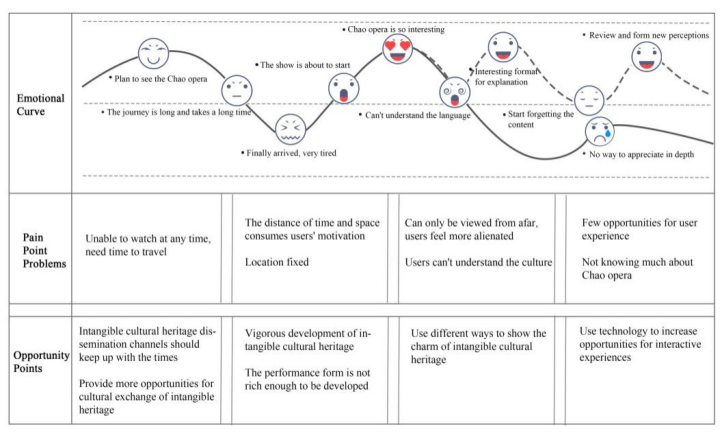
Chaoju Opera, a local opera originating from the Chaoshan region in Guan- gdong Province, is known for its unique music, gentle singing, beautiful dance, and delicate performances, which reflect its rich local characteristics and cultural connotations, earning it the title of “Kun Opera”of South China. However, its audience is predominantly elderly, with young people showing less interest in the art form. By analyzing the User Journey Map of the young user group watching Chaozhou opera, we can draw about the pain points and opportunity points of young users when experiencing the Chaozhou Opera (as shown in Figure 1). From the chart, we can see that the pain points are mainly reflected in the fact that Chaozhou opera is performed in the local dia- lect, and most of the local young generation cannot understand the meaning of the play lines, which has a high threshold. There are also issues such as the difference between young people’s viewing habits and the traditional way of watching Chaozhou opera, and it is difficult for young people to watch pati- ently and the cost of time and space required to watch it. These issues have resulted in young people knowing very little about Chaozhou opera, causing a generation gap in the audience age range for Chaozhou opera.
After analyzing the current situation of AR technology application in the communication of Intangible Cultural Heritage (ICH), this study focuses on
Figure 1: User journey map (self-drawn).
The Impact of Interactive AR Technology on the Communication 147
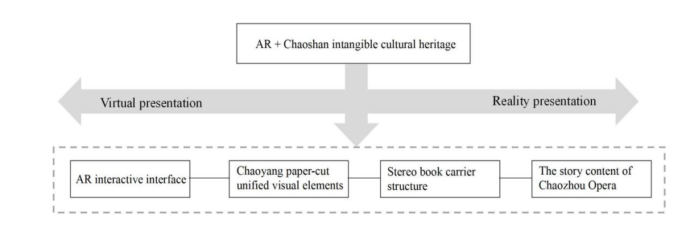
the practical application of AR stereoscopic book design for Chaozhou opera, in order to provide theoretical support for the argumentation. The general idea of the design of the AR three-dimensional book is “AR + Chaoshan Intangible Cultural Heritage”. By incorporating Chaozhou paper-cutting, which is also an intangible cultural heritage of Chaoshan, as the main visual element in the overall design, this project employs a combination of virtual and reality, integrating augmented reality (AR) virtual interaction with tra- ditional physical pop-up books. Through a narrative approach to elaborate the content of the main story in the classic masterpiece “Li Jing Ji” in Cha- ozhou opera, we design and develop a three-dimensional book of the main body of Chaozhou opera based on AR technology (as shown in Figure 2), which provides a new way and means to disseminate the non-heritage culture of Chaozhou opera and attracts more young audiences to understand and participate in the inheritance and development of Chaozhou opera culture.
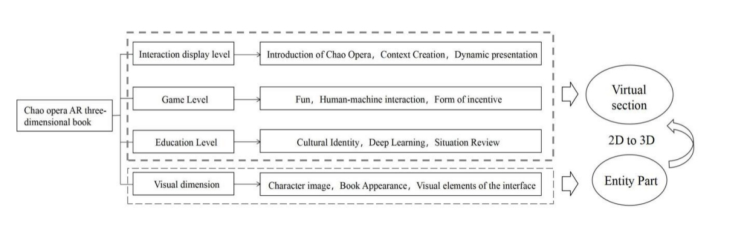
Design Framework The application of virtual technology to the transmission of ICH needs to comply with the principles of cultural and technological harmony and the territoriality of ICH (Li Qingzhang, 2023). Therefore, when designing, it is necessary to find a balance between technology and culture, to highlight the modernity and innovation of AR technology, but also to retain the tradition and culture of Chaozhou opera culture. This requires us to fully consider the characteristics and expressions of Chaozhou opera culture while implemen- ting the technology so that users can experience the heritage and development of Chaozhou opera culture while experiencing AR technology. This approach demonstrates the value and charm of culture and also promotes the integra- tion and development of technology and culture. Based on this principle, this study proposes to build a design framework from four aspects: interactive exhibition aspect, game element, educational aspect, and visual aspect ( as shown in Figure 3).
(1) Interactive Exhibition aspect: Augmented reality technology has a posi- tive significance in the dissemination and promotion of Chaozhou opera culture because AR virtual interaction technology has the advantages of being able to enhance interest in exhibitions, break geographical restri- ctions, and reduce costs. These advantages can be conducive to the
transformation of the traditional Chaozhou opera viewing mode, chan- ging the previous display of a single form, style convergence, and other issues. In the setting of the design process, the display content with inte- ractive features can present the storyline in the famous tide play “Li Jing Ji” in a more innovative way. The communication carriers used in this study, including the physical three-dimensional book, introduction video, AR interactive animation, and game-like virtual interaction, are organically combined to create a complete narrative in the user’s mind. This approach helps users to understand Chaozhou opera in a more concise and clear manner and enhances their interest in the art form (as shown in Figure 4). (2) Game element: Interactive pages are designed to incorporate every scene of the story, characters’ movements and expressions, and utilize AR technology to overcome the limitations of time and space, allowing the characters in the drama to “come to life” and narrate their story. To sort out the storyline and characters in “Lijingji”, and then “re-draw” the characters and props in the scenes by using the artistic style of Chao- zhou paper-cutting.Then the Unity3D engine is used to make the screen
The Impact of Interactive AR Technology on the Communication 149
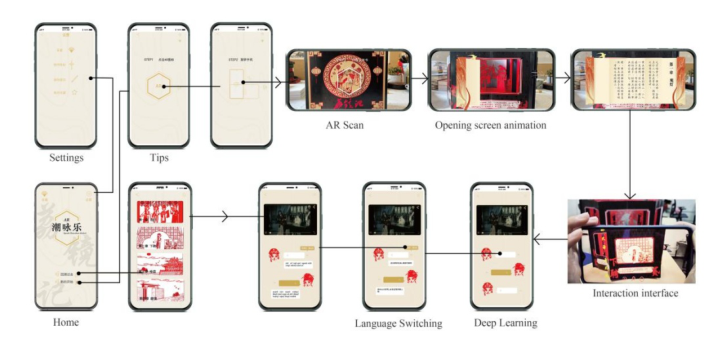
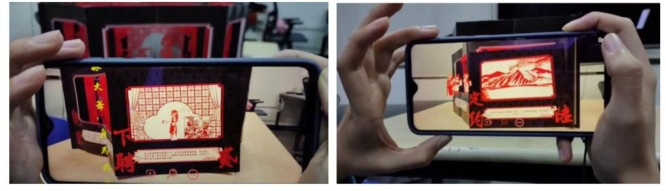
appear dynamic, so that the virtual character interacts with the three- dimensional book in physical space, dynamically simulating the story situation in the Chaozhou opera work “Li Jing Ji”. On the interactive page, users can zoom in and out to observe the details of the characters, understand the characteristics of their costumes and the artistic features of Chaozhou paper-cutting, and deepen their impression. In addition, each story chapter has a different set of AR game levels. For instance, in the second act of the play, when the heroine is compelled to marry someone else, the user is required to select the appropriate play on the left side of the screen. Upon selecting the correct answer, the heroine will commence an opera performance to express her emotions, thereby enabling the user to experience the play’s sentiments more profoundly. In the last scene of the plot, the user needs to help the hero to throw the lychee to the heroine to express love and help the hero and heroine to complete the love appointment (as shown in Figure 5). Through a fun and interactive game experience, users can quickly immerse themselves in the storyline and become interested in the Chaozhou opera.
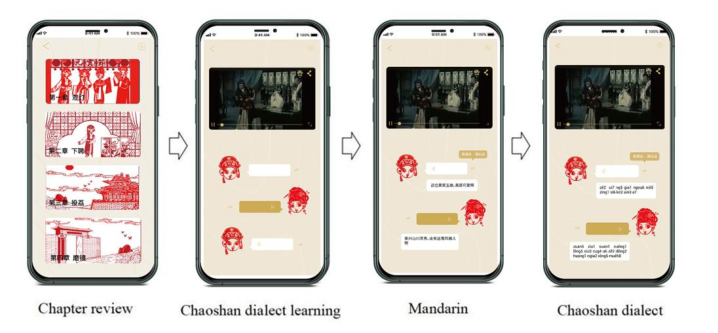
(3) Educational aspect: The local sentiment of Chaozhou opera as a local opera is often a source of homesickness for Chaoshan people who have made a living overseas. The dialect in Chaozhou opera is the essence of Chaozhou opera. However, a study of 18 youths aged 12–18 who were born in the Chaoshan area but are currently studying abroad found that only 54.5% of them could speak the Chaoshan dialect fluently, 41.9% could understand the dialect but were not fluent, and 3.6% did not understand the dialect at all. Therefore, this design includes an educa- tional feature for learning the opera script of Chaozhou opera, which aims to help users understand Chaozhou opera and the Chaoshan dia- lect more easily. In this design, users can access deep learning by clicking the “Learn More” button. After entering this feature, users can watch the video excerpts of “Li Jing Ji” and learn the pronunciation of the Chaoshan dialect by clicking on the voice bar, which can help users to learn how to use the Chaoshan dialect in the drama. The function is also set up chapter reviews, the user through the mobile app application scans the three-dimensional book of real pictures can unlock the rele- vant chapters, but not scanned chapters for the locked state, scanned chapters can watch the detailed content and interactive scenarios, no
Figure 5: AR interactive interface.
need to scan the three-dimensional book again can also learn to watch. And when users unlock all the chapters, they will be able to obtain their electronic three-dimensional book. (as shown in Figure 6).
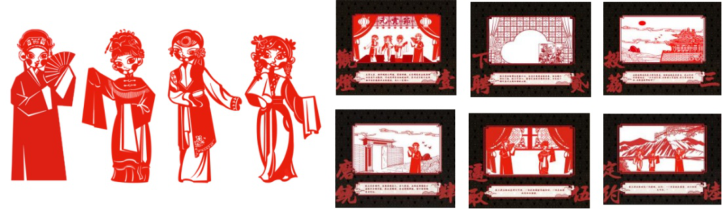
Visual aspect: Chaozhou opera is inextricably linked to local folklore acti- vities, such as collective rituals to ancestors and gods, which requires the performance of Chaozhou opera. Chaozhou opera is inextricably linked to local folklore activities, such as collective rituals to ancestors and gods that require the staging of Chaozhou opera. Chaozhou’s paper-cutting is also an intangible cultural heritage of the Chaoshan region and is also often found in local folk activities. Therefore, to present the spiritual connotation of Cha- oshan culture more richly, this design chooses Chaozhou paper-cutting as the main visual element. Chaozhou paper-cutting style is mostly auspicious and festive, so using Chaozhou paper-cutting as a unified visual element of the overall design is not only aesthetically pleasing but also has more local characteristics. Therefore, this design uses the artistic style of Chaozhou paper-cutting to recreate the main characters and scenes from the Chaozhou opera “Li Jing Ji”, creating visual images of the male and female protagonists Chen San and Huang Wuniang, as well as Chun Ying and other supporting characters. Divide the plot into six-story themes and create the corresponding six paper-cut style scenes (as shown in Figure 7). The scene screen is divi- ded into two parts: a virtual screen and a three-dimensional book real scene
Figure 6: AR interactive interface.Figure 7: Paper-cut style character scene engraving (self-painting).
The Impact of Interactive AR Technology on the Communication 151
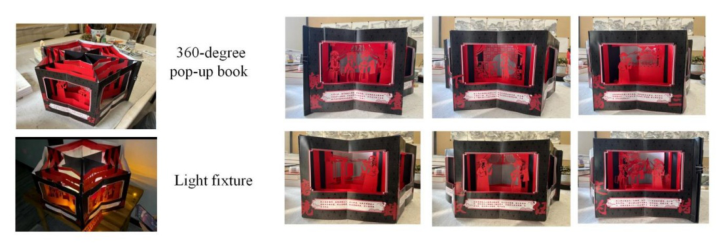
Figure 8: Stereoscopic book real photo (photograph taken by the author, 2022).Figure 9: Volume icon in the shape of a hand fan (self-drawn).
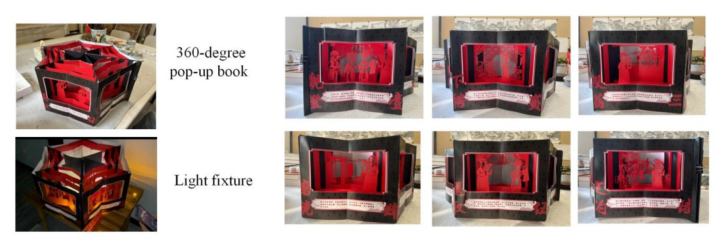
screen. The six images of the real part can form a hexagonal 360-degree three- dimensional book when opened (as shown in Figure 8). In addition, each part of the real scene can be scanned through AR to present the corresponding virtual picture, dynamically presenting the storyline.
The color scheme uses red as the main color and black as the base color, which highlights the main body and creates an elegant atmosphere. Howe- ver, for the app application interface, a fresh and simple color combination was chosen to avoid visual fatigue caused by overly bright colors on mobile devices. The use apricot and yellow creates a soft and friendly atmosphere, which aligns with the product tone of cultural app applications. In designing the icon, inspiration was taken from the handheld fan commonly used as a prop in the plot. The volume icon was designed in the form of a fan, with the degree of opening and closing representing the volume level (as shown in Figure 9). The use of purely handmade Chaozhou paper-cutting style in the three-dimensional book design adds a visually distinctive and vibrant ele- ment, which, coupled with AR technology, is better able to attract young people’s attention to intangible cultural heritage.
CONCLUSION
This study explores the feasibility and application of augmented reality technology in the dissemination of intangible cultural heritage through the introduction of augmented reality technology into the cultural dissemination of Chaozhou opera. Helping the transmission of intangible cultural heritage is cultural transmission, a single way of transmission can not adapt to the needs of society, and augmented reality technology in the transmission of intangible cultural heritage can provide new ideas to solve the inconvenie- nce of physical space and time. AR technology can enhance the interactivity,
entertainment, and participation of users in the experience. Absolutely, AR technology has the potential to transform the way we experience and engage with cultural heritage. By providing a more immersive and interactive expe- rience, it can attract new audiences and help preserve cultural heritage for future generations. With the development of new technologies and innovati- ons in this field, there is great potential for even more exciting and impactful applications of AR in cultural communication and promotion.
ACKNOWLEDGMENT
We express our gratitude to the 18 students from Chaoshan, China for their valuable support during our research, as well as to the AR/VR Workshop at the School of Art and Design, Guangdong University of Technology for providing us with the necessary platform to conduct this study. This research was supported by the project “Application of Chinese traditional patterns in cultural and creative industries” (20YJA760030), one of the achievements of this project.
REFERENCES
Cui, J., (2017). Application of augmented reality technology in disseminating intangible cultural heritage: A case study of interactive display of “Taiping Clay Toys”. Media, No. 267(22), 80–82. Li, S., (2022). Application of AR Technology in Lingnan Cultural Creative Packaging
Design in Context of Digital Economy. Packaging Engineering, 43(22), 350–358. Li, Q. C., (2023). Research on the design of Virtual Reality Technology in the inheritance of non-cultural heritage. Packaging Engineering, 1-6(2023-05-11). http://kns.cnki.net/kcms/detail/50.1094. TB.20230403.1447.004.html Tiang, X. Y. and Tiang, Y. Y., (2023). Digital Design of Cantonese Opera from the
Perspective of Embodied Cognition. Packaging Engineering, 44(06), 311–319.
LISTED IN THE AHFE DIGITAL BOOKSTORE CATALOGUE
Explore the complete digital volume
Human Factors in Virtual Environments and Game Design
Read this individual research paper free through the original publisher, or explore the full digital proceedings book.
ISBN 978-1-958651-72-8
Explore this ISBN in the AHFE Bookstore ↗Listed in the July 2026 bookstore catalogue; search by ISBN to confirm current availability · Digital book purchase optional