Silvina Félix, Miriam Reis (2023). Product design education: a kit for building empathy. In: Human Dynamics and Design for the Development of Contemporary Societies. AHFE Open Access, vol. 81, pp. 187–195. https://doi.org/10.54941/ahfe1003945
ID + Research for Design, Media and Culture, Aveiro, Portugal; School of Design, Management and Production Technologies Northern Aveiro University of Aveiro, Oliveira de Azeméis, Portugal ↗
Challenges around inclusive design and social design consciousness require understanding the thoughts and feelings of the people around us. The role of empathy in the design process is widely recognized in the literature, increasing the attention of researchers and design educators to include empathic design as a research approach in product design education. Developing empathy through experiencing others’ life provides opportunities for students to understand how people with disabilities live, feel and experience their everyday life. Product design students need to gain socially conscious awareness and improve their empathic horizon. According to the literature, through training and experience, the empathic horizon of designers can be extended and changed over time. To acquire more empathy with people, simulation devices or wearable kits can be designed to mimic the weaknesses and limitations of people with disabilities. This paper describes an empathic design process where the students designed and prototyped an empathic wearable kit and perform the task independently. Putting on ‘other shoes’ the students record the experience in video and use the think-aloud technique to communicate the difficulties felt during the task. By learning to empathize, students can improve their abilities to recognize and make interpretations of what people think, feel, and need. Empathy practice during product development can provide empathic collect probes to help in students' design process decisions.
Contemporary societies are changing very fast. Rapid transformations in societies lead to demographic shifts, new family structures, new consumption patterns and values, requests for customised products and services, emergent technologies, and diversified markets to satisfy user needs. Technological, cultural, social, and economic changes represent new opportunities to design. By continuously seeking to innovate, the design allows us to improve while providing an answer for a new future. Nowadays, the design discipline is challenged to use new techniques and strategies because the previous one often no longer responds to society’s needs.
Living in the so-called “new normal”, where design must approach the world, also, in a new way... deep down, the objects that have been most
successful and that endure in time are those that arouse emotions and feed the imagination. For the “emerging populations that do not fit the universal ideal, designers more than ever need to be receptive and responsive to hetero- geneity and changing needs of users (McDonagh et al., 2011, p. 311). Also, according to referred authors, to move towards design processes and outco- mes that are more responsive to diverse needs, it is believed that designers need to engage with users in a more intimate, closer way. The focus should be increasingly inclusive and more user-friendly design to ensure accessibility for all, including people with special needs. For the creative design process to deliver outcomes that better meet the need of a diverse and inclusive society, designers need to engage with users in a more collaborative way. According to Kärnä-Behm (2022) “to achieve successful products and services, design research nowadays is searching for new methods that unify collaboration between professional designers and future users.” (p. 577).
Faced with a humanitarian crisis resulting from successive economic and social crises aggravated by a global pandemic, “there is a universal call for empathy” (Tracey & Baaki, 2022, p. 2091). Empathy is “our intuitive abi- lity to identify with other people’s thoughts and feelings – their motivations, emotional and mental models, values, priorities, preferences, and inner con- flicts.” (Fulton Suri, 2003). When it comes to product design, empathy is an essential aspect of designing products that meet the needs of the users they are designing for.
To introduce an understanding of the user’s needs into design work and transfer it into product features, there has been an ever-growing interest in methods involving users in product design. User-centred design is a multi- disciplinary approach that relies on a user’s involvement during the design and development process aiming to “introduce an understanding of the user’s needs into design work and transfer it into the product specifications” (Kärnä-Behm, 2022, p. 577).
The need to generate products that improve people’s quality of life beco- mes even more essential when designing for people with more limitations and empathising with them is even more of a determining factor for the success of the product or service. Specific features for people with different life experie- nces and abilities entail more responsibility and bring demanding challenges to designers. Data collected from face-to-face contact with users is crucial and can be a determinant factor in the decision-making process. McDonagh & Thomas (2010) describe a research project at the University of Illinois emplo- ying empathic design strategies to break down barriers that prevent people with disabilities from becoming active participants in the designing process. The collaboration between students and people with disabilities provides uni- que opportunities for product design students “to go outside their comfort zones, transcending boundaries (cultural, social, medical and/or educational) as they worked with a population group that may be overlooked by the design community” (McDonagh & Thomas, 2010, p. 189). However, in the case study described in this paper, the post-pandemic scenario and the restrictions imposed made it difficult for students to have face-to-face contact with people with disabilities. This condition determined the empathic design strategy, as it made it impossible to collect information from direct contact with people
Product Design Education: A Kit for Building empathy 189
- through interviews or direct observation - while performing a daily task. Therefore, the teachers decided to develop and produce a wearable empathic kit that could simulate some limitations of people with disabilities.
EMPATHY IN DESIGN THINKING One of the first steps in Design Thinking (DT) is Empathy (Brown, 2009) and consider a main attribute of DT (Gasparini, 2015). Design thinking involves empathizing with users to gain insight into their needs, defining the problem to be solved, ideating potential solutions, prototyping, and testing those solu- tions, and iterating on the design based on feedback. To design products that meet users’ needs and expectations, designers should be able to empathise with the users. When project briefs are for people with different life experi- ences, different social backgrounds, cultures, and abilities, the designer must put himself in the users’ shoes. Only in this way does he/she gain insights into how the product will be used and what features are most important. Without this understanding and interaction with the user, the designer may not meet the needs of the target audience (Woodcock et al., 2019).
EMPATHIC HORIZON IN PRODUCT DESIGN Empathy is a crucial skill for product designers, however, “young student designers have little experience with populations unlike themselves” (Woo- dcock et al., 2019). Putting people at the centre of the design process like human-centred design, empathic design involves the users and stakeholders in the design process that “aims at building a cognitive and affective under- standing of people (potential users and stakeholders) for the development of concepts, products, services, strategies, and systems” (Tellez F. et al., 2019, p. 3) requiring a balance between rationality and emotion (Postma et al., 2012). Design for empathy can become a great approach to help desi- gners and design students in a variety of areas. Developing empathy through experience allows students to understand, for example, how older people feel and why they act in certain ways in their everyday lives. In this sense, kits or devices that allow students to ‘live’ an experience of ageing can be important in the early stages of the product design process (Kim et al., 2015).
Empathic Modelling To stretch a person’s empathic horizon, Thomas & McDonagh (2013) sug- gest the empathic modelling strategy of “experiencing with your own body the physical situations of others”(p. 4). According to the literature, the empa- thic horizon of designers can change over time and be extended by training and experience (Kouprie & Visser, 2009).
Thus, to widen the empathic horizon of product design students and make them understand the difficulties that disabled people experience when perfor- ming activities of daily life, the professors decided to use this method, during the semester, conducted in the form of simulation, or experiment. The empa- thic horizon is a crucial concept in understanding how individuals connect and empathize with others, and it can be influenced by a range of factors
190 Félix and Reis
and expanded through certain practices. According to Nicolle & Maguire (2003), empathic modelling is the method that allows the simulation of a lot of limited conditions that affect persons with disabilities in their everyday tasks, using, for instance, augmentation lens reduced visual acuity. Empa- thic modelling offers designers the opportunity to develop greater awareness and understanding of the user, “when training young designers to consider the wider community (people unlike themselves) during the design process, it has proven extremely valuable to take them outside their comfort zones, by seeking to develop empathy with the end user for whom they are designing.” (Thomas & McDonagh, 2013, p. 1).
A PROJECT FOR EMPATHY BUILDING This paper describes a project developed in a curricular unit related to Design and Usability (DU), aiming to promote and build empathy in product design students. During six weeks, 28 product design students (18 female and 10 male) from the 3rd year worked in teams of 2–3 members, in a total of 10 groups to develop the project proposed by the teachers - be more empathetic. The DU course syllabus is related to user research methods and tools, Human Factors, understanding end-user needs and user-product interaction. Inspi- red by the immersive experience of the industrial designer Patricia Moore (Moore, 1985) and introducing the concept of Design for all the propo- sed work intended to: (1) explore students’ understanding of Design for all and inclusive Design concepts; (2) develop an awareness about disability and explore how product design students can be more aware of the diary chal- lenges of people with disabilities; (3) Removing students from their comfort zone and encouraging them to reflect about routine tasks and activities that usually are toked for granted can represent challenges to another person and (4) Examine and evaluate how disruptive and more meaningful ideas can emerge when students use an empathic kit. The project also aims to push (force) students to explore an empathic design process to leverage successful and disruptive ideas that may emerge from a simulation scenario.
Taking into account the objectives of the project, the work was divided into three phases: the first phase was to identify the persons with perma- nent or temporary incapacities; in phase two students design and build an empathy kit to wear during the inclusive user experience; in phase three, stu- dents put on the empathic kit to experience being in other people’s shoes and improve their ability to understand and connect with the user. At the final, the students deliver a report describing the development process. Each study group start to select two types of disabilities (such as Alzheimer, Parkinson, reduced mobility, diabetes, obesity, blind, colour-blind, physically disabled, dystonia, labyrinthitis) or select temporary states due to age or condition (such as pregnant women, seniors). To learn more about the physical limi- tations caused by each permanent or temporary inability, students identified and characterised the main difficulties/ limitations these people must hold in kit ideation. During this process of identification and characterization of the disabilities inherent to the selected physical conditions, tasks emerged almost spontaneously that these people would have difficulty performing
Product Design Education: A Kit for Building empathy 191
Table 1. List of disabilities and temporary conditions selected by the students and tasks to perform using the empathic kit.
Table available in the original PDF paper.
Group Disability Everyday task Have dinner alone at a restaurant 1 Attention-deficit/hyperactivity disorder (ADHD)
Fill a bottle of water and drink it
Parkinson Drink water 2 Deafness Waking up with an alarm clock Blindness Putting on clothes and shoes 3 Dwarfism Make the bed Arthritis Peeling potatoes 4 Pregnancy Putting on clothes and shoes Siamese twins Using the bathroom 5 Diabetes Using inject insulin equipment Lower limb paralysis Moving from wheelchair to car seat 6 Dwarfism Use gym equipment Blindness Cooking 7 Parkinson Opening the house door using keys Blindness Make a carrot cake 8 Dwarfism Do the dishes Congenital anomaly of upper limbs 9 Pregnancy Put the shoes on Lack of one upper limb Peeling and cutting vegetables 10 Deafness Emergency fire situation Kyphosis Put the shoes on
autonomously in their daily routines. Thus, for each disability/illness, the students defined a routine task to simulate the difficulties that these people feel when performing it. Table 1 shows the disabilities and the everyday task selected by the students for the empathic experience.
The Empathic Design Experience To stand in someone else’s shoes and explore the experience of a person with a disability, students design a kit to wear during the immersive experience. A kit developed to undergo the challenges and experiences that a person with a different level of ability encounters in everyday activities (Figures 1, 2).
Figures 1, 2: Two examples of empathic kits proposed by the students for deafness (left) and for kyphosis (right).
192 Félix and Reis
During the practical lessons, teachers noted that students selected the routine task to perform according to the disability, but also selected the disability by anticipating how they would prototype the empathic kit.
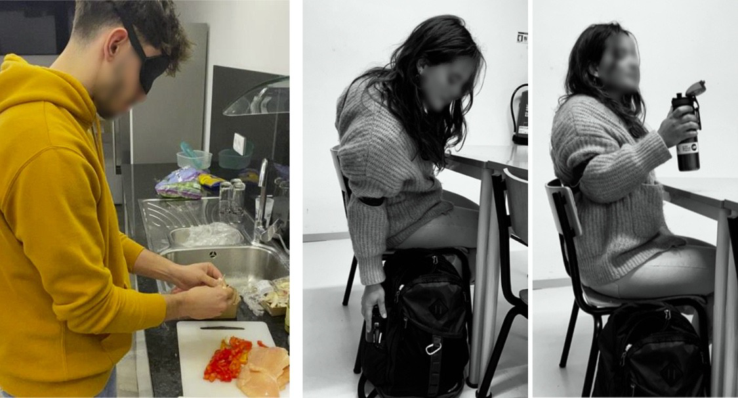
In a design education framework, this empathic design method “trying things ourselves” proposed by Thomas et al. (2012) is meant to help future designers have a better understanding of what a person with a disability might feel in a certain environment or doing everyday activities. Students bring toge- ther a set of objects, acquired or designed for that purpose, to mimic the disability (Figure 3).
To identify difficulties or problems that occurred during the task simu- lation, students designed a flowchart splitting the main routine task into sub-tasks. Flowcharts are a useful tool in usability tests to visually represent participants’ moves when performing tasks. Using flowcharts, usability desi- gners can identify where participants felt difficulties or made errors during the action.
For the immersive experience, one student “put on” the empathy kit, while the colleagues asked him/her to do the sub-tasks to complete the main task. Students were encouraged to “think aloud” for audio recording and quick notes reporting feelings, difficulties, thoughts, ideas, and proposals for impro- vement that might arise while achieving the task. Although he/she executes the routine activity, the team document the experience through video and photo registration concerning to reflect on it afterwards. It was expected that students confronted with this “design moment” of user experience would be able to: (1) identify the difficulties encountered when carrying out each sub-tasks and (2) propose a set of innovative solutions (product or service) that would allow accessibility for all to accomplish the selected task without requiring any assistance.
Figure 3: Modelling the experience of another, blindness (left) and congenital anomaly of upper limbs (right).
Product Design Education: A Kit for Building empathy 193
DISCUSSION
Regarding the project aims: (1) explore students’ understanding of design for all and inclusive design concepts; (2) develop an awareness about dairy chal- lenges faced by people with disabilities; (3) push students away from their comfort zone (4) analyse if, with an empathetic strategy, students generate disruptive and more meaningful ideas. With this project, students understood the importance of including Design for all in product design education curri- cula and recognised its relevance in a changing society. Also, students gained a conscience that certain tasks that they take for granted represent obstacles for people with disabilities to perform autonomously. Such as their assumptions and misjudges being challenged and pushed out of their comfort zone. How- ever, better (empathic) results would have been obtained if they could really leave out of the classroom and contact directly with people with disabilities in specialized institutions.
During the empathic experience, students easily identified the difficulties in completing the task and sub-tasks, however, despite using a kit to simulate the disability, they had difficulties imagining innovative and disruptive ideas for meaningful solutions. This may confirm that empathic methods are more efficient in the early stages as proposed by Tellez F. et al. (2019) “Empathic design has limitations and is not well suited for addressing every experience design problem (...) and is more valuable in the early stages of the design process when opportunities are being identified and new concepts proposed (Tellez F. et al., 2019, p. 6). Most of the products or ideas proposed by the students as viable solutions already exist or/and can be bought in comme- rcial stores. Despite standing in another’s shoes students found it difficult to generate innovative ideas.
FINAL CONSIDERATIONS This paper describes an academic project aiming to apply empathic design strategies, carried out with product design students in a course related to Design and Usability. The efficiency of using an empathy strategy is not con- sensual “and designers may need to ask themselves: in whose shoes can I stand? In other words: which end-users are designers able to empathise with? (Heylighen & Dong, 2019, p. 114) knows in advance that the simulation of an empathic situation does not represent or replace direct contact with the real users and that it is unable to capture the complexity of lived experie- nce. However, after the experience and the feedback from the students, the teachers still consider the importance of putting the students in empathetic situations, outside their comfort zone to question the effectiveness of the pro- ducts they design. These types of challenges serve also to encourage questions about the difference, leading to thinking about “other realities”. Finally, a wider discussion about empathic methods in design education is still needed to respond to new scenarios and complex challenges that future designers face in the 21st century.
194 Félix and Reis
ACKNOWLEDGMENT
This work is financed by national funds through the FCT – Fundação para a Ciência e a Tecnologia, I.P., under the scope of the project UIDB/04057/2020.
REFERENCES
Brown, T. (2009). Change by Design: How Design Thinking Transforms Organizations and Inspires Innovation. HarperBusiness. Fulton Suri, J. (2003). ‘Empathic design: Informed and inspired by other people’s
experience’. In Koskinen, I., Battarbee, K. and Mattelmäki, T. (eds), Empathic Design: User Experience in Product Design. Helsinki: IT Press, p. 52. Gasparini, A. A. (2015). Perspective and use of empathy in design thinking. ACHI 2015 - 8th International Conference on Advances in Computer-Human Interacti- ons, c, 49–54. Heylighen, A., & Dong, A. (2019). To empathise or not to empathise? Empathy and
its limits in design. Design Studies, 65, 107–124. https://doi.org/10.1016/j.destud .2019.10.007 Kärnä-Behm, J. (2022). Learning Generative Design Methods: Higher Education Students Developing Toolkits. International Journal of Art and Design Education, 4(2022). https://doi.org/10.1111/jade.12433 Kim, B., Liu, H., & Joines, S. (2015). Designing for Empathy. IDSA Education
Symposium, Seattle. Kouprie, M., & Visser, F. S. (2009). A framework for empathy in design: Stepping into and out of the user’s life. Journal of Engineering Design, 20(5), 437–448. https://doi.org/10.1080/09544820902875033 McDonagh, D., & Thomas, J. (2010). Disability + relevant design: Empathic design
strategies supporting more effective new product design outcomes. Design Journal, 13(2), 180–196. https://doi.org/10.2752/175470710X12735884220899 McDonagh, D., Thomas, J., & Strickfaden, M. (2011). Empathic design research: Moving towards a new mode of industrial design education. Design Principles and Practices, 5(4), 301–313. https://doi.org/10.18848/1833-1874/cgp/v05i04/38108 Moore, P. (1985). Disguised. Waco, Tx: World Books Nicolle, C., & Maguire, M. (2003). Empathic Modelling in Teaching Design for
All. Universal Access in HCI: Inclusive Design in the Information Society, 4, 143–147. Postma, C. E., Zwartkruis-Pelgrim, E., Daemen, E., & Du, J. (2012). Challenges of doing empathic design: Experiences from industry. International Journal of Design, 6(1), 59–70. Pratte, S., Tang, A., & Oehlberg, L. (2021). Evoking Empathy: A Framework for
Describing Empathy Tools. TEI 2021 - Proceedings of the 15th International Conference on Tangible, Embedded, and Embodied Interaction. Tellez F., A., Gonzalez-Tobon, & Juanita. (2019). Empathic Design as a Framework for Creating Meaningful Experiences. Conference Proceedings of the Academy for Design Innovation Management, 2(1). https://doi.org/10.33114/adim.2019. 03.408 Thomas, J., & McDonagh, D. (2013). Empathic design: Research strategies. Austra-
lasian Medical Journal, 6(1), 1–6. https://doi.org/10.4066/AMJ.2013.1575 Thomas, J., McDonagh, D., & Strickfaden, M. (2012). Empathic education in design: Strategies for healthcare practitioners? Australasian Medical Journal, 5(5), 292– 300.
Product Design Education: A Kit for Building empathy 195
Tracey, M. W., & Baaki, J. (2022). Empathy and empathic design for meaningful deliverables. In Educational Technology Research and Development. Woodcock, A., McDonagh, D., Magee, P., Ball, T., & Iqbal, S. (2019). Expan-
ding horizons: Engaging students with empathic thinking. Proceedings of the 21st International Conference on Engineering and Product Design Education: Towards a New Innovation Landscape, E and PDE 2019, September.
LISTED IN THE AHFE DIGITAL BOOKSTORE CATALOGUE
Explore the complete digital volume
Human Dynamics and Design for the Development of Contemporary Societies
Read this individual research paper free through the original publisher, or explore the full digital proceedings book.
ISBN 978-1-958651-57-5
Explore this ISBN in the AHFE Bookstore ↗Listed in the July 2026 bookstore catalogue; search by ISBN to confirm current availability · Digital book purchase optional