Fátima Costa, Ermanno Aparo, Liliana Soares (2023). The creation of a network, in the North of Portugal, as an opportunity for territorial sustainability. In: Human Dynamics and Design for the Development of Contemporary Societies. AHFE Open Access, vol. 81, pp. 123–128. https://doi.org/10.54941/ahfe1003540
1 CIAUD, Research Centre for Architecture, Urbanism and Design, Lisbon School of Architecture, Universidade de Lisboa, Rua Sá Nogueira, Polo Universitário do Alto da Ajuda, 1349–063 Lisboa, Portugal ↗
2 IPVC Instituto Politécnico de Viana do Castelo, Rua Escola Industrial e Comercial, Nun’Álvares, 34. 4900–347 Viana do Castelo, Portugal & CIAUD, Research Centre for ↗
This article intends to demonstrate that, in the North of Portugal, the creation of a business network can become an opportunity to achieve territorial sustainability.The development of a territorial business network system can be crucial to stimulate local development, in the sense that it represents an opportunity to favor and encourage investments. This strategy, in addition to contributing to the dynamization of the productive activities involved, will make it possible to trigger new partnerships, which may be an opportunity to develop and share resources, processes, knowledge and innovation among the intervening parties.The territory of the North of Portugal is mainly characterized by small and medium-sized companies and, according to data from the National Institute of Statistics, in the study carried out in 2008 on the structures of Portuguese companies, “there were 349,756 micro, small and medium-sized companies (SMEs) in Portugal", taking into account that the North region had 113,747 companies, influencing the region's turnover by 69.5%.With this study, the authors intend to demonstrate that in the North of Portugal, the implementation of a design-oriented territorial network strategy can be crucial to achieving territorial sustainability (Costa, F.; Soares, L.; Aparo, E., 2022) to define the evolution of the local economy. In this sense, it is intended to implement a business network system of contacts, through the business characterization of the territory under study, in this case, the North of Portugal, which promote innovation, design-driven innovation (Verganti, 2020), and are also a way of generating dynamism in productive activities, fostering sustainability and even their success or even survival. Based on localized excellence, a project built on a network can activate collaboration processes, boosting the productive capacity of each company, improving the offer and making processes and resources profitable.
The development of a territorial business network system can be crucial to stimulate local development, in the sense that it represents an opportunity to favor and encourage investments. This strategy, in addition to contributing to the dynamization of the productive activities involved, will make it possi- ble to trigger new partnerships, which may be an opportunity to develop and share resources, processes, knowledge and innovation among the intervening parties.
The territory of the North of Portugal is mainly characterized by small and medium-sized companies and, according to data from the National Institute of Statistics, in the study carried out in 2008 on the structures of Portuguese companies, “there were 349,756 micro, small and medium-sized companies (SMEs) in Portugal”, taking into account that the North region had 113,747 companies, influencing the region’s turnover by 69.5%.
Therefore, the authors question whether, in the North of Portugal, the implementation of a territorial network strategy can be crucial to achieve territorial sustainability (Costa et al., 2022) to define the evolution of the local economy. In this sense, it is intended to implement a business network system of contacts, through the characterization of the business fabric of the territory under study, in this case, the North of Portugal, which promote innovation, design-driven innovation (Verganti, 2020). In addition with this new philosophy in mind it is also possible to generate dynamism in productive activities and, consequently in the region, fostering sustainability and even the success or even survival of the same.
Moreover, this connection between the business network system can be an opportunity to create innovation through the transfer of ideas and solutions, often from seemingly different areas, enhancing the productive capacity of each company, improving supply and making processes and resources more profitable.
METHODS
This study is based on a mixed methodology, with non-interventionist and interventionist stages.
The non-interventionist phase is characterized by the analysis of the busi- ness fabric, through the survey of micro, small and medium-sized enterprises in the North of Portugal and the preparation of an analysis sheet that was used in the later phase as a way to compile the information collected and analyze the companies visited.
The interventionist phase analyzes and demonstrates the results obtained through the fieldwork, through the departure and visit to the companies identified in the first part of the work. Considering that an observation and identification work was carried out with the companies, by filling out the previously prepared analysis form and by visiting the production part of the companies. This phase allowed us to get to know the business fabric of Nor- thern Portugal, as well as the reality of each company and each business sector analysed.
THE BASES In the design research process fieldwork is very important, because empathy is created, in living with people, in creating experimentation. As Tom Kelley (2016) mentions, seeing and hearing things with our eyes and ears is the critical first step in augmenting or creating an advanced product. Innovation starts with a look.
For design research, fieldwork proves to be pertinent in that it allows for direct contact with the industry, as future project partners, as well as for the knowledge that one obtains of the reality of each activity sector and each company.
The fieldwork also allows us to understand the relationship that exists between design and business. In this sense, it allows us to understand how design relates to the productive part, both in handmade production and in
The Creation of a Network, in the North of Portugal 125
industrial work. In this case, it is based on a work of research, observation, identification and analysis of everything that encompasses each sector of acti- vity, from materials, techniques and production processes, thus creating a territorial business system.
THE RESEARCH This study was based on a mixed technique. On the one hand, in the first part, a work of identification and survey of the companies present in the North of Portugal region and the elaboration of the analysis sheet was carried out. The analysis sheet included some questions (see Table 1).
On the other hand, with the second part, based on fieldwork, in which the work team visited the identified companies, it was possible to analyze a series of data about the business fabric of Northern Portugal through the survey carried out with the analysis form. At this moment, it was possible to detect fundamental elements for the research, such as the productive sector, the number of people in the company, the knowledge about techniques and technologies, the existing partnerships and if the company has a designer.
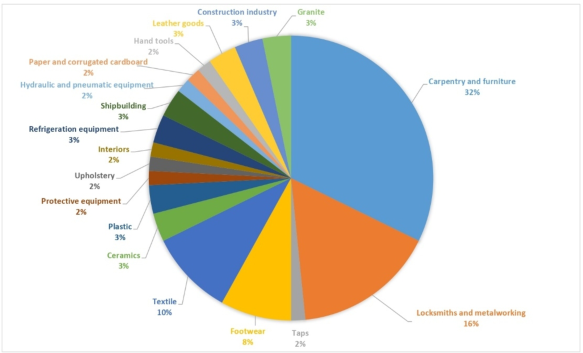
During the process sixty-two companies, were visited in order to achieve the data information. The choose have been made so far to companies in vari- ous fields of activities (see Table 2), as the North of Portugal is characterized with different fields of activities. Thus, the research may present a real state of the art.
Of the total of the sixty-two companies visited, and from eighteen diffe- rent fields of activity, the sector that stands out the most is carpentry and furniture. This scope stands out from the others, with 32% of the visits, considering that, “in Portugal, there is a high level of geographical concen- tration, and the largest number of companies in the sector is located in the north of the country” (DGAE, 2017). Next, and in descending order, are the metalworking, textile and footwear sectors.
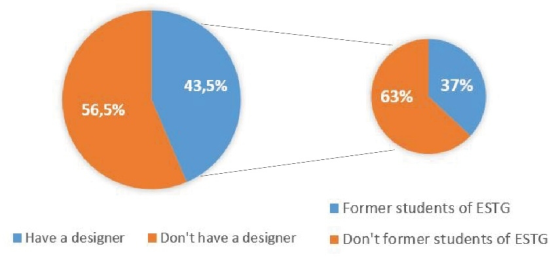
According to the work carried one, through the analysis form, it is also possible to conclude that according the total number of companies visited, 43.5% of the companies have a designer. From this percentage of companies with a designer, 37% are former students from the Polytechnic Institute of Viana do Castelo. It is possible to conclude that the business culture in the
Table 1. The topics to analyze the companies (Costa et al. 2023).
Table available in the original PDF paper.
Topics Company data (name, address and owner) and scope of activity Business volume and type of production The market and the number of employees The types of products Materials, main production processes, machinery and tools Departments existing in the company Marketing and/or distribution is carried out directly The company’s communication (website, social networks, etc.)
Table 2. The different sectors analyzed in the region (Costa et al. 2023).
Table available in the original PDF paper.
Sectors Carpentry and furniture Locksmiths and metalworking Taps Footwear Textile Ceramics Plastic Protective equipment Upholstery Interiors Refrigeration equipment Hydraulic and pneumatic equipment Paper and corrugated cardboard Shipbuilding Hand tools Leather goods Construction industry Granite
Figure 1: Division of companies visited by sector of activity (Costa et al. 2023).
north of the country shows disbelief in relation to the role that the designer can play as a strategic agent and bearer of innovation.
FUTURE RESEARCH This study will allow the achievement of future and different objectives, namely:
In the short term it is intended to achieve an analysis of at least 100 companies in the North of Portugal.
The Creation of a Network, in the North of Portugal 127
Figure 2: Percentage of companies with a designer (Costa et al. 2023).
The creation of a database with companies from the Northern Portugal region.
To clear identify the sectors of the region.
To identify the companies that don’t have a designer.
To promote the creation of partnerships between the Academy and the productive entities so that, in the future, project partners can be found.
To establish a close relationship between the Institution and the companies in the study region.
In academic terms, undergraduate and master’s students may have the opportunity to develop projects with application with the companies analyzed in this study.
This research can promote links between the companies analyzed, gene- rating, and activating a collaborative process between them.
To reach territorial sustainability in order to define the growth of the local economy, through the business classification of the territory under study.
CONCLUSION
This research project demonstrates that, in North of Portugal, the imple- mentation of a design-oriented territorial network strategy can be crucial to achieving territorial sustainability to define the evolution of the local economy.
This strategy, in addition to contributing to the dynamization of the pro- ductive activities involved, will make it possible to trigger new partnerships, which may be an opportunity to develop and share resources, processes, knowledge and innovation among the intervening parties.
For companies, this study proves to be beneficial, due to the synergy cre- ated between the productive activities involved, as well as the sharing of knowledge, resources, processes, and innovation among the intervening par- ties. For all the entities involved in this research project, the creation of synergy is important, because the links created between the academy, the companies, the industries and also the artisanal workshops may become advantageous, not only for future projects but also for the region. For, this synergy created through the system of territorial networks in the Northern Portugal region promotes success and, in some cases, even contributes to the
survival of companies and productive areas that are bearers of the region’s culture. Identifying companies that do not have designers will create the opportunity for a design professional to establish himself in a company. On the other hand, the Academy will play its role as a catalyst for connections between the business world and research.
For Academia, this research is important because the links created between academia and business may prove beneficial for future projects. As well as, for the importance of making students, as future professionals, understand that business network systems, through design, can be the ideal platforms to implement innovation in the territory. In academic terms, the analysis created may allow projects to be developed with classes of bachelor and/or master students, enhancing projects with application.
ACKNOWLEDGMENT
This work is financed by national funds through FCT - Fundação para a Ciência e a Tecnologia, I.P., under the Strategic Project with the references UIDB/04008/2020 and UIDP/04008/2020.
REFERENCES
Costa, M., Aparo, E., Soares, L. (2022). Worth by Northwest: A Design Strategy for Territorial Sustainability. In: Daniel Raposo, Nuno Martins and Daniel Brandão (eds) Human Dynamics and Design for the Development of Contemporary Soci- eties. AHFE (2022) International Conference. AHFE Open Access, vol 25. AHFE International, USA. http://doi.org/10.54941/ahfe1001424. DGAE (2017). Sinopse: Indústria do Mobiliário. Kelley, T. (2016). The Art of Innovation. London: Profile Books. Verganti, R. (2020). “Design-driven innovation: changing the rules of competition by
radically innovating what things mean”. Boston: Harvard Business Press, 2020. XV, p. 272 ISBN: 978-1-4221-2482-6.
LISTED IN THE AHFE DIGITAL BOOKSTORE CATALOGUE
Explore the complete digital volume
Human Dynamics and Design for the Development of Contemporary Societies
Read this individual research paper free through the original publisher, or explore the full digital proceedings book.
ISBN 978-1-958651-57-5
Explore this ISBN in the AHFE Bookstore ↗Listed in the July 2026 bookstore catalogue; search by ISBN to confirm current availability · Digital book purchase optional